Ruby Nation

Ruby Nation
Ruby Nation: The Webcomic
Showing posts with label representation of disability. Show all posts

Tuesday, September 2, 2014

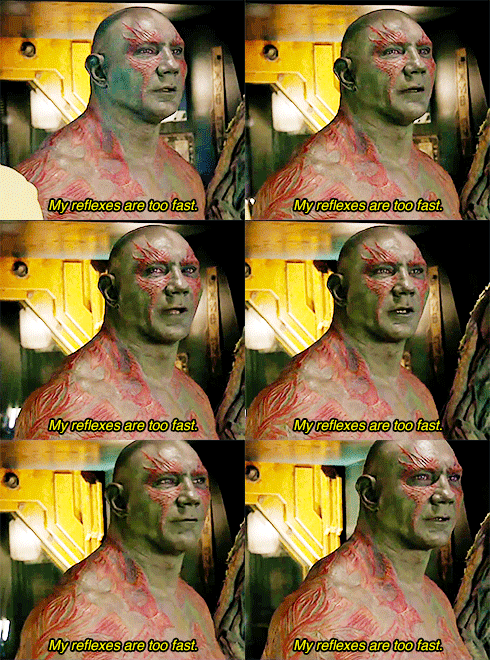
Drax Isn't Autistic, And Applicability Isn't Enough


I assume that the readers of this blog, like most of America at this point, has seen or at least heard of the Guardians of the Galaxy. I also assume that readers of this blog, like most people on social media within some sort of fandom, have seen this widely circulated post about how a fan's autistic little brother connected strongly to Drax the Destroyer, as he also had difficulties with figurative language. This is a heartwarming vignette in microcosm, that a boy who has difficulties relating to people found solace in a superhero character who also has difficulties with metaphors (albeit due to his species and not his neurology). In macrocosm, unfortunately, it means little for representation of autism in popular fiction and only serves to underscore Hollywood's exclusion of difference, except on carefully controlled terms.

Because while Drax the Destroyer may have similarities to autistic spectrum traits, most notably his inability to grasp metaphors but also his restricted interests; his abilities in battle can be best described as savant-like. Unfortunately, none of that was intentional. In the movie*, Drax is an alien from a species who, like most alien species in fiction written by human beings, has a very restricted civilization with limited diversity of personality. A lack of figurative language is apparently universal across his species, and in the movie it serves as little more than a running gag. Drax no more represents an autistic experience than Groot represents a nonverbal experience, because both are completely fantastical characters who only connect back to real disability experiences if the audience is actively willing to apply those experiences to the characters.

The boy mentioned in the post was able to make the connection because Drax's quirks overlap substantially with his own life experience. The majority of people without autism (including those who have autistic loved ones; would the boy's sister who made the post have made the connection if her brother hadn't brought it up first?) would just see Drax as a big green dolt with some funny lines at his unwitting expense. Other people with autism might also not connect Drax's experiences to their own; I certainly did, even though I completely understand the desire to see other autistic people in fiction (and have even speculated about some characters being on the spectrum). It's incredibly unlikely that Drax would've adapted as an autistic character for this movie, and even if he were, he probably would've manifested as the usual stereotypes of the nerdy and physically incapable savant, who represents a constant burden on his loved ones. He likely would not have gotten any meaningful character development**, such as Drax's admission that his desire for revenge was ultimately just a cover for his grief over the death of his wife and child. An explicitly autistic character probably wouldn't get a wife and child in the first place, instead swearing vengeance for a long-suffering mother or a destroyed model train or any other stereotype that only reflects a disinterested outsider's willfully shallow understanding of the autism spectrum experience.

Of course, that's the larger problem with the Marvel Cinematic Universe; even if it has diverse characters, it's still subservient to the Hollywood Narrative, and demands a straight, white, male, and neurotypical star. Dave Bautista proved in this movie that he's a talented actor as well as an imposing physical presence and MMA fighter, but they wouldn't make him the protagonist of a movie that cost so much to make and was advertised so thoroughly. They'd probably be even less likely to put him in the lead if he weren't covered in green and red paint, and instead appeared as his mixed-Filipino-Greek self. Same goes for Zoe Saldana's Gamora, a Dominican actress whose biggest roles were as a blue elf giantess and as a green alien warrior***. The Marvel Studios movies may have had strong results by casting unlikely choices, but the movies, like the comics before them, still started with all attractive white guys. It might've been a strange casting choice to have Andy Dwyer from Parks and Recreation (a.k.a. Chris Pratt, a.k.a. BERT MACKLIN, FBI) as Peter Quill, but it was a million times more likely that they'd cast Chris Pratt than Aziz Ansari****.

There's still a clear heirarchy of what the producers funding these multimillion-dollar special effects orgies will allow. Handsome white dudes first, women and racial minorities second if at all, disabled characters never (unless as villains). They think audiences are willing to accept raccoons and trees as star characters before the physically and/or mentally "infirm". If audience members with disabilities identify with those characters, bully for them, but it's not going to make a green alien brute anything more than a green alien brute for the rest of the world-- least of all for the people actually making this stuff.

Perhaps I'm being too harsh, and I should be grateful that we even got this little story doing the social media rounds. Perhaps that's just the way representation works, that baby steps are all that can be expected from media aimed at a wide audience. You don't get to complex and sympathetic gay characters like Hulkling and Wiccan before you do the heavy-handed " Northstar is gay and is yammering on about AIDS" story, just like you don't get to Chris Claremont's powerful and alluring Storm before you get years of Stan Lee's***** useless, weepy female love interests. But social media has, for better or worse, made conversations of representation and privilege much more relevant now than they've ever been. And at some point, when real life gives you enough shit and the fiction in which you would normally find solace now appears all too complicit, you just gotta say-- Not. Good. Enough.

* Yes, I'm aware that Drax in the comics is a human spirit placed in a powerful body like Thanos, but that's not really relevant to the films. Just like Thanos in the comics is Jim Starlin's avatar of Freudian themes in love with a literal personification of Death, instead of a generic Big Bad who's yet to actually dirty his own hands.
** In so far as the movie had character developments. As a film, it's extremely predictable, and the humor is its saving grace. Similar to the Pirates of the Carribean films, the absurdist nature of the humor and the talents of its cast are all that stand between it and banality, though at least GotG has more to rely on that one Johnny Depp.
*** Yes, I'm also aware that Saldana was also Uhura, as well as Columbiana, Aisha from the Losers, and plenty of other roles that don't involve explosions, but my point still stands.
**** I would pay so much to see Tom Haverford as Star-Lord. Aziz Ansari has the "Small Name, Big Ego" character down to a science.
***** Edited because I've been aware that Stan Lee did write some great female characters as well, such as Medusa

Wednesday, May 28, 2014

Of Course The Cripple Is Evil: Iron Man 26 Thoughts

In the latest volume of Iron Man written by Kieron Gillen, it was revealed that Tony Stark is actually adopted, picked up to play the public role of the Starks' child while the real son of Howard and Maria was in hiding. This is because that boy was genetically modified in vitro by an alien super-intelligence to be a super-genius behind a new intergalactic order, but resultantly ended up with an irreparably damaged respiratory system and had to be kept in seclusion. That boy grew up to be Arno Stark, who's recently come out of hiding while still requiring life support to keep his lungs working (be it a literal iron lung or an Iron Man exoskeleton).

Many readers guessed that Arno would end up evil. The name is a dead give-away for any Marvel history fans, given how the previous Arno Stark was the evil Iron Man of 2020. There's also the long tradition of villains being handicapped or otherwise deformed, because of course people who look or function differently are the Other and are cast under suspicion. There was some hope that Arno would end up being a nice guy, since he seemed pretty amiable and he even referenced the "Evil Cripple" trope when talking about his reticence over becoming a public figure like his adoptive brother.

These hopes were dashed in the latest issue, when it was revealed that Arno was working on a new serum of Extremis. Yes, Extremis, the super-deadly biotech serum that weaponizes human beings, and often makes them monsters. The kind that temporarily infected Tony's body, saving his life and boosting his performance as Iron Man (as well as giving him wacky super-powers like mind-controlling satellites and healing from injuries to the point of being able to reattach a severed heel) but also driving him mad with the traumatic flow of new information, to the point of entering fugue states where he talked to "ghosts". And the kind that Tony's tried to eradicate in this very volume, seeing its grotesque potential for misuse even by people with good intentions.

It's possible that we're meant to sympathize with Arno, because of Extremis also has potential for beneficial medical applications. But all that potential means nothing given the circumstances, such as...

1.) Arno isn't doing this to help other people. He's doing to help himself, so that his lungs can be fixed and he can live without external support. Never mind the fact that his external supports give him far more capability than most people, since he's at least as smart as Tony and builds his own powered suits. He wants to be cured, even if he has to use a super-deadly monster-serum to do it. Basically, he's using Curt Connors logic. 

2.) Arno has no real identity outside of being a genius and being disabled. We don't really get much indication of Arno's thoughts and feelings beyond what the plot demands. Even though he spent most of his life in seclusion, he could still think, feel, and dream. Even without an exoskeleton that gives him mobility, he's got all those capabilities. But we don't get to see those capabilities, because all we get from Arno is what he does with Tony Stark, and now what he's doing to undermine Tony Stark. The hints of Arno's life outside technology and envy of working lungs, such as his interview with ultra-leftist reporter Abigail Burns, are only told and not shown.

3.) "Magical" sci-fi cures tend not to end well. This may be so common it's become cliche, but there's a reason writers don't often write stories where there are pills that can fix all ailments. Fiction is the place where people, creators and audience alike, work out their anxieties and achieve a meaningful catharsis. Sometimes it's the place where people hide from reality and go straight to escapism, but certainly Kieron Gillen is a savvy enough writer that he wouldn't just go with "Arno uses serum to fix his lungs, succeeds in doing so, then uses serum to fix world, and creates a Candyland Utopia where nobody feels bad".

Some have criticized this mentality as anti-progress and anti-science. Certainly that's a result of the bizarrely static nature of the Marvel Universe, which has to remain similar to our reality and can't allow the super-scientists to radically change our infrastructure. But the implications of the alternative are much more troubling. If this form of super-science solving everything is a reflection of a desires, that means we see a world of easy answers. Where every problem has a solution, and those solutions can be universally applied across all kinds of problems. Where we get to see the happy ending while skipping past all the hard work and tough decisions needed to get there. Where we trust that we can take a pill to make ourselves happy and healthy, and not have to worry about the side-effects. And worst of all, where we see being infirm and disabled as something that has to be completely eradicated, and can't comprehend the notion of people being okay with the way they are (or at least being okay enough with their disabled lives that they wouldn't risk their lives on a potential cure. I'm not downplaying the challenges that come with physical and mental disabilities; I'm saying that they AREN'T fates worse than death, the fate that gives you absolutely no other options. They're certainly not worse than "dying" by virtue of turning yourself into a monster and losing all sense of self).

 Arno says he wants to use Extremis as a universal cure, one that can be applied to all medical problems. Arno is confident that he can work out all the bugs, even though no previous scientist has done so. Even if he does avoid that particular consequence of his hubris, Arno's still making himself the authority on what should be cured and what shouldn't. Perhaps Arno will decide that homosexuality is a disease that needs to be cured? Perhaps he'll decide that darker colors of skin should be swabbed away by Extremis? And perhaps when people such as Tony Stark, a man whose adult life has been defined by physical and mental weaknesses but hasn't let that stop him from doing the right thing and avoiding the easy way out, oppose Arno's mentality, he'll decide to use force because his will is more important than anyone else's?

I know that it's a slippery slope argument, but by all accounts Arno's slope currently is devoid of any and all friction. I sincerely hope that the next issues will prove me wrong.

Tuesday, July 10, 2012

The Goldfish's 10 Things Fiction Writers Need To Remember About Disability: The Spider-Man Movie People Should've Read This


One of the greatest essays I've read in the past few weeks online the Goldfish's 10 Things Fiction Writers Need to Remember About Disability. It's been broken up into Part One and Part Two, and both are well worth considering for any writer.

It's especially relevant to me because I read the first part the same week I saw the new Spider-Man movie, and while I liked that movie a lot, many of these things were ignored in regards to the film's antagonist. Of all the characters they could've picked, they chose Dr. Curt Connors, a.k.a. the Lizard. This character, who thought his amputated arm was such a disgrace that he would risk his own life to cure it (and, in doing so, turn himself into a giant reptile monster), represents several things on the Goldfish's list;

3. People with long-term impairments or chronic illness are not fascinated by their own condition or their own symptoms. While Connors doesn't natter on about statistics regarding amputated or malformed limbs, he is obsessed with curing his ailment, right down to his "World Without Weakness" rhetoric. Whatever sympathy he would've gotten for his handicap and his daily accessibility issues is lost when he starts using Eugenic language, and "weakness" is a term with further reaching connotations. Note that Connors is not dying, nor is his life completely ruined due to the lack of his arm. It's understandable that he would be frustrate with his limitation and admirable that he'd go into medical science, but using himself as a test subject shows a deeply internalized self-hating ableism. (And I get that he was feeling awful at the time, looking at being fired or even disappeared by Norman Osborn, but he'd been spouting the World Without Weakness rhetoric since his first scene.)


4. Disabled people are not all young, white, straight, affluent men. Connors is an older gentleman, so he at least beats the ageist part of that majority formula, but he's male, white, (presumably) straight, and lives comfortably. Then again, the Amazing Spider-Man movie only has a few female characters (albeit in important roles; Gwen Stacy is used superbly here as Peter's confidante as well as his girlfriend, and Emma Stone does a great job with the character. Aunt May is also used effectively, albeit with less screen time). It also has only one remotely significant character of color, that being Norman's henchman. And there are no gay, bi, or transgendered/intersexed characters. Not a surprise, and I can't hold it against this movie specifically, but it does illustrate the problem; young, white, straight, affluent, and abled men still control all the most visible narratives. 


Again, I liked Amazing Spider-Man a lot as a movie, and it's definitely in my top 5 of superhero films. But it's still a reminder that big budgets and blockbuster sales are rarely given to stories outside that very limited Hollywood narrative.


5. Disabled people go bad for a reason. There is a reason, but it's not a good one; surely Connors would've known that jamming himself full of reptile DNA wouldn't go well, either killing himself (a true act of weakness, regardless of physical or intellectual challenge) or turning himself into a monster. Since it's the latter, Connors is responsible for everyone the Lizard killed, in the same way that a drunk driver is accountable for the people they run over. Worse yet, even after Connors reverts back after his initial transformation, he's clearly gone evil by this point, addicted to the power of being the Lizard and chewing every inch of scenery.


6. There aren't many reasons for disabled people not to have sex. In the comics, Connors is (or was) married with a kid, so this was averted. Here, he seems to live alone and doesn't show any evidence of a romantic life. He's portrayed as completely sexless, though at least without a family, Connors doesn't betray those responsibilities. (And that might make the comic version worse, because in one of his most recent transformations, Connors ATE his son. Surely he'd rather have had a living son than a regrown arm, had he known what the Lizard serum would do?)


9. Disabled people know other disabled people. Connors is the only disabled character in the movie. Then again, if he'd talked to disabled people about his "World Without Weakness" nonsense, they might've been offended. I wish someone had asked him which is worse; not having an arm, or living in a world that makes you feel like a pariah without two arms? (this was done very well in X-Men First Class, when Mystique told off Xavier for trying to fit in with a bigoted world. By coincidence, that movie also had a major character try to cure his disability with science and fail miserably, with Hank McCoy's faulty mutant cure. That was even more foolish on Hank's part, because he wasn't physically limited beyond being forced to hide his simian feet, which was society's fault and not his own. Though he got off easier, because while the cure made him blue-furred, he did keep his mind, unlike Connors).


10. Disability is not a conflict that has to be resolved. Perhaps this is subverted because Connors is punished for trying to resolve that conflict, being sent to prison and not even keeping his regrown arm once he reverts to his human form. But the audience is supposed to sympathize with Connors for being an apparent "cripple", and for trying to cure his condition. And ideally, that sympathy would vanish once he acted on the feeling that he'd rather be dead or a monster than alive with one less arm than most. 


Again, thanks to The Goldfish for these great discussions!

Thursday, June 21, 2012

Metal Gear Solid: Guns of the Patriots Novel Review: A Labor of La Li Lu Le Love


As anyone who's known me in the past two years can attest, I love Metal Gear. It's been the subject of my literal autistic obsession ever since I played the original PS1 game as a digital download. Since then, I've played through every game, beat all of the games in the Solid series multiple times, collected the various merchandise (including those beautiful but expensive Play Arts figures), and worked references into several aspects of my life (including my comics). Metal Gear has all the things I look for in a story; complex and sympathetic characters, a sophisticated (if often arcane and absurd) narrative, an ability to switch between wacky humor and tear-jerking drama, and a complex metatextual understanding of its own nature as a story. The best of the series, IMO, was Metal Gear Solid 4, the canonical ending of hero Solid Snake's story as he pulls his his dying, prematurely aged body together for one big final mission.

When I heard there was a novelization of MGS4, I was initially blasé about it; novelizations are usually mediocre to poor, as cheap cash-ins haphazardly trying to shoehorn a story into a different medium. The more appropriate piece of evidence for this case is Raymond Benson's novelization of the PS1 game, which treated the story as though it were a straightforward, cheesy James Bond epic, even giving Snake several lame one-liners (such as saying "Merry Christmas" to an enemy Genome Soldier, then choking him to death and saying "Christmas came early this year!"), which didn't fit at all with his usual warrior-poet personality. But this novelization has a much greater pedigree; it was written by the late Project Itoh (real name Satoshi Ito), a Japanese novelist and a personal friend of Metal Gear creator Hideo Kojima. Itoh was diagnosed with cancer in 2001, and fought a long, hard battle that tragically ended with his death in 2009. Kojima even writes the afterward of this novel, praising Itoh's work here and on his original stories (many of which were originally fan fiction of Kojima games like Snatcher), and saying that his "genes" are now infused into the Metal Gear mythology. Given how the series is all about genes and memes passing from generation to generation, this is lofty and touching praise.

But how is the novel itself? First of all, I should say that if you're a Metal Gear fan who's played MGS4, you absolutely have to read this book. The narrator is Hal "Otacon" Emmerich, who recounts the final days of his hetero life-mate's life (as he promised at the end of the game, bearing witness to everything the legendary hero was). This is a unique and more somber account of the events, leaving out the action scenes that wouldn't have contributed to the plot (such as the Beauty and the Beast Corps battles, grotesque parodies of Kojima's own wacky mini-bosses), and adding some background detail that fills in the gaps and revises the sillier elements of the story. For example, there's a section on the villainous Liquid Snake's history, which removes all the "recessive/dominant gene" nonsense of his backstory and instead tells about how he spent many of his formative years as a POW during the Gulf War, being degraded and tortured and left out to dry by his own government, while his twin-brother Solid Snake became the glorious hero of Outer Heaven and Zanzibar Land. There's also some interesting sci-fi explanations of elements that might have confused you, such as all the bar codes on Raiden's cyborg exoskeleton, or the full extent of Snake's illness. It may not have occurred to gamers that flying from Morroco to Peru to Czechlosovakia to Alaska to a floating ocean fortress was very hard on Snake's lungs, given all the wild differences in atmospheric pressure.

And if you haven't played any of the Metal Gear games? To be honest, that's a bit of a harder sell. MGS4 was a game with an extremely complex plot that invoked story threads from throughout Metal Gear history. The game worked because there were playable segments that didn't need such complex understanding, as well as an easily understandable and sympathetic main story of Old Snake's final mission. Here, a lot of it is left to exposition, including details that tell what characters feel instead of showing. It was written to be accessible to a wider audience, but in the end there's a bit too much hand-holding with the dialogue, especially when it comes to Solid Snake's motivations. Then again, that may be justified by the fact that this is written from Otacon's perspective, and it seems within his character to mix long technical pieces with blubbering histrionics. Especially when it comes to Snake, since Otacon lived and worked closely with the man for nine years, and saw more of Snake's tender core, rather than his tough super-soldier exterior.

But though the writing can be overwrought, I'd still recommend this as a piece of science fiction. For all its warts, including a convoluted narrative, a generous amount of Narm, and a villain who is possessed by the transplanted right hand of another villain, MGS4 is still a heartfelt story with a beautiful message. By this point, the series had evolved from being an anti-war narrative to an anti-digital-control-narrative to an ANTI-NARRATIVE NARRATIVE. The dystopian future of MGS4, where mercenary companies have dominated the world, war exists as the impetus for the global economy (how very far-fetched, he says with a roll of the eyes), and almost everyone has their senses monitored and influenced by nano machines, is the grim result of a power struggle between men trying to enforce their own ideal narratives upon the world. The utopian obsessions, spawned by different misinterpretations of a heroic idol, have led to a struggle of liberty vs. security with a result that satisfies neither. And Solid Snake, an artificially created man manipulated by both sides, has to put things right, motivated by no ideology but the desire to keep the world afloat so future generations can make their own decisions. The kanji character on Snake's uniform/powered armor in MGS4 stands for "To Let The World Be"*, and while this may at first sound like cowardice, it's actually a strong endorsement of volunteerism. If people do not make their decisions of their own free will, as opposed to subscribing to a systemic master narrative (be it religion, nationality, or the idolatry of a hero like the Boss from Metal Gear Solid 3), then there can be no progress.

Now if you'll excuse me, I'm going to check out some of Project Itoh's original works, right after removing the tears from my eyes after experiencing the Microwave Hallway scene AGAIN.

* You can even use this for a disability rights reading, since it endorses acceptance of differences and individual perspectives over master narratives, including ableist ones like enforcing that people try to be "fixed". 

Sunday, March 4, 2012

The "Autism Cure" In Avengers Academy, and The Fascism of Utopia


(This is largely reposted from the Comic Book Resources forums, in response to an issue of Avengers Academy where the corporate sociopath genius kid Jeremy Briggs starts recruiting super-teens away from the school. Veil, formerly a student at Avengers Academy, touts Briggs' merits by mentioning how the work they're doing reforming society and attacking social problems is far more important than fighting villains and getting bloody hands. However, the example she gives of her work is a cure for autism. Since I normally like Avengers Academy, and since Marvel is one of my main hyper-focused Aspergian interests, this read like a punch to the gut).

Wether it was Gage's intent or not, Veil's line about working on a cure for autism immediately made me want the proper Avengers to take down Briggs and anyone working with him.

The kind of " utopia " Briggs is working towards, like most science fiction utopias, is the ideal of a few imposed upon everyone else. It's getting rid of things that people consider problems with easy solutions, by making a magic pill to cure any perceived imperfections, or using force to quietly subdue any dissidents. It's creating a pretty-looking, clean community by retroactively removing any evidence that it might have been dirty, working towards an ideal while forgetting the minority experiences that give humanity diversity, meaning, and narrative.

The autism line hits home for me, true, but it's a good example in microcosm of why Briggs is as insidious as any super-villain. Maybe Veil believes that autism is just a disease that abducts children from their parents and creates wall-eyed freaks who will never grow up to prosper, but that's hardly the case for all autistics, most of whom are capable of communication, thought, and contribution (even if on different terms, such as requiring facilitated communication). Worse yet, it excludes people with the condition from the discussion. If Briggs and Veil created a cure for the X-Gene, would it be treated as an altruistic afterthought? How about the gay gene? Does society really get to decide how the individual's neurology should be, and change it by force?

The job of the superhero is to save peoples' lives, not decide how their lives should or shouldn't be. That's the other side of the coin that we've seen since the genre's inception, which is fascism.

And another good quote about the dangers of imposing one's views on others, from Big Boss in the game Metal Gear Solid 4;

" It's not about changing the world. It's about doing our best to leave the world the way it is. It's about respecting the will of others, and believing in your own. "

Monday, February 27, 2012

Batgirl 5-6 Thoughts: Ableist Garbage Day!


(Now just imagine if the Joker said that when he opened the door and capped Barbara in the spine.)

Joking and memetic-mutating aside, Batgirl has gone from being a technically competent comic with a disgusting ableist message, to an amateurishly written and sappy mess (albeit with good art by Adrian Syaf) with a disgusting ableist message. Issues 5 and 6 involve Barbara teaming up with Batman to fight a new villainess, Gretel, who gained mind control powers after a traumatic brain injury by a mobster she was investigating. It also has a script that bends over backwards trying to convince the audience that Batgirl is great and we should all love her as much as Gail Simone does. To wit;

1.) Bruce Wayne spends the first half of this arc hypnotized, and bumbles around like a puppet until Barbara breaks the spell by bringing up how his parents are dead. Batman, the most insanely prepared man in the DC Universe or any other (right down to literally creating his own backup personality in case of mind control of mental breakdown), is overridden like an amateur. I could accept this were it not so obvious that it was done to make Barbara look better by comparison, as the one who keeps her wits and saves Bruce's ass.

2.) Bruce Wayne hugs her afterwards, and whispers, " You were always meant to be Batgirl". This is an endorsement on par with the line in The Rise of Arsenal and its tie-ins, "was he not up for the task of being Red Arrow"? A sidekick's name, a weaker spin-off of an established hero, means nothing. Furthermore, it shows that Bruce, a man who's extremely guarded about his personal life and who he lets into his crime fighting circle, is perfectly fine with Barbara going into the battlefield physically and mentally unprepared after her apparent recovery. And that he doesn't particularly mind if Barbara's spinal chip gives out in the middle of a fight. Because she's more useful to him as Batgirl than Oracle, for reasons that don't exist!

3.) Barbara's narrative captions blanket the pages, with her beating us over the head with how great it is that she be Batgirl and help people. This is standard for modern superhero comics, the kind of "emo noir" that conceals perfectly good artwork behind boxes full of navel-gazing. But it's especially galling when Barbara talks about how she was never a partner to Batman, and was her own crime fighter. Who apparently took all of Batman's moves and gadgets for her great individual identity, but that doesn't really matter.

4.) Gretel is the second case in a row where the main villain of a new Batgirl story is a heavy-handed parallel to Barbara's own trauma. In the previous case, it was Mirror, who survived an accident that killed his family, and became devoted to killing everyone else who'd experienced miracles. In this case, it's a woman who was nearly killed by criminals, and is now a lethal vigilante. Batgirl makes sure we don't miss the parallels for a second, making this analogy about as subtle as a House episode where the patient's problem somehow connects to House's leg/addiction/misanthropy (re: EVERY FUCKING EPISODE). And, of course, Barbara has to be all weepy about it, telling the cops to treat Gretel well when they ship her off to Arkham.

It's also worth noting that Gretel still has clear evidence of her trauma-- her multicolored wigs disguise her bald head, which has a bullet scar where hair would've been. Further confirming that heroic characters don't have deformities, only bad guys! I can't wait to see Barbara fight a villain who's in a wheelchair, then give a speech about how she feels their pain!

In the end, what bothers me most about Batgirl is that it represents the character as "the good cripple". She was physically and mentally scarred, but she put the former behind her with a magic cure, and she's working on 'overcoming' the latter. Disability, to Barbara, was just a transitory state so she could look stronger once she emerged from it. And when she emerges, she emerges as a character who doesn't rock the boat or say anything controversial. She's just become another face in the Bat-crowd, only distinguishable by the Pollyanna-type bullshit about second chances and miracles that flows from her mouth.

Thursday, September 8, 2011

Newsarama on Batgirl: Excerpts from Yours Truly!

A few weeks ago I was interviewed by Vaneta Rogers of Newsarama regarding the Batgirl fiasco. I have hardly been quiet about this series of unfortunate events, but I was honored by the request. Vaneta's piece is up, which also includes quotes from Denny O'Neil, John Ostrander, and Professor James B. South.

It is a high honor to be quoted alongside these industry legends. :)

Wednesday, September 7, 2011

New 52 Batgirl #1 Review: Wasn't That Paralysis Just A Hassle?


The new Batgirl comic is finally out, and it's simultaneously not as repellent as I expected, yet still inherently repellent.

In all fairness, the story is still unfolding, and it's well-told. I'm not objecting to the abilities of Gail Simone as a writer or Adrian Syaf as an artist. It's the fact that the team involved is so talented that makes this book so galling. They should be able to do something better, and avoid the pitfalls.

Because at this point, it looks like the new Barbara Gordon was still shot in the spine, but got better. She says that she was in a wheelchair for three years after the Joker attacked her, but then " a miracle" happened. We don't hear what that miracle is, and I imagine we'll find out. But I don't see how it could be anything more than a quick Phlebotnium fix. The way Barbara's narration frames the miracle, it sounds like she spent the three years without her mobility just sitting on her ass moping in a dark room, but then she found this cure and she's back in the game.

Credit should be given to Simone for at least making Barbara's "recovery" believable, in that she's not recovered from the psychological aspect. She still knows what it's like to have been in a wheelchair, and finds herself bothered by ablist remarks people make without thinking ( such as the whole "being in a chair is worse than death" bullshit). She still has nightmares about the shooting, and she's very nervous on the battlefield after the incident. The cliffhanger even has Barbara freeze up and fail to save someone thanks to a PTSD flashback from a criminal pointing a gun at her just the way the Joker did.

However, the fact remains that Barbara can walk now, and she's used that opportunity to go back to being a more famous character's distaff counterpart. The theory that she wouldn't be able to walk without her new armored costume is debunked by the images of Barbara walking around in her civvies. Perhaps the costume helps her with mobility, since her legs would've atrophied in the three years of paralysis. It could be similar to Old Snake's Octocamo suit in Metal Gear Solid 4, adding a slight boost in strength to help with her impairments but not actually making her superhuman. Of course, wacky textures on costumes are everywhere in the rebooted DCU, so it might just be Barbara jumping on this "HR Giger meets Victoria's Secret"* bandwagon.

The disability aspect is present, but it's a past-tense motivator, a handicap used to make her able-bodied self look stronger. But the things Barbara accomplished as Oracle, without leaving her chair, were much more impressive and meaningful. The comic is interesting enough and well-written enough that I'm going to keep reading it for the time being, but I sincerely hope the representation of disability goes beyond "Origin Story Tragedy". It's a deeper handling than most writers would attempt, but it's not enough to compensate for the semiotic ableism inherent in "fixing" Barbara Gordon.

* A description I saw in a ComicsAlliance comments thread, which seems especially apt when looking at the new Batgirl.

Friday, August 26, 2011

Batman 80 Page Giant: Batman Fights Autism, Strikes Blow For Sentimentality


The recent Batman: 80 Page Giant makes the unlikely intersection between Batman and autism. In the story written by Joe Caramagna, a nonverbal autistic boy is reading a Batman comic when his mother takes the book away from him. She's bitching about how he can't differentiate between fantasy and reality (apparently unable to get her stereotypes straight, as most of these morons say that autistic people are too literal to be imaginative), while his father talks about how comics are just harmless fun. After getting upset by the bickering, the boy looks out the window, and either has a fantasy that he sees Batman and Solomon Grundy fighting, or actually witnesses Batman and Grundy duking it out. But in the end, this enables the nine-year-old to say his first word, to the delight of both his parents; "Batman".

The story is slightly better than most fictional representations of autism, in that the autistic by is the actual protagonist instead of a plot device to make his parents sympathetic, and the "warrior mother" stereotype is as much a pompous blowhard as a tireless champion for her child's development. The story isn't exactly deep, but given how it's a back-up strip in an anthology magazine, we can't expect too much. On the other hand, this is the only place where we'd see the autism "issue" in a Batman comic, and it's used in a revoltingly sentimental fashion, right down to the "everything's going to be okay" ending. And if the kid can't tell the difference between fantasy and reality, he's got problems that are far more debilitating than the autism spectrum-- it's Sucker Punch all over again..

But the problems with the book are severely exacerbated when you take This Article into account, in which Caramagna tells his local newspaper about his creative process. I'm sure that Caramagna is well-intentioned, but those intentions are expressed in a very condescending manner towards autistic people. Because autism is such a horrible fate, the language surrounding it tends to focus on treating (if not outright curing/erasing) the disorder. In fact, Caramanga talks about how he designed the story to potentially "unlock their imagination"

I wanted to tell a story where comics can make a difference in someone’s life and get their creative juices going. I don’t want to make it sound like if you give a kid a comic, he’ll be cured. But I think they can be used as part of a creative therapy or artistic therapy. With autism, no one knows what might be the thing that unlocks their imagination.

I totally agree that a Batman comic can unlock a child's imagination. Because it's BATMAN. He's already a character with near-universal appeal, evidenced by the fact that he maintains a transmedia presence stronger than pretty much any other comic hero, and has his backstory etched in the public imagination. Using him as an autistic kid's fantasy/delusion isn't going to stir those creative juices any better than a straightforward Batman story. In fact, it's probably going to be less effective, because A.) people who buy Batman would likely rather read about Batman than a "special needs" sob story stereotype, and B.) the autistic character might outright offend some of us on the spectrum.

Aside from that one comment, Caramagna doesn't say anything too infuriating. Most of the problem is the way the interview frames the comic, as "fighting autism". Of course, these articles never see autism as part of an autistic person, the neurological identity that shapes them into who they are (albeit with a lot of trials along the way, but the trials of the autistic individual are rarely dealt with as something that causes THEM suffering; it's usually shown as the burden on their families); they treat it as a bogeyman, a Jokeresque villain that steals a normal child's soul.

Coincidentally, there is quite a bit of the Batman mythos that relates to autism. Bruce Wayne isn't on the spectrum because he's too multi-talented in his masteries, but the drive in which he trained at martial arts/criminology/invention/breathing in space definitely resonates with Asperger's-style obsessions. The villains he faces are often tragic figures, prisoners of their own madnesses, and can be sympathetic to those who have difficulty controlling their emotions. Hell, there are two characters that may well be on the autism spectrum (albeit by fantastical circumstances) -- Cassandra Cain, the former Batgirl and current Black Bat, has tremendous martial arts skills but struggled with basic language and literacy. And Bruce's artificially-conceived son Damien Wayne may also fit; he was built to fight, he was never given social skills, he's extremely temperamental, and while he wants to do good he has little to no idea how to do so.

Of course, this all requires critical thought, and stereotypes are so much easier to digest.

Monday, August 1, 2011

Cripz the Webcomic: A Bullet in the Spine of Bigotry


Cripz, a webcomic written by Jeff Preston and illustrated by Clara Madrenas, is to disability rights what the Boondocks was to issues of race-- a wonderful comic strip that not only takes a stand against the negative stereotypes, but takes them into the basement, chains them to a plastic chair, and works them over with power tools. It's not subtle about the way it addresses ableist inequities, and probably not for the easily offended. But some points need to be made with sledgehammer force, and Cripz obliges with the might of Mjolnir's uru head.

The comic follows two high school boys in wheelchairs; Rhett, a sensitive hyper-intellectual whose idealistic discourses tend to fly straight over peoples' heads, and Griff, a hyper-masculine rap enthusiast who milks his disabled status for all it's worth. They're eventually joined by a third character, an able-bodied girl named Katie who likes Rhett (though probably not to the same extent that he likes her) but finds Griff an obnoxious tool and doesn't take his handicap as an excuse. Griff is easily the funniest of the three, and flies in the face of the "inspirationally disadvantaged" stereotype. His innocuous look belies a wildly manipulative and borderline sociopathic mind, and were he not pitied for his disability, he would likely end up in juvenile hall. At times he seems like a male, paralyzed Sarah Silverman.

The art style seems very crude, as it has the characters as sketches on lined notebook paper pasted onto colored backgrounds. However, it works for the strip. It helps establish the otherness of the protagonists, and draws immediate attention to them. This is a talking-heads social commentary strip, so the cinematographic perspective derring-do of adventure strips isn't necessary. It works especially well in the "At the Movies" strips, where Rhett and Griff imagine themselves in movies that typically eschew the handicapped. (The Captain America spoof is especially funny, as Griff imagines that the super-soldier serum leaves Steve Rogers permanently crippled by accident, but allows him to stay out of the draft, so he can fuck all the women at home while the other men go overseas to die in battle. Yes, really.)

If I had a complaint about the strip, it would be the somewhat narrow way disability is perceived. Preston and Madrenas address the issues faced by the wheelchair-bound first and foremost, and they do touch on blindness and deafness. However, mental disabilities are not addressed, despite presenting very similar challenges. This is especially bothersome when the school janitor appears, who embodies most of the delusional deranged veteran cliches. It could easily be extrapolated that he qualifies as disabled via PTSD, yet he remains a subject for the main characters to mock. This is disappointing when you consider that Rhett and Griff are just as limited as him, even if it's their bodies and not their minds that give them the societal stigma.

But I hope that the creators will address this, because if they do, this will be one of the greatest humor comic strips ever made. Early on it captured my heart with its parody of Glee, specifically the horrid stereotype Artie's dreams of walking. Rhett's fantasy is not the ability to walk, but the possession of a pimped-out multi-story wheelchair stacked with hot chicks. Given my somewhat partisan opinion about Glee (i.e. that it's a horrible show that sits at the peak of self-aggrandizing Hollywood leftism, preaching equality but never actually taking any risks with its Benneton ad stereotypes), I immediately bookmarked the comic.

You can read all of Cripz Here.

Thursday, June 23, 2011

X-Men First Class Movie Review: Magneto Roolz, Charlie Droolz


X-Men: First Class was easily the finest Marvel movie I've ever seen, and probably the finest superhero movie (eclipsed only by Dark Knight, but at least First Class was unmolested by Christian Bale's goofy-ass growling) ever made. The difficulties with the film's production allowed director Matthew Vaughn and his crew to create a Marvel movie liberated from almost all of the cliche hollywood narratives, and gave us a superhero movie that actually had something important to say.

At its heart, the film is the story of the how X-Men's two key philosophers met,i.e. Charles Xavier (played by James McAvoy) and Erik "Magneto" Lensherr (played by Michael Fassbender). As expected from a movie about Xavier and Magneto, the story shows them drifting apart as their ideologies prove incompatible. But while the comics and the previous movies left the Xavier/Magneto equation as a matter of good vs. evil, X-Men: First Class shows us that Xavier is just as flawed as Magneto, and both men are equally victim to their hubris.

No punches are pulled in showing how different--and better-- Charles' youth was from Erik's. While Erik grew up in Auschwitz and saw his mother brutally murdered, Charles grew up in a mansion, and met a young mutant girl (Raven Darkholme/Mystique, played by Jessica Lawrence) to relieve him of his poor little rich boy angst. And while Erik spent his young adult hood hunting down Nazis in a quest to find the man who shot his mother, Charles went to Oxford, used his telepathic powers and knowledge of mutation to whore around, and kept the admiring adult Raven firmly in the friend zone (which he claimed was due to their childhood together, but was more likely motivated by his repulsion at her true, blue form; unlike Raven, Charles has no struggle trying to pass). Charles got the advantages of being a mutant without the drawbacks, and he didn't even appear to have the telepathic angst caused by stray thoughts.

The two men eventually meet when they end up facing a common enemy-- Sebastian Shaw (played by Kevin Bacon), who not only was the Nazi doctor who killed Erik's mom in an attempt to trigger his powers, but is using his Hellfire Club connections and mutant posse to try and heat up the Cold War. From there the two men instantly bond, and with the help of the CIA and agent Moira MacTaggert (Rose Byrne, playing a much different character than the comic version and her Scottish brogue), they start assembling young mutants. Of course, the more they get to know each other, the more they end up drifting apart, and the conclusion is tragic (though inevitable, given that this is a prequel).

Shaw makes an excellent villain because of the singularity of his vision and the lack of morals getting in his ways (as he did ally himself with the Nazis). But though neither Charles or Erik are as outright evil as Shaw, they both fall victim to their singular perspectives without trying to consider the other one's opinions. Note that the founding of the X-Men could not have been done without Erik-- Erik pushed to keep the CIA out of their affairs (while Charles would have cooperated), and Erik got Xavier to train the students for combat (Charles would've just taken them back to their homes, even for the ones whose homes were jails or strip clubs). Also note that Magneto doesn't become truly powerful until he embraces Xavier's motto that true focus lies between rage and serenity. When the two men cooperate, they can achieve virtually anything because they compensate for each other's weaknesses. It's when they become enemies that both end up being a detriment to mutantkind.

That's right, I said both. Vaughn's movie and McAvoy's performance give form to an idea that until recently many X-Men writers have simply danced around-- the idea that Xavier truly is holding mutantkind back. As we see in the movie, Xavier's idea of peace means teaching mutants to pass for human. He encourages Raven to maintain a regular blonde, Caucasian appearance, cooperates with government agencies that clearly want to enslave and/or terminate mutants (even if it's just starting as registration, as Erik points out), and advocates Erik against killing the former Nazi Shaw. He will use his powers to brainwash when necessary for survival, but that just makes him hypocritical. For Charles, the goal isn't "mutant and proud" so much as "you're a mutant? I hardly noticed".

Magneto's actions are similarly misguided, and definitely more destructive due to his extremist bent. Yet he's still more sympathetic than Xavier, because he actually knows what homo superior will have to face. Similar to Mystique, the audience finds him more appealing because he's fighting not just for mutantkind's survival, but also for mutantkind's individuality. Chris Rosa of Meltdown Comics got me excited about this film by telling me that Fassbender played Erik similar to Big Boss/Naked Snake of the Metal Gear Solid games, and the comparison is apt. As corrupted as both characters would later become, we see exactly what traumas put them on this path and sympathize with their perspectives, even if we can't condone their actions.

In many ways, this is a spiritual prequel to the modern X-Men comics. Grant Morrison's X-Men tried to resolve a dilemma similar to the one posed in First Class by having BOTH Xavier and Magneto prove obsolete. The way he portrayed Magneto's decline was a bit less subtle (if you can call getting high on drugs and genocide subtle, though I'd argue that it was a necessary point), but Morrison also demonstrated Xavier's impotence by having all the mutant cultural revolutions happen outside of his control. Keep in mind that the Xavier who outed the X-Men was actually his evil alien twin using his body; once the real Xavier returns, he finds himself a mere observer to a world far more complex than he could imagine. Yet that world was there all along, when the X-Men were playing superhero to appeal to the human masses while retreating to the gilded cage that is Xavier's Mansion during their off hours. This makes the X-Men's Utopia an inevitable response to a multicultural world*, allowing the new culture their own space to create their own society.

I could go on about the other details of the film, such as the specific actors' performances or the bizarre choices of characters, but the overall story was so great that complaining about small details** feels like a fanboyish waste of time. Highly Recommended.

* No matter how much of a douchepocalypse their president-for-life may be.
** I will note without reservation that the treatment of Darwin was angering, reducing one of the most charismatic of the new recruits to minority cannon fodder.

Monday, June 6, 2011

DC and Batgirl Walk To The Bank?


As part of DC's latest attempt to solve their continuity problems via increasingly convoluted reboots, Batgirl returns in a new series written by Gail Simone (who handled the character for years in her excellent Birds of Prey run). It's been confirmed that the new Batgirl is Barbara Gordon, who originally had the role but gave it up after being shot by the Joker, which left her in a wheelchair (and prompted her to become Oracle, Batman's tech-guru, founding member of the Birds of Prey, and a much more interesting character).

I don't want to jump to conclusions, so I'm hoping the speculation that this is Barbara Gordon in a high-tech Batgirl armor that gives her prosthetic locomotion is correct. In that case, it's a progression of the character, putting her back on the frontlines but still making it clear that she's disabled, and still has to cope with the physical and psychological challenges posed by her handicap (especially since she'd still have the memories and associated PTSD of being gruesomely shot by the Joker, one of the most horrifyingly sadistic villains in fiction). Walking via robot suit isn't a substitute for having working legs, especially since Barbara wouldn't be in the costume 24/7. She'd lose the symbolism of being DC's full-time wheelchair character, but if there was a compelling reason for her to take up crimefighting, it could work.

However, if this is just rebooting Barbara back to being an able-bodied superheroine (albeit an inferior distaff counterpart to Batman, with the patronizing codename "BatGIRL" despite being over 18 years old), then it's incredibly insulting. It's insulting to readers with physical and/or mental handicaps who can't retcon away their challenges. It's insulting to readers who enjoyed seeing the character progress into not only a prominent disabled character, but a genuinely interesting character thanks to the way the experience shaped her (as while Barbara was a super-genius, she was also capable of manipulating her friends for the greater good, a character trait that doesn't have anything to do with her handicap). And it's insulting to fans of Gail Simone to see that she doesn't respect the meaning fans drew from her work with Barbara, such as having the character appear to be magically cured only to have it be little more than the return of feeling to her toes (which Barbara coped with marvelously, choosing to be grateful for the little message that her limbs were still there).

Please let it be the former.

Saturday, April 23, 2011

Hal "Otacon" Emmerich, Metal Gear Solid's Autistic Hero?


Fictional characters on the autism spectrum are hard to find, and good characters in that category are almost non-existent. As autism has become more prevalent, we've seen it portrayed more often in the media, but those portrayals too often fall into the stereotypes, such as the damaged, volatile child unwittingly tearing apart his supportive family, or the emotionless polymath sociopath who can do horrible things without seeing a problem. There are very few autistic protagonists, or even supporting characters of a positive nature*.

Thus, many autistic people have found themselves speculating on which of their favorite fictional characters fit the spectrum, following the completely understandable need to see inspiring figures to fit into their own narrative world. Sometimes these fictional diagnoses are simple wish fulfillment that don't describe the diagnosed character at all, such as claiming that Severus Snape of Harry Potter has Asperger's Syndrome**. Others are much more accurate, such as Grant Morrison's in-universe speculation that Reed Richards of the Fantastic Four is autistic, and could (and should) be incorporated into canon.

An example of the latter is Hal "Otacon" Emmerich, Solid Snake's tech-guy sidekick in the Metal Gear Solid series of video games. Otacon's spectrum traits go beyond simply being a nerd, and put him squarely in the neuroatypical category. If you don't believe me, here's the evidence...

WARNING: SPOILERS FOR THE GAMES AHEAD

1.) Otacon's interests are (or were) so obsessive and insular that he missed the harsh realities attached. When he was introduced in the PSOne game, he was designing a Metal Gear unit because he wanted to make robots like he'd seen in anime. He was attached to that utopian sci-fi narrative, the kind where fantastical machines keep people safe. He was also completely oblivious to the fact that his creation was being used as a platform for nuclear missiles, until Snake bluntly spelled it out for him. Otacon's code-name is short for "Otaku Convention", and his desk is covered with little toys and posters. In another series, he might have been able to play out his fantasies and help the world with his giant robot fixation. In Metal Gear, of course, he became instrumental in the creation of the world's most devastating WMD.

2.) Otacon is extremely literal-minded. This is used with hilarious effect in the Snake campaign of Metal Gear Solid 2, where the good doctor tries to read Snake ancient words of wisdom upon saving his data (the way Mei Ling did in the previous game). Unfortunately, he completely misses the point of those famous quotes, and comes up with extremely bizarre interpretations after taking them at face value. The phrase "It's better to be first among roosters instead of last among bulls", according to Otacon, means that it's better to be a chicken because cows are subjected to alien cattle mutilations.

3.) Otacon is TERRIBLE at understanding his relationships. The extent to which he does not comprehend others' intentions (or his own, for that matter) leads to some of the most tragic scenes in a series known for its depressing tone. In MGS1, Otacon falls for Sniper Wolf, a bloodthirsty sniper and one of the terrorists holding him hostage. It is unlikely that she reciprocates beyond a show of basic decency (as he helped feed her dogs), but Otacon takes this mercy and uses it to fuel his childish crush. It's touchingly pathetic how fast-- and how hard-- he falls for Wolf, especially after her demise at the hands of Solid Snake. And we see it happen again in MGS4, when the morally ambiguous Dr. Naomi Hunter seduces Otacon so she can get data needed for a larger plan. The ease with which she manipulates him, saying all the right words about atoning for the sins of her science to create a quick emotional bond, is disturbing to watch when you know what she's up to.

The is explored in MGS2, where we learn about Otacon's past-- he was always socially isolated, and his sole companions were the family his father married-- his step-sister and step-mother. He became strongly attached to the former and even played house with her, despite the fact that she was five years old and he was a teenager (though Otacon had no salacious intentions spending so much time with the little girl-- he just wanted to experience family). Unfortunately, he was also "seduced"*** by his step-mother, which led to his father's suicide and Otacon subsequently running away from home. We don't hear much about the details other than Otacon's words (which are words of contrition, blaming himself for all of this), but it's unlikely that he understood what was going on at that point-- his inherent lack of social awareness facilitated all these tragedies.

There's also the fact that by far Otacon's strongest relationship is with Snake, as the two men work and live together, and even end up adopting a child in MGS4. The homoerotic subtext is so thick that it basically ends up as text, but it's not exactly clear if Otacon's feelings for Snake are romantic. He likely doesn't understand what he feels for Snake, other than the intensity of the connection. The sensitive nerd and the dour super-soldier end up having quite a bit in common, as seen in the "bad" ending**** of MGS1. Both are profoundly isolated human beings, even if Otacon's loneliness is more internalized than his lab-grown, shell-shocked veteran partner.

4.) Most importantly, Otacon is a complex and sympathetic character. As I said before, when autistic characters are shown in most fiction, they're shown in terms of stereotypes and plot devices. But Otacon grows and changes over the course of Metal Gear Solid, and provides a vital pillar of strength. He's the most genuinely decent character in the entire series, surpassed only by The Boss from the prequel MGS3. And The Boss is the series' messiah figure, so it's not really a contest.

When we first see Otacon, it's as a messy-haired, badly-dressed, bespectacled little dork . His first appearance is hardly auspicious, as he's wetting himself in terror when confronted by a crazed cyborg ninja. But he shows tremendous courage later in the game, taking full accountability for his part in Metal Gear's creation and risking his life to shut it down. In the second game, he's Snake's tech-guy and half of the anti-Metal Gear organization Philanthropy, working to destroy those robotic WMDs despite the risk to his personal safety. He's also become more attractive and well-dressed, though still a bit dorky looking. And by MGS4, Otacon has developed a rugged handsomeness that puts him square in Hot Scientist territory. Poor hygiene is a common trait in autistic people, but it's not an insurmountable habit-- Otacon proves this.

But most importantly, Otacon is by Snake's side during all these ordeals. Snake is the action hero of Metal Gear Solid, the one putting his life on the line at every turn. But Snake couldn't be anywhere near as successful without Otacon's support. In MGS4, Snake has prematurely aged due to his cloned physiology breaking down, and has only a few months left to live. Otacon's tech is the only thing allowing Snake to survive on the battlefield; the strength-boosting Octocamo suit was Otacon's invention, as were the vision-enhancing Solid Eye and the helper robot "Metal Gear Mark 2" (redeeming the machine's tainted name). But Otacon's greatest act comes at the end of the game, when the still-dying Snake is wondering what he has left to live for in the new world, and Otacon promises to bear witness to Snake's final days. Otacon refuses to let Snake die alone and unloved.

I doubt Hideo Kojima created Otacon with autism in mind, but if the autism label is attached to the character, it not only fits him but helps eradicate many of the negative stereotypes.

* INSERT OBLIGATORY RUBY'S WORLD LINK
** There's no evidence for this in the books, other than Snape being a thoroughly repulsive human being-- and that's just proof that he's a repulsive human being, even if he didn't prove outright evil.
*** Otacon's words. But it's a clear case of rape, and one of the few instances where female-on-male rape is shown to be just as bad.
**** In which female love interest Meryl doesn't survive, and is replaced by Otacon as Snake's symbolic reason to keep on living.

Saturday, February 26, 2011

BOTTOM 10 'Favorite' Tropes: Blog-a-Day, Pt 3

The final entry for my own TVTropes answers, featuring tropes that I usually (or never) can stand...

Misaimed Fandom: When what a fan wants becomes so important to them that they'll ignore or dismiss anything contrary, they've closed off their mind to everything. It's not just a failure of individual thought, but it holds back personal growth and development. Pretty much any fandom trope can fall under here, so I'll leave it at that instead of filling the list with Draco in Leather Pants, Opinion Myopia, Ruined FOREVER, etc.

Status Quo Is God: Particularly damning in franchise superhero comics, where the notion that everything will reset makes every new development seem like a temporary diversion. But if you're going to have a dramatic series that continues to be interesting, you need some forward motion, even if it's a risk.

Magical Negro: Because even though we live in a world of countless cultures and creeds, they all exist to prop up the white, straight, able-bodied, male lead. Sadly, this is what defines Morgan Freeman's career, despite his prodigious talents.

Stuffed In The Fridge: Because women don't exist except to prop up men, and can be easily sacrificed to the altar of drama. Though to be fair, Ron Marz (who wrote the scene with Green Lantern's girlfriend stuffed in said fridge) is far from the only culprit, has written plenty of instances of strong female characters who aren't disposable, and should be able to live down what so many other authors do on a regular basis.

Hollywood Psych: A lot of these representation tropes are asinine to the NTH degree, but this especially pushes my buttons. Especially when a character on the autism spectrum is portrayed, because it almost always makes them a burden on their lived ones (an indirect Magical Negro variant) and/or a sociopath.

Rule of Funny: Too often used in lieu of good writing, as Family Guy continually proves.

Moral Guardians: Even though I have a lot of problems with representation, I think it would be better to try and inform people, rather than brainwash them by removing alternative thoughts.

Shallow Female Love Interest:Not just because it makes the female character a prize for the male, but because it makes the male seem like a shallow sex hound for being interested in just a pretty face.

I'm A Man I Can't Help It: And yeah, it's confirmed a LOT in real life, but it doesn't mean a dick is a dickhead license.

Thursday, January 20, 2011

An Open Letter To Mark Millar Re: Superior


Dear Mark Millar,

In the unlikely event that you have been reading this blog, you probably know my increasing dissatisfaction with your output in the past few years. This comes from a place where I once loved your work, back on the Authority and the Ultimate titles. There were innovative titles that were very entertaining and felt like genuinely modern takes on the superhero genre. Even in more recent years you've delivered some very good comics like Wolverine: Enemy of the State and the Marvel Knights Spider-Man. The frustration I feel with more recent works (particularly your ICON output and your Ultimate Avengers revamp) comes from the feeling that you are working well below your potential. Some part of me still held out hope that you'd do thoughtful works again, but after I read Superior #4, I realized that wouldn't be the case.

My experience with Superior was at first conflicted; on the one hand, I thought that the not-Superman Superman analogue was the worst cliche of creator-owned superhero writers, filing serial numbers off and calling it 'meta' rather than creating unique characters. One the other hand, I was impressed with how Simon's Multiple Sclerosis was handled. You made the character's suffering realistic and sympathetic, and you treated him as a major character rather than a pet to showcase others' greatness. And even while I'd lost interest in your other books, I still wanted to see this story progress, and see how Simon would live his life with super-powers.

But that's not what this story is about, is it? The backstory of Simon is scarcely mentioned in issues 3 and 4, and instead the story starts focusing on the Superman analogue. All the old tropes are trotted out, with Simon doing all the heroic Superman things with his Superior powers, and the world acting like he's a savior. The narrator even goes out to talk about Superman-- I mean Superior's origins, and how he inspired kids people during the 30's. This is a unique insight that everyone who's even heard of The Amazing Adventures of Cavalier and Klay already knows.

Admittedly, it's optimistic, which is a far cry from your previous Icon stories (which are about, respectively, a wannabe teen hero who pretends to be gay to get chicks, and an evil Batman analogue who impregnates his enemy's daughter with the sperm of his son and booby-traps her womb. But just because it's unique for you, doesn't mean it's unique for others. I've already seen stories that try to reintroduce wonder and hope to superhero comics. I've read Marvels, the "Heroes Return" Marvel books, Grant Morrison's JLA and All-Star Superman, Mark Waid's Fantastic Four, and other comics that believed that being traditional was revolutionary. Most of them weren't so self-conscious about it, though-- they also had inherently interesting stories to go with the nostalgia.

This would merely make it forgettable had I not read your afterword for the first issue, where you talk about the importance of creating new heroic characters for each generation, like Stan Lee and Jack Kirby and Steve Ditko did in the 60's. But a technicality doesn't make something new. Superior is Prime from Malibu's Ultraverse, who was Captain Marvel from Fawcett. If it was a story about a kid dying of multiple sclerosis, as in the actually GOOD opening parts of the comic, I would have loved it. But you couldn't divorce yourself from the superhero genre, and had to make MS the Culturally Noteworthy Tragic Backstory to inspire Simon when he becomes Superior. Which, in its own way, is again reducing the disabled character to a prop off which others look better.

The cliffhanger with the seemingly compassionate but actually evil Space Monkey giving Simon's bully powers did nothing to convince me that this story will be going anywhere. I'm just not going to bother, because if you've stopped caring about trying anything different, why should I care about what you do?

Hoping you'll write something interesting again,
-Neil Kapit

Sunday, November 28, 2010

Disability Blog Carnival, Now With 100% More Neil

You may have already read my postscript for the recent Ruby's World strips, but they're also up on the Disability Blog Carnival. There are plenty of great articles here, my personal favorites being " How Disability Affects Wellbeing " and " The Big Society and Charity Model of Disability "

These blogs should be required reading for any participant in a human society. You can read them Here.

Monday, November 15, 2010

Ruby's World: Ruby and Jens Postscript: The Redemption of the Neurotypical


I've finished the latest round of text pieces for Ruby's World, but the ending came sooner than I'd originally planned. Normally I don't like to talk about my work, for fear of A.) hindering the audience's ability to make their own conclusions, and B.) coming across as a pretentious douche. However, this is a case where the audience is unfortunately not likely to come to these conclusions.

If it seems deliberate that the two boys in Ruby's life-- Jens Larson and Jiro Sasaki-- both have first names that are four letters and start with J, that's because it is deliberate. The early drafts of this story were called " Ruby and Jens ", and only had those two characters plus Ruby's father. The rest was more standard high school superhero stuff, with Ruby's giant form triggered by stress ( sort of like a pre-college " Savage She-Hulk " ). These stories, which I did in undergraduate largely as prose pieces, were extremely crude by comparison to what I'm doing now. Like any self-respecting artist, I look back upon my previous work and see only mistakes, and the only satisfaction I get is to realize that I'm not doing that shit anymore. The thing that bothered me most in hindsight was the fact that I wrote Jens as too idealized a normal guy-- he was still without powers and had a sarcastic voice, but he was unremittingly loyal and selfless, and more effective in combat situations. Which in hindsight, is pretty ridiculous even by science fiction standards; if you want to compete in a world of super-powers, you have to work harder than ever, and the sacrifices that must be made to become that competent leave scars that take you outside the world of normality. Just ask Batman.

When I revised the story in 2008 and expanded upon it dramatically as " Ruby's World ", I kept Jens around, but instead of using him as more of a male power fantasy ( albeit one who exists in a world where the protagonist is a female hero, and is measured by his ability to be badass by normal human standards ), I used him as an obnoxious counterpoint to Ruby and the new characters. Jiro was created as an explicit contrast to Jens, someone who had the hyper-competences, but came from a place of feeling like an outsider. While Jens' issues were mostly ones of teen angst, Jiro had hard challenges in his life-- autism, poverty from the hardships his Japanese-American family still faced, incredible PTSD from the experiments that made him a cybernetic super-soldier, and clear markings of difference even with his powers ( red eyes and metal joints ). And Ruby became closer to Jiro because he actually understood what it was like to be different, instead of slumming with the outcasts despite having the ability to pass for normal.

When I started writing the text pieces from Jens' perspective, I started with a clear direction in mind; I was going to make him a villain. I would have his feelings of inadequacy due to his lack of powers get to the point where he'd abandon Ruby and her group, and make a deal with Beagle Labs to get powers of his own. Of course, he wasn't going to become evil, because he was doing it to secretly help Ruby. Similar to Revolver Ocelot from the Metal Gear Solid games, he'd ultimately be on the same side as the heroes, but he'd make himself the bad guy and make morally unconscionable decisions in the process. And he'd do so knowing that it would eventually get him killed, but that sacrifice would be redemptive.

However, as I started to get feedback on these stories, particularly from a friend who eloquently expressed how he could relate to Jens, I changed course. Even though Jens could pass for normal, it was observed that he didn't feel normal-- even before the world became overtly transformed by nanotech, he felt weak and inadequate. People think it's easy for young men in American culture, at least compared to young women-- however, many of the privileges that come with being in the majority are only available if you meet the majority's criteria. If you want to be treated as a strong man ( especially in high school ), you have to act manly, to not show feelings and through your weight around, and to not have interests that could put you in the out-group. Jens was shy and awkward, and didn't fit those criteria. Even though he was male, white, straight, and neurotypical, he still didn't fit socially. Which is why he's drawn to Ruby and her group-- he knows what it feels like to be an outcast. Realizing that, I thought it would be better to keep him alive. A heroic sacrifice after feigning treachery would suggest that the character's worth was contingent on an impressive suicide, and would be a betrayal of the audience members who found something worthwhile in Jens.

So I shifted direction with the story, and changed the text pieces to reach a quicker but more subdued and humane ending. I wanted instead for Jens to reach some kind of peace with himself-- not for him to stop feeling inadequate, but to give him just enough of a morale boost to keep going. The scene with him and Alexis talking was a metatextual expression of this; both characters feel peripheral, as Alexis has the same feelings of inadequacy, and while she does have powers, they're non-combative and ill-defined ( in contrast with the rest of the series, where advanced technology explains everything ). Their ability to go on becomes contingent on their ability to find worth in themselves, instead of their roles in cultural ( and in this case, literal ) narratives.

Given my own experiences, I feel proud that I am able to use my work to examine the troubles that everyone feels-- even if they don't wear it on the outside.

Thursday, August 5, 2010

Rita Farr, the Doom Patrol, and the Social Construction of Disability


I'm interested in writing about disability representation and superhero comics, but I've never written a post about the Doom Patrol. That book has a more obvious connection between the two than any other superhero series; since its debut, it's been a book of all deformed, traumatized metahumans. Even from the original line-up, we had the paraplegic genius Niles " The Chief " caulder, brain-in-a-robot-body Cliff " Robotman " Steel, bandaged burn victim and host to the negative spirit Larry " Negative Man " Trainor, and size-shifter Rita " Elasti-Girl " Farr. And if you think one of those is not like the other, yes, it's Rita. She can shrink and grow and stretch her limbs, but she looks completely normal by default, and can turn her shape-shifting on and off at will. Her appearance is just as conventionally pretty as any super-heroine; hell, she was an actress before she got her powers. Hardly compares to a man with phantom entire-body pains or a guy who is just the scarred summer home for an energy being-- she could easily join any other super-team.

Thus, when the original Doom Patrol was killed off, it took Rita the longest time to be resurrected. Years passed before she received the inevitable superhero return; the landmark Grant Morrison run on the book had her place taken by Crazy Jane, a more visibly disturbed woman with 50 super-powered personalities. And when she was brought back, it was in John Byrne's less-than-well-received run, which was a clear jump back to the way the team used to be. Superhero comics are all about regressing back to the way they used to be, regardless of wether or not the way things were was good. So is Rita really one of these characters who only exist to serve nostalgia, a vestigial character the concept outgrew?

Keith Giffen, current writer of a particularly good Doom Patrol revamp, says no. And the latest issue is evidence, because it's revealed that Rita isn't nearly as normal as we thought. The issue's revelation is that ever since she was brought back, she's been FAKING her old appearance. Her resurrected body is really just a sentient lump of silly putty that Rita gives form. Giffen goes into particularly unsettling detail about Rita's condition, showing that Rita becomes a gelatinous blob in her sleep and has to sleep in a special chamber to keep from flooding the room, and telling us that she reassembles her appearance based on photos of her old body. ( And in characteristic Doom Patrol fashion, she handles this with gallows humor, admitting that she pressed a newspaper against herself to see if it would leave an imprint. It did. )

This calls back to the original reason Rita joined the Doom Patrol; even though she can look like an ordinary woman, everybody knows she isn't. Her career was ruined by her powers manifesting on a movie set, making her appear as a freak to the entire world. Even though she did gain control, she still had that label attached to her, and was blacklisted from Hollywood. Hence joining the Doom Patrol, a team of people with similar body traumas-- even if she could reset her appearance, she was still the same woman shaped by her powers, and shunned by the ordinary world.

Rita was the only member of the Doom Patrol who could pass; even the Chief had a physical ( though realistic ) disability and an intellect that removed him from the rest of the world. Even then, her normal appearance is just an imitation of normal, and most people see straight past the appearance and onto the stigmatizing labels. But this is exacerbated by the fact that she isn't even normal on the inside-- rather than a person with an ability others don't have, Rita is a blob that can will itself into a woman's form. And the people who know that they're talking to sentient goo will have a harder time accepting her-- even the other " monsters " on the Doom Patrol ( though they do learn to accept things quickly ).

It makes Rita's fate more tragic, and you wonder why she's going through all the trouble to appear the way she used to-- which makes her more at home with the team than ever.

Tuesday, July 20, 2010

Daredevil: The Best Disabled Character in Comics?


If judging which Marvel character was best based on the aggregate quality of their stories, most comic readers would probably say " Daredevil. " Thanks to a long and surprisingly consistent run of landmark stories, the horn-headed hero has gotten as close to becoming a great literary figure as any costumed crime fighter can become. Thanks to the works of creators like Miller, Mazuchelli, Sienkiewicz, Bendis, Maleev, Brubaker, Lark, Romita Jr., and others, Daredevil's developed a reputation for being the one Marvel franchise where writers don't hold back and the status quo isn't immediately reset. ( It's also developed the reputation of being an extremely depressing read due to the constant torment creators put Daredevil through, the comic book equivalent of Metal Gear Solid ).

He's also blind. Sure, the radioactive waste that robbed Matt Murdoch of his sight also enhanced his other senses a hundredfold, but he's robbed of the perception of sight, alienating him from most of the world. The fact that he can echolocate like a bat makes his experience isolated even from other blind people. And that's it for his superhuman powers-- the rest is just martial arts skill and back-breaking physical training. He's not particularly prominent in the Marvel Universe, rarely venturing beyond New York; a passage in Mark Millar's Wolverine even had the character mocking Daredevil, for being the pathetic crippled superhero the others joke about, while bemoaning the fact that Matt gets much more tail than the squat Canadian mutant. Yet this hasn't stopped him from being an engaging character for the audience.

So do I think Daredevil is one of the best disabled characters in comics, if not fiction in general? The answer is another question....

When was the last time you thought of Daredevil as blind?

Maybe you didn't forget that Matt can't see, but if you've been reading regularly, it probably wasn't the first thing you thought of about him. His handicap is only one part of his history, and doesn't begin to summarize the whole character. Being blind ( albeit superhumanly ) just informs the rest of his experience. Matt lost his sight as a preteen, well after his mother abandoned him and his failure of a father. His father did unethical mob enforcement jobs before Matt's accident, and Matt's handicap didn't dominate the dynamic ( re: no Jenny McCarthy " parent martyrs themselves for crippled child " claptrap ). Matt's accident was what led him to be trained by the blind sensei Stick, but he had pent-up aggression early on. And in his superhero identity, while it's apparent to people who look closely that Matt's devil mask is a blindfold, criminals don't think of him as a blind man overcoming adversity. They see him as the terrifying figure clubbing them into unconsciousness.

The major aspect of Matt's life where disability informs people about his experience is his civilian identity as a lawyer-- though he's one of the finest attorneys in New York, it does seem like part of that is the appeal of his hard-luck story. But ever since Frank Miller took over the character, Matt's life has become so complicated that the woes of his handicap are peripheral to his other problems. He's lost nearly a dozen girlfriends to murder and/or the trauma of being associated with him. He's had his career ruined by crooks who got ahold of his dual identity many times, to the point where it's public suspicion that Matt and Daredevil are the same guy. He faces some of the most outright monstrous, depraved villains in Marvel's history. And his " jurisdiction " is Hell's Kitchen, a run-down neighborhood that refuses to become safe no matter how many criminals he beats up, and a place largely ignored by other heroes. His actions, understandably, show an unstable nature only a nudge and a slap away from a complete breakdown.

The current storyline " Shadowland " has Matt Murdoch finally going through that breakdown and becoming an outright villain. He's stopped having a civilian identity, and runs a ninja clan that's turned Hell's Kitchen into a police state. The first issue of the story had Matt sic a dozen ninjas on his arch-nemesis Bullseye, to distract him so Matt could brutally and finally kill the bastard. And you'll note that in all of this the words " blind ", " disabled ", " handicapped ", and " crippled " don't even come up. Matt's arc as a fallen hero isn't contained by those labels, just informed.

That's how you represent disability in fictional characters. You make sure they have characters beyond their handicap. And anyone who argues that you can't say that of Daredevil simply hasn't been paying attention.

Saturday, May 1, 2010

Blogging Against Disablism: The Mighty Marvel Handicapped

Blogging Against Disablism Day, May 1st 2010

Today is Blogging Against Disablism Day, and I thought I'd seize upon the opportunity to bring this topic into a context that's dear to my own interests-- specifically, Marvel Comics, the company whose fictional superhero universe has inspired a larger portion of my life than I normally care to admit. But musing upon it in light of the issue of disablism, I figured out the core reason why it's such an appeal, and so obvious in My Own WorkMore than the power fantasies, the flashy visuals, the entertaining and sometimes brilliant stories, or even the the convoluted narratives that prey upon the obsessive mindsets of the autism spectrum.

The classic Marvel story is about a disabled character, disadvantaged physically and/or psychologically, forcing their way into society.

The X-Men are the most obvious example, because most of the mutant powers have an element of deformity to them. Some, like the Beast and Nightcrawler, look monstrous and are prejudged on that no matter how kind and heroic they act. Others have traits, like Archangel's wings or Rogue's life-draining skin, that they have to take pains to cover. Even the characters with powers that don't have an obvious drawback have to hide them in order to pass, being normal but realizing they're not being themselves. The villains of the X-Men tend to be bigots, using tactics ranging from giant mutant-killing robots to PR-friendly promises for a mutation cure ( Autism $peaks, anyone? ) Before the X-Men simply tried to prove their heroics as Robin-Hood type outlaw heroes, but since Grant Morrison came to the book, they've been out. The X-Men stand in front of the world for everything that they are, and everything that mutants can be. Like mutants or not, now you have to deal with them.*

Daredevil is another explicit example. As a boy, he was blinded by radioactive waste, but radioactive waste that enhanced his other senses a thousandfold. Mixing this with his martial arts training and analytical mind, Matt Murdoch became an ace lawyer by day ( who the public knows as blind ) and vigilante by night, cleaning up his crime-soaked childhood home. At the same time, even though he's not handicapped per se, Daredevil is disabled. The way he sees the world doesn't have any visuals, and the heightened impressions he gets from his other senses are difficult to block out. He's inherently alone in his perceptions, no matter how much good he does.

Then there's the heroes who received disabilities as a humanizing effect. Tony Stark pays for his war profiteering via the shrapnel to his chest; he builds a metal heart to survive and a suit of armor with which to redeem himself, but his source of power is prosthetic, and he's got a big, shiny, metal lump in his chest to remind him of his difference. Thor was punished by his father Odin for his arrogance by being forced to share an identity with a mortal, a doctor with a limp. Half of his life may be as an ass-kicking god of thunder, but the other half is as a man who lives with a handicap, but sees people with illnesses and imperfections every day, and must show them ( and possibly, himself ) compassion and understanding. And Bruce Banner, like Iron Man, paid for building WMDs by being caught in his gamma bomb test and carrying a borderline personality disorder in the form of a rampaging green monster that comes out when he loses his cool. It's a burden he, like many people with mental illnesses, has to struggle with on a day by day basis.

We can go down the list of prominent Marvel characters whose powers double as a disability metaphor all day. The first Captain America, a sickly young man in the Depression era who bravely risked his life taking a serum that made him America's best weapon against Hitler. The current Captain America Bucky Barnes, who fills the role to cope with his massive post-traumatic stress disorder ( he even has a prosthetic metal arm from a tremendous war injury ). Wolverine, whose healing factor means he has endured pains that would easily have killed anyone else, and has to live with that. We can even go by villains who represent forms of ableism; Doctor Doom, hiding his " imperfect " facial scars behind an ominous iron mask, preferring to be an emotionless machine than a flawed human; Magneto, taking mutant solidarity into a eugenic crusade against humans; Norman Osborn, who has displayed all seven deadly sins, but most commonly greed, his lust for power and his cruelty towards anyone without it ( and as we've seen, implicit hatred for his own weaknesses ).

The bottom line is that if you are a Marvel fan, your childhood heroes easily qualify as handicapped. And compared to most real people with disabilities, they have it better, because they have the luxury of attached super-powers. So overcome your prejudices; for those dealing with daily physical and psychological disabilities, and worse yet the societal stigmas imposed on such conditions, simply functioning can be an act of heroism.