Ruby Nation

Ruby Nation
Ruby Nation: The Webcomic
Showing posts with label tvtropes. Show all posts

Wednesday, May 28, 2014

Of Course The Cripple Is Evil: Iron Man 26 Thoughts

In the latest volume of Iron Man written by Kieron Gillen, it was revealed that Tony Stark is actually adopted, picked up to play the public role of the Starks' child while the real son of Howard and Maria was in hiding. This is because that boy was genetically modified in vitro by an alien super-intelligence to be a super-genius behind a new intergalactic order, but resultantly ended up with an irreparably damaged respiratory system and had to be kept in seclusion. That boy grew up to be Arno Stark, who's recently come out of hiding while still requiring life support to keep his lungs working (be it a literal iron lung or an Iron Man exoskeleton).

Many readers guessed that Arno would end up evil. The name is a dead give-away for any Marvel history fans, given how the previous Arno Stark was the evil Iron Man of 2020. There's also the long tradition of villains being handicapped or otherwise deformed, because of course people who look or function differently are the Other and are cast under suspicion. There was some hope that Arno would end up being a nice guy, since he seemed pretty amiable and he even referenced the "Evil Cripple" trope when talking about his reticence over becoming a public figure like his adoptive brother.

These hopes were dashed in the latest issue, when it was revealed that Arno was working on a new serum of Extremis. Yes, Extremis, the super-deadly biotech serum that weaponizes human beings, and often makes them monsters. The kind that temporarily infected Tony's body, saving his life and boosting his performance as Iron Man (as well as giving him wacky super-powers like mind-controlling satellites and healing from injuries to the point of being able to reattach a severed heel) but also driving him mad with the traumatic flow of new information, to the point of entering fugue states where he talked to "ghosts". And the kind that Tony's tried to eradicate in this very volume, seeing its grotesque potential for misuse even by people with good intentions.

It's possible that we're meant to sympathize with Arno, because of Extremis also has potential for beneficial medical applications. But all that potential means nothing given the circumstances, such as...

1.) Arno isn't doing this to help other people. He's doing to help himself, so that his lungs can be fixed and he can live without external support. Never mind the fact that his external supports give him far more capability than most people, since he's at least as smart as Tony and builds his own powered suits. He wants to be cured, even if he has to use a super-deadly monster-serum to do it. Basically, he's using Curt Connors logic. 

2.) Arno has no real identity outside of being a genius and being disabled. We don't really get much indication of Arno's thoughts and feelings beyond what the plot demands. Even though he spent most of his life in seclusion, he could still think, feel, and dream. Even without an exoskeleton that gives him mobility, he's got all those capabilities. But we don't get to see those capabilities, because all we get from Arno is what he does with Tony Stark, and now what he's doing to undermine Tony Stark. The hints of Arno's life outside technology and envy of working lungs, such as his interview with ultra-leftist reporter Abigail Burns, are only told and not shown.

3.) "Magical" sci-fi cures tend not to end well. This may be so common it's become cliche, but there's a reason writers don't often write stories where there are pills that can fix all ailments. Fiction is the place where people, creators and audience alike, work out their anxieties and achieve a meaningful catharsis. Sometimes it's the place where people hide from reality and go straight to escapism, but certainly Kieron Gillen is a savvy enough writer that he wouldn't just go with "Arno uses serum to fix his lungs, succeeds in doing so, then uses serum to fix world, and creates a Candyland Utopia where nobody feels bad".

Some have criticized this mentality as anti-progress and anti-science. Certainly that's a result of the bizarrely static nature of the Marvel Universe, which has to remain similar to our reality and can't allow the super-scientists to radically change our infrastructure. But the implications of the alternative are much more troubling. If this form of super-science solving everything is a reflection of a desires, that means we see a world of easy answers. Where every problem has a solution, and those solutions can be universally applied across all kinds of problems. Where we get to see the happy ending while skipping past all the hard work and tough decisions needed to get there. Where we trust that we can take a pill to make ourselves happy and healthy, and not have to worry about the side-effects. And worst of all, where we see being infirm and disabled as something that has to be completely eradicated, and can't comprehend the notion of people being okay with the way they are (or at least being okay enough with their disabled lives that they wouldn't risk their lives on a potential cure. I'm not downplaying the challenges that come with physical and mental disabilities; I'm saying that they AREN'T fates worse than death, the fate that gives you absolutely no other options. They're certainly not worse than "dying" by virtue of turning yourself into a monster and losing all sense of self).

 Arno says he wants to use Extremis as a universal cure, one that can be applied to all medical problems. Arno is confident that he can work out all the bugs, even though no previous scientist has done so. Even if he does avoid that particular consequence of his hubris, Arno's still making himself the authority on what should be cured and what shouldn't. Perhaps Arno will decide that homosexuality is a disease that needs to be cured? Perhaps he'll decide that darker colors of skin should be swabbed away by Extremis? And perhaps when people such as Tony Stark, a man whose adult life has been defined by physical and mental weaknesses but hasn't let that stop him from doing the right thing and avoiding the easy way out, oppose Arno's mentality, he'll decide to use force because his will is more important than anyone else's?

I know that it's a slippery slope argument, but by all accounts Arno's slope currently is devoid of any and all friction. I sincerely hope that the next issues will prove me wrong.

Wednesday, September 4, 2013

That Time The Beast Lost His Brains

I do strongly recommend this as an enjoyable superhero story, my kvetching about the disability representation notwithstanding.

Finding disability studies-themed readings of comics is difficult, so if I'm to keep this blog around (and I want to do so), that's what I'll focus on. So without further adieu;

It's a common plot in any series where the hero has a superhuman ability, to take away that superhuman ability and force the hero to cope with being brought down to a normal level. For the superhero themselves, that's a disability (as disability itself is a social construct; the one-eyed man being king in the land of the blind, to use an old cliche), because their normal involves having that superhuman ability. Of course, the writers usually aren't aware that they're touching on any disability themes when they do these stories, even when they take the story to such extremes that it rings painfully true for some members of the audience with similar kinds of experience. Case in point: Hank "the Beast" McCoy's loss of intelligence in the late 80's X-Factor (original X-Men team) comics.

I'll keep the continuity mentions to the foot notes so that the meat of the essay will be as readily understandable as possible, even for non-comic readers. All you need to know about the story is a basic run-down of the Beast's history. He was born Hank McCoy, a mutant with superhuman strength, agility, and prehensile toes, as well as a super-genius intellect that contrasted his animalistic powers. In his adolescence Hank started his superhero career as an original X-Man, and later launched a solo career with a new, blue fur-covered look he acquired from foolishly testing a mutant extract potion on himself. After joining various superhero teams (including a few reunions with the X-Men), he eventually rejoined the original X-Men when they formed X-Factor*. In what appeared to be an effort to court original X-Men fans' nostalgia, Hank was kidnapped in the second issue by a mad scientist who tested an anti-mutant drug on him, which caused him to lose the fur (but not his strength).

Hank kept his passable-as-human look for a while, but encountered a cruel twist of fate when he was infected by a villain named Pestilence. Pestilence's plagues interacted with the earlier anti-mutant drugs to overactivate his immune system, causing his physical strength to increase exponentially with each exertion. However, every time Hank used his mighty muscles, he not only became stronger, but also stupider-- apparently his power was "drained from his mind", or some other such pseudo-scientific explanation, as though he were an RPG character who sacrificed the INT stat to boost the STR stat. Over the course of a single battle Hank went from a PHD bio-chemist with the strength of a gorilla to...effectively the Incredible Hulk, a brutish man-child with the strength to lift buildings but with a sub-normal level of cognition.
From a Fantastic Four tie-in issue, where Hank's brain damage was used to remind the deformed Sharon Ventura that she shouldn't complain because she still had her mind. The "Inspirationally Disadvantaged" trope, I suppose.

This kind of degenerative neurological condition would normally raise a lot of different questions. For example, what parts of Hank's brain were damaged by his over-active immune system? Was he losing basic cognitive processing power? Was he losing memories? Were his motor skills affected? Was the damage in terms of the "data" inscribed upon his grey matter, or was he actually causing physical injury to his head? And how far would Hank's intellectual deterioration progress? Would he end up in an animalistic state, or would he just become completely vegetative?

I had all these questions when I read these old issues for the first time. Unfortunately, none of them were answered. Instead, we got nearly a year's worth of comics where Hank was a bumbling dolt, while his teammates gave only token attempts to discourage him from further exerting himself. While the rest of the cast was in the midst of their own typical X-Drama, Bobby "Iceman" Drake made the only overt attempts to help Hank navigate the world, such as covering for him during TV interviews. Apparently nobody bothered to take Hank to a doctor, especially not a superhuman doctor like Reed Richards or Hank Pym (the kind of people who could actually do something).

Ultimately this strangely overlooked sub-plot was resolved in the most convenient way possible, when Hank was infected for a third time-- this time by a villainess named (appropriately) Infectia, who'd been dating Bobby so she could make him her super-powered love slave. When Bobby ignored Hank's warnings over Infectia's true agenda (thinking that Hank was too stupid to know anything about anything, even though anyone not thinking exclusively with their dick could've seen that a woman named INFECTIA was bad news), Hank jumped in and took a kiss from her meant for Bobby, which wreaked havoc with his physiology, but ultimately caused him to revert to his pre-X-Factor blue form, regain all his lost intelligence, and keep all the strength he'd gained**. (Somehow).

This story occurred during the critically acclaimed run of Louise Simonson and her husband Walt Simonson, on script and art respectively. Presumably the whole physiological rigamarole was a convoluted means to make the Beast blue and furry again. Unfortunately, it fell into the trope of the temporary disability-- the impairment that only lasts an episode/issue or two so the hero can learn a lesson. And even then, it's not clear that Hank really needed to learn anything. Was losing his intellect a punishment for the sin of pride in returning to his more attractive human form? Because other than appreciating the fact that he didn't look like the Cookie Monster with a Flock of Seagulls haircut anymore, Hank never showed any arrogance over his transformation-- largely because he was barely passable as human to begin with, forced to wear special footwear to suppress his huge, prehensile feet. Was this meant to show off his heroism, proving that Hank would sacrifice anything to do the right thing? I can buy that explanation, because it is a tremendous loss-- even though superheroes risk their lives on a daily basis, lives mean less to most people than their reputations and their legacies. Especially for one of the world's sharpest minds, and one of the few mutants to enjoy public celebrity not tied into international terrorism, to be reduced to Benjy from the Sound and the Fury.


Hank inelegantly blubbering to reporter Trish Tilby, who actually started to become romantically interested in Hank here-- to the point where she was alarmed when he returned to being a hyper-intellectual blue ape. They still dated for years, until Hank further mutated into a giant blue lion in Grant Morrison's run. Being a giant cat seems an arbitrary place for her to draw the line.

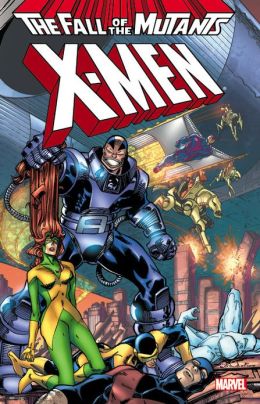
It's genuinely heart-wrenching to see how hard Hank has it with such limited brain power, especially in a scenario where the villain Apocalypse tricks Hank into sending a giant spaceship crashing into New York. And it's moving to hear Hank say that he'll do whatever he can to put things right, even if he loses what little mind he has remaining. But ultimately the story ignores the intellectual disability and all the loaded implications therein, because Hank's intellectual degradation is immediate, plateaus at the level of the Savage Green Hulk, and mostly just keeps him in the background of the main storylines. The Fall of the Mutants is considered a seminal work in the X-Canon, but how many people remember it for the master plans of Apocalypse and the rebirth of Angel as the brainwashed, metal-winged Archangel? And how many remember it for Poor Dumb Hank? Besides me, of course.

*(The original X-Factor consisted of the original X-Men pretending to be a human anti-mutant agency, promising to "control" the mutant threat while secretly rescuing and training young mutants. As many noted before me, this was the stupidest fucking premise ever for an X-Book, because the anti-mutant PR did so much harm that the few mutants X-Factor helped under their cover didn't begin to make up for it. Thankfully, the Simonsons gradually did away with this premise, and by the end of this particular storyline, X-Factor outed themselves to the public-- with surprising and well-deserved public adulation for saving the city from Apocalypse.)
** (Of course, it was soon forgotten that Hank still had that boosted strength, probably because he was really damned strong already).

Thursday, June 23, 2011

TVTropes Gives Me Bigoted Backhanded 'Praise'

Every day I go to TV Tropes, and every day I look to see if there've been edits to the Ruby's World page. Usually there aren't, so I was excited to see that somebody had catalogued some new tropes in relation to my comic. However, some of the the tropes added were offensive, and not for their dismissal of my talents. I quote directly from the YMMV section;

"Better Than It Sounds: Anybody who's trolled around the internet for long enough is no stranger to mentally handicapped people doing stories revolving around their aspie fixations with art that looks like it was done by somebody in grade school. That such a thing could be well-written, even thought-provoking and emotionally moving, is something else altogether."

Putting aside the insult towards my art (which I don't think is fair, because unlike Chandler I don't plagiarize and actively work to improve my draughtsmanship and my visual repertoire), I find the comparison between me and Christian Weston Chandler to be appalling PERIOD. This is the webcomics equivalent of Godwin's Law. And I've been compared to the being of unfathomable patheticness because A.) I am also on the autism spectrum and B.) also do a webcomic. The praise at the end is a backhanded compliment, because it suggests that I shouldn't be able to write anything good because of my apparent mental handicaps.

Given how much of Ruby's World is about the value of the individual experience due to the way the individual uses the hand life deals them (no matter how crappy), and given the explicit anti-ableist references I've made in the comic, it seems the person who added that trope didn't glean anything from my work. Apparently the value to my comic is in spite of my neurology, and is not informed by it.

Jesus, people, if you want to say "Your Webcomic Is Bad and You Should Feel Bad" to me, say it. Don't insult everyone on the spectrum in doing so, and FOR GOD'S SAKES DON'T USE CHRIS-CHAN AS YOUR STEREOTYPE OF AUTISM.

Saturday, February 26, 2011

BOTTOM 10 'Favorite' Tropes: Blog-a-Day, Pt 3

The final entry for my own TVTropes answers, featuring tropes that I usually (or never) can stand...

Misaimed Fandom: When what a fan wants becomes so important to them that they'll ignore or dismiss anything contrary, they've closed off their mind to everything. It's not just a failure of individual thought, but it holds back personal growth and development. Pretty much any fandom trope can fall under here, so I'll leave it at that instead of filling the list with Draco in Leather Pants, Opinion Myopia, Ruined FOREVER, etc.

Status Quo Is God: Particularly damning in franchise superhero comics, where the notion that everything will reset makes every new development seem like a temporary diversion. But if you're going to have a dramatic series that continues to be interesting, you need some forward motion, even if it's a risk.

Magical Negro: Because even though we live in a world of countless cultures and creeds, they all exist to prop up the white, straight, able-bodied, male lead. Sadly, this is what defines Morgan Freeman's career, despite his prodigious talents.

Stuffed In The Fridge: Because women don't exist except to prop up men, and can be easily sacrificed to the altar of drama. Though to be fair, Ron Marz (who wrote the scene with Green Lantern's girlfriend stuffed in said fridge) is far from the only culprit, has written plenty of instances of strong female characters who aren't disposable, and should be able to live down what so many other authors do on a regular basis.

Hollywood Psych: A lot of these representation tropes are asinine to the NTH degree, but this especially pushes my buttons. Especially when a character on the autism spectrum is portrayed, because it almost always makes them a burden on their lived ones (an indirect Magical Negro variant) and/or a sociopath.

Rule of Funny: Too often used in lieu of good writing, as Family Guy continually proves.

Moral Guardians: Even though I have a lot of problems with representation, I think it would be better to try and inform people, rather than brainwash them by removing alternative thoughts.

Shallow Female Love Interest:Not just because it makes the female character a prize for the male, but because it makes the male seem like a shallow sex hound for being interested in just a pretty face.

I'm A Man I Can't Help It: And yeah, it's confirmed a LOT in real life, but it doesn't mean a dick is a dickhead license.

Friday, February 25, 2011

Top 10 Favorite Tropes: Blog-A-Day, Part 2

In no particular order, the TVTropes that I love to read and write most;

Tear Jerker. I love a good tragedy, and this page helps me find plenty of reading material. Admittedly it's subjective, as some of the Tear Jerkers listed came across as gratuitous and over-the-top to me (see: Identity Crisis), but those of us who aren't afraid of a sad story can get a good idea of what they'll like.

Deconstruction: Tropes can be interpreted as rules, and when it comes to art, rules were meant to be broken. In a post-modern world, everything we know is driven by narrative, and if you're not actively taking it apart, you should ask yourself what you're doing.

Deconstructor Fleet: Most of my favorite stories of all time fall here.

Growing the Beard: The fact that series can do this is why I'm so drawn to serial fiction. While plenty of series run on longer than they should, and terrible sequels are practically the norm for many mediums, this is the strongest advantage of continuity.

Dysfunction Junction: Characters are more interesting when they're a complex mess, and the notion that ensemble casts need a token stable and happy character to balance out the more interesting characters is misguided. Everyone's some kind of mess, but that doesn't mean they can't be different kinds of screwed up.

Earn Your Happy Ending: To show that I'm not all about misery and ennui, I like it when all the character suffering and trauma actually results in something. If there's no ultimate gain to the protagonist's struggles, even if it doesn't occur within the protagonist's lifetime, then you run the risk of just being immature cynicism.

So Bad It's Horrible: You can learn just as much from complete failures as you can from a medium's canon, or even from its uneven but interesting entries. That, and they're fucking hilarious (albeit unintentionally).

Nakama: The one form of sentimentality that never fails for me is the kind that's earned through comraderie and shared experience. Religion, nationality, and ideology mean nothing without actual human relationships to back them up. Many of my favorite series run on this trope, and Ruby's World uses a similar structure.

ViewersAreGeniuses: Rare, and not always done well, but far better than the alternative.

Child Soldiers: In the real world, one of the worst examples of humanity's failings. In fiction, it appears a lot, and is often romanticized (see: most young adult fantasy stories). When played believably, mixing the horrors of war with the innocence of youth offers insight into the human condition, and how it can (and SHOULD) be bettered.

Sunday, February 13, 2011

TV Tropes Reader Questionaire


Only recently have I realized the profound effect TVTropes has had upon me, both in the way I read stories, and the way I create them. For those who don't know, TVTropes is a website that chronicles storytelling devices, describing both the recurring themes and the works in which they appear. You can see an example of the tropes here, created with help from frequent commentator and friend Jared...

http://tvtropes.org/pmwiki/pmwiki.php/Main/RubysWorld

Anyway, I've been going to TVTropes for over three years now on a daily basis. When I'm looking for new stuff to read or watch, I look through their pages ( usually using Tear Jerker as a starting point). Whenever I finish a book, movie, game, or other series, I check out its entries on the page. I have even contributed to some of the pages. And I'm far from alone in my devotion to the site.

So here are my questions for those reading my blog...

1.) Do you visit TVTropes regularly?

2.) Do you use terms from TVTropes in discussions of fiction (both online and off)?

3.) Do you find yourself consciously recognizing examples of tropes when you read or watch fiction?

4.) Do you find yourself consciously recognizing examples of tropes in real life (personal interactions, professional life, news media, etc.)?

5.) If you are a writer, do you find yourself consciously thinking of tropes when you create and define your characters and their stories?

6.) What is your favorite thing about TVTropes?

7.) What is your least favorite thing about TVTropes?

8.) Have you come across any new stories thank to TVTropes?

9.) Do you think TVTropes is a good thing for fiction, or not?

10.) What are your personal favorite tropes?

11.) What are your personal least favorite tropes?

I'll have my own answers shortly.