Ruby Nation

Ruby Nation
Ruby Nation: The Webcomic
Showing posts with label iron man. Show all posts

Wednesday, May 28, 2014

Of Course The Cripple Is Evil: Iron Man 26 Thoughts

In the latest volume of Iron Man written by Kieron Gillen, it was revealed that Tony Stark is actually adopted, picked up to play the public role of the Starks' child while the real son of Howard and Maria was in hiding. This is because that boy was genetically modified in vitro by an alien super-intelligence to be a super-genius behind a new intergalactic order, but resultantly ended up with an irreparably damaged respiratory system and had to be kept in seclusion. That boy grew up to be Arno Stark, who's recently come out of hiding while still requiring life support to keep his lungs working (be it a literal iron lung or an Iron Man exoskeleton).

Many readers guessed that Arno would end up evil. The name is a dead give-away for any Marvel history fans, given how the previous Arno Stark was the evil Iron Man of 2020. There's also the long tradition of villains being handicapped or otherwise deformed, because of course people who look or function differently are the Other and are cast under suspicion. There was some hope that Arno would end up being a nice guy, since he seemed pretty amiable and he even referenced the "Evil Cripple" trope when talking about his reticence over becoming a public figure like his adoptive brother.

These hopes were dashed in the latest issue, when it was revealed that Arno was working on a new serum of Extremis. Yes, Extremis, the super-deadly biotech serum that weaponizes human beings, and often makes them monsters. The kind that temporarily infected Tony's body, saving his life and boosting his performance as Iron Man (as well as giving him wacky super-powers like mind-controlling satellites and healing from injuries to the point of being able to reattach a severed heel) but also driving him mad with the traumatic flow of new information, to the point of entering fugue states where he talked to "ghosts". And the kind that Tony's tried to eradicate in this very volume, seeing its grotesque potential for misuse even by people with good intentions.

It's possible that we're meant to sympathize with Arno, because of Extremis also has potential for beneficial medical applications. But all that potential means nothing given the circumstances, such as...

1.) Arno isn't doing this to help other people. He's doing to help himself, so that his lungs can be fixed and he can live without external support. Never mind the fact that his external supports give him far more capability than most people, since he's at least as smart as Tony and builds his own powered suits. He wants to be cured, even if he has to use a super-deadly monster-serum to do it. Basically, he's using Curt Connors logic. 

2.) Arno has no real identity outside of being a genius and being disabled. We don't really get much indication of Arno's thoughts and feelings beyond what the plot demands. Even though he spent most of his life in seclusion, he could still think, feel, and dream. Even without an exoskeleton that gives him mobility, he's got all those capabilities. But we don't get to see those capabilities, because all we get from Arno is what he does with Tony Stark, and now what he's doing to undermine Tony Stark. The hints of Arno's life outside technology and envy of working lungs, such as his interview with ultra-leftist reporter Abigail Burns, are only told and not shown.

3.) "Magical" sci-fi cures tend not to end well. This may be so common it's become cliche, but there's a reason writers don't often write stories where there are pills that can fix all ailments. Fiction is the place where people, creators and audience alike, work out their anxieties and achieve a meaningful catharsis. Sometimes it's the place where people hide from reality and go straight to escapism, but certainly Kieron Gillen is a savvy enough writer that he wouldn't just go with "Arno uses serum to fix his lungs, succeeds in doing so, then uses serum to fix world, and creates a Candyland Utopia where nobody feels bad".

Some have criticized this mentality as anti-progress and anti-science. Certainly that's a result of the bizarrely static nature of the Marvel Universe, which has to remain similar to our reality and can't allow the super-scientists to radically change our infrastructure. But the implications of the alternative are much more troubling. If this form of super-science solving everything is a reflection of a desires, that means we see a world of easy answers. Where every problem has a solution, and those solutions can be universally applied across all kinds of problems. Where we get to see the happy ending while skipping past all the hard work and tough decisions needed to get there. Where we trust that we can take a pill to make ourselves happy and healthy, and not have to worry about the side-effects. And worst of all, where we see being infirm and disabled as something that has to be completely eradicated, and can't comprehend the notion of people being okay with the way they are (or at least being okay enough with their disabled lives that they wouldn't risk their lives on a potential cure. I'm not downplaying the challenges that come with physical and mental disabilities; I'm saying that they AREN'T fates worse than death, the fate that gives you absolutely no other options. They're certainly not worse than "dying" by virtue of turning yourself into a monster and losing all sense of self).

 Arno says he wants to use Extremis as a universal cure, one that can be applied to all medical problems. Arno is confident that he can work out all the bugs, even though no previous scientist has done so. Even if he does avoid that particular consequence of his hubris, Arno's still making himself the authority on what should be cured and what shouldn't. Perhaps Arno will decide that homosexuality is a disease that needs to be cured? Perhaps he'll decide that darker colors of skin should be swabbed away by Extremis? And perhaps when people such as Tony Stark, a man whose adult life has been defined by physical and mental weaknesses but hasn't let that stop him from doing the right thing and avoiding the easy way out, oppose Arno's mentality, he'll decide to use force because his will is more important than anyone else's?

I know that it's a slippery slope argument, but by all accounts Arno's slope currently is devoid of any and all friction. I sincerely hope that the next issues will prove me wrong.

Friday, January 10, 2014

I Got Issues Comic Reviews Week of 1/8/2014: Sex Criminals, Kamala Khan, Sad Wolverine, and the Colonial Iron Man


Trying a new format for reviewing comics, so these aren't going to go over two paragraphs each; I'm going for expedience as well as quality critique. So here's what I read this week...

Sex Criminals #4: Matt Fraction and Chip Zdarsky's painfully realistic story about people who stop time when they fuck continues. In this issue, Jon and Suzie meet even more people with their "condition", albeit a peacekeeping force who apprehend the Quiet's so-called "Sex Criminals"(TITLE DROP!). While I'm not entirely sold on the world-building of the Sex Police, that's not really the point; this is still Suzie's story, and about how her condition adds even greater complexity to the already nigh-incomprehensible territory of human intimacy. The best parts are still Suzie's narration, as she talks about her past and what sorts of things she did during the Quiet (including her first illegal activity, using the time freeze to frame her friend's rapist college boyfriend for marijuana possession-- a morally ambiguous approach with a similarly ambiguous outcome).

With Fraction's script and Chip Zdarsky's expressive art and detailed backgrounds (including some of the greatest ambient detail ever depicted for a store called "Cumworld", Sex Criminals continues to be the frank, mature sex talk the medium so badly needs. STRONGLY RECOMMENDED.

Wolverine #13; The finale of Killable, setting up the new direction for the supervillainous relaunch. As expected, Wolverine has no chance against Sabretooth without his healing factor. Sabretooth doesn't kill Logan, but instead takes the opportunity to rub Logan's mortality in his face, lecturing him on how they're not so different and how Logan's moral hypocrisies are unavoidable without his regenerative crutch. It's a brutal scene, and one of the few effective uses of the Origin continuity that I've seen, since Sabretooth calls attention to the fact that underneath his stereotypical man's man demeanor, Logan was still born as sissy nobleman's son James Howlett, and his attempt to be the blue collar hero falls apart given his privilege (both the initial wealth and the later, now absent mutant indestructibility). I hope that Sabretooth gets his not-so-inevitable comeuppance from Logan, though; similar to the Joker or the Green Goblin, Sabretooth is the kind of Complete Monster arch-villain who enjoys the kind of invincibility only a shared universe allows, and the fact that such rotten characters haven't been killed (in a permanent manner, at least) demonstrates an inherent futility to the nature of the shared universe superhero. At least Logan's killed Sabretooth before (though it obviously didn't stick), but the guy is one of the most successful characters in the Marvel Universe, and he owes it largely to his complete lack of moral restraint. "The best lack all conviction, and the worst are filled with passionate certainty", as Yeats would put it.

Perhaps once Logan becomes a super-villain himself, he'll learn that being a bad guy is the way to go in a world where nobody important to Marvel's bottom line really dies, healing factor or not. Until then, it's a powerful story, made all the more powerful by the choice the badly injured Logan is given towards the end. It's another moment that's simultaneously easy to predict in terms of logic but difficult to prepare for as an emotional response. Another great issue from Paul Cornell, and sadly the final issue with Alan Davis drawing-- there's a reason he's a legend in comics, and that reason is seen in effortless nature of this issue's storytelling. STRONGLY RECOMMENDED.

IRON MAN #20: Easily the weakest book I read this week, though that's partly because everything else was so great. Still, the Kieron Gillen run on Iron Man continues to underperform, competent but not at the level I'd expect from the one writer to make modern Cyclops into a sympathetic character.  There have been many extenuating factors, most notably the immediate shadow of Matt Fraction's brilliant run, the wretched Greg Land art plaguing the first year or so, but also the fact that most of it was stuck out in space due to the Guardians of the Galaxy status quo, and the fact that the Secret Origin story was resultantly told light years away from Tony's home planet. Not to mention thirtysomething years away from a point where the events within the origin story might have actually been relevant, as Tony had plenty of nurture to overcome whatever hypothetical genetic tampering would've been done to him in vitro, but I digress.

This current storyline is a mixed bag. On the one hand, there's the strong central idea of Tony building his own city over the ruins of the Mandarin's old regime, trying to create a test-bed for modern living. But it's told in such a way that it's hard to sympathize with Tony's goals. It's clear that Tony's overcompensating with this project to avoid dealing with the news that he was adopted, but we haven't really seen anything to indicate why the city is so great, other than Tony telling us that it is The City of the Future and not just a way for him to hide from his real problems within his toybox. There's the obviously problematic symbolism of Tony building a city over foreign soil without foreign consent, and the story itself acknowledges this-- but through the mouthpiece of Abigail "Red Peril" Burns, a one-dimensional anarchist strawman villain, devoid of anything but buzzwords and firepower. There's an impressive fight scene with Tony facing her using a battery of remote units (with the help of his new "brother" Arno Stark), as well as Tony cleverly wearing an invisible Iron Man suit over his street clothes. The art by Joe Bennett helps as well, and not just because it's not Greg Land. Bennett offers a strong cinematic flair reminiscent of Bryan Hitch.

I think my central problem with the current Iron Man volume is that it's obviously using a movie-style take on the character, where we're supposed to interpret the protagonist's complete disinterest in the consequences of his actions as roguishly charming. I'm much more interested in Arno's story, and the implication that he chooses not to rebuild his Iron Lung into something capable of mobility. Perhaps he's reticent to go out into the world after spending his entire life hiding, due to his comment earlier on how people tend to see people like him (i.e. handicapped geniuses) as villainous. Then again, that may be in part an excuse for the fact that such a transition would be frightening. It's a believable and sympathetic approach to a character potentially "overcoming" a disability, even if it's in going from an Iron Lung to an Iron Exoskeleton. Too bad it's not the main story. Overall, MILDLY RECOMMENDED.

ALL-NEW MARVEL NOW POINT ONE: Now this was a pleasant surprise. Six strips, and not a stinker in the bunch. I'm not going to buy all of these books, but all of the prologue stories were strong examples of craft. I'm probably not going to get the Invaders series by James Robinson and Steve Pugh, given my lack of interest in the Invaders, but it did look like a good hook for a traditional super-team comic. The Black Widow story by Nathan Edmonson and Phil Noto was also pretty good, especially the art, even if the script was a bit predictable in its portrayal of Natasha as a conflicted assassin. I'm more interested in the Loki series by Al Ewing and Lee Garbett, which has a strong grasp of the character (at least the Tom Hiddleston version that will likely be the default take from here on out). And the Avengers World strip by Jonathan Hickman, Nick Spencer, and Rags Morales could lead to something really great, provided that the writing is influenced more by Spencer than Hickman. Spencer has a strong flair for character work, which can be true for Jonathan Hickman but usually isn't, due to his greater interest in writing stories as meticulous chess games with complex plotting and strategizing taking precedence over a dramatic hook. (His Avengers is especially guilty of this, but it was foreshadowed in his Ultimates series, which started strong but quickly regressed into a demonstration of how awesome the villainous Reed Richards could be).

The two books I will definitely be buying after reading this comic are Silver Surfer by Dan Slott and Michael Allred, and especially Ms. Marvel by G. Willow Wilson and Adrian Alphona. I enjoy Dan Slott's writing quite a bit, and I like the idea of Silver Surfer getting a Doctor Who-style companion so he has someone to talk to besides his crippling sense of self-pity (and Slott uses it to his advantage by playing the Surfer's seriousness as comical in contrast to everything around him). The art by Michael Allred is beautiful as always, and the pop art charms are most important when we see the Surfer fighting a bunch of anthropomorphic sea-predator pirates. The Ms. Marvel story deserves special praise, and not just because it pisses off the right kinds of people. New 16-year-old Muslim superheroine Kamala Khan immediately shows the kind of conceptual strength right off the bat that most teenage heroes only dream of acquiring. She's a shape-shifter as a metaphor for a child of multiple cultures and demands, growing up in New Jersey under Pakistani-American parents, with both mother and father having their own sets of well-intentioned demand (the mother for the right marriage, the father for the right career). She's definitely an eccentric young woman who's immediately figured out creative uses for her powers, but there's not much room for her to express her abilities; her first superfight is limited to a monster in a junkyard, and even that's interrupted by a call from her mother. The art by Adrian Alphona is perfect, as I would expect from the artist of Runaways; he's especially good at showing Kamala's powers in action, and how awesome being able to stretch one's body and limbs can be. Too bad it doesn't help her larger identity issues, or in Kamala's words; "I can change my face, but I wear a mask instead. There are LAYERS of unpackable crazy up in here."

Based on the overall quality but also the strength of the Ms. Marvel story, STRONGLY RECOMMENDED.

Friday, May 17, 2013

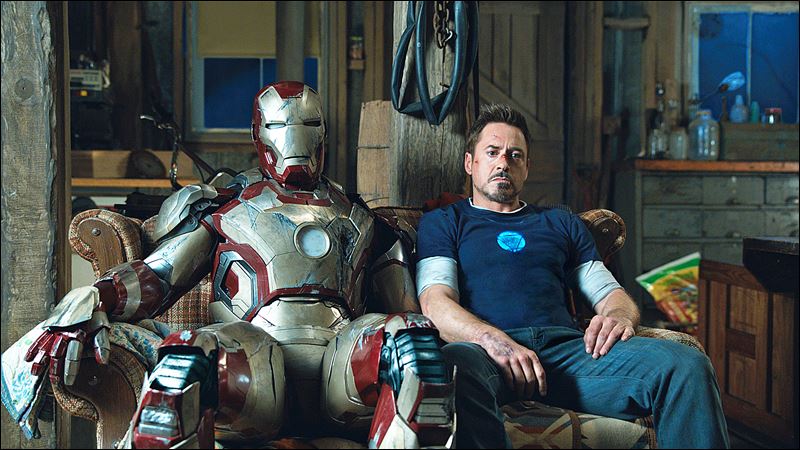
And More Of Why I Hated Iron Man 3

(Reposted from my comic blog, which you should be reading. My feelings a week later have only gotten harsher.)


Some days I am very grateful for the fact that I do an independent webcomic, with no content beyond what I create, no editing beyond what I choose, and no readers beyond a small few devoted and cherished fans. Yesterday was one of those days, because it was the day I finally saw Iron Man 3.

Iron Man 3, directed by Shane Black (replacing Jon Faverau), is not a bad movie. It has the same cast of the previous Iron Man movies (which I really enjoyed, albeit with reservations), and it had a few new characters who were played effectively. It even had some good ideas, such as Tony Stark's anxiety attacks following the events of the Avengers. However, none of those ideas got any space to breathe, and the Hollywood formula smothered the movie so that everything potentially interesting about it was diluted in a stream of explosions and one-liners.

If Iron Man 3 were played as a completely straightforward superhero movie, such as Captain America, it could've excelled at that. But the more thoughtful bits raise important questions and take them absolutely nowhere. Tony's anxiety attacks begin as a serious issue, showing a tortured mind whose view of a rational universe has been shattered in the wake of discovering gods and aliens, and who builds armor after armor in a compulsive attempt to regain his security. This is in the first act; in the second act, Tony's anxiety attacks are just reduced to comic relief as he flips out in front of a little kid, and by the third act, he's completely "overcome" them (as if you can just punch emotional problems into oblivion). 

(NOTE: EXPLICIT SPOILERS FOLLOW)

The intriguing start and piss-poor payoff continues through the rest of the movie. For example, the Mandarin is brought in as a Bin Laden-style terrorist, releasing viral videos of his deeds with messages about America's sins (SUCH AS A REFERENCE TO THE SAND CREEK MASSACRE, as an allegory for the casualties of America's nation-building in Iraq). In the second act, we see that this new interpretation of the Mandarin is just a smokescreen, as he's really just an actor hired by the main villain to distract from his real activities. This is a clever twist that plays on Orientalist fears, but it's ruined by some painfully extended comic relief sequences with actor Mandarin, and then it's completely dropped when the real villain turns out to be just another monologuing jackass, whose speech about the power of anonymity is completely ruined by the fact that he's GIVING A FUCKING SPEECH. What's more, the present-day implications of the genocide against the indigenous Americans are completely dropped, even when there's plenty of appropriate subtext (such as Jim Rhodes/War Machine going on a wild goose chase for the Mandarin while in his new Iron Patriot suit, giving third-world citizens the sight of a red-white-and-blue death machine breaking into their homes and threatening them without warning).

Everything in the movie follows this pattern. The Extremis formula, used in the comics for an interesting exploration of transhumanism (as well as its inventor Maya Hansen, a great example of a once-idealistic scientist corrupted by the military-industrial complex), just serves to make flaming villains here. Tony's compulsive armor-building, a sign of emotional turmoil, turns out to be just the thing needed to save the day in the Obligatory Climax Explosion Orgy. Even the humor scenes fail, because of how scripted they feel. Where Jon Favreau made even the weaker parts of his Iron Man movies entertaining thanks to all the ad-libs, you can tell here that there's a heavier directorial hand, and the situations (such as all the time where Tony fixes his armor with the help of the little kid) show us just how tightly they're sticking to the script and telling us THIS IS FUNNY.

It's all smothered by cliches, robbing it the opportunity to be even an interesting failure. It's not a bad movie, and I don't hold anything against its cast and crew. It's just a mediocre movie clearly ruined by the process of executive meddling, and again, it makes me very grateful I don't have to deal with that shit.

Comic Book Iron Man Vs. Movie Iron Man in the Most One-Sided Fight Ever

(Having a blog devoted to my artist brand didn't work out, so I'm going back to what works; this blog, and writing about things bigger than me)


Overall, the comic version of Iron Man is one of the few superheroes who represents an adult morality, as opposed to an adolescent or even childish one. Tony is a complex man with enough power and influence that everything he does or doesn't do has massive ramifications, and he's fully aware of that fact. His goals are much greater than simply saving the world from villains, so his enemies tend to come across as petty characters despite their destructive capabilities, who are threatened by the fact that Tony can be fiscally successful without Ayn Rand-style opportunism. Even then he's often forced to make hard decisions and do morally ambiguous things, because he's responsible for so many people-- not just in the present, but in the future. Tony Stark's personal problems tend to similarly represent more complex emotional territory than most superheroes, since his fight to lead mankind away from their bad habits towards better choices is represented in his own struggles with addiction (be it alcohol, women, or even just the desire to control everything).

The movie version of Iron Man is less abstract because he's a much simpler and shallower character. He is an overgrown teenager whose activities all stem from what he wants, with the only cases of him actually doing anything altruistic are ultimately self-serving, such as the Stark Expo (which shows no actual inventions, just a vanity project with a lot of sound and fury), or the compulsive armor building (which is just a means of managing his own insecurities with just as much potential for ill as good). Note how all the times Tony actually goes into combat in the movie, it's either a matter of self-defense or vengeance (even in the first movie, he only goes after the terrorists in Yinsen's village). This might be interesting if he were not portrayed as the hero, but instead he's immediately forgiven for his sins because the films demand happy endings. 

If the comic is being rejected, it's being rejected in favor of a sugary Hollywood iteration who can easily overcome his problems to suit the three-act screenplay structure, so that they don't get in the way of the power fantasy that can't hold up to a world of abstractions.

Sunday, December 2, 2012

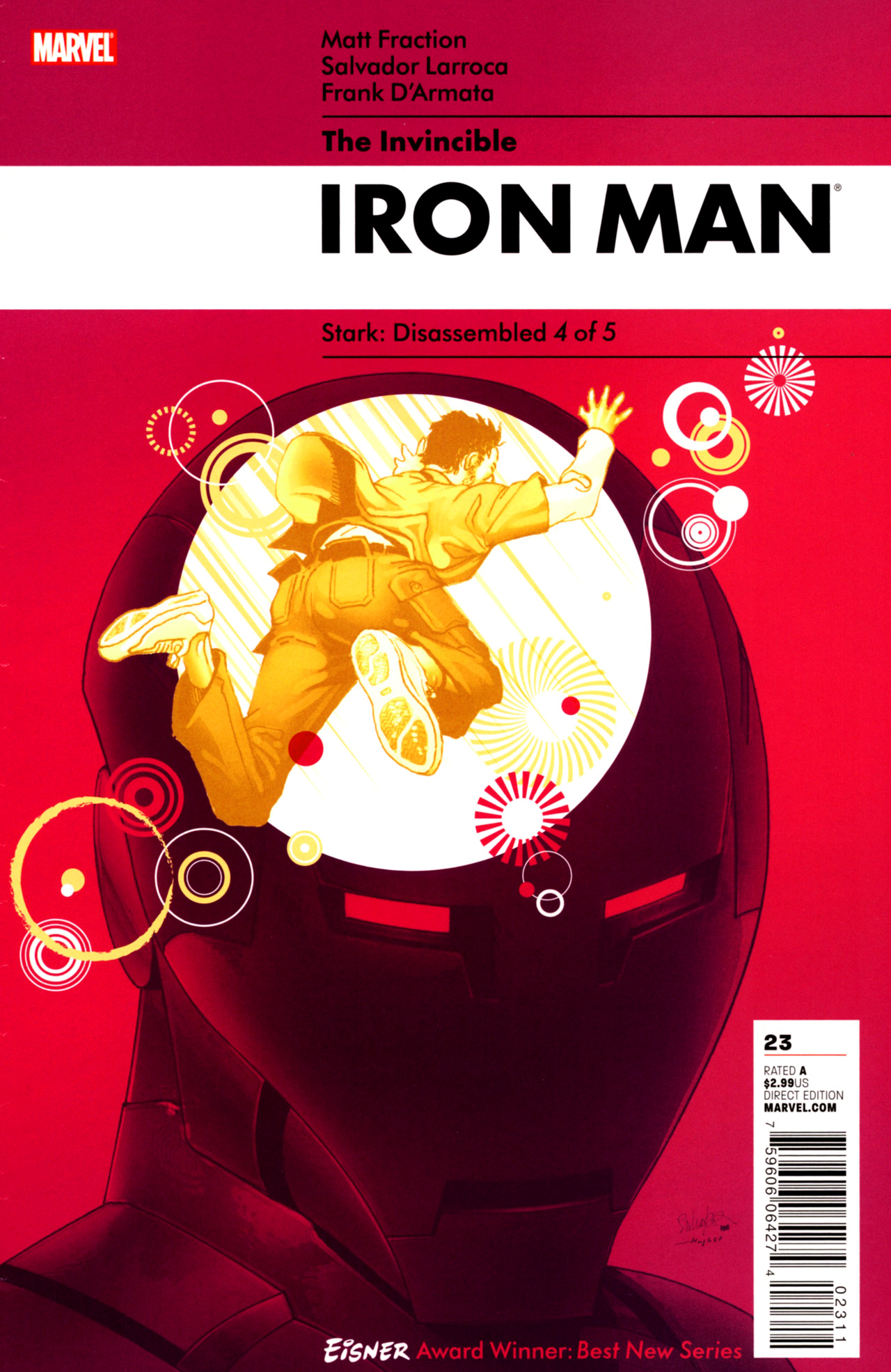
Matt Fraction Iron Man Retrospective: That's It? Hell Yeah It Is


Genre fiction tends not to be the place for subtle, complex emotions. With names like comedy, suspense, drama, and horror, genres in their purest form tend to cater to simpler desires, evoking simple yet visceral emotions if done well. This isn't a bad thing, as that's hard to do in practice and should be lauded when done successfully. However, the best works are the ones that augur more complex feelings, put you in emotional places that are all too real but rarely discussed in our fictional fantasies. This is the difference between, say, anger at a designated foe, and pervasive frustration over a lack of personal progress. A dramatic collapse into addiction followed by a heroic triumph of willpower, versus a realization that those compulsions have just been sublimated into other areas. Or even the difference between a triumphantly happy ending, and an ending where the hero left the world slightly better than he found it-- but only slightly.

Matt Fraction has been doing this with artist Salvador Larroca* on the Invincible Iron Man for four and a half years, taking the character into emotional territories seemingly beyond the scope of the superhero genre. As of October 2012, Fraction finished his tenure on the book with a surprisingly downbeat epilogue. After a penultimate issue of all action, where Iron Man teamed up with pretty much every non-Avenger ally available (and even some enemies) to stop the Mandarin, Tony returned to America after months in his arch-enemy's captivity. What Tony concludes, to his dismay, is that the world hasn't changed much in his absence, still stuck in the past.

Actually, that's not quite true; Tony's friends and colleagues were doing okay without him. Resilient, previously Stark Resilient, became fairly successful without its mega-celebrity founder, using the repuslor technology to make superior consumer goods without a single cent of military funding.Pepper Potts moved on with her life, eventually hooking up with dowdy but reliable Carson Wyche (one of Resilient's star inventors, whose career had previously been ruined by Tony during his decadent and petty pre-Iron Man days) and learning to live without the Rescue armor. The civilian works of Tony Stark continued without him or Iron Man-- his real legacy. But that's not something that Tony can really appreciate, so the only person really stuck in the past is him. Tony's company escaped the Marvel Universe's Nietzche-esque eternal recurrence, and are off doing good if rather dull work by making better, cleaned products that are presumably cheaper. But Tony is stuck in the same cycles of heroes and villains and will never escape them, thanks to the fact that his existence as a Marvel comic character is meant to sell merchandise first.**

The main theme of Fraction's run on Iron Man is the explicit question of wether or not the Iron Man is a good thing. Sure, Tony saves the world as Iron Man, but there are plenty of other superheroes who do that without all of Tony's baggage; who don't sponsor their super-powers with military-industrial blood money, who aren't responsible for thousands of civilian deaths at the hands of Stark weapons, and who aren't so wealthy that they can retreat into their addictions while shirking their responsibilities. Some might even say that Tony's decision to atone for his arms dealing sins as Iron Man served him far more than anyone else, giving him the visceral thrill of being a superhero and catering to his death drive impulses, instead of really cleaning up the Stark-branded messes left on battlefields across the world.

This theme was much easier for Fraction to express at the start of his run, when Tony was the Orwellian ruler of the world as Director of SHIELD. When Tony relapsed into the military-industrial complex full force after the events of Civil War, it was much easier to critique the problems in his imperialistic approach. The first twenty-four issues of the Fraction/Larroca Iron Man fired upon all cylinders, especially during Tony's atonement in World's Most Wanted (which kick-started the Handi-Capable blogging, as some of you may remember). After that it was more uneven, since the Heroic Age led to Tony Stark trying for a more pacifistic approach, which really wasn't condusive to serial superhero comics. (The Stark Resilient arc was particularly egregious, with its first half being entirely set-up for Tony's new company.)

Of course, that may have been the point, because a lot of life-- particularly recovery from addiction-- isn't earth-shattering drama. It's living day-by-day, paying your bills, managing your relationships, and trying to do a little better than you did the previous day. And this doesn't really work for Tony Stark, who risks his life on a daily basis and goes through more women than James Bond. In many ways, Tony still lives an addict's life, even if he's kept himself clean of alcohol; he lives a life of consumption, keeps others at arm's length, is frozen at the emotional maturity of a teenager, and doesn't place any value on his personal safety.*** This isn't really the kind of person you want as a responsible leader for a trusted brand, and when Tony fails, his companies tend to fail with him.

The final chapters, however, did have Tony save the day when nobody else could, by ultimately defeating the Mandarin-- who was quite cleverly played as a twisted mirror of Tony's own conspicuous consumption, a Kim Jong Il-style**** hedonist so obsessed with his self-mythology that he became enslaved by it (what with the rings actually controlling him). Just like in real life, weapons are a necessary evil some times, when you need to defend the just and the innocent. But Iron Man is still a weapon, and tying worship of weapons into the public sphere has grave moral consequences, as Eisenhower (correctly) warned. So this makes the ending, with Tony leaving his company and going off to find new adventures in space, an appropriate if bittersweet conclusion.

One of Tony's final lines to his former employees is "I'll do better next time". So much of fiction deals with character development in very broad strokes, either ignoring it or having characters Learn Lessons and Grow Stronger. Tony isn't a completely different person after all of his experiences in Fraction's stories, nor can one expect him to be. Nor is Resilient poised to dramatically change the world, in the broad "curing cancer and making cars fly" strokes too often shown in science fiction "utopias". They make cleaner cars and cleaner phone batteries. They're helping people live life a little better, and they're offering it to the public in a completely voluntary fashion; you don't choose a Stark phone because of a Dr. Doom-like edict sweeping society, you presumably choose it because it's just a better phone. The world is thus a little better, from this small bit of progress-- which is ultimately the best we can hope for in terms of lasting good. Humans and their societies can't change overnight, nor can they become perfect-- they can just move in the right direction, and that's what Tony's done.

It's a complicated message for a superhero comic, but a very powerful one when fully understood. I'm really going to miss Matt Fraction on Iron Man, and despite some misgivings about certain parts of this story, I have nothing but praise for the sum of those parts.

* Larroca's art deserves special mention, as he became better and better with each issue. His tech is always beautiful and inventive, but his characterizations are also superb; though he's often critiqued for relying too much on photo reference, his art uses such economy of line that those faces get life beyond their original inspiration. I'm going to buy the new Cable and X-Force comic just for his art. And Colossus, of course.
** Which isn't really a bad thing, it just is. This is also why creators who do such brilliant things with the franchise characters deserve special applause.
*** Illustrated beautifully in the .1 issue, where Tony recounts his entire history in the context of an Alcoholics Anonymous meeting. If you buy a single issue of Fraction's run, buy Invincible Iron Man 500.1
**** Which is why for a moment I was disappointed that Ben Kingsley was cast as the Mandarin in Iron Man 3, because I would've gone with the Kim Jong Il puppet from Team America World Police :P

Monday, October 22, 2012

Thursday, August 9, 2012

The Fall of Hank Pym, The Avengers' Greatest Failure


It's occurred to be before that the controversy around the character of Hank Pym (a.k.a. Ant-Man/Giant-Man/Goliath/Yellowjacket/Wasp) has a mental illness component that's rarely addressed. The character has polarized Marvel readers since that 1981 issue where he struck his then-wife Janet Van Dyne (a.k.a. the Wasp)*. That issue, and the larger storyline to which it's connected, has been out of print for years, so the actual context of the event has been largely divorced from that one panel of Hank hitting Jan. But since the whole story has finally been reprinted in the Avengers: Trial of Yellowjacket trade paperback release (which I strongly recommend), there's finally the opportunity to examine Hank's deeds with closer scrutiny.

On the one hand, Hank does behave badly, and he's not so far gone that he loses responsibility for his actions. Having just re-joined the Avengers after an unsuccessful return to his scientific work (during which Jan tayed on the team), Hank's an unstable nervous wreck, and he takes his frustrations out on Jan. Jan, trying to be the good wife, tries gently reasoning with him, even though he's snapping at her over every perceived slight. What's important to note is that while the physical abuse of Jan is often brought up, the verbal and psychological abuse is downplayed, but that played just as much of a role in their divorce. At one point, when Jan's trying to decide which of her Wasp costumes she should wear to the Avengers meeting, Hank uses his Yellowjacket suit to blast one out of her hand. He's using a deadly weapon to destroy her property, and thus issuing an implicit threat. Jan doesn't say anything in response, still under the impression that she can help him (and thus continuing to enable his use of her as a scapegoat, as is so often and sadly the case).

Hank's behavior is reprehensible, and it goes beyond a domestic dispute and into nearly manslaughtering the entire Avengers. He creates a robot to attack the Avengers so he can shut it down and appear to have saved the day, but like all robots in these stories (most notably, Hank's accidental creation of Avengers arch-nemesis Ultron), it goes berserk, everyone sees through Hank's ruse, and Jan ends up shutting it down. It would be kind of hard for him to plead insanity when he had enough rational ability to make a giant killer robot, even if it ultimately couldn't be controlled. Looking closely at Hank's behavior, he's aware that he's doing the wrong things, but he ends up doing them anyway because he can't control his impulses and is so desperate to prove his worth. He doesn't try to win back the Avengers or his wife after these events, realizing the immensity what he's done; he doesn't even accept any charity, despite the fact that he was living off of Jan's trust fund and is otherwise penniless.

So yes, Hank is responsible for his sins. But while he could have controlled himself even in the context of his nervous breakdown, the event did not occur in a vacuum. Hank had previously been unstable, due to his own low self-esteem, his unhealthy relationship with Jan (a younger woman who he had nothing in common with, other than her resemblance to his dead first wife), his guilt over the creation of Ultron**, and the adverse psychological side-effects of his powers. And during this whole time, the Avengers were right there, watching but doing virtually nothing. Nobody on the team asked Hank what was bothering him. Nobody suggested therapy for him or Jan, together or separately. Nobody was worrying about his long-term mental stability, even when he fell into delusions where he thought he was another, more aggressive man. His marriage to Jan occurred when he was high on Science Chemical Fumes and called himself Yellowjacket, believing himself the murderer of the original Hank Pym. The great fraternity of superheroes was nothing more than a Greek Chorus bearing passive witness to the downward spiral of one of their founding members, up until his baggage became a physical threat.***

It's worth noting that this story happened right before the similar downward spiral of another Avengers founder; Tony Stark, a.k.a. Iron Man. At this point, most of the Avengers didn't know Tony's secret identity, and when he ended up dating Jan shortly after her divorce, she wasn't aware that she was dating one of her (and Hank's) co-workers. Tony fell for her and couldn't bring himself to tell her the truth, at least until Captain America guilt-tripped him into doing so. The result was a messy break-up that fuelled Tony's own depression, until he outright disappeared from the Avengers. This was due to the story in his own book, where the psychological warfare of Obadiah Stane caused him to sink into an alcoholic relapse. Tony's storyline was controlled by the Iron Man creative team, but you could see Tony fraying at the edges bit by bit in the Avengers, withdrawing from interacting with the team (and his ex), with nobody doing much to check in with him.

The Avengers have an absolutely abysmal track record taking care of their own. Hank is only one of the heroes to have a catastrophic nervous breakdown while on the team; the list of fallen heroes on the Avengers roster include the aforementioned Tony, Wanda Maximoff, Pietro Maximoff, Simon Williams, Clint Barton, Bruce Banner, Carol Danvers, and more. But as far as he fell, Hank managed to pick himself up. He earned Jan's forgiveness (and even a few reconciliations, however temporary), he earned his place back in the Avengers, and everything he's done since has been an act of atonement. He's not entirely stable, but nobody is immune to stress, especially not as a superhero.

Can't he get fandom's forgiveness?

*(It's worth noting that the writer of the original story, Jim Shooter, wrote the scene as Hank pushing her away with more force than intended, but the artist drew it like just another superhero fight scene; hence, an isolated incident became a scarlet letter.)
**(Who's actually killed millions of people. How come Hank gets more grief for one slap than for creating a genocidal anti-organic monster? )
***(Joe Casey's excellent Earth's Mightiest Heroes mini-series portrayed the wedding in a much darker light, where Jan and everyone else was playing along with Hank's delusion to avoid an even greater meltdown. Not sure if this makes the Avengers look better, or much, much worse.)


Sunday, May 6, 2012

Avengers Movie Review: A Thoughtful Fangasm (SPOILERS)


When I saw the Avengers movie yesterday, I thought there were two film's competing for the (hypothetical) audience's attention, and while I enjoyed one, I could've done without the other. The first film is a thoughtful character piece which takes a look at the costs of military expansion and the theory of deterrence's validity. It's immediately established that Fury would never have unleashed Loki and his Chitau'ri allies on Earth were he not fiddling with the Tesseract as a means to make weapons. He claims that he was looking at a source of clean energy, but as is so often the case with the military industrial complex, the beneficial uses of the new technology just end up as the agreeable wrapping paper trying to hide the jingoistic core. He assembles the Avengers to clean up the mess he effectively caused, and when they find out what he's really been up to, he justifies it by blaming them for bringing superhuman menaces to Earth and claiming a need for self-defense. Self-defense is perfectly valid, but it's hard to believe that Fury and SHIELD would just stop at deterrence. This is an organization wire-tapping every electronic device around the globe, confiscating/stockpiling the weapons of the worst criminals in history, and sending their highly skilled agents to capture or kill people at will. If anything, it confirms Loki's idea that people want to be ruled-- that they would rather feel safe with Big Brother watching over them, than know any true freedom. Which works up to the point when it doesn't, when you end up with neither due to an invasion. The best review I've found of the Avengers is Something Awful's, which eloquently (if critically) expresses this problem. However, I disagree with the author's belief that the Avengers is a justification of the US brand of imperialism. If anything, it's advocating the ability of individuals over byzantine political systems. The Avengers are all unique, skilled, yet damaged individuals. They may have been collected by Fury, but when they form a team, they do so on their own terms. And after they defeat the enemies, they go their separate ways, but will still come together if needed for another crisis. The Avengers don't represent America or any other nation; they represent people who can and will save lives. The only will they follow is the will of Coulson, after he proved too good for our sinful planet. The other film, on the other hand, is exactly what I feared the Avengers would be; a sensationalistic fangasm, a film that exists with no purpose beyond putting a bunch of big stars in the same room. For the most part, the Avengers avoids this due to mixing thoughtful and sympathetic character scenes with the big set pieces. However, we all know which one gets asses in seats. So unfortunately, the latter half of the movie is one long, repetitive fight. Which would be fine if it were shorter, but when you keep the action at that high level for so long, it stops being so intense. The Chitau'ri have no personality beyond being Mooks for the Avengers to slaughter (I assume they don't have families, right?), and their design doesn't even go beyond most CG aliens. When the Chitau'ri ship appeared, the big metal snake reminded me of Shockwave's craft in Transformers 3. Any time I'm comparing something to a Michael Bay movie, that's not a good sign, though at least this movie has substance beyond the prolonged final battle and at least keeps its goddamned camera steady. My fear was that this would be the end of the super hero movie's unique qualities; once they get to the crossovers, they become the same recycled garbage that so often characterizes the comics. The superhero is no longer special, but a face in a crowd of hundreds of others, with the act of putting on a costume being just another profession in that universe (albeit one that looks ridiculous to most in our universe). The Avengers doesn't go that far, as it thankfully keeps to a smaller cast and features a well-written story on top of all the requisite explosions. Still, can the next Avengers movies keep that self-contained? Or will we inevitably see "Avengers V: Secret Infinity Siege " and " Avengers VI: Coulson Reborn"? My general perspective with Marvel media (or any big franchise divorced from its original creators, for that matter) is to assume it's going to be bad and be surprised when it isn't. But with the Avengers, at least, I was surprised. Highly Recommended.

Thursday, December 8, 2011

Matt Fraction And Nathan Fox Give Bin Laden A Taste Of Fear Itself

Go Here For The Story

Yesterday gave comics a surprising boost of notoriety when GQ published a comic strip version of Bin Laden's final moments. The comic was written by Matt Fraction, one of my favorite comic writers, while the art is by comic artist Nathan Fox. The two previously collaborated on Invincible Iron Man 500, where Fox illustrated the parts of Fraction's dystopian future where we saw Tony's son turned into a literal War Machine, under the control of the Mandarin.

This story is an extremely intense piece of comic storytelling, and effectively chronicles the Seals' raid on Bin Laden's final hiding place. What's most interesting about it isn't the portrayal of the Seals, but of Bin Laden himself. Here, the mastermind behind Al Qaeda is almost a sympathetic figure. He's the most infamous mass-murderer of the current century, his organization responsible for the deaths of thousands including both American and European citizens as well as his "fellow" Muslims. But in his final moments, he's just a sick, scared old man who's been hiding in the dark for years, thinking in clipped, frantic captions as he awaits the inevitable.

In the annotations, Fraction denies that he wanted to get into Bin Laden's head, for obvious reasons; what person, of any respectable political affiliation, would try to excuse this monster's actions? But Fraction isn't excusing anything Bin Laden did. If anything, he and Nathan Fox are using their chosen medium to make Bin Laden the concept see the errors of his ways. In the end, Bin Laden only brought misery to the world, and that includes his own kin. The look Fox put on Osama's face as one of his grown sons runs out to protect him and ends up dead says a lot; is Osama simply scared, or is there a hint of remorse for the fact that his child died for his own sins?

Some may interpret this as propaganda for the US, but it's really a great piece of storytelling that combats the ideals for which Bin Laden caused so many deaths. Bin Laden may have wanted to be a martyr who inspired an even greater wave of suicide bombings. But if Fraction and Fox's comic is his legacy, then everything Bin Laden did just led him to an undignified, pathetic end.

Monday, October 10, 2011

The Jeph Loeb Drinking Game


Note: Do not try this at home. This Avengers: X-Sanction preview alone will get you completely plastered.

--When a fight scene erupts for no clear reason other than to have a fight scene, take a shot. (Avengers vs. Lethal Legion)

--When a bunch of heroes or villains are assembled in an "iconic" arrangement, take a shot. (The Avengers are Marvel's Big Five-- Wolverine, Spider-Man, Iron Man, Captain America, the Hulk by way of the Red Hulk-- joined by the Falcon, presumably as a token. The Lethal Legion are veteran Avengers foes Living Laser, Grim Reaper, Whirlwind, and Radioactive Man. The latter of which hasn't been a conventional super-villain in a long time, instead acting as a loyal soldier for China).

--When a character makes a quip with the same amount of wit as a schoolyard taunt, take a shot. (Spider-Man: "Why is there never a jailbreak on nice, pleasant, warm nights in New York?" Wolverine: "Why is it you never shut up?")

--When a character goes into heavy-handed, mopey first-person caption narration, take a shot. (Cable's internal monologue about being a soldier).

--When the conflicts are revealed to be the acts of an ubermensch villain manipulating events with far more capability than they should be able to have, take a shot. (Not seen here, but with Loeb's history of using villains like Hush, Romulus, Ultimate Doctor Doom, The Intelligencia, and others, there's often a mastermind with unconvincingly extreme mastery).

--When a character is brought back to an "iconic" state in a way that defies everything previously established, take a shot. (This series is about bringing Cable back from the dead. Even though his absence wasn't exactly derailing the Marvel Universe.)

Now excuse me as I go into the ER for alcohol poisoning.

Monday, August 22, 2011

How To Write A Fear Itself Tie-In comic


Step 1.) Check the comic you're writing to see if there's an overarching story in progress. If there is, put it on hold until the end of the summer.

Step 2.) Find an existing character (one who isn't necessarily connected to the comic) and give them a magic hammer with a merchandise-friendly redesign attached. Don't worry about wether or not the character will actually be merchandised.

Step 3.) Give that character a new name along the lines of "(Name), Breaker of (Thing)". The first name should be something punchy, even if it doesn't make sense in any known language. The second should be something that sounds ominous.

Step 4.) Now that you have your (Breaker), have them start randomly killing (Random Civilians). Don't worry about giving them a credible motivation, the (Random Runic Dialogue) should make them seem ominous enough to compensate.

Step 5.) Have the comic's existing (Hero/Heroes) drop everything they were doing to try and stop the Breaker of Something.

Step 6.) Show how no matter what powers the cast have, or what strategies they use, the (Hero/Heroes) do anything against (Breaker). At the same time, NEVER have (Breaker) inflict any lasting damage upon anyone who counts, beyond (Random Civilians)

Step 7.) Between the action scenes, intersperse talking heads of (Hero/Heroes) whining and crying about how they can't beat (Breaker). If you wish, you can connect it to some sort of larger sociological point about the economy or the war on terror or whatnot. Don't go too far with this point, lest you get away from the Formula.

Step 8.) Resume your comic's normal storyline after the Fear Itself event is over, hoping your existing readers haven't gotten totally sick of this shit.

Thursday, July 7, 2011

Fear Itself #4: Taking a (Cold) One for the Team


While I've been entirely neutral about the main Fear Itself book, Marvel's once-again-obligatory crossover event gave us a great Iron Man scene yesterday. This is no surprise, as Fear Itself is written by Matt Fraction. However, Fraction gives Tony the opportunity to shine by having him stand up both to Odin the All-Father and his own alcohol addiction.

The scene is particularly bizarre, as it's technically Tony petitioning Odin for help saving the world. Since Odin is much more powerful than any of Earth's heroes (even Thor, the Odinson himself), this is a wise decision. But since Odin is so arrogant and has so little regard for humans, it was unlikely he would risk his own hide to help mortals, and might only do so if they showed complete submission.

So what does Tony do? Grabs a bottle of booze, sacrifices the sobriety he's kept for years in a single swig, and demands Odin help them now that he's shown the requisite loss of dignity.

Of course, Tony isn't actually submitting to the All-Father. He's making it clear that he has no respect for Odin and is only asking out of utter necessity. Instead, he's prodding at Odin's pride, even calling him a bully. The sacrifice of dignity is Tony jumping through the kinds of hoops Odin expects of everyone else, all the while satirizing Odin's need to bring others to his knees.

Tony also isn't sacrificing much by taking a drink. If anything, he's confronting what's been one of his worst Achilles' heels. There are many alcoholics that are able to overcome their problem to the point of being able to drink again in moderation. Tony isn't one of those, and even though he's been willfully* sober since his 1980s uber-binge. Yet the policy of complete and utter abstinence hasn't worked too well for him, as writers have taken every opportunity to show how he still thirsts. Fraction himself addressed this in the .1 issue, showing how Tony compensates for his alcohol addiction by indulging in his sex addiction. At least Tony can't crash his Iron Man suit into a bus load of school children under the influence of having blown his wad, but he's still maintaining an addictive personality and feeding his alcoholism through total abstinence.

it was only a matter of time before Tony relapsed, given his thirst; Obadiah Stane ruined Tony by prodding at this weakness, and Justine Hammer sent Tony a bottle through mail in the hopes of repeating this plan. But though Tony may be drunk now, this doesn't mean he's off the wagon. In fact, it may mean that he'll be able to control his addiction, rather than simply deny it. Just because he's not submitting before a higher power (Literally!) doesn't mean he'll once again be a hopeless drunk.

Well played, Mr. Fraction.

* Excluding instances where he was supernaturally forced to drink, such as when the AI VOR/TEX stole his body

Saturday, June 25, 2011

RIP Gene Colan :(


Legendary Marvel artist Gene Colan passed a couple of days ago, at the age of 84. I met him briefly at San Diego ComiCon in 2001, when I was still a punk teenager. He was a very nice man and seemed pleased that I was aware of his artwork on Iron Man. Though I imagine most 16-year-old boys wouldn't have been aware of those classic old issues, it would be years before I became aware of the breadth of his career.

Gene Colan had one of the most illustrious careers in comics, starting back when Marvel was still called Timely. At Marvel, he helped bring their fledgling superhero universe to life. His contributions included the early Daredevil comics, the creation of the Falcon (one of the first African-American superheroes, and a mainstay in the universe to this date), a large part of Steve Gerber's Howard the Duck series, and the entirety of Tomb of Dracula. All of this was drawn in his sharp, fluid, value-intensive style.

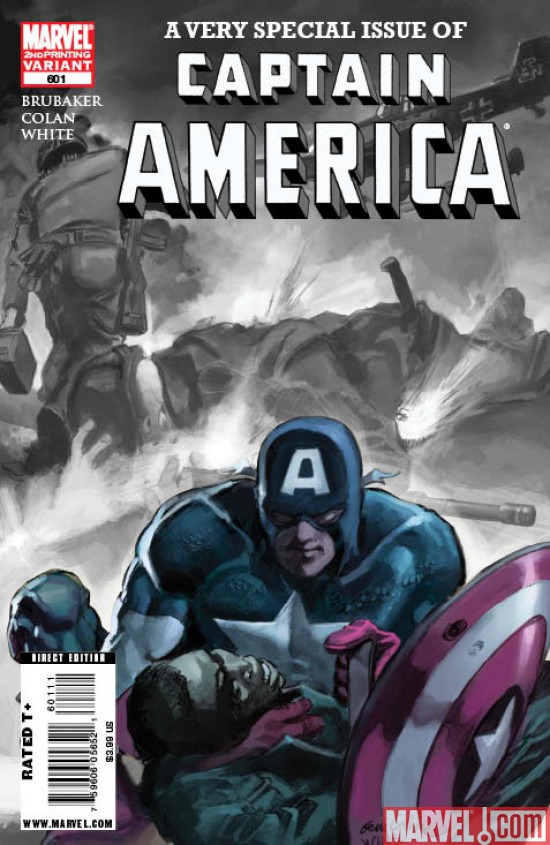
What I want to focus on, though, is his final Marvel work; a flashback WW2 Captain America story written by Ed Brubaker. When I saw this, it didn't look like the Gene Colan comics of which I was familiar, due to the unique mix of graphite and watercolor. But it was just as beautiful as any of his earlier works. It was a dark, atmospheric style suited to a dark, atmospheric story involving Captain America and Bucky being besieged by vampires. Not only was Colan an extremely talented artist but he was able to continue learning, growing, and reinventing himself, even as he approached his final days.

God bless you, Gene, and rest in peace. :(

Tuesday, May 3, 2011

The Heroic Age And Its Discontents


One year ago, Marvel's big thing was the Heroic Age, returning to a place of heroes being heroes and villains being villains after years of Civil Wars and Dark Reigns. Today, this is giving way for Fear Itself, which so far has the Marvel Universe public returning to their usual state of apocalyptic panic and incompetent xenophobia. The age of the bright, cheery shared universe status quo is ending, in favor of Mighty Marvel chaos and trepidation.

And I, for one, am relieved by this development.

The Heroic Age reminded me of Civil War in the sense that the only good titles published under that banner were rebelling AGAINST the basic premise, wether intentional or not. When Civil War was going on, the framework set up by Mark Millar was so shoddy that every other writer ended up contradicting the original intention, as seen in stories where Iron Man is portrayed as an outright villain (which, to be fair, is the only thing you can do with the creator of Clor) instead of one of two morally relative sides, or stories where the heroes' attempts to capture actual wrong-doers are hobbled by bureaucracy and petty in-fighting. The Heroic Age doesn't suffer from the same problem in the sense that it's not a poorly built world-- the premise is pretty straightforward. The problem with the Heroic Age is that the setup is anti-dramatic.

Marvel's marketing of the Heroic Age was the kind of "everything's going to be alright" optimism seen during Obama's inauguration, and lost after reality set in. Because the Marvel Universe is fictional, the authors could convincingly sweep the recent past under the rug and move forward, as seen by Cyclops dodging any and all penalties for his sins in X-Force. But by the same token, peace and prosperity is NOT ideal for a fictional universe. Conflict is what motivates good drama, but the Heroic Age moved the Marvel Universe into a peacetime state, with the conflicts largely regressed back to isolated supervillain fisticuffs.

If this meant a return to books that were relatively self-contained with shared universe compatibility becoming optional, I would be all for the Heroic Age. But Marvel launched it as the new status quo for all the books. The new Director of SHIELD, a job whose occupant is required to appear in every Marvel book, is Steve Rogers. Since his reputation makes Abraham Lincoln look like a child pornographer, he'll never be caught doing the kinds of morally dubious things Nick Fury and Tony Stark had to do (and which gave Norman Osborn a hard-on). His Avengers are basically every hero under the sun, pro-registration and anti-registration alike (though that issue's been removed). And his enmity with Tony Stark was resolved in Avengers Prime, which amounted to an Asgardian adventure making Tony beg for forgiveness (despite having a good case for pro-registration, random acts of evil like Clor aside), and Steve forgiving him.

The X-Men's DeciMation dilemma was resolved, but in a half-assed way that swept the issue of the limited mutant population under the rug and exonerated Cyclops for unforgivable sins-- note how Steve Rogers doesn't seem to know about X-Force, the Legacy Virus strain in Secret Invasion, or other war crimes. Their first Heroic Age story basically ignored the hard questions and had them fight vampires, offering little more than inconsequential fight scenes and Twilight-bandwagoning*. Daredevil's descent into fanaticism would have been justified by what he'd been through and what the heroes had conveniently forgotten, but it turned out that it was just a demon using him as a meat-puppet. And the Secret Avengers' first mission (not sure about their later ones) hardly fit the tone that black ops requires, instead having them fight villains on Mars. As Ellis put it (IIRC), it's secret because nobody cares.

The books that have been genuinely compelling in the Heroic Age have been the ones questioning this optimism. Avengers Academy is the best example, because it deals with the kids traumatized by Norman Osborn's experiments, and has them counseled by the Avengers with the most baggage of their own. Captain America has made a big deal about how Bucky can't escape his past, especially when standing next to a living Steve Rogers. And the new X-Force, with Wolverine leading a team of hardened anti-heroes instead of child soldiers, openly acknowledges that some situations will require resolutions that can't be seen in the Heroic Age. Of course, these are all stories going against the nature of the Heroic Age's naive optimism. They're saying, don't let the bright marketing fool you-- the life of a hero still casts shadows.

What's been the most interesting example of the Heroic Age's tension is Stark Resilient, the first post-lobotomy story by Matt Fraction and Salvador Larocca. Thanks to erasing his brain (and the Registration Database with it), Tony doesn't remember any of his Civil War-era sins. But he's pieced together what he's done, and has almost completely stepped out of the military-industrial complex that informs modern superhero stories. Not only has he retired from his role as all-seeing police chief a la Major Zero**, but he's given up trying to engage in conflict unless provoked. His goal is to win wars preemptively by eliminating reasons for conflict, be it with the repulsor batteries threatening to replace oil, or by creating new jobs in the rebuilding of Asgard. Unfortunately, his engagement with the bad guys has gone beyond self-defense and towards an obstructive pacifism, as he simply tries to avoid conflict rather than resolving it (as seen by his show of faux-groveling in the Doc Ock story). He'll have to once more learn that sometimes force is a necessary solution, and that some enemies can't be coaxed with the promise of an improved quality of life.

Still, it's preferable to slugging vampires.

*Thank God Jubilee lost her original mutant powers, otherwise she'd be a Sparkling Vampire.

** If you've played Metal Gear Solid 4, you know just how well this comparison fits.

Sunday, April 24, 2011

Black Panther The Unfulfilled, Brain-Damaged Badass: Guest Post By Omar Karindu


(The latter is taken with permission from Omar Karindu, who wrote this during one of our PM exchanges at Alvaro's. Since it is both a great essay and ties well into the blog's overall themes, I asked if I could share his work.)

I've probably said this before in one of our exchanges, but the mentality at the IM board can also be found at the Black Panther and (especially) Superman boards. There are also a few Batman fans around the world who behave the same way; some of them even seem to end up writing at DC. Certain kinds of characters seem to come from a place of privilege -- framed initially as physically or mentally "unbeatable," with high-status jobs or massive wealth -- and that attracts a type of fan who wants an unreflective power fantasy. This is especially unfortunate for Superman, given the wonderful way his early adventures positioned him as a genuine hero of the underprivileged with a very progressive agenda for the times.* The superhero at its inception is a utopian fantasy, even if we need to deconstruct that fantasy in order to get real meaning and social value from it.**

Our discussion at the IMMB also made me turn back to to Priest's Panther run, partly because the board's reaction to T'Challa briefly outwitting Stark smacked of not only what we've been discussing, but a host of unfortunate implications tied to American forms of white privilege. Looking at it now, I wonder if Priest's run deserves even higher estimation than I gave it at the time it was first published: prior to issue #50, when Executive Meddling derailed the title, it's actually a striking example of the deconstruction you mention -- T'Challa behaves like the omnicompetent, stoic, and secretive superhero type who is always ahead of the curve.

It doesn't bring him easy victories and a life of luxury. Instead, he pays dearly for it; when he decides to behave like an ubermensch, beyond the morality and concerns of his friends and allies, he doesn't get the easy forgiveness Bruce Wayne endlessly receives. Instead, he suffers serious, lasting physical consequences and, more importantly, loses his moral compass entirely and ends up butchering a teenaged girl in what amounts to a political misunderstanding. One of the running themes is that T'Challa fears this --at one point, Storm tells him his ill-considered reliance on stoicism threatens to turn him into another Magneto -- and by the end of he essentially has turned into a well-intentioned extremist/knight templar like Magneto because of his desire to control everyone else for their own good, and his refusal to show what he considers human weakness. The run as a whole is a sort of sideways commentary on the Batman-as-living-god take on "characters of privilege.****

Running that arc with the Panther does have some of its own Unfortunate Implications, of course. It may have worked better when Charlie Huston did it with Moon Knight. But Hudlin tended to make the character into little more than a race-lifted imitation of the fannish vision for white privilege characters I mentioned above, and I really don't think that's a solution any more than, say, the resort to forms of anticolonial violence that mirror colonial uses of violence has ever been a solution to colonialism.

Best,*****
Kris

* I may never forgive Whitney Ellsworth for his refusal to let Lois figure out the secret and react appropriately, maturely, and even heroically as Joe Siegel intended. 60 years later, that somewhat more egalitarian premise for their relationship been proven to work quite well.

** Boring, condescending lecture I give freshmen on utopia, please skip : not a road map to utopia, since super-powers don't really exist and simple force doesn't really work, but rather a fantasy image with which one can codify and express the values that we, in our world where eutopia is outopia, should aspire to more pragmatically. The vision of utopia is unattainable, but it also provides license to benign and progressive aspirations, license I think is necessary. Western culture's loss of the utopia as a genre -- almost none have been written since the early modern period -- is not necessarily a good thing. Utopian visions do need to be interrogated fiercely, however; part of their value is also that they invite such critiques, that utopian narratives require dystopian responses, which in turn require reconstructive utopianisms. in other words, dialectic. (Freshman lecture is now over.)

*** I can't remember if you'd already cited it, but if not you should add Priest's Panther to your list of characters who defy neurotypical norms; the character ends up with a brain aneurysm late in the run as part of the title's deconstruction of superhero tropes. In this case, it's a realistic consequence of the standard "underdog" superhero fight where Our Hero rallies from a savage beating and wins in the end.

***** David Foster Wallace did this so much better than anyone else. I miss him.

Thursday, January 27, 2011

Why Iron Man Represents Civilization's Worst

(Reposted from the Iron Man Message Board, in response to the usual bitching about Matt Fraction's run)

Science isn't bad, but weapons are. And the problems with Tony's character are thus;

A.) He started out making weapons. He wasn't a civilian scientist who helped the war effort against a common enemy, he was an arms manufacturer from the start.

B.) He made billions off of the weapons he designed, and was very conspicuous about the way he used that money. Wearing suits that cost more money than an Afghani family makes in a year, paid for off of land mines that maim and kill those families, isn't in good taste.

C.) Tony's wars have never been the wars for which America is proud. In the past, in-comics jingoism aside, he was associated with Vietnam. In recent years, he's been associated with Afghanistan and the War on Terror. Regardless of your personal position on either of those wars, neither has been a particularly good mark on America's reputation.

D.) Up until that one fateful trip, Tony was never a soldier. He didn't see combat himself, and left his devices in the hands of the actual fighting men and women risking their lives. Even as Iron Man, he goes into combat insulated in a metal prosthesis that does all the fighting for him. At least in the past he entered combat with a heart injury and was truly putting himself at risk each time, but once his ticker was fixed, he was hardly facing opponents stronger than himself most of the time.

E.) Tony didn't even make his money himself. He made Stark Industries more successful than during his father's tenure, but he already had millions upon millions with which to start. The hardships he knew were from his father's disdain, but to most people, that just comes across as "poor little rich boy" syndrome.

F.) Even once he became Iron Man and stopped making weapons for others, he still made himself a symbol of imperialism. A billionaire playboy, putting on an ostentatious gold-and-red war suit, entering combat with a weapon that may avoid accidentally launching missiles at wedding parties, but has no problem shooting brown people with guns. That line is paraphrased from a particularly insightful (if harsh) assessment of the movies...

http://www.somethingawful.com/d/current-movie-reviews/iron-man-drivel.php?page=3

Basically, the problem isn't that Tony's a nerd and not a jock, or even that he's about science and not procreation. Even if he wasn't deliberately evil before he became Iron Man, even afterwards he represents a global system of profound inequality and constant struggle. The ending to issue 500 was the worst-case scenario of Tony's fears-- that he'd never do enough good to make up for his sins. The ending, however, had his daughter live in a society starting from zero, so at least Tony's sacrifice earned humanity a second chance, with a new generation that can at least make their own mistakes instead of having to struggle with their parents and grandparents' sins.

With Iron Man, you can either try to ignore these concerns and play the character as a straight superhero genre story, or you can deal with them. If you choose the latter, as Matt Fraction has done, you're dealing with an extremely tragic narrative.

Thursday, December 30, 2010

The Allie Awards: Best Comics Of 2010


I wouldn't feel right doing a list of negatives without a list of positives, so even though my interest in following monthly comics has diminished, I still read plenty of good stuff this year. Named for the world's greatest cat, here are the awards for the best of the best, the comics that had me genuinely excited.

BEST NEW SUPERHERO SERIES: Avengers Academy by Christos Gage and Mike McKone. Yeah, it sounded like just another teen team book...until the end of the first issue, when it was revealed that all the teens are at-risk superhumans with troubled pasts, and the adults are only training them to keep them from becoming villains. Then it was clear that Avengers Academy would be an excellent new book with a complex cast of characters. The fact that they're younger doesn't mean they're treated condescendingly by the creative team-- in fact, these kids are just as competent as the adults (though when the adults are all failed Avengers, it might not be saying too much).

BEST ONGOING SUPERHERO SERIES: Invincible Iron Man by Matt Fraction and Salvador Larroca. Last year's World's Most Wanted story was, and still is, my all-time favorite Iron Man saga. This year didn't quite measure up to that, as a lot of it was set-up needed to rebuild everything Tony had lost. But even when the story was going too slow, I didn't find it less interesting. Last year had Tony going on what appeared to be his final mission, sacrificing his entire legacy down to the last brain cell so it would stay out of Norman's hands. This year had Tony wake up with an incomplete memory, learning about the horrible mistakes he'd made without having any attachment to having made them, and trying to redefine who he is. Making a new company out of a small group of trusted partners, ditching the military entirely to just focus on his clean energy, and using Pepper's Rescue identity as a symbol for the ideal future of Iron Man were moves that indicated that Tony was A.) determined to make the world a better place, and B.) desperate to move forward to the point of not thinking the implications of his moves through.

In the process, we got a lot of great stuff, including the Iron Man Requiem back-up strip (that, in a move of metatextual tragicomedy, has the brain-damaged Tony hallucinate that his origin was AGAIN in Vietnam), a rather creepy look into Tony's sub-conscious, a brilliant reinventing of the Mandarin as egotistical despot a la Kim Jong Il or Christian Weston Chandler, an excellent-looking new armor, and the villains forming into a family act. Like the Aristocrats, except...well, given how it's the granddaughter of Justin Hammer/daughter of the Mandarin and the son of Obadiah Stane, it's pretty much the Aristocrats.

MOST SATISFYING SUPERHERO MOMENT: Siege #3 by Brian Michael Bendis and Olivier Coipel. After letting the world fall apart in the midst of their petty in-fighting, the Avengers get their shit together and take back their country. Captain America leads the charge against Norman Osborn, Iron Man shuts down the Iron Patriot tech with a condescending push of a button, and Spider-Man punches the bastard in the face. It wasn't brilliant, but damn did it feel good to see.

BEST SERIES CONCLUSION: Scott Pilgrim Vol. 6 by Bryan Lee O'Malley. This series has become popular not just for its video game references mixed with twentysomething angst, but the fact that it's actually quite well-done. After having broken up with Ramona in the previous volume, Scott regresses to his irresponsible man-child ways, only to find that it's no longer even remotely endearing. Embarassed, he has to pull himself together and fight Ramona's final evil Ex, Gideon Graves. But it's not Scott who gets the spotlight, but Ramona, who finally realizes that she can move past her baggage, and joins in the magically realistic fight. The ending doesn't go directly for happily ever after, but for the idea that Scott and Ramona now have the chance to movee on, and it doesn't treat Ramona as a prize to be won or lost, but a capable agent in the story.

Oh, and Gideon is finished off with a move from Chrono Trigger. Can't forget that.

BEST WEBCOMIC: The City of Reality by Ian Samson This series about a cartoony, hyper-idealistic city representing an isolationist paradise in a really horrible cosmos is one of my favorite webcomics ever. Unfortunately it went on hiatus this year, but it had some utterly great stories, most particularly the utter collapse of Reality's attempt to open its borders. This series made optimism cool, and hopefully Ian Samson will get back to it sooner rather than later. But don't take my word for it.... you can see the whole site Here.

BEST TEAR JERKER: The Boys #47, by Garth Ennis and Darick Robertson. The gratuitous violence and debauchery in this series obscures the brilliant storytelling and character depth. For years we've seen Wee Hughie, the only member of the Boys who is actually a nice person, dating Annie January, who (unbeknownst to him) is a member of the decadent military-industrial super-team known as the Seven. When he finds out not only this fact, but sees footage of her giving a group blow-job to get on the team. Given how a member of the Seven carelessly got his last girlfriend killed, Hughie is furious with Annie and throws ever horrible insult he can make at her. Annie, who has been feeling horrible and traumatized about what she had done, doesn't defend herself and begs for forgiveness. Hughie knows she's right, but leaves her anyway. It was an extremely tragic moment for the characters whose relationship was the heart of the series, and it was done perfectly.

Sunday, September 12, 2010

Invincible Iron Man 30; Nice Job Breaking The Space-Time Continuum, Tony


After a bit of a lag since Stark Disassembled, the Matt Fraction/Salvador Larroca Iron Man book has started to pick up the pace. The latest issue had more plot, as Tony Stark and Sasha Hammer ( Ezekiel Stane's cybernetic girlfriend and part of the mother-daughter team behind the current Hammer Industries ) finally meet, and inevitably come to blows. Before that, they have a surprisingly civil conversation about Tony's new armor, a liquid metal thing powered by his repulsor heart, stored in the hollows of his skeleton, and shaped by his brain. Tony reveals that he got the idea from Iron Lad of the Young Avengers, who came from the future with a similar design. Which led Tony to invent the neuro-kinetic armor technology, which would later be adopted by Iron Lad, who came back in time and inspired Tony to create the neuro-kinetic armor technology, which would later be adopted by Iron Lad...

I appreciate the nod to the Young Avengers ( and Fraction has mentioned in his interviews that the new armor was inspired by both the Iron Lad suit and the movie suit ), but time-travel stories are ridiculous enough as is, and this story had absolutely no need of a continuum-thrashing paradox. Some futurist you are, Tony...

Wednesday, September 1, 2010

Iron Man Legacy 6: A Great Hidden Chapter of Tony's Lost Weekend


Today saw the release of Iron Man Legacy #6, by Fred Van Lente ( writer ) and Steve Kurth ( artist ). Though the series takes place throughout Iron Man history, the inaugural arc was set in a fairly generic status quo period ( what seemed to be post-Secretary of Defense, pre-Extremis ), so I wasn't compelled to read it beyond the first issue. But the second arc, " Industrial Revolution ", takes place in a more obscure part of Iron Man history-- Tony Stark's first trip to the West Coast.

Iron Man veterans will remember that after he lost everything in an extended alcoholic binge, Tony sought to rebuild his life on the other side of the country. With the substitute Iron Man Jim Rhodes and the brainy Erwin twins, Tony went to Los Angeles and started a technology firm. At the time, he had just decided to stop drinking and didn't want the pressure of being in the armor, instead helping Rhodey learn and maintain the suit ( much to Rhodey's chagrin ). Those were good stories, with exceptional writing by Denny O'Neil and utterly stunning artwork by Luke McDonnel. Unfortunately, O'Neil was not an Iron Man fan, and as great as his stories were, it was rather clear that he didn't care for Tony Stark ( probably because Tony was a decadent ex-arms dealer, while O'Neil was the guy who had Green Lantern and Green Arrow take a cross-country trip to find the real America ).

Then again, that was over two decades ago. Iron Man has developed as a character by exponential leaps and bounds since those days, and Van Lente takes the more recent history into account. For one, we finally get an explanation why Tony's friends in the superhero community didn't offer him help when he was sleeping on the streets; he would have refused charity even after he sobered up, given his pride. For another, Tony is still carrying an Iron Man armor around, albeit an old one he can't afford to keep in top shape, and that he only snuck past Obadiah Stane because he disguised it as a bag of his father's golf clubs. Finally, Tony's time in LA is noticed by the Pride, the West Coast superhuman crime syndicate that served as the parents/villains in the Runaways comic.

That is quite a bit of retroactive surgery, especially having Tony lug around an armor of his own ( I suppose to keep in line with more recent portrayals of the character, where Tony thinks of the suit not as Iron Man the superheroic dual identity, but THE Iron Man, a tool he uses towards his larger goals ). But it's a really promising start to the arc. While the old stories had Tony take more of a zen humility towards his recovery, Van Lente's version reminds us that this is still very much the cocky bastard we know and love. Tony makes a lot of self-effacing comments as he wanders Wilshire Boulevard, like how Oprah owes him a big confessional scene on her show, or how he now understands Spider-Man's difficulty affording web fluid ( and will reverse engineer a more efficient brand once he regains his wealth ). These definitely have a bitter edge, keeping with Tony's larger character; this is the point where Tony has lost everything due to his own damn fault, basically having given all his resources over to a madman while he was enjoying the luxury of a drunken stupor. ( A nice flashback scene is shown where Obadiah Stane is gloating over the recently deposed Tony, about how he won't last a day without his wealth; another nice continuity nod, since Obadiah was poor as a child, and became a cold-blooded mastermind in order to get an advantage over the world that gave him such a lousy start ).

Tony's best stories are lessons in humility for him, be it the original Stane Saga, Matt Fraction's run, or his neural degeneration under Byrne/Kaminski. I like that Van Lente is revisiting this chapter of Tony's history, and having Tony confront just how far he's fallen when he's hanging out on the street with a paranoid schizophrenic, and realizes that not so long ago, he, too, was a deranged street person. Very few challenging stories have been told with franchise superheroes that don't get retconned away somehow, but Tony's descent into alcoholism is one of them. Even though he regained all his wealth, he still endured the trauma and shame of that class plummet. It's good that we get a reminder of just how far he fell.

Also, I want to give equal commendation to artist Steve Kurth, who did the previous Legacy arc as well as the Ultimate Armor Wars series. Not only is that timeliness impressive in an era where many artists need a break after a single arc, but the art is beautiful. The rendering of the Proto-Classic armor ( the one with the horned mask ) is especially impressive, as well as the awkwardness of Tony having to get around on his armor's roller skates once his boots run out of jet fuel.

Monday, May 24, 2010

Wonder Man, The Crybaby Fanboy Avenger


Last week saw the release of Avengers #1, the new book by Brian Michael Bendis and John Romita Jr. that returns Marvel's venerable superhero team to a position of public adoration. This is after five years of stories also written largely by Bendis that had the Avengers come upon increasingly hard times, starting with the Scarlet Witch's descent into madness and culminating in Norman Osborn obtaining the official rights to the team. Many fans have wondered if Bendis will be able to write more optimistic Avengers stories, and some have completely dismissed the book before it even launched, including one within the text...

" From my point of view...the super hero civil war, the mutant decimation, the skrull invasion, norman osborn, they have-- they all have one thing in common...they are all the Avengers' fault. "

This whiny fan would be Simon Williams, a.k.a. veteran Avenger Wonder Man. This isn't the first time that Simon has complained about the state of things, either; during the Dark Reign stories in New Avengers, we saw him ranting on national television about how being an Avenger is pointless, Norman is what the public deserves, and God is dead ( seriously ). This was, of course, him whining in lieu of actually joining the other Avengers to fight Norman. ( He would join up with some super-villains in a Lethal Legion mini-series to fight Norman, and eventually get arrested, but I haven't read those issues and can't comment ).

But Simon's refusal to be an Avenger in modern times isn't a brave stand against the heroes' failings-- it's the temper tantrum of a spoiled brat who refuses to have things any way but his. It's the reaction of a character who is seeing the world change around him and, unable to accept that life is hard and that good people can make mistakes, chooses simply to say " Screw you guys, I'm going home. ". That the cover for the next issue has Simon attacking the new team suggests that when he does take action, it will be destructive action, trying to force the Avengers to stop taking scary risks.

Basically, Simon is acting like the stereotypical Avengers fan who rails constantly against Bendis for changing the franchise, but doesn't have any constructive criticisms as to how Bendis could do a better job, ( beyond rambling on about the " Good Ol' Days " ), and refuses to accept any potential merits to what he's doing.

It seems like Bendis would be the type of writer to use this sort of metatextual symbolism on purpose, since his Avengers stories have been almost entirely about the characters trying to determine what their identities are. Wonder Man is especially symbolic of a different era in the Avengers, because he's a character whose backstory is almost exclusively confined to the Avengers books, and who represents the worst of the book being about its own arcane, insular continuity soap opera. He was introduced as a throwaway villain, a character the Masters of Evil used to infiltrate the Avengers, but who developed a conscience and sacrificed himself in the name of redemption. Later, after a long absence where he was believed dead, it was revealed that his iconic energy body couldn't die, so he returned to the team. Since then, he's been involved in various story threads concerning Avengers " office romance ", and aside from an attempt at a solo series in the 1990's, hasn't done much else.

To whit; Simon Williams' brother became a deranged super-villain known as the Grim Reaper. He has another " brother " in the Vision, an android whose brain patterns are derived from his own. Simon had a thing for Vision's wife the Scarlet Witch, to the point of refusing to offer his brain patterns to rebuild a destroyed Vision. When he died a second time, the Witch's love brought him back, and he was gleefully sleeping with his brother's ex before breaking up with her because of her residual feelings for the Vision. Oh, and he's dicked around with a career as a B-List action movie star with the help from Hercules, developed an extremely homoerotic buddy in the Beast, and had a rivalry with Iron Man ( who unknowingly ran his father's company out of business, leading Simon to embezzle funding ).

Amidst all of this, what Simon is devoid of is a compelling character hook on his own. Like many characters on the historical Avengers line-up, he's a C-Lister whose appeal is only in the context of an ensemble cast-- take away his connections to the team, and he's not much more than a badly dressed, exponentially whinier ersatz Superman. Which makes him fine when the Avengers is a book about itself, with the team more preoccupied by who's sleeping with who than with doing their jobs and fighting evil. But Bendis has actually given the team opposition much more significant and lasting than villains against the status quo-- old soap opera plot threads have turned into catastrophic nervous breakdowns taking many lives, increasingly complicated cultural situations have created schisms between former friends, and villains have succeeded by attacking through the system. The heroes like Iron Man who Simon blames for causing the problems were only trying to save lives under circumstances where there were no clear solutions, and even then they paid dearly for it. Simon, on the other hand, has been on the sidelines at best, and simply refusing to do anything at worst.

So, without the classic Avengers makeup, Simon doesn't have much to hang his hat on. Now that it's gone, and can't return to the way it was, he can't ( or won't ) think of anything to do except piss and moan about how things are so scary and complicated. Sound familiar?

While there are many valid criticisms that can be levied at Bendis for his Avengers stories ( and I've made several of them ), I can sympathize with his position. His job, as the writer of the book, is to keep it consistently interesting so that people keep buying it. He's done so by trying a lot of different things, and not all of them have worked, with some even being catastrophic mistakes ( see: the Sentry ). But like the Avengers, he's been in a position where he has to take risks-- the franchise had been reduced to B-List at best shortly before he took over, with little to differentiate it from any other super-team book, so he was brought in to overhaul it. And he, like the Avengers at the start of Heroic Age, has ultimately succeeded into transforming the Avengers into something that's once again important. Many of his online critics, like Wonder Man, don't like the direction of the team but aren't going to risk finding something else to attach their attention to, so they'll just level less-than-constructive criticism at it.

You can practically hear him screaming " Worst. Avengers. Ever! " as a battle cry.