Ruby Nation

Ruby Nation
Ruby Nation: The Webcomic
Showing posts with label fandom issues. Show all posts

Thursday, January 26, 2012

Why Do Superhero Fans Fear Drama?


I've been simmering on this topic for a long time, but a recent video by Linkara (15 Things Wrong With Identity Crisis) took this frustration to a boiling point. The video itself wasn't so bad, as while I disagreed with Linkara on several points, I respect the thought and effort he puts into his critiques. What really bugged me was (with some exceptions) the circle jerk of fan reactions that followed, which tended to coalesce on the same theme; " Dark is bad, make superhero comics fun again", followed by the usual whining and crying about the state of modern comics.

Far be it for me to defend Identity Crisis, as I didn't like the book myself for several reasons covered in Linkara's review (most notably the rape). But the reasons people don't like it seem to revolve around the fact that certain characters were killed off and removed from the status quo, and certain characters were changed. The moaning is often associated with the loss of more light-hearted incarnations of the characters, such as Tim Drake when his dad was alive, or Ralph and Sue Dibny as a couple. This then goes into whining and crying about a lot of post-Identity Crisis comics like Countdown and Cry for Justice, using Brad Meltzer as the scapegoat for these comics (despite the fact that he didn't write them). Occasionally someone will try to say that dark isn't necessarily bad, but they'll follow it with a "but it doesn't make a story good", then point to examples of where a story is good without being dark. And you'll often see citations of the All Ages titles as examples of how to do these characters right, the titles that are meant for very young children and tend not to have much development or moral complexity.

If dark just means gratuitous, then I'm more sympathetic to this perspective. However, the critiques aren't just with the gore (which I agree is off-putting in most modern DC comics), but with the notion that these bad things happen. The cry is for "fun", and by "fun", they mean a specific status quo, a specific story structure (usually single issues with a happy resolution at the end), and a specific interpretation of characters. "Fun" is what they know and what they're comfortable with; the complaints tend not to come from people trying to broaden their horizons and challenge their expectations.

In one sense, I'm trying to show that it cuts both ways, this battle of light vs. dark. If stories can be told without mature content, they can also be told with mature content. If some superhero creators are obsessed with making the characters grow up with them, others perseverate over keeping them at the idealized status quo. But ultimately, the dark stories-- or, more precisely, the stories with substantial drama and risk for the characters-- are the ones that really succeed. The greatest stories for each character, the ones that are part of their canon, are the ones that really pushed them-- Frank Miller's run for Daredevil, Chris Claremont's run on the X-Men, etc. Without struggle the hero cannot show his or her heroism; if it's just a fight of the week, the ending is never in doubt, and there's no reason to care, other than as a brief escape from reality. Of course, these stories were printed before the internet, so their reputations escaped the constant bitching of fans with computers.

Unfortunately, a lot of superhero fandom seems to cling to the escape hatch, to hide from reality within their Silver Agey security bubble. Even creators will end up pandering to them, including creators like Darwyn Cooke and Greg Rucka who have done excellent dark stuff in the genre. But they still get on the "fun" bandwagon, as if disavowing their work in order to capture for themselves this pleasant navel-gazing. The meaning possible for the superhero is thus pissed away, leaving the result as a pleasant but unattainable ideal rather than a figure whose struggles inspire people to attain the ideals in their own lives.

In the end, while I still don't like Identity Crisis, I find it more favorable based on the fact that it prodded at people who need prodding out of their bubble. If people suffer so much from drama and tragedy in superhero comics, either their lives are very good and their only real problems are with their fiction, or they put a disproportionate need upon fiction as a coping mechanism. Fun is part of life; it is not all of life.

Sunday, April 24, 2011

Black Panther The Unfulfilled, Brain-Damaged Badass: Guest Post By Omar Karindu


(The latter is taken with permission from Omar Karindu, who wrote this during one of our PM exchanges at Alvaro's. Since it is both a great essay and ties well into the blog's overall themes, I asked if I could share his work.)

I've probably said this before in one of our exchanges, but the mentality at the IM board can also be found at the Black Panther and (especially) Superman boards. There are also a few Batman fans around the world who behave the same way; some of them even seem to end up writing at DC. Certain kinds of characters seem to come from a place of privilege -- framed initially as physically or mentally "unbeatable," with high-status jobs or massive wealth -- and that attracts a type of fan who wants an unreflective power fantasy. This is especially unfortunate for Superman, given the wonderful way his early adventures positioned him as a genuine hero of the underprivileged with a very progressive agenda for the times.* The superhero at its inception is a utopian fantasy, even if we need to deconstruct that fantasy in order to get real meaning and social value from it.**

Our discussion at the IMMB also made me turn back to to Priest's Panther run, partly because the board's reaction to T'Challa briefly outwitting Stark smacked of not only what we've been discussing, but a host of unfortunate implications tied to American forms of white privilege. Looking at it now, I wonder if Priest's run deserves even higher estimation than I gave it at the time it was first published: prior to issue #50, when Executive Meddling derailed the title, it's actually a striking example of the deconstruction you mention -- T'Challa behaves like the omnicompetent, stoic, and secretive superhero type who is always ahead of the curve.

It doesn't bring him easy victories and a life of luxury. Instead, he pays dearly for it; when he decides to behave like an ubermensch, beyond the morality and concerns of his friends and allies, he doesn't get the easy forgiveness Bruce Wayne endlessly receives. Instead, he suffers serious, lasting physical consequences and, more importantly, loses his moral compass entirely and ends up butchering a teenaged girl in what amounts to a political misunderstanding. One of the running themes is that T'Challa fears this --at one point, Storm tells him his ill-considered reliance on stoicism threatens to turn him into another Magneto -- and by the end of he essentially has turned into a well-intentioned extremist/knight templar like Magneto because of his desire to control everyone else for their own good, and his refusal to show what he considers human weakness. The run as a whole is a sort of sideways commentary on the Batman-as-living-god take on "characters of privilege.****

Running that arc with the Panther does have some of its own Unfortunate Implications, of course. It may have worked better when Charlie Huston did it with Moon Knight. But Hudlin tended to make the character into little more than a race-lifted imitation of the fannish vision for white privilege characters I mentioned above, and I really don't think that's a solution any more than, say, the resort to forms of anticolonial violence that mirror colonial uses of violence has ever been a solution to colonialism.

Best,*****
Kris

* I may never forgive Whitney Ellsworth for his refusal to let Lois figure out the secret and react appropriately, maturely, and even heroically as Joe Siegel intended. 60 years later, that somewhat more egalitarian premise for their relationship been proven to work quite well.

** Boring, condescending lecture I give freshmen on utopia, please skip : not a road map to utopia, since super-powers don't really exist and simple force doesn't really work, but rather a fantasy image with which one can codify and express the values that we, in our world where eutopia is outopia, should aspire to more pragmatically. The vision of utopia is unattainable, but it also provides license to benign and progressive aspirations, license I think is necessary. Western culture's loss of the utopia as a genre -- almost none have been written since the early modern period -- is not necessarily a good thing. Utopian visions do need to be interrogated fiercely, however; part of their value is also that they invite such critiques, that utopian narratives require dystopian responses, which in turn require reconstructive utopianisms. in other words, dialectic. (Freshman lecture is now over.)

*** I can't remember if you'd already cited it, but if not you should add Priest's Panther to your list of characters who defy neurotypical norms; the character ends up with a brain aneurysm late in the run as part of the title's deconstruction of superhero tropes. In this case, it's a realistic consequence of the standard "underdog" superhero fight where Our Hero rallies from a savage beating and wins in the end.

***** David Foster Wallace did this so much better than anyone else. I miss him.

Thursday, October 21, 2010

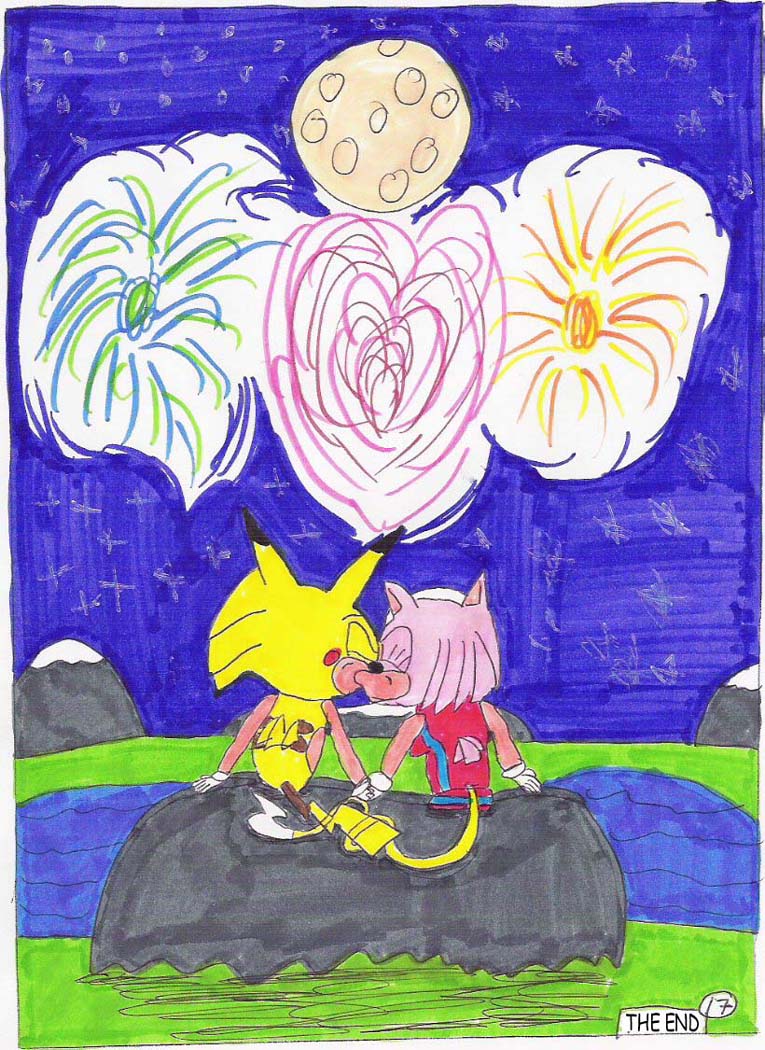
Sonichu Episodes 4-6 Review: The Black Sonichu Saga And The Vestigial Remnants of Sonic


Read Here

I'm reviewing " the Black Sonichu Saga " as one lump installment because, frankly, there's not much to say here. This is still the point where Chris-Chan's Caligula-like reign over CWCVille doesn't totally dominate Sonichu, and as such, the stories can be read as just another awful fanfic crossover, instead of a surreal documentation of Christian Weston Chandler's ongoing nervous breakdown. Everything here is plagiarized; Black Sonichu is an inferior copy of Shadow the Hedgehog, himself a transparently grim-and-gritty copy of Sonic the Hedgehog. His construction was a joint effort by the Pokemon villain Giovanni ( leader of Team Rocket ), and Sonic's arch-nemesis Dr. Robotnik. His black shade is explained as accidental, as his creator Bill the Scientist spilled Cherry Cola over the Sonichu DNA.*

So yeah, there's no gripping narrative here, intentional or not. The swindled Sonic and Pokemon villains make an evil Sonichu clone, said evil Sonichu clone kidnaps Rosechu, Sonichu and Sonic the Hedgehog ( also swindled from his copyrighted environment ) team up to fight Black Sonichu and Metal Sonichu ( a derivative of Metal Sonic, another evil Sonic doppelganger ). The day is saved, with Black Sonichu defeated, Metal Sonichu retreating to the moon, and Rosechu getting to have girl talk with Amy Rose.

Christian Weston Chandler has repeatedly tried to counter accusations of plagiarism by saying that Sonichu is a parody. But this isn't making fun of Sonic or Pokemon, or even using them to try and make some sort of point. This is just a poorly written, poorly drawn regurgitation of those series' formulas. The worst fact is that even though both Sonic and Pokemon have comic adaptations, Chandler chose to plagiarize from the animated medias, the games and the cartoons. He has no grasp of sequential storytelling; he uses massive text walls to dump information upon his readers, and those salvos of Comic Sans MS usually don't even have full figures attached-- he cheats and has the speaker be a severed head floating in white space. He takes on the Pokemon style of having characters scream the names of their moves while they attack, but instead of utilizing the page space for dramatic angles, Chandler crams the action into little panels the size and ( poorly approximated ) shape of a Game Boy screen. Presumably he doesn't use a ruler, or even use the line tool in Photoshop to create borders.

The only thematic value the " Black Sonichu Saga " has is that Black Sonichu becomes a major character later on, and there's some interest in having the original Sonic the Hedgehog meet his his hideous half-Pokemon counterpart. To Chandler's credit, Sonichu holds up okay as a character when compared to his inspiration. Of course, given how Sonic's games have been infected by superfluous and uninspired supporting characters over the past decade or so, that's not a compliment to Chandler so much as an insult to Sega. Were he divorced from Chandler's problems, Sonichu would fit right in with Amy Rose, Shadow, Big the Cat, Silver the Hedgehog, Rouge the Bat, Cream the Rabbit, and any number of other annoying spin-offs.

Sunday, October 17, 2010

Sonichu Episode 3 Critical Review: Eternal President of the Republic of CWCVille


Witness the Work for your Self

Sonichu Episode 3 is an interesting transitional episode, marking the point where Sonichu stops being a children's adventure story and starts becoming the final stand for Christian Weston Chandler's besieged youth. On the one hand, it has a very clear good vs. evil plot, with the villainous Naitsirch ( Christian spelled backwards ) trying to kidnap Pokemon-- a standard plot for the show that contains half of Sonichu's conceptual DNA. On the other hand, it is the full introduction of the stage upon which Sonichu is set-- CWCVille, the city where Chris-Chan is mayor, and holds his office in the shopping mall.

Fan works regarding Sonichu often treat CWCVille as a totalitarian state, dominated by the promotion of its dictator's ego. Later issues of Sonichu will justify this, but for now CWCVille is a haven where Chris-Chan is treated with respect-- he's a benevolent authority figure who has the townsfolk's respect, even if the townsfolk are mostly mutant hedgehogs. But this is also the debut for Chris-Chan's major character arc-- his " love quest ". Chris-Chan is absolutely obsessed with finding a girlfriend, and treats the search for a relationship as a Herculean ordeal. Ironically, at this point he can't find a mate, even within a fictional world of his own creation. But his " son " Sonichu is there to give Chris-Chan words of encouragement. Even though Sonichu's thought balloons show that he doesn't really believe Chris-Chan will be successful, he still admires his creator's courage for continually trying.

At this point, Chris-Chan knows he is not the hero who gets the girl, but the sad sack nice guy who can't get past the " friend zone ". He uses the comic as a means of coping with this problem, by having the hero to whom he aspires validating him. Even though Sonichu calls Chris-Chan " father ", he's more of a good big brother figure here; Chris-Chan watches how Sonichu and Rosechu interact, and he sees the kind of relationship he thinks he should have. It's similar to a sick child seeing an actor dressed as their favorite cartoon character as part of a Make-a-Wish event, and having the actor tell the kid how important they are. Except that Chris-Chan is A.) a grown man and B.) has no serious illnesses.

Sonichu's relationship with Rosechu is another important development here, showcasing what Chandler believes a man-woman relationship should be. Rosechu exhibits every female gender stereotype in existence-- she wears pink, she shops to the point of running up a massive credit card debt, she has Sonichu lug her purchases around like a pack mule, and she's completely useless in an actual fight. This is a common phenomenon in boys' adventure stories, where we are told that the female is just as tough as the guys, but she never actually proves it ( at risk of upstaging the men ). Believe me when I say that the hypocrisy here is NOT an isolated incident for Sonichu; most of the perverse appeal of Sonichu comes from Chandler's extremely twisted conception of " women's rights ". The hypocrisy of trying to telling us that the main heroine is effective while showing her as helpless without her man is just the beginning.

But the story here is still a story that, hypothetically, could be taken as a straight adventure comic. Granted, it would be an adventure comic well below professional standards, due to the unique storytelling methods chandler employs. Chandler makes countless amateur mistakes; he uses Comic Sans MS as a font, his pages are infected with white space, and his panel borders are crudely drawn by hand. This isn't even beginning to describe the many errors present with his anatomy, perspective, reference material, and basic consistency. But since I'm analyzing Sonichu as a postmodern artistic statement for the sake of this academic exercise, I think it serves the story. The childish, Crayola-colored visuals accentuate the fact that CWCVille is an adult-free Neverland, and they make the instances where more mature issues slip in even more jarring.

Sonichu Episode 2 Critical Review: The OTP Syndrome, Electric Hedgehog Style


Sonichu Episode 2 continues to set up the world of CWCVille, and while it's still relatively benign in its content, it predicts the relationship dynamics that would help make Sonichu an ironic favorite. What's unfortunate is that the " chemistry " between Sonichu and Rosechu is NOT a problem exclusive to Christian Weston Chandler's personal problems.

Like most Sonichu stories, the plot of episode 2 is about as deep as a wet piece of paper. While looking for food for his new, larger body, Sonichu realizes that he's lonely and needs a mate. At that exact moment, Rosechu walks by and Sonichu is immediately smitten. Later, Rosechu is talking with her Pokemon trainer Kel about how she needs a mate; they are conveniently interrupted by Sonichu arriving at the door. Not in the least bit perturbed by Sonichu having followed her home, Rosechu invites Sonichu in for dinner. A few days later, Sonichu and Rosechu look at the night sky together, exchange some truly awkward confessions of love, and kiss.

There is no conflict in Sonichu and Rosechu's relationship, even when they first meet. Their personalities complement each other and their goals are identical. The entire basis for the coupling is because Chandler considers them the One True Pairing. After all, Chandler is as much fan as creator, so if he wants to live vicariously through Sonichu, he'll make sure that the character has what Chandler considers an ideal relationship-- one based on " true love " and not any shared interests or experience.

Almost everything in Sonichu is lifted from other sources, and Rosechu is no different-- she is based on Amy Rose, the pink female hedgehog from the Sonic series. However, while Amy is smitten with Sonic, Sonic has never returned Amy's affections-- in canon, at least. Their dynamic is very much like a gender-flipped Pepe Le Pew cartoon, and Sonic's only kindness towards Amy is being willing to save her life when her stalkerish activities put her in danger. In other words, the canon Sonic/Amy dynamic is a relationship meant for comedy. But Chandler is just one of several fans who see an actual relationship between the two, with Sonic eventually returning the affections. In Chandler's " adaptation ", the variants of Sonic and Amy do not have any dramatic tension interfering with their romance. That they have romance is enough.

Any fandom will have readers who view the stories in context of the relationships, and wether or not they fit the reader's individual tastes a la a bingo game. They need not even have any basis in canon, and often don't; Sonic has the aforementioned Sonic/Amy, Avatar: The Last Airbender has Kitara/Zuko*, and Metal Gear Solid has Snake/Otacon**. The most egregious example may be Harry Potter, where Harry/Hermione 'shippers even threatened to boycott the books if Harry ended up with Ginny. It's worth noting that regardless of the pairings, NONE OF THESE SERIES ARE BASED EXCLUSIVELY ON ROMANCE. The interest in shipping comes from the personal baggage the fans collectively bring to the forums.

This is an odd phenomenon, and unfortunately, it's one that threatens to derail drama and creativity-- instead of reading stories because they're curious where the characters will end up, fans have strong preconceived notions of what they want to see, and won't accept anything else. It doesn't matter for Chandler that nobody cares about Sonichu and Rosechu's true love but him, because this world is his escapist paradise. Unfortunately, the phenomenon isn't restricted to the mass of neuroses and perversions that is Christian Weston Chandler-- just take a glance at the majority of fan fiction.***

One of the most interesting relationships that I've read in a mainstream comic is the X-Men pairing of Scott Summers and Emma Frost. This is because it's an active deconstruction of the nature of the OTP. While Scott and Jean Grey were the official pairing of the X-Men****, Grant Morrison had Scott come to realize that after all the hardship he'd been through in his life, he didn't want a perfect relationship. He found himself more comfortable with tempestuous ex-villainess Emma Frost, whose sins made her more relatable. The relationship began with an affair and was cemented with a kiss over Jean Grey's corpse, but so what? These are mutant pariahs whose profession has a high mortality rate. They aren't part of the culture that sets the terms for what acceptable love is, they aren't necessarily going to be drawn to conventional notions of relationships, and they're going to seize any chance at happiness they can get. Of course, this is antithetical to fandom logic, but it allows for more story options.

* Of course, because Aang/Kitara was an Official Coupling done with all the subtlety of a sledgehammer and logic of a fanfic parody, I can understand this.
** And Hideo Kojima has all but made this canon, since MGS4 ends with Snake living out his final days with Otacon and their adopted daughter Sunny. I can't even call Metal Gear a homoerotic series anymore, because between this, Ocelot being a secret hero motivated by his gay love for Big Boss, and the Big Boss/Miller slashfic missions in Peace Walker, Kojima is basically pre-empting the fandom with homosexual pairings.
*** There are many great fan fics, mind you. I want to make clear that just because the medium is used by terrible writers doesn't mean it has exclusively terrible writers. Some are even more inventive than the canon creators.
**** I often think of the main 'ship in my own comic as a reconstruction of the Scott/Jean dynamic, with genuine devotion and love being constantly challenged by the fact that Ruby and Jiro are two outcasts with troubled histories and no other real options.

Saturday, October 16, 2010

Sonichu Episode 1 Critical Review: A Postmodern Masterpiece Begins


I've discussed the fascinatingly pathetic phenomenon of Sonichu before, in context of the hilarious parody Asperchu. For something so utterly terrible, Christian Weston Chandler's much-derided webcomic has drawn more interest than many genuinely good stories. Most likely this is because Chandler* is so ready and unwittingly willing to embarrass himself, and the internet is quick to seize upon the bizarre and novel. But I think there's something to Sonichu that's more compelling than simply being a bad comic by a truly disturbing individual.**

Academia enjoys its alternate readings of works, and Sonichu need not be any different. Reading it as Chandler intended, as a children's adventure comic, means getting a badly written, badly drawn expression of an author's neuroses for an audience that could care less. But reading Sonichu as a parody ( and not " parody " in the way Chandler intends, as an excuse to swindle copyrighted characters ) shows a genuinely interesting psychodrama. Sonichu is an unintentionally brilliant commentary on genre fiction and its fans, and how people use stories and characters to cope with a complex world. Everybody does this, but Chandler's excesses illuminate fandom in a less-than-flattering light.

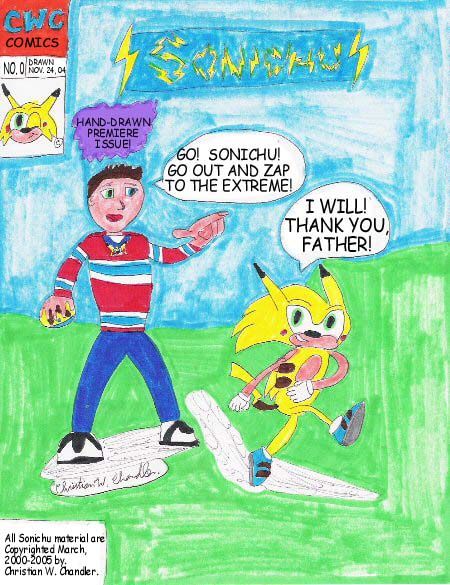
Even from the first Sonichu story, we see that the " electrical hedgehog Pokemon " is not the star of his strip. The very cover of " Issue Zero " has comic Chris-Chan telling Sonichu to " Zap out to the Extreme ", and Sonichu thanking his " father " for the instruction. The dynamic between Chris-Chan and Sonichu is meant to be father and son, but it goes without saying that biology would not allow a virgin birth of a cartoon animal to a human male. Instead, Sonichu serves as Chandler's idealized avatar-- if the Chris-Chan who appears in the comic is meant to represent Chandler's " dogged nice guy " conception of himself, then Sonichu is who Chandler wants to be, the children's hero who thrives within a never-maturing status quo.

Not only does Chris-Chan hog the cover, but he serves as the narrator for the debut story. He frames the story as its " intrusive creator ", telling us how the unwitting influence of Super Sonic transformed a Pikachu into Sonichu, and a Raichu into his female counterpart and girlfriend Rosechu. The Pikachu is literally just sitting there, about to be eaten by a monster, when he is transformed into Sonichu. After the transformation, he immediately fights and defeats the monster. He's cheered by the public, is impressed by his newfound power and ability to speak, and does not hesitate to rename himself " Sonichu ". Chris-Chan starts and ends this sequence, reminding us that Sonichu is his creation-- Chandler not only lives vicariously through Sonichu, but feeds off of the hypothetical adulation Sonichu receives, hoping that there will be a trickle-down fandom from his creation to him. He's creator and fan in one.

The episode concludes with a " Who's Who " list, involving Sonichu, Rosechu, the " Chaotic Combo " of other recolored hedgehog characters, the villains ( based on Chandler's real-life antagonists ), and three mysterious new Sonichus. There's not much to say about this as writing, since it's clearly telling and not showing. But it does reinforce the idea that Sonichu is about a status quo-- and in later chapters, that status quo finds itself under threat and has to resist.

More to Come..

* I'm referring to the real world Christian Weston Chandler by his last name, while the in-comic CWC will be called " Chris-Chan ".
** And this is NOT because of his autism. While Chandler may use his autism diagnosis as an attempt to excuse his problems, too many people bash him in context of his condition. Autism does not make people do any of the things Chandler has done, and calling him things like " that autistic fuck " or " autistic man-child " in the comments will not be tolerated.

Sunday, January 3, 2010

Apologizing for My Gender: Alyson Hannigan and Wired's Sexiest Geeks

( CAVEAT: This isn't so much comic related, as a criticism of geekdom/fandom's ass-backwards sexual politics. )

Wired.com is currently running a contest for 2009's Sexiest Geek. The candidates are celebrities from various geek-related interests, and include both genders. However, if a male geek is a candidate, the odds are much higher that the attached image will have them with full clothing, looking casual or at least posed for a conventional head-shot and not a Maxim pin-up.

Posted by an anonymous fan, the picture for Alyson Hannigan, the actress who starred as horny band camp girl Michelle in the American Pie movies, was in every episode of geek phenomenon Buffy the Vampire Slayer, and is a regular on the awesome sit-com How I Met Your Mother, is here...


It is worth noting that this picture came from the men's magazine FHM in 2003, when Hannigan was 29. There are plenty of pictures that " Anonymous " could have gotten of her in the present day, six years and one pregnancy later. Certainly she's far from unattractive, but why would they want a picture of a woman in her * gasp * mid-thirties when they could recycle an old issue of a younger Alyson posing in sexy schoolgirl attire?

For comparison, here's a picture of Nathan Fillion, another actor popular for his work in Joss Whedon shows and considered quite the looker...


But if he were given the same treatment that most of the women in the Sexiest Geek contest have received, we'd likely be seeing this charming shot...


And I doubt that the geek community at large, too often stuck in a He-Man Woman-Hater's club mentality, would vote for Fillion on the basis of the good Captain Malcolm " Mal " Reynolds' bared ass.

I'm not opposed to a Sexiest Geek contest, but the image of Alyson Hannigan ( amongst most though not all of the women in the contest, such as Danica McKeller, Kristen Bell, Kari Bryon, Jewel Staite, and others ) is the kind of low-clothing image that a 15-year-old me would have voted for. In the decade since, I've matured enough to realize that women are people with no more or less inherent value than men, and should be treated as having the same complexity-- skin is just one part. I've also realized that being a geek means being outside the norm, with more esoteric and intellectual pursuits-- the kind of mentality that shouldn't be won over by " T&A + connection to favorite TV show ". That thinking is the norm-- the large portion of humanity that for whatever reason you feel apart from.

There are many things that could hypothetically put Hannigan on that list, but instead of an outdated pin-up, how about something that actually captures her true appeal to geekdom, such as this..


From the set of How I Met Your Mother, when Hannigan was pregnant. The baby bump was ( rather poorly ) hidden most of the time, but the writers actually worked it into the show's canon in some scenes of her winning a hot-dog eating contest. Isn't her participation in that kind of quirky humor a better appeal than just another FHM pin-up?

....wait, I already know the answer to that.