

Showing posts with label dc comics. Show all posts
Showing posts with label dc comics. Show all posts
Wednesday, May 14, 2014


Wednesday, December 25, 2013
Forever Evil, The Most DC Comicsy DC Comic of The Year

Really, this says it all. An evil alternate universe Superman powering up by snorting Kryptonite as though it were crack cocaine. This was the most DC Comicsy moment of 2013. Make of that what you will.
Happy Holidays, and sorry if this is a far, far less adequate present than you all deserve.
Saturday, May 19, 2012
Grant Morrison, Supergods, and Super-Obama; WTF
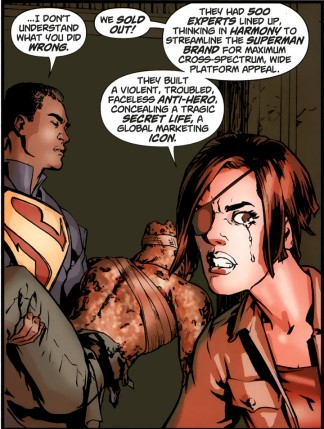
A friend of mine (Omar Karindu, as he goes by on Comics Should Be Good and Alvaro's Comicboards) suggested that Action Comics #9, the filler issue with President Calvin Ellis (a.k.a. President Superman, a.k.a the Super-Obama from that Alex Ross shirt brought into canon), was filled with subtext about how companies screw comic creators. Upon re-reading the comic, it's pretty obvious, and quite troubling.
In the comic, Super-Obama faces a corrupted Superman tupla (Tibetan for Solid Thought, a living idea). This was created by the Clark Kent, Jimmy Olsen, and Lois Lane of another world, who created the living idea to embody all that is great in humanity. But they needed a lot of money to bring the Super-Idea into existence, so they went to an amoral corporation who took their Super-Idea and warped it into their Super-Brand. Hence, that trio's world became an Orwellian police state ruled by a faceless, violent Super-Brand, which was colonizing other universes and killing their super-men. To quote their Clark's dying last words;
" He becomes anything you want him to be....our world wanted THAT..."
This is an interesting interpretation of the creator's rights debate that has particularly been on the forefront of the industry discussion in recent months. It also comes across as hypocritical coming from Grant Morrison. Not only has Morrison built his career largely on the characters of others (Superman in particular, but also Batman, the Justice League, and to a lesser extent the X-Men), but his interpretation of Superman transcends any writers or artists-- even Jerry Siegel and Joe Shuster, who he characterizes more as agents of the collective unconscious rather than actual creators of the character.
In Supergods, Morrison's history text/critical essay collection/autobiography/metaphysical ramble (which I've held off on reviewing due to its extremely frustrating and rambling nature), the Scottish writer basically dismisses the problems of Siegel and Shuster. He says that he started "believing" that DC swindled these two young men out of what was rightfully theirs, but later realized that it was business as usual, and both Siegel and Shuster legitimately sold Superman to DC while expecting to keep creating other heroes. Since Morrison is one of DC's highest-profile creators, it makes sense that he wouldn't speak badly about the company that made him a star. But Supergods talks about how Superman is an idea of greatness beyond the men and woman who created him, so Siegel and Shuster end up just a footnote to their own creation. Never mind the fact that both men fought hard battles for the character that DC made billions off of, or that they struggled to make end's meet while their creation made the rich even richer. They're just sacrifices to the cause.
Matt Seneca provides a good argument against Morrison's dismissal, albeit with harsher language against the man than I would use. I love Morrison's work, though I can't and won't speak to his quality as an actual human being. But his creed, the idea that fictional characters are ultimately more important than real people, isn't just New Age bollocks. It's also the kind of idea that creates the same problem Super-Obama must face, where a faceless brand is placed above the welfare of flesh-and-blood humans. And that comic doesn't even give it a good resolution, because it's Super-Obama who defeats the Super-Brand, not the Clark, Jimmy, and Lois who rightfully own it. Lois calls Super-Obama "Superman done right", but she's just crediting him as a good example of The Brand, not praising his virtues as an individual.
Is Morrison making a hypocritical argument with Action Comics #9, arguing against the ideas that he celebrates as one of DC's golden boys? Is he making a subversives attack against the company through his comics, the kind of statement he can't make directly? Does it even matter? Not really, because Super-Obama was the star of a filler issue. Next issue, we'll go back to the young, "hip", white, marketable "Ultimate Superman" we've seen in the New 52 reboot. And it won't matter that Super-Obama was an example of how to use the brand for good, to empower the downtrodden and reclaim power from the oppressors, because the brand is more important than the sum of its parts. In the end, Superman exists to sell Superman. The great stories told with the character are the result of the individual writers and artists putting in the creative effort to animate him, but in the end, there is no inherent value to Superman. Morrison tries to present Superman as a religion, but like any religion, it can be used as a tool of oppression.
And it's in really bad taste to call attention to the problem at the same time you're profiting from its perpetuation.
Monday, February 27, 2012
Batgirl 5-6 Thoughts: Ableist Garbage Day!

(Now just imagine if the Joker said that when he opened the door and capped Barbara in the spine.)
Joking and memetic-mutating aside, Batgirl has gone from being a technically competent comic with a disgusting ableist message, to an amateurishly written and sappy mess (albeit with good art by Adrian Syaf) with a disgusting ableist message. Issues 5 and 6 involve Barbara teaming up with Batman to fight a new villainess, Gretel, who gained mind control powers after a traumatic brain injury by a mobster she was investigating. It also has a script that bends over backwards trying to convince the audience that Batgirl is great and we should all love her as much as Gail Simone does. To wit;
1.) Bruce Wayne spends the first half of this arc hypnotized, and bumbles around like a puppet until Barbara breaks the spell by bringing up how his parents are dead. Batman, the most insanely prepared man in the DC Universe or any other (right down to literally creating his own backup personality in case of mind control of mental breakdown), is overridden like an amateur. I could accept this were it not so obvious that it was done to make Barbara look better by comparison, as the one who keeps her wits and saves Bruce's ass.
2.) Bruce Wayne hugs her afterwards, and whispers, " You were always meant to be Batgirl". This is an endorsement on par with the line in The Rise of Arsenal and its tie-ins, "was he not up for the task of being Red Arrow"? A sidekick's name, a weaker spin-off of an established hero, means nothing. Furthermore, it shows that Bruce, a man who's extremely guarded about his personal life and who he lets into his crime fighting circle, is perfectly fine with Barbara going into the battlefield physically and mentally unprepared after her apparent recovery. And that he doesn't particularly mind if Barbara's spinal chip gives out in the middle of a fight. Because she's more useful to him as Batgirl than Oracle, for reasons that don't exist!
3.) Barbara's narrative captions blanket the pages, with her beating us over the head with how great it is that she be Batgirl and help people. This is standard for modern superhero comics, the kind of "emo noir" that conceals perfectly good artwork behind boxes full of navel-gazing. But it's especially galling when Barbara talks about how she was never a partner to Batman, and was her own crime fighter. Who apparently took all of Batman's moves and gadgets for her great individual identity, but that doesn't really matter.
4.) Gretel is the second case in a row where the main villain of a new Batgirl story is a heavy-handed parallel to Barbara's own trauma. In the previous case, it was Mirror, who survived an accident that killed his family, and became devoted to killing everyone else who'd experienced miracles. In this case, it's a woman who was nearly killed by criminals, and is now a lethal vigilante. Batgirl makes sure we don't miss the parallels for a second, making this analogy about as subtle as a House episode where the patient's problem somehow connects to House's leg/addiction/misanthropy (re: EVERY FUCKING EPISODE). And, of course, Barbara has to be all weepy about it, telling the cops to treat Gretel well when they ship her off to Arkham.
It's also worth noting that Gretel still has clear evidence of her trauma-- her multicolored wigs disguise her bald head, which has a bullet scar where hair would've been. Further confirming that heroic characters don't have deformities, only bad guys! I can't wait to see Barbara fight a villain who's in a wheelchair, then give a speech about how she feels their pain!
In the end, what bothers me most about Batgirl is that it represents the character as "the good cripple". She was physically and mentally scarred, but she put the former behind her with a magic cure, and she's working on 'overcoming' the latter. Disability, to Barbara, was just a transitory state so she could look stronger once she emerged from it. And when she emerges, she emerges as a character who doesn't rock the boat or say anything controversial. She's just become another face in the Bat-crowd, only distinguishable by the Pollyanna-type bullshit about second chances and miracles that flows from her mouth.
Saturday, February 4, 2012
Another Reason Why Before Watchmen Should NOT Exist: It'd Dated Already

There are a hundred and one reasons why DC shouldn't go forward with Before Watchmen, the controversial series of prequels to the superhero genre's Citizen Kane. I've heard plenty of discussion about the continuing disrespect towards the original creators, the fact that few if any creators could measure up to the originals, the fact that there's no more story to tell with the characters, etc. However, one thing about which I haven't heard much discussion is the series' timeline.
Watchmen not only debuted in the 1980s, but was entirely about the 1980's. Alan Moore and Dave Gibbons created an alternate timeline leading to an alternate 1985. The plot is set against a Cold War gone hot, with the Russians poised to nuke America. The characters' origins are rooted in the Great Depression for the first generation, and the Vietnam era for the second. Rorscach's hero is Harry Truman, for God's sakes.
Most of the most successful comic book characters are from eras long past, and even further into the past than Watchmen. But those characters weren't given backstories as rooted to history, and they benefitted from regular updates and revamps (such as moving Iron Man's origin story to the war du jour, or modifying Captain America's history to make him a man out of time). Since we aren't getting an Ultimate Watchmen, we're instead getting more stories set in the deep past, exploring characters whose conclusions are foregone against a backdrop unfamiliar to a modern audience.
This is not an indictment of historical fiction or even of prequels, but rather an indictment of the bean counters at DC for bringing this wretched project to light. They've courted a lot of hate from fans, and for what? Prequels exploring the historical minutae of a twenty-five-year-old story that really doesn't need it? Even if Watchmen is a classic known to people who don't regularly read comics, classic is inherently dated. And unless Before Watchmen includes some miraculously innovative take on the material that already exists**, it's going to be an inherently limited and superfluous exercise with little profit beyond the short-term.
* (Image Found On Internet)
** (Grant Morrison's Multiversity would have been this, because Morrison's talent as well as his outspoken distaste for Watchmen made him one of a handful of creators who could actually make something of this doomed idea.)
Thursday, January 26, 2012
Why Do Superhero Fans Fear Drama?

I've been simmering on this topic for a long time, but a recent video by Linkara (15 Things Wrong With Identity Crisis) took this frustration to a boiling point. The video itself wasn't so bad, as while I disagreed with Linkara on several points, I respect the thought and effort he puts into his critiques. What really bugged me was (with some exceptions) the circle jerk of fan reactions that followed, which tended to coalesce on the same theme; " Dark is bad, make superhero comics fun again", followed by the usual whining and crying about the state of modern comics.
Far be it for me to defend Identity Crisis, as I didn't like the book myself for several reasons covered in Linkara's review (most notably the rape). But the reasons people don't like it seem to revolve around the fact that certain characters were killed off and removed from the status quo, and certain characters were changed. The moaning is often associated with the loss of more light-hearted incarnations of the characters, such as Tim Drake when his dad was alive, or Ralph and Sue Dibny as a couple. This then goes into whining and crying about a lot of post-Identity Crisis comics like Countdown and Cry for Justice, using Brad Meltzer as the scapegoat for these comics (despite the fact that he didn't write them). Occasionally someone will try to say that dark isn't necessarily bad, but they'll follow it with a "but it doesn't make a story good", then point to examples of where a story is good without being dark. And you'll often see citations of the All Ages titles as examples of how to do these characters right, the titles that are meant for very young children and tend not to have much development or moral complexity.
If dark just means gratuitous, then I'm more sympathetic to this perspective. However, the critiques aren't just with the gore (which I agree is off-putting in most modern DC comics), but with the notion that these bad things happen. The cry is for "fun", and by "fun", they mean a specific status quo, a specific story structure (usually single issues with a happy resolution at the end), and a specific interpretation of characters. "Fun" is what they know and what they're comfortable with; the complaints tend not to come from people trying to broaden their horizons and challenge their expectations.
In one sense, I'm trying to show that it cuts both ways, this battle of light vs. dark. If stories can be told without mature content, they can also be told with mature content. If some superhero creators are obsessed with making the characters grow up with them, others perseverate over keeping them at the idealized status quo. But ultimately, the dark stories-- or, more precisely, the stories with substantial drama and risk for the characters-- are the ones that really succeed. The greatest stories for each character, the ones that are part of their canon, are the ones that really pushed them-- Frank Miller's run for Daredevil, Chris Claremont's run on the X-Men, etc. Without struggle the hero cannot show his or her heroism; if it's just a fight of the week, the ending is never in doubt, and there's no reason to care, other than as a brief escape from reality. Of course, these stories were printed before the internet, so their reputations escaped the constant bitching of fans with computers.
Unfortunately, a lot of superhero fandom seems to cling to the escape hatch, to hide from reality within their Silver Agey security bubble. Even creators will end up pandering to them, including creators like Darwyn Cooke and Greg Rucka who have done excellent dark stuff in the genre. But they still get on the "fun" bandwagon, as if disavowing their work in order to capture for themselves this pleasant navel-gazing. The meaning possible for the superhero is thus pissed away, leaving the result as a pleasant but unattainable ideal rather than a figure whose struggles inspire people to attain the ideals in their own lives.
In the end, while I still don't like Identity Crisis, I find it more favorable based on the fact that it prodded at people who need prodding out of their bubble. If people suffer so much from drama and tragedy in superhero comics, either their lives are very good and their only real problems are with their fiction, or they put a disproportionate need upon fiction as a coping mechanism. Fun is part of life; it is not all of life.
Sunday, January 1, 2012
Batgirl, The Most Repulsive Comic of 2011
At the end of 2011, the new Batgirl has completed its first arc, and while it's not too bad from a craft standpoint, the implications are so disgusting that it was easily the worst comic I read all year. That includes plenty of comics that WERE bad from a craft standpoint, and even more comics that had a decent level of craft but were based on profoundly stupid concepts. But none of these comics had as revolting a message behind them, and even if they did, their negative implications were immediately seized upon by the audience. The new Batgirl is vile, but a positive commercial and critical reception enable its vileness.
Again, the issue here isn't with the art or writing, at least no more so than any other comic. Adrian Syaf's art is exceptional, and he at least makes the book nice to look at. And Gail Simone's script is decently constructed, if not nearly as good as her work on Birds of Prey or Secret Six. But she's based the book around one of the worst representations of disability I've seen in recent years. This is a comic that deals explicitly with the fact that the character of Barbara Gordon was the rare character who was both a semiotic victory and a memorable, complex entity on her own-- then pisses all over it.
I've already mentioned the bullshit conceit behind this book, that Barbara Gordon can walk again and is using that opportunity to be Batgirl. Now that we're a full four-issue story arc into this comic, we learn how Barbara was cured; she went to a special clinic in South Africa, to receive an experimental surgery. There's the chance that her condition could deteriorate, especially with intense physical strain (the kind that comes part and parcel with crime-fighting), but she's doing it anyway. In Barbara's mind, she's received a miracle, and she has to use her second chance to help people.
It's a strong religious metaphor without the courage to attach itself to a specific religion. But worse, it's a miracle cure that reinforces the notion that Barbara was broken because she couldn't walk. It doesn't matter that it's from the fringes of real-world science instead of DC Universe Phlebotnium, it's still an awful plot device. Barbara can walk again, so she's using this chance to become the exact same person she was before being put in the wheelchair. Her time as Oracle is completely glossed over, with the only bit of past continuity explicitly referenced being when she was shot by the Joker.
Worse yet, the book has the gall to try to treat disability with respect. Barbara scoffs at how Alysia* talks about the loss of mobility as a pitiful fate, and talks about what the chair "lets you do". It's referenced that the word "cure" was a dirty word in the Gordon household, with her father having brought up the clinic with veiled language (so as not to offend Barbara's proud identity). But this means absolutely nothing because Barbara still took the cure, and still enjoys not only her life as an able-bodied person, but as a pinnacle of athletic skill.
Some might argue that it's Barbara's choice to take this cure, and to live the kind of life she wants without accepting limitations. Except Barbara doesn't have much respect for her own life, for the following reasons;
1.) Subjecting herself to an experimental and possible life-threatening surgery in order to walk again, as though the risk of being dead was worth the reward of being able to walk.
2.) Becoming a crimefighter despite being badly out of practice and physically/psychologically unfit for the task. Throwing herself onto the battlefield in situations that could (and, in fact, did) cost civilians their lives due to her incompetence.
3.) Refusing help from her ex-boyfriend and fellow Bat-sidekick Dick Grayson, brushing him off as an over-protective man and going off to fight the villain herself. (This isn't a feminist issue, it's an issue of someone close Barbara not wanting her to get herself killed out of stupid pride).
4.) Being yet another member of the Bat-Family, now in a role that hundreds of crimefighters do better (thanks to Batman, Incorporated). Grant Morrison's notion of Oracle as a cyber-crimefighting digital Batgirl was silly and rooted in very dated conceptions of the internet, but it at least gave Barbara a unique role suited to her skill-set. Here she's just one of the Bat-Grunts, albeit without the ability to handle her emotional baggage.
In short, the message of the new Batgirl is that being disabled limits what you can do, being "normal" is an ideal for which you should readily throw away your life, and disability is just a pit-stop on the able-bodied hero's journey. To this, I use the words of a still-active disabled character, played by an extremely talented actor with a disability (Peter Dinklage);
" [as a cripple] I beg to differ. Death is so terribly final, while life is full of possibilities. "-- Tyrion Lannister, George R. R. Martin's A Game of Thrones
*the Ethnic Best Friend, because DC's books still have to belong to the white characters; so long, Cassandra Cain!
Again, the issue here isn't with the art or writing, at least no more so than any other comic. Adrian Syaf's art is exceptional, and he at least makes the book nice to look at. And Gail Simone's script is decently constructed, if not nearly as good as her work on Birds of Prey or Secret Six. But she's based the book around one of the worst representations of disability I've seen in recent years. This is a comic that deals explicitly with the fact that the character of Barbara Gordon was the rare character who was both a semiotic victory and a memorable, complex entity on her own-- then pisses all over it.
I've already mentioned the bullshit conceit behind this book, that Barbara Gordon can walk again and is using that opportunity to be Batgirl. Now that we're a full four-issue story arc into this comic, we learn how Barbara was cured; she went to a special clinic in South Africa, to receive an experimental surgery. There's the chance that her condition could deteriorate, especially with intense physical strain (the kind that comes part and parcel with crime-fighting), but she's doing it anyway. In Barbara's mind, she's received a miracle, and she has to use her second chance to help people.
It's a strong religious metaphor without the courage to attach itself to a specific religion. But worse, it's a miracle cure that reinforces the notion that Barbara was broken because she couldn't walk. It doesn't matter that it's from the fringes of real-world science instead of DC Universe Phlebotnium, it's still an awful plot device. Barbara can walk again, so she's using this chance to become the exact same person she was before being put in the wheelchair. Her time as Oracle is completely glossed over, with the only bit of past continuity explicitly referenced being when she was shot by the Joker.
Worse yet, the book has the gall to try to treat disability with respect. Barbara scoffs at how Alysia* talks about the loss of mobility as a pitiful fate, and talks about what the chair "lets you do". It's referenced that the word "cure" was a dirty word in the Gordon household, with her father having brought up the clinic with veiled language (so as not to offend Barbara's proud identity). But this means absolutely nothing because Barbara still took the cure, and still enjoys not only her life as an able-bodied person, but as a pinnacle of athletic skill.
Some might argue that it's Barbara's choice to take this cure, and to live the kind of life she wants without accepting limitations. Except Barbara doesn't have much respect for her own life, for the following reasons;
1.) Subjecting herself to an experimental and possible life-threatening surgery in order to walk again, as though the risk of being dead was worth the reward of being able to walk.
2.) Becoming a crimefighter despite being badly out of practice and physically/psychologically unfit for the task. Throwing herself onto the battlefield in situations that could (and, in fact, did) cost civilians their lives due to her incompetence.
3.) Refusing help from her ex-boyfriend and fellow Bat-sidekick Dick Grayson, brushing him off as an over-protective man and going off to fight the villain herself. (This isn't a feminist issue, it's an issue of someone close Barbara not wanting her to get herself killed out of stupid pride).
4.) Being yet another member of the Bat-Family, now in a role that hundreds of crimefighters do better (thanks to Batman, Incorporated). Grant Morrison's notion of Oracle as a cyber-crimefighting digital Batgirl was silly and rooted in very dated conceptions of the internet, but it at least gave Barbara a unique role suited to her skill-set. Here she's just one of the Bat-Grunts, albeit without the ability to handle her emotional baggage.
In short, the message of the new Batgirl is that being disabled limits what you can do, being "normal" is an ideal for which you should readily throw away your life, and disability is just a pit-stop on the able-bodied hero's journey. To this, I use the words of a still-active disabled character, played by an extremely talented actor with a disability (Peter Dinklage);
" [as a cripple] I beg to differ. Death is so terribly final, while life is full of possibilities. "-- Tyrion Lannister, George R. R. Martin's A Game of Thrones
*the Ethnic Best Friend, because DC's books still have to belong to the white characters; so long, Cassandra Cain!
Thursday, September 15, 2011
5 Ways to Magically Cure a Disabled Character, Part 1: Conspicuous Assistive Technology
In the comments section of my Batgirl review, it was asked why Barbara never used the DC Universe's supertech or magic to fix her spine. This is a question that comes up often around this issue, and is valid. Granted, it's a slippery slope towards removing any sense of dramatic urgency from the world, when you can just Phlebotnium any infirmity away, but it stretches disbelief a bit too far when characters bemoan their tragedies but don't go for the genre solutions right in front of them.
Of course, as another comment noted, supernatural injuries would be treated by supernatural medicines, and every medicine has its side-effects. So I'm doing this series of blogs to examine the ways in which these magic cures can be used to further the story and explore issues of disability, rather than simply swipe them under the rug and pretend they don't exist.
NUMBER FIVE: THE CURE IS DEFORMING (I.E. CYBORG PARTS)
This might stretch disbelief as well, because if the universe has technology sophisticated enough to replace a lost limb with a superhumanly strong prosthesis, it could go just a little further and replace it with one that looks human as well. However, it's a good symbolic way to show that even though the character has regained their mobility, they remain affected by the experience. It also makes the notion of "fixing" a disability less appealing, because disability is a social construct. This is a reason given for why Barbara Gordon never asked her pals in the Justice League to make her a walking exoskeleton; a wheelchair is hardly as conspicuous as a clunky robot suit that gives the wearer enough strength to crush a man like a paper cup.

BEST EXAMPLE: Cyborg of the Teen Titans. Victor Stone's life was saved from a life-threatening injury by replacing most of his body with metal parts. However, Vic wasn't very happy about this, and the fact that his father did the operation further intensified his daddy issues. He was kicked off of his high school football team, was abandoned by his girlfriend, and basically got cut off from society. It wasn't until he met the Teen Titans that he found a purpose to live again, fighting alongside other outsiders, saving lives, and taking out his anger on people who had it coming. But he was still mostly robotic, his human parts limited to half his face and bits of his torso.
What's also worth noting is that even though Victor's new body let him be a superhero, it also had a spectacular downside; it ruined his ability to be an athlete. When Vic was human, he loved football, and trained intensively so he could get stronger and stronger. But his cyborg body was not only superhumanly strong, but limits were built into his mechanical muscles. Several stories touched on the fact that he didn't like how he was robbed of the ability to improve himself with exercise. An episode of the cartoon even had this as the central conflict (though it ended with Cyborg beating the villain through the power of determination, presumably because his meaty bits gave him a boost of strength....somehow).
Other Sci-Fi/Fantasy Examples:
Raiden from Metal Gear Solid 4; The much-loathed replacement Snake from MGS2 got a major upgrade in MGS4, becoming a Cyborg Ninja. But he looked even less human than any of the other cyborgs, with claw-like hands, cloven feet, and the lower half of his head replaced by metal. At the ending he gets his combat limbs replaced with more realistic prostheses, but you can see all the seams. Raiden's most human appearance since his cyborganization still makes him look like a Ken doll.
Robotman from Doom Patrol: Poor Cliff Steele is an even greater extreme of the "disfiguring prostheses" trope; he's a brain in a jar, attached to a robotic body. Not only is he treated as a freak (even despite his heroic exploits; the Doom Patrol are some of the most Marvel-like characters in DC), but the amount of everyday human sensations that he's lost is profound. Cliff's described his predicament as phantom pain for his entire body.
Barret from Final Fantasy VII: The JRPG analogue to Mr. T lost his hand when being shot at by Shinra goons, the same goons who destroyed his hometown and killed his wife. The replacement for his hand was a huge cannon he used in vengeance. This is an odd version because Barret intentionally chose an intimidating weapon instead of a prosthetic hand, not caring about much beyond killing all of Shinra. In the Advent Children animated movie, he mellows out and gets a regular prosthetic, a metal hand that's conspicuous but actually functions like the original limb.
And again, you could just invent perfect replacements, but if it's a perfect transition, where's the story? An amputee might be pitied, but a cyborg is more likely to be feared and hated. It's a good metaphor for the way the experience of such trauma changes a person; once it's there, you can't be the same person you were, and others will pick on that.
Of course, as another comment noted, supernatural injuries would be treated by supernatural medicines, and every medicine has its side-effects. So I'm doing this series of blogs to examine the ways in which these magic cures can be used to further the story and explore issues of disability, rather than simply swipe them under the rug and pretend they don't exist.
NUMBER FIVE: THE CURE IS DEFORMING (I.E. CYBORG PARTS)
This might stretch disbelief as well, because if the universe has technology sophisticated enough to replace a lost limb with a superhumanly strong prosthesis, it could go just a little further and replace it with one that looks human as well. However, it's a good symbolic way to show that even though the character has regained their mobility, they remain affected by the experience. It also makes the notion of "fixing" a disability less appealing, because disability is a social construct. This is a reason given for why Barbara Gordon never asked her pals in the Justice League to make her a walking exoskeleton; a wheelchair is hardly as conspicuous as a clunky robot suit that gives the wearer enough strength to crush a man like a paper cup.

BEST EXAMPLE: Cyborg of the Teen Titans. Victor Stone's life was saved from a life-threatening injury by replacing most of his body with metal parts. However, Vic wasn't very happy about this, and the fact that his father did the operation further intensified his daddy issues. He was kicked off of his high school football team, was abandoned by his girlfriend, and basically got cut off from society. It wasn't until he met the Teen Titans that he found a purpose to live again, fighting alongside other outsiders, saving lives, and taking out his anger on people who had it coming. But he was still mostly robotic, his human parts limited to half his face and bits of his torso.
What's also worth noting is that even though Victor's new body let him be a superhero, it also had a spectacular downside; it ruined his ability to be an athlete. When Vic was human, he loved football, and trained intensively so he could get stronger and stronger. But his cyborg body was not only superhumanly strong, but limits were built into his mechanical muscles. Several stories touched on the fact that he didn't like how he was robbed of the ability to improve himself with exercise. An episode of the cartoon even had this as the central conflict (though it ended with Cyborg beating the villain through the power of determination, presumably because his meaty bits gave him a boost of strength....somehow).
Other Sci-Fi/Fantasy Examples:
Raiden from Metal Gear Solid 4; The much-loathed replacement Snake from MGS2 got a major upgrade in MGS4, becoming a Cyborg Ninja. But he looked even less human than any of the other cyborgs, with claw-like hands, cloven feet, and the lower half of his head replaced by metal. At the ending he gets his combat limbs replaced with more realistic prostheses, but you can see all the seams. Raiden's most human appearance since his cyborganization still makes him look like a Ken doll.
Robotman from Doom Patrol: Poor Cliff Steele is an even greater extreme of the "disfiguring prostheses" trope; he's a brain in a jar, attached to a robotic body. Not only is he treated as a freak (even despite his heroic exploits; the Doom Patrol are some of the most Marvel-like characters in DC), but the amount of everyday human sensations that he's lost is profound. Cliff's described his predicament as phantom pain for his entire body.
Barret from Final Fantasy VII: The JRPG analogue to Mr. T lost his hand when being shot at by Shinra goons, the same goons who destroyed his hometown and killed his wife. The replacement for his hand was a huge cannon he used in vengeance. This is an odd version because Barret intentionally chose an intimidating weapon instead of a prosthetic hand, not caring about much beyond killing all of Shinra. In the Advent Children animated movie, he mellows out and gets a regular prosthetic, a metal hand that's conspicuous but actually functions like the original limb.
And again, you could just invent perfect replacements, but if it's a perfect transition, where's the story? An amputee might be pitied, but a cyborg is more likely to be feared and hated. It's a good metaphor for the way the experience of such trauma changes a person; once it's there, you can't be the same person you were, and others will pick on that.
Monday, August 1, 2011
Dan DiDio Talks Accessibility and Diversity at SDCC 2011
In Response To A Very Valid Point
This is a really feeble attempt to justify the return to Barbara Gordon Batgirl. As for the attempts to diversify... I will quote a great Master Jedi and let him respond...
" DO OR DO NOT. THERE IS NO TRY."
Oh, and the comment about "accessibility" just ground salt into the wound.
This is a really feeble attempt to justify the return to Barbara Gordon Batgirl. As for the attempts to diversify... I will quote a great Master Jedi and let him respond...
" DO OR DO NOT. THERE IS NO TRY."
Oh, and the comment about "accessibility" just ground salt into the wound.
Tuesday, July 12, 2011
Dammit, DC Comics, Stop Infecting My Dreams/Other Fandoms
I had a bizarre dream that only a mind as obsessive about pop culture as mine could come up with unconsciously. In a dream, I was looking through a game store and saw a new game called "Metal Gear Solid: Rebirth". The front box had series hero Solid Snake at his proper age, as opposed to the prematurely elderly state we saw in MGS4. The back explained that Snake was healed by nanomachines, and that he was on a brand new adventure. If I recall correctly, Meryl was by his side; apparently she had dumped her new, kind-hearted (if uncomfortably incontinent) husband Johnny Sasaki for her teenaged crush.
WARNING: SPOILERS FOR METAL GEAR SOLID 4 FOLLOW
This came as a surprise to me in the dream, because MGS4 clearly ended with the implication that Snake was as good as dead. His body was continuing to age due to the breakdown of his cloned physiology, and while he wasn't going to turn into a Foxdie WMD as previously expected, he still had only a few months remaining. Hideo Kojima intended MGS4 as the end of Solid Snake's story, and possibly the entire Metal Gear saga as well. All the subsequent games have been prequels or remakes, and the rest of the supporting cast either got a happy ending or were killed off. Unless Konami goes behind Kojima's back (which is unlikely, as the success of Metal Gear has been based heavily on its creator's artistic vision), this is not going to happen in reality, and it would be terrible if it did. It would be a slap in the face towards the original games, the members of the audience who actually understood Kojima's vision, and even towards game makers with new ideas. All in the name of trying to preserve nostalgia, rather than creating new games and properties that create future nostalgia.
Perhaps this dream was influenced by the news of the DC relaunch, as the other half of the American comics industry's Big Two has a stiff one for regressions and repetitions. While they have hired great creators and allowed them to take several franchises in interesting new directions (most notably with Batman and Green Lantern, in spite of the latter bringing back Hal Jordan as the star), they've become obsessed with a constant, Nietzcheian return to the same. Even before the relaunch was announced, Barry Allen, the Silver Age Flash who died way back in 1987, came back from the grave and shuffled his successor Wally West back to the sidelines; we saw this in a mini-series called Flash: Rebirth, by the same creative team as Green Lantern: Rebirth (which did the same for Hal Jordan and the Green Lantern Corps, albeit in a superiorly executed fashion). Similarly, the Green Lantern: Secret Origin story by Geoff Johns that updated Hal's backstory for modern continuity was followed by a Superman: Secret Origin, also by Johns. Secret Origin was followed by J. Michael Stracynski's Earth One OGN, another re-telling of the Man of Steel's early days.
The pattern repetition continues in many facets of the company's superhero publishing. The relaunch itself is a more drastic variant on One Year Later, the Post-Infinite Crisis event that had every book jump ahead one year and give their characters a new status quo. In the DCNu (as it's become known), Aquaman will have his third revamp since 2003, the second being the One Year Later run by Kurt Busiek-- if you count Aquaman's return in the Brightest Day maxi-series as another relaunch, this marks four for the character. Ditto for Hawkman and Hawkgirl. The Flash will be getting his fourth relaunch in that time, which includes the abortive Bart Allen Flash, the Wild Wests family, Barry Allen's return, and the upcoming series. This isn't even touching the unfortunate racial implications of these relaunches/regressions; for example, Ray Palmer coming back as the Atom following the death of Ryan Choi, or Wally West's multiracial family being supplanted by Barry and Iris Allen, who'd look totally appropriate at a country club.
On an individual level, many of these series were good, and many of the DCNu titles will assuredly be good. On a larger level, though, this shows an obsession with trying to preserve the same properties, continually trying to bring them back while using the minor status quo variations as the illusion of change. Maybe DC will never get any great new characters, as their star franchises are those swindled from their creators many decades ago-- today the industry is developed enough that original properties are kept by their creators. But can they at least not take those properties in an endless circle?
The Metal Gear Solid 4 analogy is especially appropriate given that game's revelations about the series at large. The Patriots, the shadowy organization responsible for all the ills of the world, are revealed to simply be super-computers. Everything they do fits into their programming, and they're stuck in a recursive loop. This explains why the Metal Gear sequels all follow the same pattern; Snake is always called upon to fight rogue super-soldiers trying to liberate the world from the Patriots (unfortunately for the world, this is planned via nuclear holocaust). Snake will always be assisted along the way, once by a FOXDIE virus covertly implanted into his body, and again by a mysterious Cyborg Ninja with a Patriot-designed exoskeleton. MGS4 is filled with subtext about how the Patriots' methods (re: sequels) are driving the world (and video game franchises) into the ground; the Beauty and the Beast Corps that Snake fights are grotesque mergers of previous bosses, with the animal names from MGS1, the weapons from MGS2, and the personalities from MGS3. All with a bit of too-disturbing-to-be-arousing T&A underneath.
In other news, have you seen the new Harley Quinn costume? Perhaps the Patriots have moved to reality, except they're interested in superhero comics instead of the military-industrial complex. At least Snake gets to rest in peace.
Wednesday, June 29, 2011
Dear Facebook DCU SDCC Protest: HAHAHAHAHAHAHAHA

Oh wait, you're not kidding.
Look, I'm no stranger to having fan preferences and making online complaints when those preferences aren't met (though I try to distinguish between what's personal preference and what's genuinely a loss of depth in the comics, and only act on the latter), but trying to organize a live protest? As in, people dragging their asses to SDCC to whine about DC changing "their comics" while thinking themselves as important as the Tiananmen Square Tank Man?
Thursday, June 16, 2011
Dear Rebooted Superman

You've got your costume on inside-out. The trim goes on the inside. A Man of Tomorrow should be able to figure this out.
Friday, June 10, 2011
Gail Simone Talks Batgirl, and why Able-Bodied is Better

In light of the online controversy regarding the new, seemingly able-bodied Batgirl series, Gail Simone gave an interview with Newsarama blogger Jill Pantozzi (who wrote a wonderful essay about the importance of the paraplegic Oracle's merits, as an inspiration for her own life and physical challenges). Simone was nice enough to respond to Pantozzi's article with an interview; however, while Simone was limited by her inability to divulge spoilers about the new title, she made comments that betray her responsibilities not only to represent people with disabilities, but to tell a good story respecting the intelligence of the readers.
While Simone remains civil in the Interview, her arguments for the able-bodied Barbara Gordon Batgirl use the worst tendencies of modern DC Comics as an excuse for retconning Barbara's spine back-- in other words, saying that "everyone else is jumping off a cliff, so I might as well too". She mentions various resurrections and magical "healings" as reasons why erasing the spinal damage done by the Joker's bullet should be acceptable...
"For newsworthiness, well, I just took a look the top sales charts for Marvel and DC, and it's unavoidable...the stories that the readers support in large numbers are nearly all in the middle of storylines that were considered completely unthinkable at one point; Hal Jordon replacing Kyle Rayner, Bucky returning from the dead, Jason Todd returning from the dead, Johnny Storm dying, Dick Grayson as Batman, Bruce Wayne dying, Barry Allen returning as the Flash, on and on and on. To some, these are all stunts, but they have been executed brilliantly and I strongly suspect many will be among the best-remembered stories of their respective runs.
...it's open to strong debate wether or not these are brilliant stories. Even the ones that were executed brilliantly have their problems; for example, having Batman's death be explicitly temporary from day one undermined what little drama superhero comics retain. But as Simone continues to dodge the issue, she tries to give plot-related reasons to remove Oracle that sidestep the disability issue...
"A lot of readers and a lot of editors had a story problem with Oracle, in that she made for such an easy, convenient story accelerator, that we missed the sense of having characters have to struggle to discover, to solve mysteries. Famously, it helped make Batman less of a detective and more of a monster hunter."
So don't use her as a convenient story accelerator. Just because you can use a character's skills as a deus ex machina doesn't mean you have to. And it gets especially more damning when she tries to divide the opinions of PWD advocates...
"But I want to get this out really quickly, it's about the myth of monolithic opinion. It's been sort of simply accepted that there's this block of disabled folks who are against this idea, en masse, and I do have to say quickly that that's not the case. There has always been a vocal minority of PWD [people with disabilities] who wanted to see Babs healed and out of the chair, always. It started out a tiny minority but it did get larger as the years went on. Again, I don't want those people to be forgotten. Even with some PWD advocacy groups, the response has always been mixed. I feel like I have to represent that group as well, here. It's a much smaller group, as far as I can tell, however. "
I've encountered people, even people with disabilities who want to see Babs healed and out of the chair. I tend not to see them as people whose opinions are worth acknowledging. Their opinion is rooted in escapist wish fulfillment, trying to imagine a world where disabling injuries can be magically healed. That's all well and good, but if you find your own challenges such a curse, escaping in the adventures of a character who does get her legs back isn't going to solve shit. It's just a soma that, instead of letting you contextualize your own experience through fiction and receive a greater understanding, simply gives you a brief distraction from reality.
A major reason many people (myself included) like Oracle is because she's one of the few superhero characters who is legitimately handicapped with no tie-in superpowers. She doesn't have super-compensating senses like the blind Daredevil, or super-powered artificial limbs like the disfigured Cyborg. She is in a wheelchair, and all of her activities have to be done from that chair. The way she negotiates life and ethics from a place of severe physical and societal limitations is inspiring, and as Jill Pantozzi expressed, serves as a role model in the best ways.
But then, this is the straw on my metaphorical hump...
"Role model or not, that is problematic and uncomfortable, and the excuses to not cure her, in a world of purple rays and magic and super-science, are often unconvincing or wholly meta-textual. And the longer it goes on, the more it has stretched credibility."
Of course it's meta-textual, it's a fucking story. If you take continuity literally, you can use said purple rays and magic and super-science to solve all problems. You just pull out whatever deus ex machina you want and erase the conflict, thus erasing the drama. Again, this makes fiction into an escape, not a catharsis. Instead of creating a world to reflect and better understand our own, you're just creating a virtual reality that people can cower to when actual reality is too hard.
Simone goes on to talk about how she's always loved Batgirl, and how she's always wanted to write Barbara as Batgirl, and how being shot by the Joker was her motivation for starting the Women in Refrigerators project. She also says that she was impressed by the writers who made Barbara stronger person from being in the chair, and didn't want to take away the character she became through that adversity. But that appears to be exactly what she's doing, otherwise she wouldn't need to get on the defensive. No matter how great the character became in Birds of Prey, under the hand of Simone, Dixon, and others, it means nothing because the nostalgia for the character in the less-than-serious 60's show is paramount. Yes, Barbara's transition to Oracle came from a Fridging in The Killing Joke, where she was shot by the Joker just to make him look more evil. But does that mean the 20 years of the character since then have been for nothing?
Simone has become an excellent writer not just for her skills, but for her acknowledgement that the world of superheroes is full of perspectives beyond the majority, just like our own. This feels like a betrayal, because it sure sounds like she's erasing one of those perspectives to go back to a fantasy FROM the minority.
It doesn't matter that this is Barbara's first solo ongoing series, because if her mobility is fully restored and her experiences are washed away, she's just yet another supermodel in tights, and tights borrowed from a male character at that. When you remove the adversity, you remove the conflict, and you remove the meaning gained.
Monday, June 6, 2011
DC and Batgirl Walk To The Bank?

As part of DC's latest attempt to solve their continuity problems via increasingly convoluted reboots, Batgirl returns in a new series written by Gail Simone (who handled the character for years in her excellent Birds of Prey run). It's been confirmed that the new Batgirl is Barbara Gordon, who originally had the role but gave it up after being shot by the Joker, which left her in a wheelchair (and prompted her to become Oracle, Batman's tech-guru, founding member of the Birds of Prey, and a much more interesting character).
I don't want to jump to conclusions, so I'm hoping the speculation that this is Barbara Gordon in a high-tech Batgirl armor that gives her prosthetic locomotion is correct. In that case, it's a progression of the character, putting her back on the frontlines but still making it clear that she's disabled, and still has to cope with the physical and psychological challenges posed by her handicap (especially since she'd still have the memories and associated PTSD of being gruesomely shot by the Joker, one of the most horrifyingly sadistic villains in fiction). Walking via robot suit isn't a substitute for having working legs, especially since Barbara wouldn't be in the costume 24/7. She'd lose the symbolism of being DC's full-time wheelchair character, but if there was a compelling reason for her to take up crimefighting, it could work.
However, if this is just rebooting Barbara back to being an able-bodied superheroine (albeit an inferior distaff counterpart to Batman, with the patronizing codename "BatGIRL" despite being over 18 years old), then it's incredibly insulting. It's insulting to readers with physical and/or mental handicaps who can't retcon away their challenges. It's insulting to readers who enjoyed seeing the character progress into not only a prominent disabled character, but a genuinely interesting character thanks to the way the experience shaped her (as while Barbara was a super-genius, she was also capable of manipulating her friends for the greater good, a character trait that doesn't have anything to do with her handicap). And it's insulting to fans of Gail Simone to see that she doesn't respect the meaning fans drew from her work with Barbara, such as having the character appear to be magically cured only to have it be little more than the return of feeling to her toes (which Barbara coped with marvelously, choosing to be grateful for the little message that her limbs were still there).
Please let it be the former.
Sunday, February 27, 2011
Superman/Batman: Apocalypse: Lolita of Steel

Stanley Kubrick was one of the most accomplished and innovative directors in the history of film. One of his most interesting feats was the fact that he made a film of Vladimir Nabokov's Lolita, and under the MPAA's totalitarian Hayes Code no less. While Kubrick wasn't satisfied with the way the thoroughly censored adaptation turned out, he did manage to create a film riddled with sexual suggestion. If he couldn't do a film that explicitly told the pedophile's story, then he'd find plenty of ways to hint at Humbert Humbert's lust for a 14-year-old girl*, using careful direction to show the character's gravitation towards Lolita (and her reciprocation) without actually stating it.
Superman/Batman: Apocalypse, the animated adaptation of Jeph Loeb and the late Michael Turner's Supergirl reboot, works the same way, except the disturbing implications AREN'T intentional. And that's why it went from just being a lame movie to an outright disturbing one.
The story centers around Kara Zor-El, Superman's teenaged cousin from Krypton. Its plot, typical of a Jeph Loeb story, is a frenetic jump between various action sequences without much plot connecting them. All of the instances follow Kara trying to find a place to fit in, given the destruction of her homeworld. She arrives on Earth completely naked, witnessed by some construction workers who try to rape her (big mistake, given her super-powers). From there we see her trying different identities influenced by the adults guiding her. It's worth noting that she meets few if any other teenagers, and is the sole icon of youth and inexperience amidst a cast of grown-ups. It's also worth noting that each time she tries out an identity, Kara gets a new set of clothes that invariably fails to adequately clothe her. For example...
-- When Clark Kent takes Kara in, he takes her shopping. As Kara becomes assimilated in an improbably quick fashion (because apparently teenaged girls across all cultures take to conspicuous consumption like a duck to water), she tries on a bunch of trashy outfits, while Clark looks on with a raised eyebrow and a stern expression at his younger cousin's choices.
-- When Wonder Woman decides that Kara would best grow up on Paradise Island with other super-powered women, she takes to the Amazon wardrobe of leather body armor (and not much of it). Though Kara bonds with the Amazonians, she's still clearly the youngest there, taken in with a firm, trusting, and blatantly homoerotic hand from Lilah (a.k.a. Harbringer).
-- After being kidnapped and brainwashed by Darkseid, Kara wears a really trashy black leather ensemble, using the time-honored tradition of using leather fetish gear to evoke eeevil.
-- Finally, once she and Clark defeat Darkseid and return, Kara's "independent choice" is to become Supergirl, with a bared madriff and improbably short skirt.
The last one is the nail in the coffin; even Kara's final decision has her dressed in her paternal figure's colors, but skewed to emphasize her youth and sexuality. Worst of all, the character design clearly imitates Michael Turner's version. While I hate to speak ill of the dead and don't think Turner was a bad human being at all, his version of Supergirl was especially troubling. She had no body fat, a very thin bone structure, and an elongated torso to show off her belly button. Turner's Kara was an anorexic with big breasts attached.
To be fair, the scenes on Paradise Island keep Apocalypse from failing the Blechdel Test, because Kara and Lilah talk about things other then men. However, Kara is still the lone teenager in a cast of adults, and every wardrobe change has her re-interpreted through the lens of an adult's sublimated fantasies. Be they the outfits Clark outwardly disapproves of, the dominatrix getup Darkseid assigns, or the miniskirt outfit with branding borrowed from Superman, Kara is only given an identity in the context of others. And this wouldn't be so troubling if Kara actually looked and acted like a real girl, instead of a middle aged man's sexualized interpretation.
Needless to say, I didn't like this movie and thought it a waste of the talent of Summer Glau. I hope she gets a voice-over role soon that is closer to the complex characters she's known for playing, as opposed to an emaciated underage superloli.
Friday, December 24, 2010
The Limp Arrow Awards For Worst Comics Of 2010

Originally I had entitled these end-of-year rant posts the "Humperdoozie ", after the inbred descendant of Christ from Preacher. However, I realized that might come across as though I equate crappy comics with developmental disabilities, and I don't want that. So I've changed the award name to something more specific and less offensive-- except to people who can't get it up because of nanite arm stump infection. Fortunately, none of them are coming forward any time soon.
Here's the best way I can express my opinion about the year's comics-- 2010 was the year when I stopped identifying myself as a superhero comic fan. I'd enjoyed a lot of the stuff from 2009, and I still enjoyed some things in 2010. But this was the year where I finally emancipated myself from specific allegiances, because I'd found other interests that filled the void. I've found franchise superhero comics largely an Ouroburos that somehow kept finding more of its tail upon which to nosh, and I don't know if it was just getting fed up with the directions of comics, or focusing my attention on other mediums that told the kinds of stories I actually wanted to see.
But let's put it this way...you know how Mark Millar wrote his own afterword for Superior #1, saying about how comics fans needed new superhero characters to replace the tired constructs of the Golden and Silver Ages? Well, I found my new hero. His name is Solid Snake. :P
Anyway, onwards with the awards...
Worst Story Resolution: X-Men: Second Coming. After dragging the DeciMation out for five years, Marvel resolves it via living deus ex machina Hope Summers, whose Phoenix powers revive the mutant race with....five new mutants. That's equal to the amount of mutants killed in the crossover, significantly less than the amount of mutants killed since the DeciMation, and not even remotely worth the moral compromises Cyclops made in the name of chasing a messiah child without any evidence to support his faith. Yet now Cyclops is the hero, and everyone loves him, even though he's treated every mutant he wasn't sleeping with (re: every mutant except Emma and maybe Wolverine ) as expendable. Seeing Scott awarded the Medal of Honor by Captain America was especially jarring, since Cap wouldn't have stood for the shit Scott did, even in a wartime situation.
Worst New Direction: JMS' Superman. Walking through small towns trying to find the real America was corny when Green Lantern and Green Arrow did it in the 70's. But at least they were open to learning from their experience. Superman's just ditching his responsibilities to the entire world so he can slum it with mere mortals and feel better about himself. At best he's a politician going on a campaign trail to win his constituents' favor, and at worst he's an anthropologist fascinated by the behavior of us chimpanzees. Neither seems like a good use of his talents, and it's an especially jarring waste of a year's worth of comics.
Worst Move For Diversity Of Representation: DC Comics killing off the Ryan Choi Atom. Was Ray Palmer such an original and compelling personality that he had to return to the role at the cost of the new guy's life? What made him so much more " iconic " in that minor role, that he would have his competition eliminated by divine intervention...oh, wait, he's a white Silver Age character. And Ryan's a Chinese-American from the current generation. That explains it, and it's hardly the only example of the classic white guys taking back roles from their more diverse counterparts. At least in this case, people who enjoyed the All-New Atom comic/don't enjoy DC's current direction got a karmic bone by seeing the villain who killed Ryan sentenced to death by Snoo-Snoo.
Worst Comic About A Junkie Ex-Sideckick Who Cradles A Dead Cat During A Heroin Hallucination After Being Unable To Get It Up With The Supervillain Babymama Of His Dead Daughter Due To A Nanobot Infection In His Arm Stump: Rise of Arsenal. Okay, it didn't have too much competiton, but still, you can't make that shit up. At least, you couldn't until a professional writer DID.
Worst Trend: Identity Sub-Franchising. The Incredible Hulk has become The Incredible Hulks, with every character of his supporting cast now being a similar gamma-powered monster. Batman has become Batman Inc., franchising his identity built through a lifetime of suffering out to anyone who passes the job interview. Wolverine's gone from a solo X-Men spin-off to his own franchise, with a team book of is own and books for his clone daughter and evil son. There are two Captain Americas, a family of Flashes, and a Lantern Corps of every color. Has everyonejust given up on the idea that being a superhero can be inherently special? Or is it just
Limp Arrow 2010 Lifetime Unachievement Award: Mark Millar. See the above comment, except that his " new " concepts are a book about comic book fanboys playing at being heroes, a book about a Batman rip-off acting like a Joker rip-off, and a book about a Shazam rip-off. If you don't want to do the same old thing as everyone else, don't do the same old thing as everyone else! Filing off the serial numbers and adding a lot of swearing and "timely" pop culture references isn't good enough.
Tuesday, December 7, 2010
Signs Your Life Has Been Revamped By Geoff Johns

-- You find yourself in the same job and wardrobe that you had in your twenties. If you are in your twenties now, you find yourself in the same classes and wardrobe that you had in high school. All of the progress you have made since has been nullified via convoluted circumstances that reset your status quo.
-- Similarly, elements of your outdated wardrobe are now given intense personal significance. If you wore leg-warmers, you've started wearing them again because they were given to you by a friend who was hit by a bus. If you sported a mullet, you have once again chosen that hairstyle because it reminds you of the uncle who touched you, and gives you the feeling that you've conquered your past.
-- All of your friends and family throughout your entire life history are hanging around. You find that your life is basically just one big family reunion, with kindergarten playmates, high school sweethearts, bitter workplace rivals, and dead grandparents popping up. Oh yeah, and I forgot to mention...
-- All of the people who've passed on in your life have come back. They may be traumatized after having been dead, but they're back to life and healthy. Any sense of loss is gone, replaced with confusion and a vague irritation at being manipulated by the powers that be.
-- In addition to everyone who'd been in your life having returned, you also find that a bunch of new people with close ties to your old associates have appeared. If you are in a poker league called " the Kitchen Table Crew ", they now face competition from the mysterious " Breakfast Nook Crew ", the bizarre and unpredictable " Linen Closet Crew ", and the sinister " Waterbed in the Basement Crew ".
-- Your rivals have become much nastier. The schoolyard bully who gave everyone wedgies now rips peoples' spines out through their buttocks. The guy who makes offensive racist jokes at work now keeps the bodies of his minority victims in his basement, and uses their coffers to put on puppet shows. And the obnoxious teenaged clerk at the convenience store has laced all the hot dogs with neurotoxins that cause four hours of mind-blowing pain before death.
-- Last but not least, you are having vision troubles because narrative caption boxes expressing your personal problems obscure everything you see.
Monday, August 16, 2010
New Batman Costume is Bat-tastic and Manly

DC has released their November Solicits, with the information for Batman, Inc. Already we know that it has Bruce Wayne, back from his journey through time and merchandise-ready period costumes, franchising his identity out around the world. I have mixed feelings about this; as a general rule I don't like when multiple characters share a superhero identity, since it dilutes the importance of the main guy. Batman is a unique case because he's the result of Bruce Wayne toiling constantly to become the perfect weapon against crime, and Grant Morrison's own stories have shown that any attempts to replace him are either mixed at best ( Dick Grayson ) or catastrophic ( the new Red Hood, the three Bat-Cops, the future Damien who sells Gotham to Satan, etc. ). However, most of Morrison's stories on Batman have been utterly stellar, so I'll suspend judgment until the final product arrives.
What I can judge is the new look for the Bat-Suit, as shown on the covers by Yanick Paquette and Andy Kubert. Fortunately, it's quite a good look. It's still unmistakably Batman, but the little details have been refined and modernized. For one thing, the underoos are finally gone-- briefs over leggings are an obnoxious relic of the circus strongman roots of superheroes, and there was no reason Batman should have kept wearing them for so many decades. The darker swaths of fabric on the sides of the suit are an effective replacement, and give the look more texture, like it's an actual suit of armor instead of body paint ( since Batman is not bulletproof, it's good that we see him wearing some protection ). Ribbing on the boots and gloves has a similar effect, with the same success. And the yellow Bat-emblem returns after being simply a black pattern for years-- normally I'd prefer the original shirt, but since Batman's trying to make himself a brand, the logo takes on extra importance.
Time will tell if this design endures; unfortunately, complex costumes tend not to last. The X-Men stopped wearing leather to regress to colorful spandex, most of the Ultimates started wearing tights ( something they had never done before in that universe ) when Millar and Hitch left, and many characters in Brian Michael Bendis' Avengers have returned to their 70's looks ( not coincidentally, the era when Bendis started reading Marvel ). It's likely that Batman will be back in his undreroos in the near future, because " iconic " too often means " simplistic and bland ". But here's hoping he rocks the new look for a while.
Thursday, August 5, 2010
Rita Farr, the Doom Patrol, and the Social Construction of Disability
_004-1.png)
I'm interested in writing about disability representation and superhero comics, but I've never written a post about the Doom Patrol. That book has a more obvious connection between the two than any other superhero series; since its debut, it's been a book of all deformed, traumatized metahumans. Even from the original line-up, we had the paraplegic genius Niles " The Chief " caulder, brain-in-a-robot-body Cliff " Robotman " Steel, bandaged burn victim and host to the negative spirit Larry " Negative Man " Trainor, and size-shifter Rita " Elasti-Girl " Farr. And if you think one of those is not like the other, yes, it's Rita. She can shrink and grow and stretch her limbs, but she looks completely normal by default, and can turn her shape-shifting on and off at will. Her appearance is just as conventionally pretty as any super-heroine; hell, she was an actress before she got her powers. Hardly compares to a man with phantom entire-body pains or a guy who is just the scarred summer home for an energy being-- she could easily join any other super-team.
Thus, when the original Doom Patrol was killed off, it took Rita the longest time to be resurrected. Years passed before she received the inevitable superhero return; the landmark Grant Morrison run on the book had her place taken by Crazy Jane, a more visibly disturbed woman with 50 super-powered personalities. And when she was brought back, it was in John Byrne's less-than-well-received run, which was a clear jump back to the way the team used to be. Superhero comics are all about regressing back to the way they used to be, regardless of wether or not the way things were was good. So is Rita really one of these characters who only exist to serve nostalgia, a vestigial character the concept outgrew?
Keith Giffen, current writer of a particularly good Doom Patrol revamp, says no. And the latest issue is evidence, because it's revealed that Rita isn't nearly as normal as we thought. The issue's revelation is that ever since she was brought back, she's been FAKING her old appearance. Her resurrected body is really just a sentient lump of silly putty that Rita gives form. Giffen goes into particularly unsettling detail about Rita's condition, showing that Rita becomes a gelatinous blob in her sleep and has to sleep in a special chamber to keep from flooding the room, and telling us that she reassembles her appearance based on photos of her old body. ( And in characteristic Doom Patrol fashion, she handles this with gallows humor, admitting that she pressed a newspaper against herself to see if it would leave an imprint. It did. )
This calls back to the original reason Rita joined the Doom Patrol; even though she can look like an ordinary woman, everybody knows she isn't. Her career was ruined by her powers manifesting on a movie set, making her appear as a freak to the entire world. Even though she did gain control, she still had that label attached to her, and was blacklisted from Hollywood. Hence joining the Doom Patrol, a team of people with similar body traumas-- even if she could reset her appearance, she was still the same woman shaped by her powers, and shunned by the ordinary world.
Rita was the only member of the Doom Patrol who could pass; even the Chief had a physical ( though realistic ) disability and an intellect that removed him from the rest of the world. Even then, her normal appearance is just an imitation of normal, and most people see straight past the appearance and onto the stigmatizing labels. But this is exacerbated by the fact that she isn't even normal on the inside-- rather than a person with an ability others don't have, Rita is a blob that can will itself into a woman's form. And the people who know that they're talking to sentient goo will have a harder time accepting her-- even the other " monsters " on the Doom Patrol ( though they do learn to accept things quickly ).
It makes Rita's fate more tragic, and you wonder why she's going through all the trouble to appear the way she used to-- which makes her more at home with the team than ever.
Friday, June 25, 2010
Brightest Day Relaunch Green Arrow #1: NOT TERRIBLE?!

I must announce to my undying surprise that having read the first issue of the new Green Arrow ( written by J.T. Krul and illustrated by Diogenes Neves ), I found it not only not awful, but actually enjoyable. I say this because while I've been following the Green Arrow books since Cry for Justice, I've been doing so with a sense of perverse irony, the kind that makes train crashes, coked-up former child stars, and contemporary Frank Miller comics interesting. Since the book's direction has been dictated by the infamous Cry for Justice, the final issues of the current Green Arrow title featured little more than angst and bloodshed, with Oliver Queen seeking vengeance for the destruction of his hometown and the death of his adoptive granddaughter. The spin-off Rise of Arsenal, starring GA's former sidekick minus one five-year-old daughter and one arm, has been even worst.
I think the image of Roy Harper high on heroin and cradling a dead cat he believes is his daughter after nearly murdering a bunch of street hoods after failing to perform in bed with his super-villainess babymama Cheshire says more than I ever could about that series.
But that baggage has been minimized in the new title, and suggests that the problems with those previous stories were likely due to the source material, not the writer. The premise of the new series is this; there's a star-shaped forest in the middle of Star City, and the outlaw Green Arrow uses it as a base of operations as he fights crime and corruption in the urban perimeter. While the reason there's a giant star-shaped section of forest in the middle of Star City is ludicrous crossover stuff ( which I sincerely hope will be kept peripheral in this book ), it distinguishes the place from just being another New York analogue, and makes the character a literal modern-day Robin Hood. The forest is an interesting character itself, allowing Ollie not only cover for his vigilante operation, but a complex three-dimensional landscape where he's right at home. Where else would a green leotard be effective camouflage?
In the meantime, the urban perimeter takes the Robin Hood comparison further. It's a corrupt city ruled by evil authorities, which is standard for most vigilante stories, but is given an effective figurehead here-- Isabel Rochev, new CEO of the Queen family munitions firm, and way into the royalty bit. Her character design has her wearing a full face mask and goggles mixed with a regal red robe, a costume worthy of a Final Fantasy villain in its flamboyant creepiness. She's even hiring a private security force to take down Ollie, and maintain order. And no, we don't know what her face looks like-- I assume it's scarred, but I hope the answer is more original.
It's not the most original premise, but it's definitely a unique take on the story, and Diogenes Neves' art is great-- he's a very effective storyteller, and has the characters emote with an appealingly cartoony style ( that doesn't clash with the realism elsewhere ). The opening sequence of Ollie fighting a street gang in the forest suggests that he's going to be very good with the setting, as Ollie takes full advantage of the space with tactics more guerilla than usual. The scenes following with Ollie escorting the gang's attempted victim back to safety are just as effective, showing the forest to be both lush and beautiful as well as creepy and labyrinthine.
It's not a great story, but it's a very good start, and given what it's come from, that's extremely impressive.
Subscribe to:
Posts (Atom)
