Ruby Nation

Ruby Nation
Ruby Nation: The Webcomic
Showing posts with label cyclops. Show all posts

Tuesday, September 10, 2013

My Interview With Webcomic Underdogs On My Comics & My Disability


" Not only are my comics therapeutic for me, but my particular conditions (co-morbid depression and anxiety as well as autism) are essential to the creative process. At its core, underneath the convoluted narrative and superhero genre trappings, Ruby Nation is a story about how our physical and mental imperfections shape us, and how we are ultimately defined by our choices in response to such trauma and isolation. I’ve used the tag-line “Broken Heroes for a Broken World”, which could also describe many of the most enduring superhero characters. A key difference in my work, however, is that the characters have realistic handicaps to go with their fantastical ones; for example, Jiro himself is autistic in addition to having a largely cybernetic body and brain. I think it makes characters more complex and ultimately sympathetic to give them that kind of texture, as opposed to simply having fantastical angst-giving handicaps (for example, Cyclops of the X-Men has brain damage that prevents him from controlling his optic blasts, but that childhood head trauma manifests in no way other than forcing him to wear his visor and frequently whine about it) "

(Full article here)

Wednesday, April 4, 2012

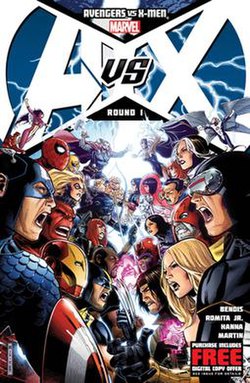
Avengers vs. X-Men #1 Thoughts: The I Hate Cyclops Fanclub


I honestly wasn't expecting this comic to be as good as it was, especially with Marvel clearly marketing it towards the battle boards types who don't care about plot, character, theme, style, draughtsmanship, design, or anything else but living vicariously through their favorite character being successfully violent. Thankfully, there was all of the above stuff in this first issue by Brian Michael Bendis and John Romita Jr. And the conflict started with a bang, strong enough to make me want to read more.

The most interesting part of the book is the fact that it's actually pushed Scott Summers to the point where all the previous books have only alluded; that he is actually a villain, the kind of crackpot megalomaniac to fill the void that the semi-reformed Magneto has left. His "training" of Hope represents the exact kind of cruel behavior that caused Wolverine to take half the team to the East Coast. In that scene both Magneto and Emma are dismayed by Cyclops' ruthlessness, as he's deliberately inflicting as much pain upon Hope as possible without causing any impairing injury. He claims that this was how Professor Xavier trained him, but nothing could be further from the truth. Xavier may have trained the young X-Men to fight, but he didn't make them suffer to get his point across.

In the argument between Cyclops and Captain America, Scott tells Steve Rogers that they've never done anything for the mutant species. He may have a point, but Scott's also made clear that he doesn't want anything to do with the human race, either. He's segregated all those willing to follow him on a banana republic floating away from humanity, and he's kept the X-Men out of most of the recent events in the superhero community; the X-Men didn't lift a finger to help during the Civil War or the World War Hulk stories, and they only defended their own borders during Secret Invasion, Dark Reign, and Fear Itself. Now he plans to doom all of human and mutant kind by trying to use the Phoenix, reborn in Hope, to revive the mutant species. Maybe he actually believes he can control the Phoenix, but more likely he's so obsessed with his goals that he doesn't even care about who dies.

All of which would still make him a sympathetic antagonist if he at least cared about the individuals who make up the species he'll do anything to protect. But Cyclops is now no better than Joseph Kony, treating anyone in his army-- no matter how young-- as an expendable weapon. His final line, that Hope no longer has any say over what happens to her, is very telling. Hopefully now that he's crossed the moral event horizon, he'll finally get what he deserves.

Friday, December 24, 2010

The Limp Arrow Awards For Worst Comics Of 2010


Originally I had entitled these end-of-year rant posts the "Humperdoozie ", after the inbred descendant of Christ from Preacher. However, I realized that might come across as though I equate crappy comics with developmental disabilities, and I don't want that. So I've changed the award name to something more specific and less offensive-- except to people who can't get it up because of nanite arm stump infection. Fortunately, none of them are coming forward any time soon.

Here's the best way I can express my opinion about the year's comics-- 2010 was the year when I stopped identifying myself as a superhero comic fan. I'd enjoyed a lot of the stuff from 2009, and I still enjoyed some things in 2010. But this was the year where I finally emancipated myself from specific allegiances, because I'd found other interests that filled the void. I've found franchise superhero comics largely an Ouroburos that somehow kept finding more of its tail upon which to nosh, and I don't know if it was just getting fed up with the directions of comics, or focusing my attention on other mediums that told the kinds of stories I actually wanted to see.

But let's put it this way...you know how Mark Millar wrote his own afterword for Superior #1, saying about how comics fans needed new superhero characters to replace the tired constructs of the Golden and Silver Ages? Well, I found my new hero. His name is Solid Snake. :P

Anyway, onwards with the awards...

Worst Story Resolution: X-Men: Second Coming. After dragging the DeciMation out for five years, Marvel resolves it via living deus ex machina Hope Summers, whose Phoenix powers revive the mutant race with....five new mutants. That's equal to the amount of mutants killed in the crossover, significantly less than the amount of mutants killed since the DeciMation, and not even remotely worth the moral compromises Cyclops made in the name of chasing a messiah child without any evidence to support his faith. Yet now Cyclops is the hero, and everyone loves him, even though he's treated every mutant he wasn't sleeping with (re: every mutant except Emma and maybe Wolverine ) as expendable. Seeing Scott awarded the Medal of Honor by Captain America was especially jarring, since Cap wouldn't have stood for the shit Scott did, even in a wartime situation.

Worst New Direction: JMS' Superman. Walking through small towns trying to find the real America was corny when Green Lantern and Green Arrow did it in the 70's. But at least they were open to learning from their experience. Superman's just ditching his responsibilities to the entire world so he can slum it with mere mortals and feel better about himself. At best he's a politician going on a campaign trail to win his constituents' favor, and at worst he's an anthropologist fascinated by the behavior of us chimpanzees. Neither seems like a good use of his talents, and it's an especially jarring waste of a year's worth of comics.

Worst Move For Diversity Of Representation: DC Comics killing off the Ryan Choi Atom. Was Ray Palmer such an original and compelling personality that he had to return to the role at the cost of the new guy's life? What made him so much more " iconic " in that minor role, that he would have his competition eliminated by divine intervention...oh, wait, he's a white Silver Age character. And Ryan's a Chinese-American from the current generation. That explains it, and it's hardly the only example of the classic white guys taking back roles from their more diverse counterparts. At least in this case, people who enjoyed the All-New Atom comic/don't enjoy DC's current direction got a karmic bone by seeing the villain who killed Ryan sentenced to death by Snoo-Snoo.

Worst Comic About A Junkie Ex-Sideckick Who Cradles A Dead Cat During A Heroin Hallucination After Being Unable To Get It Up With The Supervillain Babymama Of His Dead Daughter Due To A Nanobot Infection In His Arm Stump: Rise of Arsenal. Okay, it didn't have too much competiton, but still, you can't make that shit up. At least, you couldn't until a professional writer DID.

Worst Trend: Identity Sub-Franchising. The Incredible Hulk has become The Incredible Hulks, with every character of his supporting cast now being a similar gamma-powered monster. Batman has become Batman Inc., franchising his identity built through a lifetime of suffering out to anyone who passes the job interview. Wolverine's gone from a solo X-Men spin-off to his own franchise, with a team book of is own and books for his clone daughter and evil son. There are two Captain Americas, a family of Flashes, and a Lantern Corps of every color. Has everyonejust given up on the idea that being a superhero can be inherently special? Or is it just

Limp Arrow 2010 Lifetime Unachievement Award: Mark Millar. See the above comment, except that his " new " concepts are a book about comic book fanboys playing at being heroes, a book about a Batman rip-off acting like a Joker rip-off, and a book about a Shazam rip-off. If you don't want to do the same old thing as everyone else, don't do the same old thing as everyone else! Filing off the serial numbers and adding a lot of swearing and "timely" pop culture references isn't good enough.

Sunday, January 10, 2010

Joss Whedon, Cyclops, and Overcoming Brain Damage Through Willpower

Joss Whedon, accomplished writer of television, films, comics, and online musicals, has a lot to say about issues of identity. The good news is that he offers a genuinely unique perspective, and openly addresses identity politics ( particularly gender and sexuality ) in pop cultural spaces where others blissfully ignore them. The bad news is that his messages, as expressed by his ensemble casts of sci-fi anti-heroes, don't always succeed. Then again, this is another product of Whedon's constant experimenting; he'll follow Buffy Season Five with Buffy Season Six.

When Joss Whedon took on writing the X-Men with his artistic collaborator John Cassaday, it seemed as though he would be exploring identity issues thoroughly-- given how Marvel mutants have been used as a metaphor for any group to ever experience systemic oppression, this would give him ready-made tools to tell those sorts of stories. As it turned out, he and Cassaday preferred to tell their own version of the " classic " X-Men formula, which tends to put them on various sci-fi " vacation " adventures instead of dealing with their race's problems. But there was one disability-themed issue that was brought up by the text-- and then tossed aside in the final act, not to be picked up by his successors.

The question Whedon raised was; why can't Cyclops control his eye beams? Was it because of head trauma, or was it really because of a psychological block from childhood?

As anyone who has read/watched an X-Men story for a five minute interval knows, Scott " Cyclops " Summers' life has been one big conga line of tragedy and despair. Not only did he grow up in an orphanage, after his parents " died "* in a plane crash and his brother was adopted instead of him, but Scott's mutant powers manifested as force blasts that poured out of his eyes, unable to be contained except by his eyelids or his " ruby quartz "** eyewear. At times it has been suggested that Scott's mutant power would naturally have been something he could control, were it not for the head injury he sustained in that fateful plane crash. So, aside from the occasional plot deus ex machina temporarily healing his skull, Scott remains unable to control his optic blasts, and lives in a state of constant self-control and emotional repression.

What Whedon did was have his morally ambiguous new girlfriend/former enemy Emma Frost give Scott a psychic " therapy session ", where Scott was taken on a tour through his many insecurities and traumas, and was confronted with the truth about his lack of power control-- at some point in his childhood, Scott subconsciously decided to make his optic blasts uncontrollable, so he would be forced to stay constantly vigilant. At that point, Cyclops decides to make another choice, and switches his power to " Off "-- for most of the second half of Whedon's story, he's basically a regular human in an X-Men jacket, his eyes even returning to their natural brown instead of a red glow.

There are two ways to view this story; one, that Whedon had Scott really deconstruct why his abilities are such a convenient curse, and another, that Whedon is equating real physical brain damage with a psychological problem you can just " snap out of ". The latter would be a problem if it were a real person's medical history being misrepresented, instead of a fictional superhero with a science-defying power*** who's been around in 47 years of stories that often contradict each other and keep him from aging past 29. As it stands, I can accept that Scott's lack of control is due to deep-seated PTSD instead of brain injury, not only because I don't want to bother with the rigors of making it fit or not within continuity, but because it's " all in your head " doesn't make it any less real or painful. However, the deconstruction would only work if it was part of an ongoing story where Cyclops further learns about how to master his powers and his emotions alike.

Since Whedon was only writing the X-Men for two years' worth of stories****, he did not take Scott much further on the journey. No, what Whedon did-- which is the really troubling part-- is show that ultimately Scott could control his optic blasts without completely shutting them off, but all this amounts to is a surprise attack against an unsuspecting bad guy. As he explains to Emma later, it is possible for him to control his power, but it takes a tremendous amount of willpower, and too taxing despite the " clarity " he feels.

So what we have is not that Scott is unable to control his blasts because of physical disability or mental illness; the problem is that he can control his power, but it's just very hard and not worth the strain. Are we supposed to infer that Scott is now content having force beams that can smash a tank constantly pouring out of his eyes, held back only by gaudy red eyewear? Is it that he's too weak and/or lazy to want total control, despite his entire life being one desperate attempt to hold onto what little order he can find? Or is the message that Scott has accepted that there's an aspect to him that he can't control, and has found piece with it?

Whatever Whedon was trying to say with this story, it doesn't matter-- it's never come up again, and Scott's still forced to wear his mask 24/7. And since Whedon didn't really go deep enough into the issue to allow for any well-founded interpretation, it's just another interesting failure for the man's catalog*****, the exploration of trauma and recovery reduced to another ill-conceived sci-fi sub-plot.

* ( As any X-Fan knows, they didn't really die, but I try to keep the backstory minimal in these essays. With the X-Men, this is a Herculean endeavor. )
** ( Why ruby quartz? Co-creator Stan Lee thought it sounded cool. Things like this make the literary reader of pop culture increasingly self-conscious about their analysis. )
*** ( According to one of the Marvel handbooks, he doesn't have eyes so much as portals to another dimension that unleash energy, with a psychic field allowing him the experience of sight, or some such. I don't think he'd have a normal human brain structure to begin with if this is the case. )
**** ( Due to delays, it took twice that long. I'm pointing it out here before it's inevitably derided by someone else. )
***** ( Which also includes Willow going from curious about sexuality to a stereotypical self-proclaimed Wicca Lesbian, Spike struggling to prove that he can be good without a soul only to get one himself and void the discussion, and pretty much every episode of Dollhouse on a conceptual level. )

Sunday, December 20, 2009

The 2009 Humperdoozie Awards for Exceptional Blundering in American Comics

Last year, I wrote the first Humpredoozies* article, listing the dumbest things that I thought Western publishers did. Looking back, I have to admit that 2008 was quite a bit worse for comics, and this year has seen better output overall; there will always be complete turkeys in comics, but it's much less common that great work is produced, and this year's given us Chew, Asterios Polyp, Beasts of Burden, World's Most Wanted, and Dick and Damien's Excellent Adventure**, as well as more consistently good work from continuing series. I also have to admit that I should have actually written a column on the stuff I liked that year, instead of just promising it. 2008 me was far weaker at this blogging thing, but 2009 will avenge the mistakes of the past and punch them in the weiner.

But as I said, there will always be complete turkeys, and the Humperdoozies award the worst of the worst-- the comics that aren't just weakly written and drawn, but do something outstandingly stupid and reach a level of suck that isn't just forgettable, but repellant. Every medium has its flops, but comics have a smaller audience than most-- and while that means great things can happen due to the lack of supervision, it also means a tendency for asylums staffed with inmates. So without further ado, here those allegorical inmates are...

THE RORY GILMORE AWARD FOR MOST REPREHENSIBLE PROTAGONIST: Cyclops, Uncanny X-Men by Matt Fraction, Greg Land, and the Dodsons. I name this award for the young co-star of the excellent Gilmore Girls show, who became more spoiled, egotistical, and self-destructive as the show went on ( and yes, I am a heterosexual man AND a fan of GGs ). And even as Rory moved away from her mother's hard-working values to her grandparents' WASPy decadence, developed tastes in men similar to those of Eva Braun, commit actual crimes without remorse or significant consequence, and all the while acted like she was still a great student and a good person with unique insights-- it seemed that the show's writers were coming very close to acknowledging what a reprehensible, vapid bitch Rory had become, but didn't actually go through with it. Such is the case with Cyclops, the first and once greatest of the X-Man.

People have commented that Scott Summers has gone downhill since he left his saintly wife Jean Grey for the profoundly immodest ex-villainess Emma Frost, but now his decisions are even less moral than hers. What's more, Scott's not even good at being a manipulative bastard-- his schemes are bluntly obvious and only succeed on luck. He didn't defeat Norman Osborn-- he just moved the mutant community to an offshore island, cowering from Norman's dark reign in international waters. He stopped Ares and Sentry, but only did so by having two of his people make deals with even worse forces ( Hela, and the Void, respectively ). He didn't bother to think through little concerns like food, electricity, indoor plumbing, or NOT HAVING THE FUCKING THING SINK INTO THE OCEAN before he made his island nation. And he's still commanding the X-Force squad of mutant assassins, a PR nightmare in the making so great that even the Red Hulk scoffs at it. Yet even though he's done nothing except buy mutantkind time against inevitable destruction, much of which wouldn't have come about if he'd actually gotten his shit together, Scott still believes he's a great leader with a master plan.

And apparently so does Matt Fraction, because at the end of the day, Scott is still treated as the great hero whose master plan justifies throwing out Xavier's founding mission of peaceful co-existence in favor of an isolationist, segregated mutant nation on a desolate ocean rock. Meanwhile, the other X-Men comics have to deal with the nonsense status quo of Nation X, and every time a character appears in the same panel as Cyclops and isn't causing him physical and/or emotional harm, their heroism loses credibility.

THE WOLFENSTEIN 2D AWARD FOR NEEDLESS BLOODSHED ON PAGE: Blackest Night and tie-ins, by DC Comics. The past few years have seen DC's superhero comics go from being PG to practically R-rated in terms of gore. Whatever the quality of the stories have been, there seems to be an encouragement for horror-movie levels of violence. Except, unlike the better horror movies, the bright spandex trappings of the DC Universe make such displays of gorn the kind of thing you wish were joking about. Comedic heroes get capped in the head, animal sidekicks devour their owners, Black Adam has become so good at ripping people apart that he can rip someone in half with one hand while the other plays with himself, and Superboy Prime seems to be a deliberate self-parody-- he wants things to be the traditional way he remembers them, but he unleashes an orgy of dismemberment to get it every time he appears.

However, I would rather have a superhero universe that doesn't revel in blood and guts instead of one that lampshades itself and doesn't do anything about it-- and if Blackest Night is any indication, it's just going to get worse. The many characters who have died are back-- except, to further indicate why most DC writers would be a more comfortable fit on the scripts to the next few dozen SAW movies, they're back as evil zombies!*** And they go forth to further kill and eat the surviving heroes, all the while giving long speeches about how the heroes are such failures. Yes, DC Comics have finally become one big horror movie. Now they just need to ditch all the superheroes in favor of nubile teenage cannon fodder in Abercombie and Fitch decor, so they can finally stop pretending they're doing anything else.

THE KURT COBAIN AND MORTAL KOMBAT AWARD FOR POINTLESS NINETIES NOSTALGIA: Invincible 60. Granted, Image United was a more blatant example ( though I didn't read it and don't plan to ) but this " summer crossover in one issue " guest-starring everyone Image still has some rights to was really frustrating. Certainly it was an interesting idea, and far and away preferrable to Marvel or DC dragging these stories across their entire respective lines for months, but I really hoped for better from Kirkman. Invincible is one of the best superhero comics on the stands, and a prime example of how creator-owned stories are good even for traditional genre fare-- a major reason being because they don't have to deal with such crossover nonsense and can just get to the meat of the story. But this comic, which wastes many pages on casts of characters from other creators' books who will not have any meaningful development here, fell into the avoidable excesses of the rest of the superhero genre. And since many of these Image all-stars aren't big commercial draws for anyone except fans of 1990's superhero comics that didn't stop holding a torch for shoulder pads and BFGs, I don't even know if it was so important that they appear on the pages themselves, as opposed to just the cover.

Suffice to say, I give Invincible 60 this award because while the main story was good, it didn't need so much page space devoted to the crossover orgy, and that detracted from the Invincible series at hand.

THE REPETITIVE REDUNDANCY AND REDUNDANT REPETITION AWARD: Tie between Flash: Rebirth and Superman: Secret Origin, DC Comics. Geoff Johns' Green Lantern reboot has been extremely successful, even though people initially questioned the wisdom of bringing back long-dead Silver Age hero Hal Jordan. Since it's proven successful, DC has to respond the only way a big comic company in charge of a shared superhero universe can; beat that approach into the ground until it stops selling. Case in point; two series with themes and even titles lifted from key Green Lantern stories, both also written by Geoff Johns, just applied to different characters.

However, while the approach has been applied to different characters, it's been done so in a way that doesn't fit the individual case. Hal Jordan's return can be justified by the fact that he'd had a sloppily written and inconclusive death/fall from grace, and excising the Green Lantern Corps from the franchise in favor of a Peter Parker Expy being the center of attention sacrificed too much. But Barry Allen had an extremely conclusive and memorable heroic over two decades ago, and his replacement Wally West had proven himself a worthy replacement in that time ( including the many Wally West Flash stories at the hand of Geoff Johns himself ). Similarly, Green Lantern: Secret Origin was a beneficial update to Hal Jordan's backstory that helped foreshadow new developments in the series, while the Superman story; well, everyone with a passing familiarity with superheroes knows Superman, and he's already had a great many origin retellings, so why yet another one?

Since Johns is writing, there's a high degree of craft involved, and the artists are excellent for both, but I would hate to have material for " The Geoff Johns Story Blueprint ", especially if I have to write " The Geoff Johns story wallows in the past regardless of the quality of the present ".

THE CRY FOR JUSTICE AWARD FOR BEING CRY FOR JUSTICE: Cry for Justice, DC Comics. Yes, Cry for Justice falls into the " Shaped like Itself " category, because this thing is so profoundly ridiculous that it doesn't fit into anyone category. The creative team was promising-- James Robinson is a respected veteran of DC comics, and the shots we saw from digital painter Mauro Cascoli were beautifu, but in practice all they've done is create a work that takes itself far more seriously than it should. It's similar to Blackest Night in terms of the violence, but instead of taking refuge in horror-movie audacity, it treats itself like Big PRestigious Story in the vein of Kingdom Come-- and fails spectacularly at doing so.

To the people outside the DC Comics offices ( and probably a few inside, if they care to admit it ), this is not a great work. It is a ridiculous story that treats some of the biggest cliches' in superhero comics like they're somehow novel. The veteran heroes who decide to take a hard line against super-crime are not only ripping off books like X-Force and the Authority that have been doing that for many years, but they're quite obviously echoing the use of torture in the War on Terror, without doing it in a context with even the slightest resemblance to the real world's depth. So, instead of increased stakes for the Justice League, we get the protagonists coming off as grumpy old men, trying to use the tactics of the people they're trying to keep off their lawns.

And it just gets worse from there. Characters are brought from various corridors of the DCU to receive grim-and-gritty updates-- Congo Bill, a human mind in an ancient gorilla body, comes in to weep over his fallen brethren and demand vengeance himself. The Atom, a character with the inherently unimpressive power of shrinking, uses it to step inside captives' heads and interrogate them by stomping on their brains ( and he does it so often even the characters in the work itself get tired of it ). Black Canary is kept absent for the first part, but later comes back to chastise her husband Green Arrow for his actions-- and, because apparently having her as a strong independent heroine wasn't kosher, her complaints are more about him neglecting her feelings than his team's use of TORTURE. Meanwhile, the token female on the main cast is the teenaged Supergirl-- hanging out with a bunch of middle-aged men, with only Captain Marvel Jr. around to diffuse the impression that she's just their shared Lolita.

The story is profoudnly melodramatic. The art would be good in another title, but that would be providing said title wasn't trying so hard to impress the audience. The dialogue is some of the clunkiest ever printed in a professional work ( " We want Prometheus! And justice, when you get down to it. " ). And even amidst the release of Blackest Night, the scene in the latest issue with Roy Harper getting his arm ripped off manages to out-gorn most of its competition for pointless dismemberment. If there's one consolation, it's that this has been an unintentionally hilarious comic. But it wasn't shipped as " Laugh at Justice ", right?

THE HUMPERDOOZIES 2009 LIFETIME UNDERACHIEVEMENT AWARD: Greg Land, Uncanny X-Men. Last year I gave this prize to Jeph Loeb, who hasn't stopped doing ridiculously stupid scripts since then, but hasn't topped himself either. I also gave an award to Greg Land last year, and he hasn't changed his style-- so he wins it this year. Comic companies will always do stupid things, but rarely will they do stuff that is outright angering beyond the parameters of regular nerd rage-- and Land's continuing work fits.

Everything about Land's art that can be said has been said-- it's overly surface, the character poses are stiff and lifeless, the faces are almost universally identical to each other, the scenes use reference material to the point of plagiarism, and the women are drawn like porn stars ( even teenaged characters; perhaps I should have named this " The Roman Polanski Award " ) . And yet, he's still drawing the X-Men as half of the regular art team. Apparently, since he gets work done on time and looks pretty in an air-brushed sort of way, the nigh-complete deterioration of his willingness to do original work and express something unique with his art is an acceptable loss. This isn't just goofy art in the realm of Rob Liefeld, which at least has some endearing qualities in its technical flaws and masculine excess. This is the kind of art that is offensively bad, and deserves as little respect as the artist apparently has for his audience.

Well, I have less anger at comics this year, and I hope that I'll have even less to rant about next year, but somehow I doubt that.

* Named for the calling cry of the Grail's Messiah in Preacher, who came from Christ's bloodline, but is the result of so many centuries of inbreeding that he's regressed a few million years of evolution. " Son of God or son of Man, you don't fuck your sister and expect much good to come of it ", to paraphrase Herr Starr, that still seems to be what comic book companies excel at with their publishing decisions.
** Batman and Robin, but since that's the main story hook of the new direction, that's how I'll be referencing it.
*** I'm aware that DC editors have gone on record to argue that the Blackest Night villains aren't zombies, since they're not shambling and mindless. But they're still undead, butt-ugly, evil, and make living beings into similarly undead, butt-ugly, and evil creatures. If it looks like a duck, quacks like a duck, etc..

Monday, September 28, 2009

Uncanny X-Men 515; What Cyclops Needs

As the X-Men emerge from the Dark Reign crossover Utopia, now as an isolationist nation with an almost entirely mutant population ( a good summary can be found in Newsarama's review here ), I continue to be baffled as to what writer Matt Fraction is trying to do with the X-Men's leadership. And this generally isn't a good sign for an ongoing superhero comic in the traditional model, when you have no idea if you're supposed to be reading the book ironically; is Scott Summers supposed to be a brave leader in charge of tough decisions, or is he a blundering fool?

The presentation of the character in the last issue makes him seem especially unclear. Mere moments after securing his borders, Cyclops is finally getting around to making the X-Men's island a place that can actually support a population. He's just getting to giving orders to set up food and water and power, and it's clear that the other X-Men are quickly losing faith in him. At the same time, he's acting as though he's in charge and knows what he's doing, requesting that the other mutants have faith in what he's doing. He even tells his old mentor Charles " You had a dream, I have a plan ". Except that he hasn't had a plan, he's just been stumbling around from crisis to crisis, barely breaking even.

We see that Scott Summers is breaking under the pressure of being the mutant messiah; his few quiet moments show the man completely wiped out, like he's a feather's tap away from a nervous breakdown. But he's still acting as though he's the strong, confident leader. He's making decisions, they're just really sloppy, spur-of-the-moment ones. It's like he went completely mad years ago and nobody told him.

Which makes sense given the character's backstory-- this is a man who constantly has to be careful of the death rays coming from his eyes, who was orphaned at a young age and taken in by a strange telepathic teacher who molded him into a soldier ( instead of a son ), who has been in love with one woman to the point of being with three alternate versions of her, and who recently betrayed that woman to give into a mistress ( Emma ) that appealed to his repressed desires. Except that the " Cyclops is too riddled with PTSD to be a credible leader " plot has been going on for years now. And the other X-Men haven't done jack or shit about it; they're clearly questioning his ability to save the mutant race, but they still follow him.

It's a tremendous elephant in the room, and it's going from being interesting to being maddeningly frustrating. I think at this point, the other X-Men should stage an intervention for the guy, all of his closest friends confronting him on just how damaged he is. Instead of Hank being catty ( okay, pun intended ) about Scott's poor choices, or even leaving the team in a hissy fit, how about Hank telling Scott about how he hasn't dealt with his problems? Instead of Logan slapping Scott in the face every time X-Force gets another insane murder mission, how about Logan invoking Jean Grey's name to remind Scott of how far he's fallen?

It'd certainly be better to see one of the series' most important characters build back up, instead of remaining broken and pretending otherwise.