Ruby Nation

Ruby Nation
Ruby Nation: The Webcomic
Showing posts with label marvel. Show all posts

Tuesday, September 2, 2014

Drax Isn't Autistic, And Applicability Isn't Enough


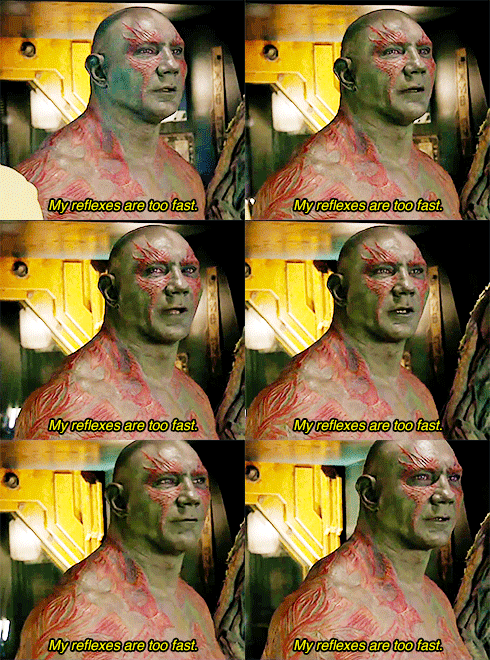
I assume that the readers of this blog, like most of America at this point, has seen or at least heard of the Guardians of the Galaxy. I also assume that readers of this blog, like most people on social media within some sort of fandom, have seen this widely circulated post about how a fan's autistic little brother connected strongly to Drax the Destroyer, as he also had difficulties with figurative language. This is a heartwarming vignette in microcosm, that a boy who has difficulties relating to people found solace in a superhero character who also has difficulties with metaphors (albeit due to his species and not his neurology). In macrocosm, unfortunately, it means little for representation of autism in popular fiction and only serves to underscore Hollywood's exclusion of difference, except on carefully controlled terms.

Because while Drax the Destroyer may have similarities to autistic spectrum traits, most notably his inability to grasp metaphors but also his restricted interests; his abilities in battle can be best described as savant-like. Unfortunately, none of that was intentional. In the movie*, Drax is an alien from a species who, like most alien species in fiction written by human beings, has a very restricted civilization with limited diversity of personality. A lack of figurative language is apparently universal across his species, and in the movie it serves as little more than a running gag. Drax no more represents an autistic experience than Groot represents a nonverbal experience, because both are completely fantastical characters who only connect back to real disability experiences if the audience is actively willing to apply those experiences to the characters.

The boy mentioned in the post was able to make the connection because Drax's quirks overlap substantially with his own life experience. The majority of people without autism (including those who have autistic loved ones; would the boy's sister who made the post have made the connection if her brother hadn't brought it up first?) would just see Drax as a big green dolt with some funny lines at his unwitting expense. Other people with autism might also not connect Drax's experiences to their own; I certainly did, even though I completely understand the desire to see other autistic people in fiction (and have even speculated about some characters being on the spectrum). It's incredibly unlikely that Drax would've adapted as an autistic character for this movie, and even if he were, he probably would've manifested as the usual stereotypes of the nerdy and physically incapable savant, who represents a constant burden on his loved ones. He likely would not have gotten any meaningful character development**, such as Drax's admission that his desire for revenge was ultimately just a cover for his grief over the death of his wife and child. An explicitly autistic character probably wouldn't get a wife and child in the first place, instead swearing vengeance for a long-suffering mother or a destroyed model train or any other stereotype that only reflects a disinterested outsider's willfully shallow understanding of the autism spectrum experience.

Of course, that's the larger problem with the Marvel Cinematic Universe; even if it has diverse characters, it's still subservient to the Hollywood Narrative, and demands a straight, white, male, and neurotypical star. Dave Bautista proved in this movie that he's a talented actor as well as an imposing physical presence and MMA fighter, but they wouldn't make him the protagonist of a movie that cost so much to make and was advertised so thoroughly. They'd probably be even less likely to put him in the lead if he weren't covered in green and red paint, and instead appeared as his mixed-Filipino-Greek self. Same goes for Zoe Saldana's Gamora, a Dominican actress whose biggest roles were as a blue elf giantess and as a green alien warrior***. The Marvel Studios movies may have had strong results by casting unlikely choices, but the movies, like the comics before them, still started with all attractive white guys. It might've been a strange casting choice to have Andy Dwyer from Parks and Recreation (a.k.a. Chris Pratt, a.k.a. BERT MACKLIN, FBI) as Peter Quill, but it was a million times more likely that they'd cast Chris Pratt than Aziz Ansari****.

There's still a clear heirarchy of what the producers funding these multimillion-dollar special effects orgies will allow. Handsome white dudes first, women and racial minorities second if at all, disabled characters never (unless as villains). They think audiences are willing to accept raccoons and trees as star characters before the physically and/or mentally "infirm". If audience members with disabilities identify with those characters, bully for them, but it's not going to make a green alien brute anything more than a green alien brute for the rest of the world-- least of all for the people actually making this stuff.

Perhaps I'm being too harsh, and I should be grateful that we even got this little story doing the social media rounds. Perhaps that's just the way representation works, that baby steps are all that can be expected from media aimed at a wide audience. You don't get to complex and sympathetic gay characters like Hulkling and Wiccan before you do the heavy-handed " Northstar is gay and is yammering on about AIDS" story, just like you don't get to Chris Claremont's powerful and alluring Storm before you get years of Stan Lee's***** useless, weepy female love interests. But social media has, for better or worse, made conversations of representation and privilege much more relevant now than they've ever been. And at some point, when real life gives you enough shit and the fiction in which you would normally find solace now appears all too complicit, you just gotta say-- Not. Good. Enough.

* Yes, I'm aware that Drax in the comics is a human spirit placed in a powerful body like Thanos, but that's not really relevant to the films. Just like Thanos in the comics is Jim Starlin's avatar of Freudian themes in love with a literal personification of Death, instead of a generic Big Bad who's yet to actually dirty his own hands.
** In so far as the movie had character developments. As a film, it's extremely predictable, and the humor is its saving grace. Similar to the Pirates of the Carribean films, the absurdist nature of the humor and the talents of its cast are all that stand between it and banality, though at least GotG has more to rely on that one Johnny Depp.
*** Yes, I'm also aware that Saldana was also Uhura, as well as Columbiana, Aisha from the Losers, and plenty of other roles that don't involve explosions, but my point still stands.
**** I would pay so much to see Tom Haverford as Star-Lord. Aziz Ansari has the "Small Name, Big Ego" character down to a science.
***** Edited because I've been aware that Stan Lee did write some great female characters as well, such as Medusa

Friday, January 17, 2014

I Got Issues Comic Reviews for 1/15/2014: Velvet, Miracleman, Amazing X-Men, and Ultimate Ultimates


Another week, another stack of comics (though unfortunately I couldn't find a copy of Voice in the Dark #3).

AMAZING X-MEN #3: The art by Ed McGuinness is an absolute dream, full of excitement and energy in every panel. The story is at this point mostly an excuse to give Ed McGuiness exciting things to draw. It's a Jason Aaron X-Men comic, which means it's full of wacky high-concept stuff first and characterization second. The interactions between the characters are perfunctory, especially with the obvious character shipping (and the revelation that Nightcrawler and Storm have always been in love with each other, and didn't Aaron just pair her up with Wolverine? Either she's polyamorous, which I wouldn't mind, or pairing her up is the most interesting thing Aaron has planned for Ororo, which I would seriously mind)At least this doesn't have any overbearingly wacky stuff like the 12-year-old Hellfire Club (literally the most annoying team of villains in Marvel history, from my perspective at least), but it's still a comic about the X-Men joining Nightcrawler in the afterlife to fight Satan and his pirate crew. In other words, it's the Axe Cop of the X-Men. But again, great art. RECOMMENDED.

ULTIMATE COMICS CATACLYSM: THE ULTIMATES #3: The Ultimate comics have stuck around far longer than they should have, the promise of a simpler, more relatable Marvel Universe long since expired in favor of a bunch of earth-shaking cataclysms. Galactus eating the world is the third time we've seen this happen, but this tie-in by Josh Fialkov and Carmine di Giandomenico has been surprisingly entertaining. It takes the rather predictable doomsday set-up and uses it to do a fast-paced, snappily-written story with a snarkier take on the formula. Since the story has Nick Fury's Ultimate Howling Commandos (re: a bunch of second and third stringers, such as Ultimate Stature and Ultimate Hercules) on an essential doomsday mission against a techno-organic Gah Lak Tus cult. The characters are suitably dysfunctional, but there's a bit of pathos too with Danny Ketch's dying words, and his eventual fate. It doesn't really end, but it's interesting enough that I'll actually try the Ultimate FF book that follows. The art by Carmine di Giandomenico is exceptional too, which nearly matches the widescreen detail of Bryan Hitch but has a fluid, expressive line more appealing than the usual "photo-realism" we see in this sort of book. RECOMMENDED.

MIRACLEMAN #1: It's 12 pages of the Alan Moore/Garry Leach run padded out with old Mick Anglo strips for childred and extra material for a price of $5.99. The great lost work of Western comics is why people are here, but it's not even the majority of the product; Marvel's gouging the audience who'd buy this for all they're worth. I'd never read the original Miracleman stories, so I can't really judge the overall story. This prologue is beautifully drawn by Leach, but the script is extremely familiar in its portrayal of the superhero as an outlet for a mid-life crisis-- though that's be due to its influence, both on Moore's later works and the genre in general. Still, this issue itself is an expensive curio, so I'd have to give it a MILDLY RECOMMENDED.

VELVET #3: It's great that Ed Brubaker and Steve Epting, two creators perhaps best known for the Winter Soldier story of Captain America, can now do their thing unfettered by Marvel franchises and apparently make a living at it as well. In this case it's Velvet, a.k.a. "what if Moneypenny went on a rampage to avenge a dead James Bond". It kind of defies belief that Velvet can be such a strong action heroine at her age (at least in her fifties) with her long retirement from field work, but given how my favorite spy story involves a man physically in his seventies fighting against mooing robots and nanotech vampires, I'm in no position to complain. This is the sort of story that seems like a perfectly natural take on the high concept, but still comes across as novel and exciting. Velvet's perspective as a woman offers her a distinct insight in to the Martini-flavored spy game, as she's a PROTAGONIST who uses the Honey Trap techniques instead of a love interest/femme fatale. Everything about this book, from the script to the art to the coloring to the basic magazine design with the white gutters, just works. STRONGLY RECOMMENDED.

Wednesday, January 15, 2014

Top 10 Better Alan Moore Miracleman Reprint Credits than "The Original Writer"


Marvel has enough brass to reprint Miracleman against Moore's wishes without actually putting his name on the book, but why stop there...

--Prospero
--Jordan Elliott
--Alan Smithee
--Storybook Smith
--Mallan Oore
--Captain Adam
--The Occupier
--Kid Moore
--Sodam Yat
--Alan Morrison

Friday, January 10, 2014

I Got Issues Comic Reviews Week of 1/8/2014: Sex Criminals, Kamala Khan, Sad Wolverine, and the Colonial Iron Man


Trying a new format for reviewing comics, so these aren't going to go over two paragraphs each; I'm going for expedience as well as quality critique. So here's what I read this week...

Sex Criminals #4: Matt Fraction and Chip Zdarsky's painfully realistic story about people who stop time when they fuck continues. In this issue, Jon and Suzie meet even more people with their "condition", albeit a peacekeeping force who apprehend the Quiet's so-called "Sex Criminals"(TITLE DROP!). While I'm not entirely sold on the world-building of the Sex Police, that's not really the point; this is still Suzie's story, and about how her condition adds even greater complexity to the already nigh-incomprehensible territory of human intimacy. The best parts are still Suzie's narration, as she talks about her past and what sorts of things she did during the Quiet (including her first illegal activity, using the time freeze to frame her friend's rapist college boyfriend for marijuana possession-- a morally ambiguous approach with a similarly ambiguous outcome).

With Fraction's script and Chip Zdarsky's expressive art and detailed backgrounds (including some of the greatest ambient detail ever depicted for a store called "Cumworld", Sex Criminals continues to be the frank, mature sex talk the medium so badly needs. STRONGLY RECOMMENDED.

Wolverine #13; The finale of Killable, setting up the new direction for the supervillainous relaunch. As expected, Wolverine has no chance against Sabretooth without his healing factor. Sabretooth doesn't kill Logan, but instead takes the opportunity to rub Logan's mortality in his face, lecturing him on how they're not so different and how Logan's moral hypocrisies are unavoidable without his regenerative crutch. It's a brutal scene, and one of the few effective uses of the Origin continuity that I've seen, since Sabretooth calls attention to the fact that underneath his stereotypical man's man demeanor, Logan was still born as sissy nobleman's son James Howlett, and his attempt to be the blue collar hero falls apart given his privilege (both the initial wealth and the later, now absent mutant indestructibility). I hope that Sabretooth gets his not-so-inevitable comeuppance from Logan, though; similar to the Joker or the Green Goblin, Sabretooth is the kind of Complete Monster arch-villain who enjoys the kind of invincibility only a shared universe allows, and the fact that such rotten characters haven't been killed (in a permanent manner, at least) demonstrates an inherent futility to the nature of the shared universe superhero. At least Logan's killed Sabretooth before (though it obviously didn't stick), but the guy is one of the most successful characters in the Marvel Universe, and he owes it largely to his complete lack of moral restraint. "The best lack all conviction, and the worst are filled with passionate certainty", as Yeats would put it.

Perhaps once Logan becomes a super-villain himself, he'll learn that being a bad guy is the way to go in a world where nobody important to Marvel's bottom line really dies, healing factor or not. Until then, it's a powerful story, made all the more powerful by the choice the badly injured Logan is given towards the end. It's another moment that's simultaneously easy to predict in terms of logic but difficult to prepare for as an emotional response. Another great issue from Paul Cornell, and sadly the final issue with Alan Davis drawing-- there's a reason he's a legend in comics, and that reason is seen in effortless nature of this issue's storytelling. STRONGLY RECOMMENDED.

IRON MAN #20: Easily the weakest book I read this week, though that's partly because everything else was so great. Still, the Kieron Gillen run on Iron Man continues to underperform, competent but not at the level I'd expect from the one writer to make modern Cyclops into a sympathetic character.  There have been many extenuating factors, most notably the immediate shadow of Matt Fraction's brilliant run, the wretched Greg Land art plaguing the first year or so, but also the fact that most of it was stuck out in space due to the Guardians of the Galaxy status quo, and the fact that the Secret Origin story was resultantly told light years away from Tony's home planet. Not to mention thirtysomething years away from a point where the events within the origin story might have actually been relevant, as Tony had plenty of nurture to overcome whatever hypothetical genetic tampering would've been done to him in vitro, but I digress.

This current storyline is a mixed bag. On the one hand, there's the strong central idea of Tony building his own city over the ruins of the Mandarin's old regime, trying to create a test-bed for modern living. But it's told in such a way that it's hard to sympathize with Tony's goals. It's clear that Tony's overcompensating with this project to avoid dealing with the news that he was adopted, but we haven't really seen anything to indicate why the city is so great, other than Tony telling us that it is The City of the Future and not just a way for him to hide from his real problems within his toybox. There's the obviously problematic symbolism of Tony building a city over foreign soil without foreign consent, and the story itself acknowledges this-- but through the mouthpiece of Abigail "Red Peril" Burns, a one-dimensional anarchist strawman villain, devoid of anything but buzzwords and firepower. There's an impressive fight scene with Tony facing her using a battery of remote units (with the help of his new "brother" Arno Stark), as well as Tony cleverly wearing an invisible Iron Man suit over his street clothes. The art by Joe Bennett helps as well, and not just because it's not Greg Land. Bennett offers a strong cinematic flair reminiscent of Bryan Hitch.

I think my central problem with the current Iron Man volume is that it's obviously using a movie-style take on the character, where we're supposed to interpret the protagonist's complete disinterest in the consequences of his actions as roguishly charming. I'm much more interested in Arno's story, and the implication that he chooses not to rebuild his Iron Lung into something capable of mobility. Perhaps he's reticent to go out into the world after spending his entire life hiding, due to his comment earlier on how people tend to see people like him (i.e. handicapped geniuses) as villainous. Then again, that may be in part an excuse for the fact that such a transition would be frightening. It's a believable and sympathetic approach to a character potentially "overcoming" a disability, even if it's in going from an Iron Lung to an Iron Exoskeleton. Too bad it's not the main story. Overall, MILDLY RECOMMENDED.

ALL-NEW MARVEL NOW POINT ONE: Now this was a pleasant surprise. Six strips, and not a stinker in the bunch. I'm not going to buy all of these books, but all of the prologue stories were strong examples of craft. I'm probably not going to get the Invaders series by James Robinson and Steve Pugh, given my lack of interest in the Invaders, but it did look like a good hook for a traditional super-team comic. The Black Widow story by Nathan Edmonson and Phil Noto was also pretty good, especially the art, even if the script was a bit predictable in its portrayal of Natasha as a conflicted assassin. I'm more interested in the Loki series by Al Ewing and Lee Garbett, which has a strong grasp of the character (at least the Tom Hiddleston version that will likely be the default take from here on out). And the Avengers World strip by Jonathan Hickman, Nick Spencer, and Rags Morales could lead to something really great, provided that the writing is influenced more by Spencer than Hickman. Spencer has a strong flair for character work, which can be true for Jonathan Hickman but usually isn't, due to his greater interest in writing stories as meticulous chess games with complex plotting and strategizing taking precedence over a dramatic hook. (His Avengers is especially guilty of this, but it was foreshadowed in his Ultimates series, which started strong but quickly regressed into a demonstration of how awesome the villainous Reed Richards could be).

The two books I will definitely be buying after reading this comic are Silver Surfer by Dan Slott and Michael Allred, and especially Ms. Marvel by G. Willow Wilson and Adrian Alphona. I enjoy Dan Slott's writing quite a bit, and I like the idea of Silver Surfer getting a Doctor Who-style companion so he has someone to talk to besides his crippling sense of self-pity (and Slott uses it to his advantage by playing the Surfer's seriousness as comical in contrast to everything around him). The art by Michael Allred is beautiful as always, and the pop art charms are most important when we see the Surfer fighting a bunch of anthropomorphic sea-predator pirates. The Ms. Marvel story deserves special praise, and not just because it pisses off the right kinds of people. New 16-year-old Muslim superheroine Kamala Khan immediately shows the kind of conceptual strength right off the bat that most teenage heroes only dream of acquiring. She's a shape-shifter as a metaphor for a child of multiple cultures and demands, growing up in New Jersey under Pakistani-American parents, with both mother and father having their own sets of well-intentioned demand (the mother for the right marriage, the father for the right career). She's definitely an eccentric young woman who's immediately figured out creative uses for her powers, but there's not much room for her to express her abilities; her first superfight is limited to a monster in a junkyard, and even that's interrupted by a call from her mother. The art by Adrian Alphona is perfect, as I would expect from the artist of Runaways; he's especially good at showing Kamala's powers in action, and how awesome being able to stretch one's body and limbs can be. Too bad it doesn't help her larger identity issues, or in Kamala's words; "I can change my face, but I wear a mask instead. There are LAYERS of unpackable crazy up in here."

Based on the overall quality but also the strength of the Ms. Marvel story, STRONGLY RECOMMENDED.

Tuesday, September 10, 2013

My Interview With Webcomic Underdogs On My Comics & My Disability


" Not only are my comics therapeutic for me, but my particular conditions (co-morbid depression and anxiety as well as autism) are essential to the creative process. At its core, underneath the convoluted narrative and superhero genre trappings, Ruby Nation is a story about how our physical and mental imperfections shape us, and how we are ultimately defined by our choices in response to such trauma and isolation. I’ve used the tag-line “Broken Heroes for a Broken World”, which could also describe many of the most enduring superhero characters. A key difference in my work, however, is that the characters have realistic handicaps to go with their fantastical ones; for example, Jiro himself is autistic in addition to having a largely cybernetic body and brain. I think it makes characters more complex and ultimately sympathetic to give them that kind of texture, as opposed to simply having fantastical angst-giving handicaps (for example, Cyclops of the X-Men has brain damage that prevents him from controlling his optic blasts, but that childhood head trauma manifests in no way other than forcing him to wear his visor and frequently whine about it) "

(Full article here)

Friday, May 17, 2013

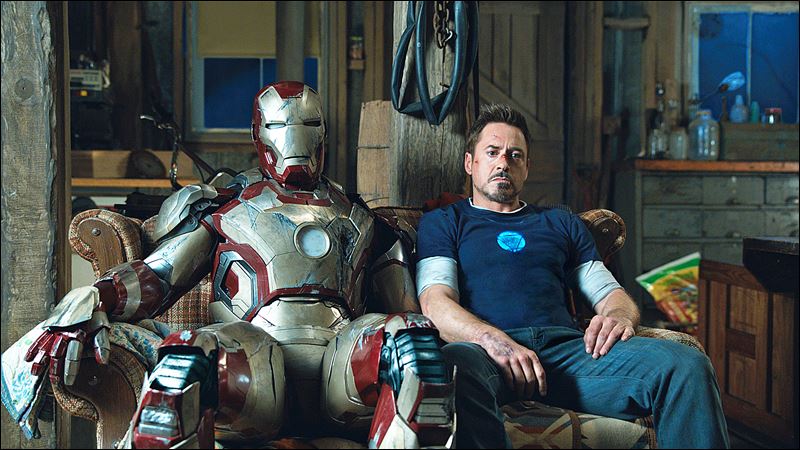
And More Of Why I Hated Iron Man 3

(Reposted from my comic blog, which you should be reading. My feelings a week later have only gotten harsher.)


Some days I am very grateful for the fact that I do an independent webcomic, with no content beyond what I create, no editing beyond what I choose, and no readers beyond a small few devoted and cherished fans. Yesterday was one of those days, because it was the day I finally saw Iron Man 3.

Iron Man 3, directed by Shane Black (replacing Jon Faverau), is not a bad movie. It has the same cast of the previous Iron Man movies (which I really enjoyed, albeit with reservations), and it had a few new characters who were played effectively. It even had some good ideas, such as Tony Stark's anxiety attacks following the events of the Avengers. However, none of those ideas got any space to breathe, and the Hollywood formula smothered the movie so that everything potentially interesting about it was diluted in a stream of explosions and one-liners.

If Iron Man 3 were played as a completely straightforward superhero movie, such as Captain America, it could've excelled at that. But the more thoughtful bits raise important questions and take them absolutely nowhere. Tony's anxiety attacks begin as a serious issue, showing a tortured mind whose view of a rational universe has been shattered in the wake of discovering gods and aliens, and who builds armor after armor in a compulsive attempt to regain his security. This is in the first act; in the second act, Tony's anxiety attacks are just reduced to comic relief as he flips out in front of a little kid, and by the third act, he's completely "overcome" them (as if you can just punch emotional problems into oblivion). 

(NOTE: EXPLICIT SPOILERS FOLLOW)

The intriguing start and piss-poor payoff continues through the rest of the movie. For example, the Mandarin is brought in as a Bin Laden-style terrorist, releasing viral videos of his deeds with messages about America's sins (SUCH AS A REFERENCE TO THE SAND CREEK MASSACRE, as an allegory for the casualties of America's nation-building in Iraq). In the second act, we see that this new interpretation of the Mandarin is just a smokescreen, as he's really just an actor hired by the main villain to distract from his real activities. This is a clever twist that plays on Orientalist fears, but it's ruined by some painfully extended comic relief sequences with actor Mandarin, and then it's completely dropped when the real villain turns out to be just another monologuing jackass, whose speech about the power of anonymity is completely ruined by the fact that he's GIVING A FUCKING SPEECH. What's more, the present-day implications of the genocide against the indigenous Americans are completely dropped, even when there's plenty of appropriate subtext (such as Jim Rhodes/War Machine going on a wild goose chase for the Mandarin while in his new Iron Patriot suit, giving third-world citizens the sight of a red-white-and-blue death machine breaking into their homes and threatening them without warning).

Everything in the movie follows this pattern. The Extremis formula, used in the comics for an interesting exploration of transhumanism (as well as its inventor Maya Hansen, a great example of a once-idealistic scientist corrupted by the military-industrial complex), just serves to make flaming villains here. Tony's compulsive armor-building, a sign of emotional turmoil, turns out to be just the thing needed to save the day in the Obligatory Climax Explosion Orgy. Even the humor scenes fail, because of how scripted they feel. Where Jon Favreau made even the weaker parts of his Iron Man movies entertaining thanks to all the ad-libs, you can tell here that there's a heavier directorial hand, and the situations (such as all the time where Tony fixes his armor with the help of the little kid) show us just how tightly they're sticking to the script and telling us THIS IS FUNNY.

It's all smothered by cliches, robbing it the opportunity to be even an interesting failure. It's not a bad movie, and I don't hold anything against its cast and crew. It's just a mediocre movie clearly ruined by the process of executive meddling, and again, it makes me very grateful I don't have to deal with that shit.

Thursday, August 9, 2012

The Fall of Hank Pym, The Avengers' Greatest Failure


It's occurred to be before that the controversy around the character of Hank Pym (a.k.a. Ant-Man/Giant-Man/Goliath/Yellowjacket/Wasp) has a mental illness component that's rarely addressed. The character has polarized Marvel readers since that 1981 issue where he struck his then-wife Janet Van Dyne (a.k.a. the Wasp)*. That issue, and the larger storyline to which it's connected, has been out of print for years, so the actual context of the event has been largely divorced from that one panel of Hank hitting Jan. But since the whole story has finally been reprinted in the Avengers: Trial of Yellowjacket trade paperback release (which I strongly recommend), there's finally the opportunity to examine Hank's deeds with closer scrutiny.

On the one hand, Hank does behave badly, and he's not so far gone that he loses responsibility for his actions. Having just re-joined the Avengers after an unsuccessful return to his scientific work (during which Jan tayed on the team), Hank's an unstable nervous wreck, and he takes his frustrations out on Jan. Jan, trying to be the good wife, tries gently reasoning with him, even though he's snapping at her over every perceived slight. What's important to note is that while the physical abuse of Jan is often brought up, the verbal and psychological abuse is downplayed, but that played just as much of a role in their divorce. At one point, when Jan's trying to decide which of her Wasp costumes she should wear to the Avengers meeting, Hank uses his Yellowjacket suit to blast one out of her hand. He's using a deadly weapon to destroy her property, and thus issuing an implicit threat. Jan doesn't say anything in response, still under the impression that she can help him (and thus continuing to enable his use of her as a scapegoat, as is so often and sadly the case).

Hank's behavior is reprehensible, and it goes beyond a domestic dispute and into nearly manslaughtering the entire Avengers. He creates a robot to attack the Avengers so he can shut it down and appear to have saved the day, but like all robots in these stories (most notably, Hank's accidental creation of Avengers arch-nemesis Ultron), it goes berserk, everyone sees through Hank's ruse, and Jan ends up shutting it down. It would be kind of hard for him to plead insanity when he had enough rational ability to make a giant killer robot, even if it ultimately couldn't be controlled. Looking closely at Hank's behavior, he's aware that he's doing the wrong things, but he ends up doing them anyway because he can't control his impulses and is so desperate to prove his worth. He doesn't try to win back the Avengers or his wife after these events, realizing the immensity what he's done; he doesn't even accept any charity, despite the fact that he was living off of Jan's trust fund and is otherwise penniless.

So yes, Hank is responsible for his sins. But while he could have controlled himself even in the context of his nervous breakdown, the event did not occur in a vacuum. Hank had previously been unstable, due to his own low self-esteem, his unhealthy relationship with Jan (a younger woman who he had nothing in common with, other than her resemblance to his dead first wife), his guilt over the creation of Ultron**, and the adverse psychological side-effects of his powers. And during this whole time, the Avengers were right there, watching but doing virtually nothing. Nobody on the team asked Hank what was bothering him. Nobody suggested therapy for him or Jan, together or separately. Nobody was worrying about his long-term mental stability, even when he fell into delusions where he thought he was another, more aggressive man. His marriage to Jan occurred when he was high on Science Chemical Fumes and called himself Yellowjacket, believing himself the murderer of the original Hank Pym. The great fraternity of superheroes was nothing more than a Greek Chorus bearing passive witness to the downward spiral of one of their founding members, up until his baggage became a physical threat.***

It's worth noting that this story happened right before the similar downward spiral of another Avengers founder; Tony Stark, a.k.a. Iron Man. At this point, most of the Avengers didn't know Tony's secret identity, and when he ended up dating Jan shortly after her divorce, she wasn't aware that she was dating one of her (and Hank's) co-workers. Tony fell for her and couldn't bring himself to tell her the truth, at least until Captain America guilt-tripped him into doing so. The result was a messy break-up that fuelled Tony's own depression, until he outright disappeared from the Avengers. This was due to the story in his own book, where the psychological warfare of Obadiah Stane caused him to sink into an alcoholic relapse. Tony's storyline was controlled by the Iron Man creative team, but you could see Tony fraying at the edges bit by bit in the Avengers, withdrawing from interacting with the team (and his ex), with nobody doing much to check in with him.

The Avengers have an absolutely abysmal track record taking care of their own. Hank is only one of the heroes to have a catastrophic nervous breakdown while on the team; the list of fallen heroes on the Avengers roster include the aforementioned Tony, Wanda Maximoff, Pietro Maximoff, Simon Williams, Clint Barton, Bruce Banner, Carol Danvers, and more. But as far as he fell, Hank managed to pick himself up. He earned Jan's forgiveness (and even a few reconciliations, however temporary), he earned his place back in the Avengers, and everything he's done since has been an act of atonement. He's not entirely stable, but nobody is immune to stress, especially not as a superhero.

Can't he get fandom's forgiveness?

*(It's worth noting that the writer of the original story, Jim Shooter, wrote the scene as Hank pushing her away with more force than intended, but the artist drew it like just another superhero fight scene; hence, an isolated incident became a scarlet letter.)
**(Who's actually killed millions of people. How come Hank gets more grief for one slap than for creating a genocidal anti-organic monster? )
***(Joe Casey's excellent Earth's Mightiest Heroes mini-series portrayed the wedding in a much darker light, where Jan and everyone else was playing along with Hank's delusion to avoid an even greater meltdown. Not sure if this makes the Avengers look better, or much, much worse.)


Wednesday, June 20, 2012

Northstar's Big Gay Wedding vs. Cyclops' Big Dumb Utopia


(First of all, I apologize for not doing more blogging here, and want to make clear that my readers here are indeed an important priority for me. So here's more content for those interested in what I think, which miraculously includes at least a few.)

Two important Marvel comics released this week. The first one was Astonishing X-Men #51, where Jean-Paul Baubier (a.k.a former Alpha Flighter and current X-Man Northstar) and his boyfriend Kyle Jinadu married in the state of New York. The other one was Avengers vs. X-Men #6, where Cyclops and four other X-Men claimed the power of the Phoenix for themselves, and used it to transform the world into a  Mutant-run Panopticon with free food, water, and energy for all- provided nobody steps out of line.

And Northstar did much more for mutant kind and the world than Cyclops did.

Scott Summers' "Pax Utopia" (as he calls it) is the kind of quick, shallow fix that characterizes almost all fictional paradises, and creates a standard that reality can't possibly reach. With the power of the Phoenix, his X-Men have created a world where nobody wants for anything, except for freedom from his reign. In the best case scenario, living in Scott's world means you're living in a sterile but pleasant bubble a la Adolus Huxley's Brave New World, where you don't need to worry about anything because you can just get a drug for any potential pains. In the worst case scenario, it's a pervasive prison where your telepathic mutant overlords can make your disappear for even a wrong thought. This is a perversion of what Charles Xavier dreamed, because instead of appealing to the human race's logic and compassion, Scott has just scared them into submission. Then again, that was his goal with the Extinction Team at the beginning of the new Uncanny X-Men series.

Northstar, on the other hand, acted on a much smaller and more personal level-- he married his boyfriend. He even did it in the state of New York, which already allows gay marriages (as a page in the back of the comic so helpfully illustrates). But Jean-Paul and Kyle did so in front of a crowd of seemingly hundreds, human and mutant, and with members of both teams of X-Men (at Wolverine's school and Cyclops' Bay Area banana republic). This isn't just a gay marriage, but an inter-species one, and even an inter-racial one (since Jean-Paul is white and Kyle is black, though the stigma of mixed-race marriage has lessened by comparison). Jean-Paul and Kyle fell in love with each other not despite their differences, but because of them; even the difficulties of marrying an X-Man constantly chased by super-villains wasn't enough to deter Kyle.

If progress doesn't happen by choice, it's not progress. Cyclops may try to save the world, but he's long since lost interest in engaging with it. He almost never takes off his X-Men costume, he does everything as the self-appointed Leader of The Mutant Race, and he speaks of defending lofty ideals over actual people. He can't make peace with the humans because he doesn't care about them, and the gifts he offers homo sapiens in Avengers vs. X-Men 6 come at the price of making the species into mutant kind's pampered pets. The Big Gay Mutant Wedding was a much greater victory for Xavier's cause because it was a literal union between human and mutant. And better have progress start with one couple choosing love past boundaries than making humanity into seven billion well-fed slaves of mutant masters.

Tuesday, April 17, 2012

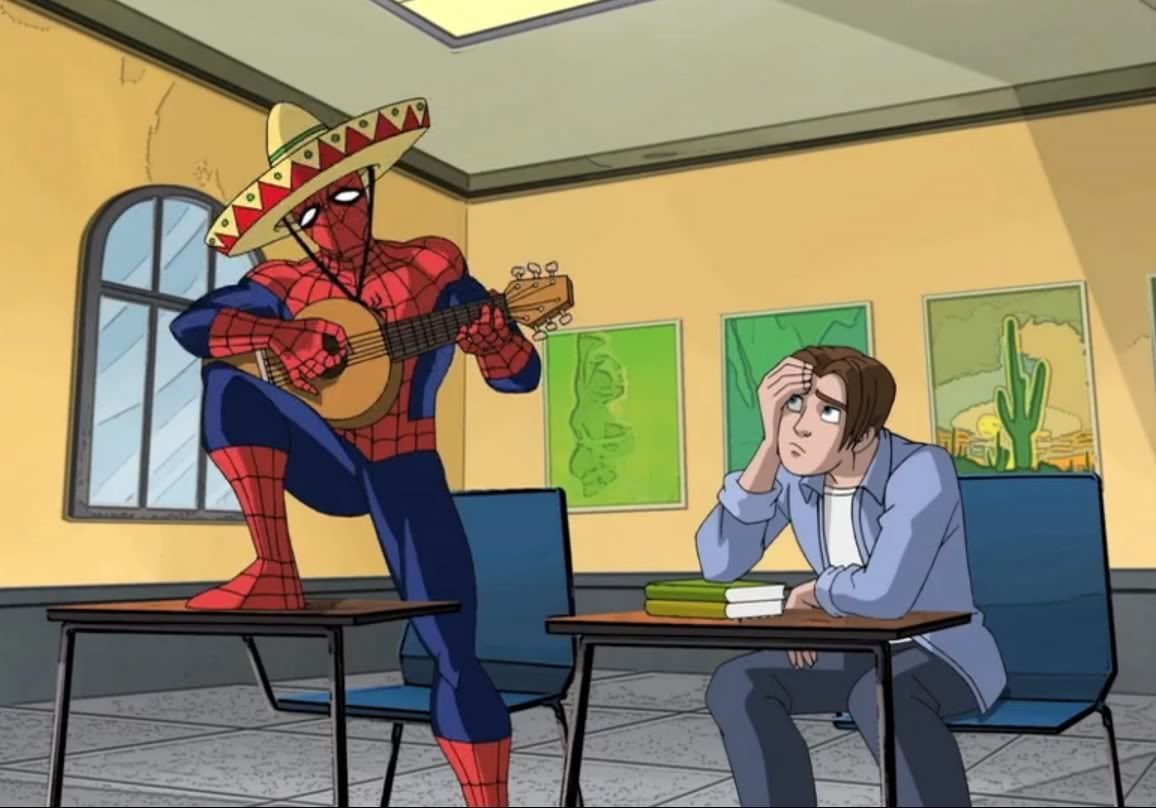
Ultimate Spider-Man Cartoon Rant: The Tyranny of the Dreamworks Eyebrow


-- Since I'm reviewing something that is clearly not aimed at my demographic (as Disney XD is meant for tweens and teens, not mid-twenties English MAs who perseverate over pop culture's unfortunate implications), I'm going to do this review in a more fluid structure, posted more around observations and emotional impressions rather than actual critical judgments. Even if I did think Ultimate Spider-Man was outright terrible, its existence doesn't negatively impact my life any more than I choose to let it. And I'm not one of those "you raped my childhood" fandom pundits, mainly because I think it's profoundly inappropriate to use rape as a description of anything but actual rape.

-- That said, it really gets under my skin that the Greg Weissman Spectacular Spider-Man cartoon was cancelled after only two seasons, while this takes its place. That was one of the best superhero animated adaptations ever! Why couldn't Disney XD have just kept that around, rather than making their own new cartoon with a far more dubious (and less movie-accurate, I might add) premise and execution?!

-- The first distinguishing feature of the Ultimate Spider-Man cartoon is the way that Peter Parker now talks to the audience and goes into dream sequence asides, a la Peter Griffin or Dr. John Dorian. This is obnoxious enough as is, since any dramatic value is rendered moot by making Peter's internal monologue a stand-up routine for an imaginary audience. This is worse in the scenes where Peter is not wearing his Spider-Man mask, because he uses the insufferable mannerisms and expressions of Dreamworks' "CGI characters with attitude". Raising an eyebrow and smirking does not validate your opinion.

What I hope to see is a Scrubs-style treatment of this where, while Peter is going off into one of his dream sequences, we see him standing completely still and oblivious in reality, with everyone looking at him in awkward dismay. Preferably followed by a bullet through his spider-brains, as he's too busy fantasizing about humiliating Flash or Nova or whoever to even recognize his spider-sense.

-- The second distinguishing feature of the Ultimate Spider-Man cartoon is the enrollment of Peter into Nick Fury's little superhero academy, which also intersects with Peter's day-to-day life because all of the metahuman cadets are enrolled at Midtown High (complete with movie immigrant Agent Coulson as the new principal!). There are two things about this which bother me; one, the fact that it's contrived on a level unforeseen since the Spider-Man and his Amazing Friends cartoon. And two, the extremely uncomfortable taste this leaves for readers of the Ultimate Spider-Man comic. Remember how beneficial THAT Nick Fury was to THAT Peter? How cleaning up the messes of Fury's black ops stuff got that Peter killed? Then again, this Peter is one whose death I would enjoy.

--Speaking of that hostility towards this Peter Parker, the character shows many of the same characteristics as Ben 10 and Generator Rex, two other protagonists of shows led by the Man of Action studio. Both characters are young male heroes who possess all the characteristics stereotypically required of a young male Saturday morning cartoon hero. They're rebellious, but they obey the system just enough to maintain a coexistence with the real world. They have problems, but they're almost always grounded towards the "relatable" (social life, girls, overbearing authority figures) and rarely dip into more challenging existential issues. They're book-dumb nimrods who don't particularly care about academic pursuits and don't learn from their mistakes any more than they have to in order to survive. And they exude attitude at every opportunity, taking attention away from the other, more interesting characters on their respective shows.

It's a safe, marketable rebel, the kind who doesn't rebel enough to make any actual sacrifices, the everyman character who doesn't have any traits unique enough to make him a true individual. It works pretty well for Ben and Rex, since they're original characters. For Spider-Man, having him as a hyper-aggressive show-off just doesn't work. That's the kind of self-absorbed attitude that made him let the burglar go, leading to his Uncle Ben's death. Contrary to popular belief of creators, the best Spider-Man stories aren't the ones that deal with him as a teenager/young adult with teenager/young adult angst; they're the kind that have him acting as a reasonable adult, or as close to one as he can get (which puts him head and shoulders above most reasonable adults). He's not called Spider-Boy, he's called Spider-Man. He's the kind of character who always carries the weight of the world on his shoulders, and agonizes over every decision he makes. The joking attitude is part of him, the front he uses to cope with tragedy and take the wind out of his enemies' sails. It isn't all of him.

-- I should clarify my own biases here; I LOATHE the teenage superhero sub-genre. I say this as someone who has read a lot of the teenage superhero sub-genre and even writes and draws his own teenage superhero webcomic. But then, Ruby Nation is meant to deconstruct these "Wake Up, Go To School, Save The World" tropes. I don't like the idea of the kid hero who treats saving the world like a game. I don't like the idea of their mistakes being just chalked up to growing pains, when countless lives are at stake. And I don't like the idea of a character becoming a superhero out of the desire to play hero, and treating that as easy while stuff like school and girls are hard. The job, as I see it, carries a tremendous psychological weight. If you're emotionally healthy, you aren't likely to put on a costume and risk your life as a vigilante. And the consequences of regular social life are nothing compared to these life-and-death situations. Maybe it's because I never fit into the regular social order of high school (even as part of a geeky sub-clique), but every time they start whining about how they can save the world but can't get to class on time or what not, I roll my eyes in aggravation.

I'm not saying they're bad or shouldn't exist, and I'm definitely not advocating the Civil War treatment of those characters (where they were treated as incompetent glory-hounds who got hundreds killed, despite the New Warriors all having been established as competent and altruistic enough to avoid that shit). But it seems to me like the problems associated with a teenager are nothing compared to the problems associated with being a superhero, not the other way around. Personal preference, personal baggage.

-- The show does have its merits. The animation is very good, and the voice acting is pretty solid. The other young superheroes are engaging characters, and in many ways overshadow Peter himself (especially Kid Iron Fist, played by Greg Cipes doing a great surfer dude/zen dude impression). Norman Osborn is used well, and the use of Doctor Octopus as a behind-the-scenes manipulator works excellently. He's extremely creepy, lurking in the shadows with his tentacles.

On the other hand, Spectacular Spider-Man did a lot of this far better, and that was evident from the very first few episodes. That show's Peter was driven by his desire to do good first, even if he made mistakes along the way. Their Harry was a more complex and tragic figure, rather than the wacky rich best friend he seems cast as in all incarnations. Their Gwen was a far better best friend to Peter than this Mary Jane, who's basically a junior Lois Lane (complete with stupidly getting herself in danger in order to get a story-- though I guess that makes her perfect for this Peter). The animation style was more unique, and the story blended drama and comedy much better. And this was in the first few episodes.

-- Overall, I don't like the show, but it's compelling in a train wreck sort of way. Maybe it'll grow on me the way the Glen Murakami Teen Titans show did. Or maybe it'll develop a good larger story, and shy away from the wacky asides. In any event, it's not for me. I also like the fact that the comic creators in Man of Action get a lot of money for these formulaic tween/teen action shows, so they have the financial support to do awesome comics like Joe Kelly's I Kill Giants and Joe Casey's Butcher Baker Righteous Maker.

Friday, March 16, 2012

Change Your Tights: Comics Without Frontiers on Superheroes and Drama


While it might not exactly be praise, it was flattering to see my earlier post about superhero fans fearing bad things happening to their favorite characters referenced by Miguel of Comics Without Frontiers. Miguel's blog is always great, thought-provoking reading, but this is an especially good piece.

The just of Miguel's post is a comparison between the drama of Mutant Massacre (one of my favorite comics of all time) and the drama of Fear Itself (the absolute height of mediocrity, without even the entertaining terribleness of Ultimates 3 or Cry for Justice). THere are many great points here, especially the observation that the Avengers never remove their costumes in Fear Itself. They're in their tights the whole mission, without showing any life outside of their battles and missions. You'd figure they'd at least change clothes to ward off the inevitable jock itch of sweaty spandex/leather/latex/armor.

I remember Mark Millar, when he was doing the Ultimates, commenting how he didn't like when Iron Man attended social functions in full armor. This is clear from the Ultimates series, where Tony (and the rest of the cast for that matter) spend as much time in their civvies doing normal-person things as they do on the battlefield in their action suits. Unfortunately, Millar fell victim to the no-life-outside-tights problem in Civil War, where most of the characters just hang around in their tights the whole story, and tense meetings have their drama undercut by the fact that characters are wearing their bird/bee/banana yellow wolverine costumes.

Sunday, March 4, 2012

The "Autism Cure" In Avengers Academy, and The Fascism of Utopia


(This is largely reposted from the Comic Book Resources forums, in response to an issue of Avengers Academy where the corporate sociopath genius kid Jeremy Briggs starts recruiting super-teens away from the school. Veil, formerly a student at Avengers Academy, touts Briggs' merits by mentioning how the work they're doing reforming society and attacking social problems is far more important than fighting villains and getting bloody hands. However, the example she gives of her work is a cure for autism. Since I normally like Avengers Academy, and since Marvel is one of my main hyper-focused Aspergian interests, this read like a punch to the gut).

Wether it was Gage's intent or not, Veil's line about working on a cure for autism immediately made me want the proper Avengers to take down Briggs and anyone working with him.

The kind of " utopia " Briggs is working towards, like most science fiction utopias, is the ideal of a few imposed upon everyone else. It's getting rid of things that people consider problems with easy solutions, by making a magic pill to cure any perceived imperfections, or using force to quietly subdue any dissidents. It's creating a pretty-looking, clean community by retroactively removing any evidence that it might have been dirty, working towards an ideal while forgetting the minority experiences that give humanity diversity, meaning, and narrative.

The autism line hits home for me, true, but it's a good example in microcosm of why Briggs is as insidious as any super-villain. Maybe Veil believes that autism is just a disease that abducts children from their parents and creates wall-eyed freaks who will never grow up to prosper, but that's hardly the case for all autistics, most of whom are capable of communication, thought, and contribution (even if on different terms, such as requiring facilitated communication). Worse yet, it excludes people with the condition from the discussion. If Briggs and Veil created a cure for the X-Gene, would it be treated as an altruistic afterthought? How about the gay gene? Does society really get to decide how the individual's neurology should be, and change it by force?

The job of the superhero is to save peoples' lives, not decide how their lives should or shouldn't be. That's the other side of the coin that we've seen since the genre's inception, which is fascism.

And another good quote about the dangers of imposing one's views on others, from Big Boss in the game Metal Gear Solid 4;

" It's not about changing the world. It's about doing our best to leave the world the way it is. It's about respecting the will of others, and believing in your own. "

Monday, August 22, 2011

How To Write A Fear Itself Tie-In comic


Step 1.) Check the comic you're writing to see if there's an overarching story in progress. If there is, put it on hold until the end of the summer.

Step 2.) Find an existing character (one who isn't necessarily connected to the comic) and give them a magic hammer with a merchandise-friendly redesign attached. Don't worry about wether or not the character will actually be merchandised.

Step 3.) Give that character a new name along the lines of "(Name), Breaker of (Thing)". The first name should be something punchy, even if it doesn't make sense in any known language. The second should be something that sounds ominous.

Step 4.) Now that you have your (Breaker), have them start randomly killing (Random Civilians). Don't worry about giving them a credible motivation, the (Random Runic Dialogue) should make them seem ominous enough to compensate.

Step 5.) Have the comic's existing (Hero/Heroes) drop everything they were doing to try and stop the Breaker of Something.

Step 6.) Show how no matter what powers the cast have, or what strategies they use, the (Hero/Heroes) do anything against (Breaker). At the same time, NEVER have (Breaker) inflict any lasting damage upon anyone who counts, beyond (Random Civilians)

Step 7.) Between the action scenes, intersperse talking heads of (Hero/Heroes) whining and crying about how they can't beat (Breaker). If you wish, you can connect it to some sort of larger sociological point about the economy or the war on terror or whatnot. Don't go too far with this point, lest you get away from the Formula.

Step 8.) Resume your comic's normal storyline after the Fear Itself event is over, hoping your existing readers haven't gotten totally sick of this shit.

Saturday, June 25, 2011

RIP Gene Colan :(


Legendary Marvel artist Gene Colan passed a couple of days ago, at the age of 84. I met him briefly at San Diego ComiCon in 2001, when I was still a punk teenager. He was a very nice man and seemed pleased that I was aware of his artwork on Iron Man. Though I imagine most 16-year-old boys wouldn't have been aware of those classic old issues, it would be years before I became aware of the breadth of his career.

Gene Colan had one of the most illustrious careers in comics, starting back when Marvel was still called Timely. At Marvel, he helped bring their fledgling superhero universe to life. His contributions included the early Daredevil comics, the creation of the Falcon (one of the first African-American superheroes, and a mainstay in the universe to this date), a large part of Steve Gerber's Howard the Duck series, and the entirety of Tomb of Dracula. All of this was drawn in his sharp, fluid, value-intensive style.

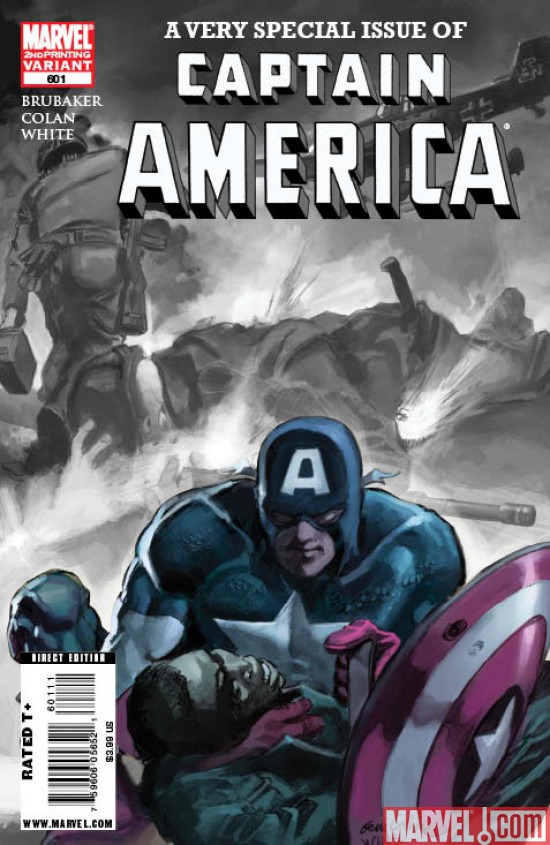
What I want to focus on, though, is his final Marvel work; a flashback WW2 Captain America story written by Ed Brubaker. When I saw this, it didn't look like the Gene Colan comics of which I was familiar, due to the unique mix of graphite and watercolor. But it was just as beautiful as any of his earlier works. It was a dark, atmospheric style suited to a dark, atmospheric story involving Captain America and Bucky being besieged by vampires. Not only was Colan an extremely talented artist but he was able to continue learning, growing, and reinventing himself, even as he approached his final days.

God bless you, Gene, and rest in peace. :(

Thursday, June 23, 2011

X-Men First Class Movie Review: Magneto Roolz, Charlie Droolz


X-Men: First Class was easily the finest Marvel movie I've ever seen, and probably the finest superhero movie (eclipsed only by Dark Knight, but at least First Class was unmolested by Christian Bale's goofy-ass growling) ever made. The difficulties with the film's production allowed director Matthew Vaughn and his crew to create a Marvel movie liberated from almost all of the cliche hollywood narratives, and gave us a superhero movie that actually had something important to say.

At its heart, the film is the story of the how X-Men's two key philosophers met,i.e. Charles Xavier (played by James McAvoy) and Erik "Magneto" Lensherr (played by Michael Fassbender). As expected from a movie about Xavier and Magneto, the story shows them drifting apart as their ideologies prove incompatible. But while the comics and the previous movies left the Xavier/Magneto equation as a matter of good vs. evil, X-Men: First Class shows us that Xavier is just as flawed as Magneto, and both men are equally victim to their hubris.

No punches are pulled in showing how different--and better-- Charles' youth was from Erik's. While Erik grew up in Auschwitz and saw his mother brutally murdered, Charles grew up in a mansion, and met a young mutant girl (Raven Darkholme/Mystique, played by Jessica Lawrence) to relieve him of his poor little rich boy angst. And while Erik spent his young adult hood hunting down Nazis in a quest to find the man who shot his mother, Charles went to Oxford, used his telepathic powers and knowledge of mutation to whore around, and kept the admiring adult Raven firmly in the friend zone (which he claimed was due to their childhood together, but was more likely motivated by his repulsion at her true, blue form; unlike Raven, Charles has no struggle trying to pass). Charles got the advantages of being a mutant without the drawbacks, and he didn't even appear to have the telepathic angst caused by stray thoughts.

The two men eventually meet when they end up facing a common enemy-- Sebastian Shaw (played by Kevin Bacon), who not only was the Nazi doctor who killed Erik's mom in an attempt to trigger his powers, but is using his Hellfire Club connections and mutant posse to try and heat up the Cold War. From there the two men instantly bond, and with the help of the CIA and agent Moira MacTaggert (Rose Byrne, playing a much different character than the comic version and her Scottish brogue), they start assembling young mutants. Of course, the more they get to know each other, the more they end up drifting apart, and the conclusion is tragic (though inevitable, given that this is a prequel).

Shaw makes an excellent villain because of the singularity of his vision and the lack of morals getting in his ways (as he did ally himself with the Nazis). But though neither Charles or Erik are as outright evil as Shaw, they both fall victim to their singular perspectives without trying to consider the other one's opinions. Note that the founding of the X-Men could not have been done without Erik-- Erik pushed to keep the CIA out of their affairs (while Charles would have cooperated), and Erik got Xavier to train the students for combat (Charles would've just taken them back to their homes, even for the ones whose homes were jails or strip clubs). Also note that Magneto doesn't become truly powerful until he embraces Xavier's motto that true focus lies between rage and serenity. When the two men cooperate, they can achieve virtually anything because they compensate for each other's weaknesses. It's when they become enemies that both end up being a detriment to mutantkind.

That's right, I said both. Vaughn's movie and McAvoy's performance give form to an idea that until recently many X-Men writers have simply danced around-- the idea that Xavier truly is holding mutantkind back. As we see in the movie, Xavier's idea of peace means teaching mutants to pass for human. He encourages Raven to maintain a regular blonde, Caucasian appearance, cooperates with government agencies that clearly want to enslave and/or terminate mutants (even if it's just starting as registration, as Erik points out), and advocates Erik against killing the former Nazi Shaw. He will use his powers to brainwash when necessary for survival, but that just makes him hypocritical. For Charles, the goal isn't "mutant and proud" so much as "you're a mutant? I hardly noticed".

Magneto's actions are similarly misguided, and definitely more destructive due to his extremist bent. Yet he's still more sympathetic than Xavier, because he actually knows what homo superior will have to face. Similar to Mystique, the audience finds him more appealing because he's fighting not just for mutantkind's survival, but also for mutantkind's individuality. Chris Rosa of Meltdown Comics got me excited about this film by telling me that Fassbender played Erik similar to Big Boss/Naked Snake of the Metal Gear Solid games, and the comparison is apt. As corrupted as both characters would later become, we see exactly what traumas put them on this path and sympathize with their perspectives, even if we can't condone their actions.

In many ways, this is a spiritual prequel to the modern X-Men comics. Grant Morrison's X-Men tried to resolve a dilemma similar to the one posed in First Class by having BOTH Xavier and Magneto prove obsolete. The way he portrayed Magneto's decline was a bit less subtle (if you can call getting high on drugs and genocide subtle, though I'd argue that it was a necessary point), but Morrison also demonstrated Xavier's impotence by having all the mutant cultural revolutions happen outside of his control. Keep in mind that the Xavier who outed the X-Men was actually his evil alien twin using his body; once the real Xavier returns, he finds himself a mere observer to a world far more complex than he could imagine. Yet that world was there all along, when the X-Men were playing superhero to appeal to the human masses while retreating to the gilded cage that is Xavier's Mansion during their off hours. This makes the X-Men's Utopia an inevitable response to a multicultural world*, allowing the new culture their own space to create their own society.

I could go on about the other details of the film, such as the specific actors' performances or the bizarre choices of characters, but the overall story was so great that complaining about small details** feels like a fanboyish waste of time. Highly Recommended.

* No matter how much of a douchepocalypse their president-for-life may be.
** I will note without reservation that the treatment of Darwin was angering, reducing one of the most charismatic of the new recruits to minority cannon fodder.

Thursday, January 27, 2011

Why Iron Man Represents Civilization's Worst

(Reposted from the Iron Man Message Board, in response to the usual bitching about Matt Fraction's run)

Science isn't bad, but weapons are. And the problems with Tony's character are thus;

A.) He started out making weapons. He wasn't a civilian scientist who helped the war effort against a common enemy, he was an arms manufacturer from the start.

B.) He made billions off of the weapons he designed, and was very conspicuous about the way he used that money. Wearing suits that cost more money than an Afghani family makes in a year, paid for off of land mines that maim and kill those families, isn't in good taste.

C.) Tony's wars have never been the wars for which America is proud. In the past, in-comics jingoism aside, he was associated with Vietnam. In recent years, he's been associated with Afghanistan and the War on Terror. Regardless of your personal position on either of those wars, neither has been a particularly good mark on America's reputation.

D.) Up until that one fateful trip, Tony was never a soldier. He didn't see combat himself, and left his devices in the hands of the actual fighting men and women risking their lives. Even as Iron Man, he goes into combat insulated in a metal prosthesis that does all the fighting for him. At least in the past he entered combat with a heart injury and was truly putting himself at risk each time, but once his ticker was fixed, he was hardly facing opponents stronger than himself most of the time.

E.) Tony didn't even make his money himself. He made Stark Industries more successful than during his father's tenure, but he already had millions upon millions with which to start. The hardships he knew were from his father's disdain, but to most people, that just comes across as "poor little rich boy" syndrome.

F.) Even once he became Iron Man and stopped making weapons for others, he still made himself a symbol of imperialism. A billionaire playboy, putting on an ostentatious gold-and-red war suit, entering combat with a weapon that may avoid accidentally launching missiles at wedding parties, but has no problem shooting brown people with guns. That line is paraphrased from a particularly insightful (if harsh) assessment of the movies...

http://www.somethingawful.com/d/current-movie-reviews/iron-man-drivel.php?page=3

Basically, the problem isn't that Tony's a nerd and not a jock, or even that he's about science and not procreation. Even if he wasn't deliberately evil before he became Iron Man, even afterwards he represents a global system of profound inequality and constant struggle. The ending to issue 500 was the worst-case scenario of Tony's fears-- that he'd never do enough good to make up for his sins. The ending, however, had his daughter live in a society starting from zero, so at least Tony's sacrifice earned humanity a second chance, with a new generation that can at least make their own mistakes instead of having to struggle with their parents and grandparents' sins.

With Iron Man, you can either try to ignore these concerns and play the character as a straight superhero genre story, or you can deal with them. If you choose the latter, as Matt Fraction has done, you're dealing with an extremely tragic narrative.

Wednesday, August 11, 2010

Great Moments in Otherwise Terrible Comics?


Here's a question for you all to actively answer in the comments...

What are your favorite scenes in crappy comics?

To give you an example, I'll discuss the good stuff I found in The Other, the big Spider-Book crossover written by JMS ( whose Spider-Man I discussed earlier, after the above cat sat on my copies of his work ), Reginald Hudlin, and Peter David, with art by Mike Deodato Jr., Pat " the Transman " Lee, and the late, lamented Mike Wieringo...

-- There were a lot of excellent character moments with Peter and his supporting cast, both his family and his Avengers comrades. Peter's death sentence stirred a lot of drama to the surface, insights that we might not otherwise have seen. MJ gives a heartbreaking speech about how Peter subconsciously goes into battle half-cocked out of a death wish born of survivor's guilt. Aunt May internally curses Uncle Ben for not allowing Peter to move on with his life. And Peter himself has a great scene where he almost kills a villain, cursing how unfair it is that he's being punished for trying to atone for one mistake he made, and talking about being free to make another big mistake as he beats the hell out of the bad guy. Even after he came back ( one of many reasons why this was a stupid story ), there were some interesting points, like MJ talking about surviving Peter's ( believed ) death made her realize that she was a stronger person than she thought.

And we can't forget how Wolverine hit on the grieving MJ to distract herself from her despair, and how her words of thanks afterwards were along the lines of " I know you didn't hit on me on purpose because I'm so out of your league ".

-- Peter found some clever uses for his spider-powers after his resurrection. The spider-stingers in his wrist....well, there aren't words in human language to described how fucking ridiculous that concept is, even by superhero standards. But I liked the final issue with Peter experimenting with his powers. Seeing him find creative ways to use his abilities, like feeling the vibrations of a target through his webbing, or having a rescued child cling to his back the way he clings to walls, were pretty cool. If only he figured out how to use these without a contrived mystical experience.

-- Mike Wieringo's art was exceptional. Mike Deodato's work was good as always, and Pat Lee managed to be tolerable despite his continuing use of his trademarked " Dull Surprise " expression. But Wieringo was an exceptionally gifted cartoonist. Even with fewer lines than most superhero artists, he managed to exude character from his figures. Look at scenes like Cap tearing up upon Peter's death, Logan's reaction to MJ's aforementioned speech, and of course, Peter getting cornrows when visiting Africa. He is still very much missed. :(

These traits make this Big Lipped Alligator Moment of a story tolerable....well, almost.

So what are your picks?

Tuesday, June 15, 2010

Kitty Review: Allie Approves of JMS' Amazing Spider-Man


Admittedly, I was prompted to post this due to the camera photo opportunity of Allie, our lovable tabby cat, sitting on a stack of my comics. That he chose to sit on some of my Amazing Spider-Man Ultimate Collections ( large trade paperbacks collecting chunks of J. Michael Stracyinski's stories ) was appropriate, because I've been reading those thoroughly lately, and appreciating them a lot.

Discussions of JMS' Amazing Spider-Man tend to be myopic, focusing on the big events-- the totem stuff, the WTC tribute, Sins Past, the Other, the Iron Spider, and of course, the infamous One More Day. It is true that a lot of those stories were terrible-- I mean, there's no way to spin " Gwen Stacy had Norman Osborn's mutant love children before he murdered her " to sound like anything less than crap. Then again, most of the later stuff had a strong editorial hand, or was tied into crossover stuff. But to focus only on those is to undermine the excellent individual stories going on in between.

What I liked so much about JMS' Spider-Man was that he made the character of Peter Parker care. Even though Peter was still a working-class twentysomething, he lived his life to the fullest, and did everything he could. Having Peter become a high school teacher was a stroke of genius; despite low pay and unruly students, he realized that he could help kids feeling just as isolated and misunderstood as he was. When villains attacked him and his loved ones, he didn't just quip and dodge-- if needed, he'd go in there and fight until he blacked out from sheer pain and exhaustion. And when his marriage with Mary Jane was falling apart, he'd drag his ass all the way across the country to win her back.

JMS has been criticized for overly melodramatic writing, and in some cases that's a very accurate critique ( re: the WTC tribute, and the infamous tears from murderous despot Dr. Doom ). However, for Spider-Man JMS' voice worked very well. His stories worked to show us that Peter wasn't a superhero in the professionalized terms of modern comics ( i.e. anyone registered with the Initiative ), but a genuine hero. Compared to Ezekiel, who tried to seek power but never ended up using it for pure good, Peter's determination to do the right thing was all the more inspiring. Compared to his high school friend Charles Weiderman, who used his nerdy isolation to obsess over super-soldier fantasies, Peter was impressive for not giving into the bitterness of his lonely youth. Even Peter's family got in the act-- Aunt May became a staunch supporter of Spider-Man after finding out Peter's secret identity, helping in all the ways a seventy-something woman can help ( which is more than you'd think ), and Mary Jane tried to work out her difficulties being a superhero's wife like an adult.

Yes, " Adult ". Not adult in the sense of having more gore, but in facing consequences with responsibility and integrity. Post-JMS Spider-Man comics have been determined to show us that " twentysomething " means " slacker ", with Peter stumbling around blindly, mooching off his friends and family, and being Spider-Man reactively. These comics show us that for Peter, being Spider-Man isn't a choice he makes to do good in the world; it's a burden he's taken because he doesn't want to disappoint the big sky-daddy ( in his case, his uncle ). This Peter has the morality of a six-year-old, acting in accordance with internalized fear of being bad, while not really giving thought to hard choices and major progressions. As a twentysomething myself, it's grating that Spider-Man's fortysomething-plus writers see my generation like this-- especially if they're right, that this audience wants Spider-Man as a slacker who fights crime as an impulse/hobby.

But I digress...the point is that for all the melodramatic warts, and the stupid event stuff, JMS wrote great stories that were ethically driven and emotionally meaningful. They were more than just a bed for a cat wanting to nap in the sun.

( Though they serve that purpose well enough. )

Thursday, May 6, 2010

New Ultimates #2: Captain America Can't Handle Your Internets

( preview courtesy of Comic Book Resources )


Finding a flaw in a comic written by Jeph Loeb is like finding a grain of sand on a beach. New Ultimates, the third mini-series involving Loeb writing the ersatz-Avengers as bungling morons failing to do much of anything besides indulge their sex addictions, is yet another example. Only two issues in and already it's another instance of a very thin plot, a two-dimensional cast, an extremely adolescent portrayal of adult relationships, and a bunch of action scenes trying to compensate for those other failings. Granted, Loeb is capable of making the action scenes outrageous enough to be entertaining, even if ironically ( see: Red Hulk ).

But what bothers me most about modern Jeph Loeb comics isn't when he's being outrageous, because that's what he does. It's when he's being sincere. It's when Loeb is treating these characters as though their emotions have real dramatic weight, and that we should care about them in a context other than seeing them fight and/or shag. Case in point: Captain America's narration this issue, where he makes the following comment on modern society...

" I grew up in the streets not far from here. Only compared to today, it might as well be a million miles away. We had no iPad, no iPod, no anything. In fact, the closest telephone was down the block in Ed Carlman's drugstore on the corner. And no one complained that life was downloading too slowly. "

As much as it may seem like nitpicking, I'm going to go the three major things wrong with this quote, why it's a microcosm for bad writing at large, and how other writers of the Ult-U version of Cap have expressed the same sentiments better..

1.) Captain America is not at odds with technology. The Super-Soldier Serum not only enhanced his body, but also his mind. This is especially apparent with Ultimate Cap, who was shown to be the super-soldier that everyone else tried and failed to duplicate with his quick-thinking and master strategies as well as his physical strength and fighting skills. Millar even had Nick Fury reference that Cap " learns skills faster than a damn computer ". And in Ultimate Human, Warren Ellis had Bruce Banner say that his failed derivative of the Super-Soldier Serum was meant to enhance his intellect the way the original made a regular Brooklyn grunt into the finest military mind in history ( and yes, we all know that it didn't QUITE work out that way, but still ). Digital technology is not going to be one of the things Steve Rogers finds most objectionable with modern times. If he can pilot an F-16, he's not going to find a mass market entertainment device to be a Gordian Knot for his 1940's brain.

Now, there are plenty of things about modern times that do confuse and bother Steve. Loeb touches on the obvious ones, namely that all his friends and family either died or aged terribly, and that he doesn't understand modern women. But he missed the Civil Rights movement, the removal of the Hayes Code for movies ( and a general darkening of pop culture in general ), several unpopular wars, an increasingly poor standard of American health with an increased complexity to medicine and psychology, and more massive cultural shifts. And the iPod is what's got his knickers in a twist?

2.) Captain America is not emo. Millar had him distract himself from his problems with being a man out of time by throwing himself into his missions. In some cases, we'd get him in quiet moments and see how hard his adjustment was going. But those were glimpses of Steve in his private life, and furthermore, they were emotions that came about through is interactions with others. He broke down in front of his old war partner Bucky because he had been holding in how isolated he felt for so long, and Bucky was the only person he felt safe confiding in. That's why the scene was so great-- because it came as a surprise to everyone, especially Cap. The other scenes had him taking action, even in his personal life ( for example, his arguments with Janet van Dyne as she drifted back towards her abusive ex ).

I've already talked about why first person caption narration is a crutch. It's obnoxious to see it here when previous volumes of the Ultimates ( even Loeb's ) steered clear of it. It's worse because both New Ultimates and Loeb's Ultimate X have taken on this storytelling method, and have done so with all the pathos and nuance of a Lifetime Original Movie.

3.) It's the most obvious and cliche reference. What extra-textual references a writer makes can be a good barometer of their creativity. If they use the most familiar reference possible, that's usually a sign that they aren't trying hard enough. This is why when we see great literature discussed in pop culture, it's very often Shakespeare, and it's either Hamlet or Romeo and Juliet ( more often the latter ). This is why writers looking for a real-world evil will invariably use Hitler, despite so many other complete monsters throughout history whose legacies haven't been trivialized to the point of being internet flame war arguments. And this is why the most common pop culture references we see in fiction are the ones going on right now-- Titanic, the Matrix, Britney Spears, and Mortal Kombat being some of the more brutally over-used examples from the past two decades.

The iPad was announced shortly around the time this script would have been written. If nothing else, couldn't Cap have made reference to a different high-tech gadget or technological process? Perhaps go off on a rant about file sharing, or internet porn, or other modern development outside his experience? He could at least have mentioned that naming a new computing device as though it were a feminine hygiene product would be an affront to Lady Liberty's decency...

Saturday, April 10, 2010

Temporary Deaths: The First Deadly Sin of Modern Comics


( The first part of a seven-part series examining cliches of the last decade of American comics. Illustrations are all by yours truly. )

The Trend: A major superhero is killed off in front of the audience. The truth, however, is that they didn't actually die, and will later come back in some really contrived supernatural manner-- writers have stopped pretending that dead means dead, and will kill off a character to do stories about their absence. But the cast all believes the hero is dead, so we're subjected to long, often angsty mourning scenes before they return.

The Culprits: Batman ( Batman RIP and Final Crisis ), Captain America ( Captain America: Reborn ), an arseload of DC heroes in Blackest Night ( such as Martian Manhunter, Aquaman, Hawkman and Hawkgirl, and others who will be starring in Brightest Day ), Hawkeye ( twice in Bendis' run on Avengers ), Phoenix ( Planet X and Phoenix: Endsong ), Thor ( Thor Disassembled, though that was a case of taking the Odinson off the board until they got a creative team with a good hook for him ). The ur-example is, of course, Superman's Death in the 1990's.

The Problem: Reading superhero comics, we already have to suspend a lot of disbelief. And this isn't even counting the ability to accept a world full of gods, aliens, robots, demons, and other polygenre supernaturals. Unless you're reading a creator-owned superhero comic like Dynamo 5 or Invincible ( both of which I strongly recommend, BTW ), you're dealing with characters who are frozen in place in the interests of the franchise. Peter Parker is never going to see his thirtieth birthday, Tony Stark's origin story is going to be retconned to take place in wherever America last fought an unpopular war*, and no super-battle is going to end with the hero getting capped in the head and stuffed in a box. This isn't to say that franchise superheroes are inherently stifling to innovation, just that there are restraints that writers have to work around creatively.

Having a character get killed off with no intention of having them stay dead isn't working around the restraints, it's calling attention to them. It's reminding us that nothing that happens has consequence because everything gets reset, and in doing so, it makes the stories told during the hero's dirt cat-nap seem like a waste of time.

Take the death of Captain America. If I were to actually believe that Steve Rogers could stay dead, I would absolutely love Brubaker's stories since, because Bucky Barnes is a more interesting Captain than his Patriotic Super-Jesus predecessor. But when you stop treating these as a coming of age story about Bucky overcoming his trauma to take up his brother-in-arms' duties, and realize that said brother-in-arms was just sent off on a really contrived Groundhog D-Day scenario, it becomes less engaging because it's just Bucky as the substitute. Even though I love Ed Brubaker's writing and appreciate him keeping Bucky around as Cap, I just know that when Steve Rogers said he wanted Bucky to stay as Cap or else he'd die, that Steve was breaking the fourth wall. The whole exercise was enjoyable, but it required a lot of disbelief to be actively suspended.

Worse than that is the current situation with Batman, which follows a very similar structure, but is even more ridiculous and difficult to accept. The fact that we learn from the start that Bruce isn't dead makes it seem like all the heroes mourning him are fools, since they live in the DC Universe and are even more familiar than us with means to bring a character killed by unusual means back. And unlike with Steve and Bucky, Dick Grayson is not a more interesting character than Bruce Wayne-- he's had his sidekick inferiority complex for many moons now, and the fact that he's actually been forced to replace his mentor makes the whining super-obnoxious ( though to at least Grant Morrison's credit, the whining's been abbreviated in the main book ). We know that Dick isn't going to get the chance to step up and become the Batman, so as entertaining as the stories are, it's hard to ignore the fact that they're killing time until the main event of Bruce's return. Again, if I believed that Dick would stay as Batman ( and since Batman is a character who exists across so many different media and adaptations, it'd be easy for DC to do alt-continuity stories with the original Caped Crusader while allowing DickBat to continue and develop ), I might not have this problem.

I'm not even going to approach the blanket resurrection of Blackest Night, since I haven't actually read the final issue, but I stopped reading that series early because calling textual attention to the endless cycles of death and resurrection on superhero comics didn't make them any easier to tolerate.

The Solution: Find more unique means to take a major player off the board, ones that don't involve rigor mortis. Tony Stark has been removed from the Marvel Universe three times without killing him; once in a drinking binge, again when dying of nerve damage and faking his death to undergo surgery, and most recently when he became a fugitive bent on destroying the data in his brain. When Chris Claremont wanted to shake up the X-Men way back inthe Mutant Massacre, he didn't kill Colossus, Nightcrawler, and Shadowcat-- he just sidelined them with serious injuries, severe enough to take them off the team and shake the X-Men's confidence, but certainly not a death sentence. And Professor Xavier is the undisputed master of finding ways to disappear when a writer feels like the X-Men don't need adult supervision ( he was stranded in space during the Mutant Massacre, for example ).

With these solutions, you can do stories about a major character's absence without needing a super-silly resurrection story.

Sunday, March 28, 2010

War Machine 1 & 2 Graphic Novel Review: Military-Angst Complex


The Jist: When James " Rhodey " Rhodes was a lower-middle class black boy growing up in South Philidelphia, expectations for what he'd grow up to be were low. But as an adult, Rhodey's been a decorated US Military hero, the private pilot and bestest boyfriend of Tony Stark, a substitute Iron Man for years, and eventually his own armored hero as War Machine. Now, rebuilt with cybernetic parts after being blown up on a mission, he's a literal machine. And as his name suggests, he wants to declare war-- in this case, on every petty warmonger on the planet.

The Crew: Greg Pak ( writer ), Leonardo Manco ( artist Vol. 1 and issue 8 ), Wellington Alves, Mahmud A. Asrar, Allan Jefferson, R.B. Silva, and more( artists vol. 2 )

The Verdict: To start with, I want to say that War Machine's redesign for this series may be the least inspired costume design I've seen yet. Not the worst, mind you, but the least original and unique-- it's basically a greyscale Iron Man with an assload of weapons hanging off his back. Which is the most exact description you can give of War Machine's looks, but I would have liked to see a bit more thought than " Iron Man with attached 90's style armament porn ". He looks like a robotic version of Big Shot, the Punisher spoof from the Tick cartoon who carried a huge box of guns on his back and fired at anything until he ran out of bullets, in which he'd start sobbing about how his mother didn't love him. Re: A SPOOF character, not appropriate for a comic that takes itself seriously.

Of course, there are a lot of things I would have liked to see from this series that I didn't. That description of Leonardo Manco's War Machine design describes how I feel about the book in general-- it's not_that_bad as a whole, but it's definitely an underperformer, especcially given the quality of the creative team.

The central problem with this comic is that it's trying for a balance of real-world commentary and Marvel Universe exploration, and doing it in a very sloppy fashion. This is most obvious in the first trade, where Rhodey takes his cyborganized body to several Marvel Universe third-world military juntas to kill all the " real " bad guys. I'm not terribly opposed to seeing guys who torture and kill innocent civilians getting a bullet in the head, but these are a shamelessly superficial rendition of real-world despots. " Santo Marco " is not Columbia; it's the country Marvel writers use when they want to say something about Columbia ( or other South American nation torn apart by civil war ) but don't want to bother researching the complexities of real-world Columbian politics. So they bring in Santo Marco with its endless supply of two-bit genocidal thugs, and have Rhodey try to solve the country's problems by killing every person with a " kill number " ( something that his cyborg operating system attaches to everyone he sees, based on how many deaths they've willfully caused ).

If you're wondering how flying in to cap warlords in the head is a heroic action ( or even one with any long-term benefit; is the word " power vacuum " even in Rhodey's databanks? ), it's not. Greg Pak has called his approach to this series " Iron Man meets the Punisher ", but he's still playing Rhodey as a sympathetic character, one who is trying to do the right thing, even justifying it by talking about how his cybernetic brain won't let him even temporarily forget every murder and rape he's witnessed. Except that the Punisher isn't a sympathetic character, and especially since Garth Ennis got to him, he's been portrayed as a monster who happens to point his bullets at other monsters. Ennis' stories with the character, especially the ones where he was involved in real-world struggles ( most notably the Irish civil struggles of Ennis' own background ), never suggested that Frank's solution was the right one or even a right one.

Also worth noting about Ennis' real-world commentaries in the Punisher is that he didn't bring in other Marvel characters to make them-- his Frank Castle existed in an independent space, and whenever superheroes wandered in, they were embarrassingly ill-equipped to deal with it. Rhodey, on the other hand, is dealing with military juntas, tribal genocides, and frequent rapes in the Marvel Universe. In Santo Marco, one tribe uses a hacked Sentinel to genetically weed out and kill members of the other tribes. In Aquiria ( a.k.a Marvel's ersatz Middle Eastern theocracy ), he's fighting a private military contractor named " Eaglestar " using appropriated tech from the alien robot Ultimo. And in the opening strip from Marvel's website, Rhodey fights a Roxxon ( a.k.a. Marvel's ersatz corrupt oil conglomerate ) executive trying to eliminate Inuit tribes from ideal drilling space with cyborg bears. Pak wisely knows to have occasional asides from the characters where they recognize how absurd this shit is, but we're still getting world politics shoe-horned into the Marvel Universe in a manner that can't be taken seriously-- and when you have open acknowledgement that one of the female characters was beaten and raped by prison guards, following with a dramatic entrance by Ares, Greek God of War, seems horribly inappropriate.

If I seem overly upset with this comic, I have to admit that part of it is because I really like Jim Rhodes as a character, and think that everything I like about him is absent here. When Rhodey debuted as Tony Stark's best friend, he was a perfect and immediate fit because he offered an intrinsically human counterpart to Tony's ubermensch futurism; he was Wilson to Tony's House, down to the unfortunate enabling of Tony' addiction. As the substitute Iron Man and even as the ( unfortunately named ) War Machine, he was a likable character, because he was a hero as a soldier long before he met Tony, and wearing Iron Man armor was a right that he genuinely earned. His conflicts came from the fact that he was deeply uncomfortable with making the kinds of hard moral decisions that Tony has to make on a regular basis-- but all of that's absent here. He can't appear in regular human settings because he's a disfigured cyborg, but if you're wondering how much his condition lowers his quality of life ( and from the looks of it, his new body has all the " armament " of a Ken Doll ), we don't get any answers. All we know is that he's ugly, he's mad, and he's taking it out on everyone his databanks give a kill number. Quite the character reduction.

To the War Machine creative team's credit, the book improves dramatically with the second and final collection, when Rhodey sets his sights on Norman Osborn and his Dark Reign. It doesn't become great, mind you, but it develops the makings for an enjoyable mid-tier superhero book. The supporting cast is expanded on, bringing a " Team War Machine " together from various Iron Man supporting characters, including Rhodey's mother. The opposition is shifted from one-dimensional takes on real world monsters to Norman, and while it's hard to ever believe that the substitute Iron Man is going to be the one out of all the heroes to take Norman down, the guy's scenery-chewing brand of theatrical villainy is always entertaining. And while the art team shifts from Leonardo Manco to various fill-in pencillers and inkers, that actually works to the book's benefit. Manco's dark, gritty style was great when he was working with Andy Diggle on the urban fantasy Hellblazer, but his more realistic rendering only served to illuminate how ridiculous the stories were. The more conventional superhero art the later teams offered played well to the series' tone.

But as they said about J. Edgar Hoover's attentions to the economy-- too little, too late. The book's first arc was an obnoxious throwback to the worst parts of 1990's comics*, and readers picked up on that. It's luck that let War Machine last a whole year, and even with the character getting a big push thanks to Iron Man 2, it may be a while before Rhodey gets another solo series. On the plus side, Pak started the series by showing that Tony Stark had cloned Rhodey a fresh body, and ends it by transferring Rhodey's mind there. No longer a scowling, trigger-happy eunuch, War Machine is in a position where a new creative team can do something really good with him.

While there are some merits to the series and it picks up in the second half, overall it was a failed experiment that left a bad taste in my mouth, so I'll have to give it a Not Recommended.