Ruby Nation

Ruby Nation
Ruby Nation: The Webcomic
Showing posts with label spider-man. Show all posts

Tuesday, July 10, 2012

The Goldfish's 10 Things Fiction Writers Need To Remember About Disability: The Spider-Man Movie People Should've Read This


One of the greatest essays I've read in the past few weeks online the Goldfish's 10 Things Fiction Writers Need to Remember About Disability. It's been broken up into Part One and Part Two, and both are well worth considering for any writer.

It's especially relevant to me because I read the first part the same week I saw the new Spider-Man movie, and while I liked that movie a lot, many of these things were ignored in regards to the film's antagonist. Of all the characters they could've picked, they chose Dr. Curt Connors, a.k.a. the Lizard. This character, who thought his amputated arm was such a disgrace that he would risk his own life to cure it (and, in doing so, turn himself into a giant reptile monster), represents several things on the Goldfish's list;

3. People with long-term impairments or chronic illness are not fascinated by their own condition or their own symptoms. While Connors doesn't natter on about statistics regarding amputated or malformed limbs, he is obsessed with curing his ailment, right down to his "World Without Weakness" rhetoric. Whatever sympathy he would've gotten for his handicap and his daily accessibility issues is lost when he starts using Eugenic language, and "weakness" is a term with further reaching connotations. Note that Connors is not dying, nor is his life completely ruined due to the lack of his arm. It's understandable that he would be frustrate with his limitation and admirable that he'd go into medical science, but using himself as a test subject shows a deeply internalized self-hating ableism. (And I get that he was feeling awful at the time, looking at being fired or even disappeared by Norman Osborn, but he'd been spouting the World Without Weakness rhetoric since his first scene.)


4. Disabled people are not all young, white, straight, affluent men. Connors is an older gentleman, so he at least beats the ageist part of that majority formula, but he's male, white, (presumably) straight, and lives comfortably. Then again, the Amazing Spider-Man movie only has a few female characters (albeit in important roles; Gwen Stacy is used superbly here as Peter's confidante as well as his girlfriend, and Emma Stone does a great job with the character. Aunt May is also used effectively, albeit with less screen time). It also has only one remotely significant character of color, that being Norman's henchman. And there are no gay, bi, or transgendered/intersexed characters. Not a surprise, and I can't hold it against this movie specifically, but it does illustrate the problem; young, white, straight, affluent, and abled men still control all the most visible narratives. 


Again, I liked Amazing Spider-Man a lot as a movie, and it's definitely in my top 5 of superhero films. But it's still a reminder that big budgets and blockbuster sales are rarely given to stories outside that very limited Hollywood narrative.


5. Disabled people go bad for a reason. There is a reason, but it's not a good one; surely Connors would've known that jamming himself full of reptile DNA wouldn't go well, either killing himself (a true act of weakness, regardless of physical or intellectual challenge) or turning himself into a monster. Since it's the latter, Connors is responsible for everyone the Lizard killed, in the same way that a drunk driver is accountable for the people they run over. Worse yet, even after Connors reverts back after his initial transformation, he's clearly gone evil by this point, addicted to the power of being the Lizard and chewing every inch of scenery.


6. There aren't many reasons for disabled people not to have sex. In the comics, Connors is (or was) married with a kid, so this was averted. Here, he seems to live alone and doesn't show any evidence of a romantic life. He's portrayed as completely sexless, though at least without a family, Connors doesn't betray those responsibilities. (And that might make the comic version worse, because in one of his most recent transformations, Connors ATE his son. Surely he'd rather have had a living son than a regrown arm, had he known what the Lizard serum would do?)


9. Disabled people know other disabled people. Connors is the only disabled character in the movie. Then again, if he'd talked to disabled people about his "World Without Weakness" nonsense, they might've been offended. I wish someone had asked him which is worse; not having an arm, or living in a world that makes you feel like a pariah without two arms? (this was done very well in X-Men First Class, when Mystique told off Xavier for trying to fit in with a bigoted world. By coincidence, that movie also had a major character try to cure his disability with science and fail miserably, with Hank McCoy's faulty mutant cure. That was even more foolish on Hank's part, because he wasn't physically limited beyond being forced to hide his simian feet, which was society's fault and not his own. Though he got off easier, because while the cure made him blue-furred, he did keep his mind, unlike Connors).


10. Disability is not a conflict that has to be resolved. Perhaps this is subverted because Connors is punished for trying to resolve that conflict, being sent to prison and not even keeping his regrown arm once he reverts to his human form. But the audience is supposed to sympathize with Connors for being an apparent "cripple", and for trying to cure his condition. And ideally, that sympathy would vanish once he acted on the feeling that he'd rather be dead or a monster than alive with one less arm than most. 


Again, thanks to The Goldfish for these great discussions!

Tuesday, April 17, 2012

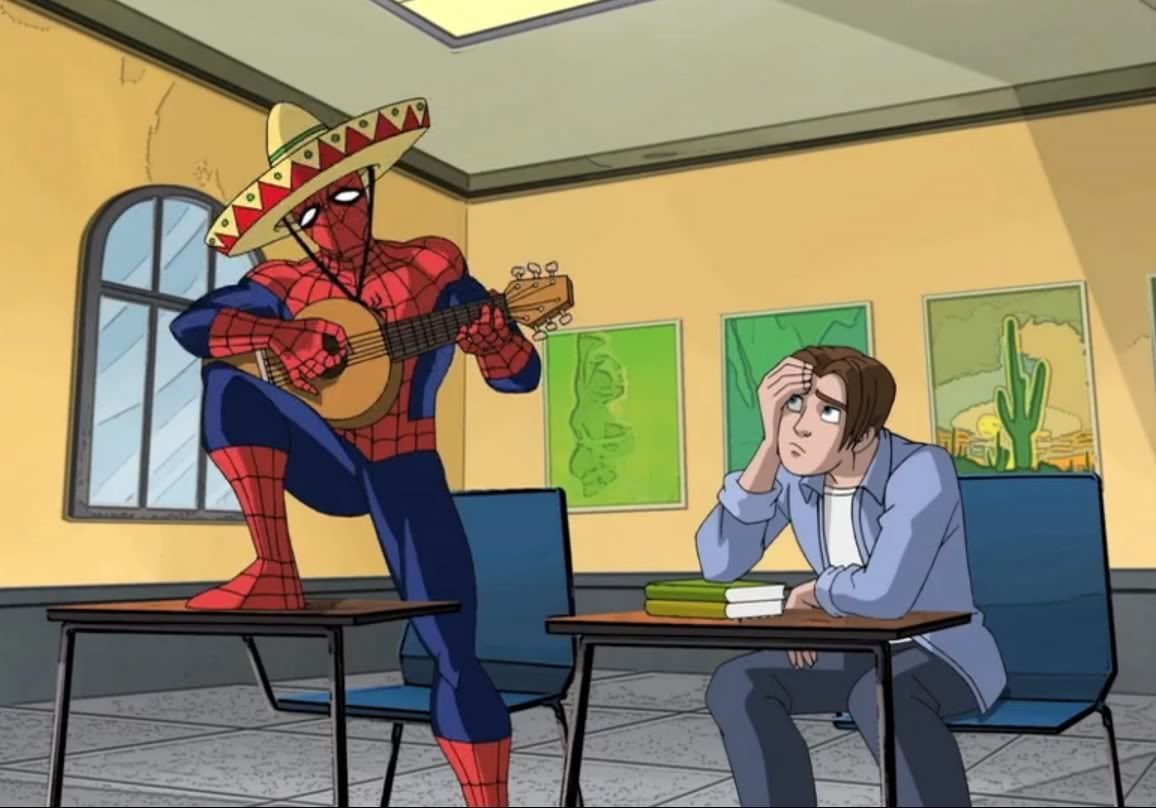
Ultimate Spider-Man Cartoon Rant: The Tyranny of the Dreamworks Eyebrow


-- Since I'm reviewing something that is clearly not aimed at my demographic (as Disney XD is meant for tweens and teens, not mid-twenties English MAs who perseverate over pop culture's unfortunate implications), I'm going to do this review in a more fluid structure, posted more around observations and emotional impressions rather than actual critical judgments. Even if I did think Ultimate Spider-Man was outright terrible, its existence doesn't negatively impact my life any more than I choose to let it. And I'm not one of those "you raped my childhood" fandom pundits, mainly because I think it's profoundly inappropriate to use rape as a description of anything but actual rape.

-- That said, it really gets under my skin that the Greg Weissman Spectacular Spider-Man cartoon was cancelled after only two seasons, while this takes its place. That was one of the best superhero animated adaptations ever! Why couldn't Disney XD have just kept that around, rather than making their own new cartoon with a far more dubious (and less movie-accurate, I might add) premise and execution?!

-- The first distinguishing feature of the Ultimate Spider-Man cartoon is the way that Peter Parker now talks to the audience and goes into dream sequence asides, a la Peter Griffin or Dr. John Dorian. This is obnoxious enough as is, since any dramatic value is rendered moot by making Peter's internal monologue a stand-up routine for an imaginary audience. This is worse in the scenes where Peter is not wearing his Spider-Man mask, because he uses the insufferable mannerisms and expressions of Dreamworks' "CGI characters with attitude". Raising an eyebrow and smirking does not validate your opinion.

What I hope to see is a Scrubs-style treatment of this where, while Peter is going off into one of his dream sequences, we see him standing completely still and oblivious in reality, with everyone looking at him in awkward dismay. Preferably followed by a bullet through his spider-brains, as he's too busy fantasizing about humiliating Flash or Nova or whoever to even recognize his spider-sense.

-- The second distinguishing feature of the Ultimate Spider-Man cartoon is the enrollment of Peter into Nick Fury's little superhero academy, which also intersects with Peter's day-to-day life because all of the metahuman cadets are enrolled at Midtown High (complete with movie immigrant Agent Coulson as the new principal!). There are two things about this which bother me; one, the fact that it's contrived on a level unforeseen since the Spider-Man and his Amazing Friends cartoon. And two, the extremely uncomfortable taste this leaves for readers of the Ultimate Spider-Man comic. Remember how beneficial THAT Nick Fury was to THAT Peter? How cleaning up the messes of Fury's black ops stuff got that Peter killed? Then again, this Peter is one whose death I would enjoy.

--Speaking of that hostility towards this Peter Parker, the character shows many of the same characteristics as Ben 10 and Generator Rex, two other protagonists of shows led by the Man of Action studio. Both characters are young male heroes who possess all the characteristics stereotypically required of a young male Saturday morning cartoon hero. They're rebellious, but they obey the system just enough to maintain a coexistence with the real world. They have problems, but they're almost always grounded towards the "relatable" (social life, girls, overbearing authority figures) and rarely dip into more challenging existential issues. They're book-dumb nimrods who don't particularly care about academic pursuits and don't learn from their mistakes any more than they have to in order to survive. And they exude attitude at every opportunity, taking attention away from the other, more interesting characters on their respective shows.

It's a safe, marketable rebel, the kind who doesn't rebel enough to make any actual sacrifices, the everyman character who doesn't have any traits unique enough to make him a true individual. It works pretty well for Ben and Rex, since they're original characters. For Spider-Man, having him as a hyper-aggressive show-off just doesn't work. That's the kind of self-absorbed attitude that made him let the burglar go, leading to his Uncle Ben's death. Contrary to popular belief of creators, the best Spider-Man stories aren't the ones that deal with him as a teenager/young adult with teenager/young adult angst; they're the kind that have him acting as a reasonable adult, or as close to one as he can get (which puts him head and shoulders above most reasonable adults). He's not called Spider-Boy, he's called Spider-Man. He's the kind of character who always carries the weight of the world on his shoulders, and agonizes over every decision he makes. The joking attitude is part of him, the front he uses to cope with tragedy and take the wind out of his enemies' sails. It isn't all of him.

-- I should clarify my own biases here; I LOATHE the teenage superhero sub-genre. I say this as someone who has read a lot of the teenage superhero sub-genre and even writes and draws his own teenage superhero webcomic. But then, Ruby Nation is meant to deconstruct these "Wake Up, Go To School, Save The World" tropes. I don't like the idea of the kid hero who treats saving the world like a game. I don't like the idea of their mistakes being just chalked up to growing pains, when countless lives are at stake. And I don't like the idea of a character becoming a superhero out of the desire to play hero, and treating that as easy while stuff like school and girls are hard. The job, as I see it, carries a tremendous psychological weight. If you're emotionally healthy, you aren't likely to put on a costume and risk your life as a vigilante. And the consequences of regular social life are nothing compared to these life-and-death situations. Maybe it's because I never fit into the regular social order of high school (even as part of a geeky sub-clique), but every time they start whining about how they can save the world but can't get to class on time or what not, I roll my eyes in aggravation.

I'm not saying they're bad or shouldn't exist, and I'm definitely not advocating the Civil War treatment of those characters (where they were treated as incompetent glory-hounds who got hundreds killed, despite the New Warriors all having been established as competent and altruistic enough to avoid that shit). But it seems to me like the problems associated with a teenager are nothing compared to the problems associated with being a superhero, not the other way around. Personal preference, personal baggage.

-- The show does have its merits. The animation is very good, and the voice acting is pretty solid. The other young superheroes are engaging characters, and in many ways overshadow Peter himself (especially Kid Iron Fist, played by Greg Cipes doing a great surfer dude/zen dude impression). Norman Osborn is used well, and the use of Doctor Octopus as a behind-the-scenes manipulator works excellently. He's extremely creepy, lurking in the shadows with his tentacles.

On the other hand, Spectacular Spider-Man did a lot of this far better, and that was evident from the very first few episodes. That show's Peter was driven by his desire to do good first, even if he made mistakes along the way. Their Harry was a more complex and tragic figure, rather than the wacky rich best friend he seems cast as in all incarnations. Their Gwen was a far better best friend to Peter than this Mary Jane, who's basically a junior Lois Lane (complete with stupidly getting herself in danger in order to get a story-- though I guess that makes her perfect for this Peter). The animation style was more unique, and the story blended drama and comedy much better. And this was in the first few episodes.

-- Overall, I don't like the show, but it's compelling in a train wreck sort of way. Maybe it'll grow on me the way the Glen Murakami Teen Titans show did. Or maybe it'll develop a good larger story, and shy away from the wacky asides. In any event, it's not for me. I also like the fact that the comic creators in Man of Action get a lot of money for these formulaic tween/teen action shows, so they have the financial support to do awesome comics like Joe Kelly's I Kill Giants and Joe Casey's Butcher Baker Righteous Maker.

Monday, October 10, 2011

The Jeph Loeb Drinking Game


Note: Do not try this at home. This Avengers: X-Sanction preview alone will get you completely plastered.

--When a fight scene erupts for no clear reason other than to have a fight scene, take a shot. (Avengers vs. Lethal Legion)

--When a bunch of heroes or villains are assembled in an "iconic" arrangement, take a shot. (The Avengers are Marvel's Big Five-- Wolverine, Spider-Man, Iron Man, Captain America, the Hulk by way of the Red Hulk-- joined by the Falcon, presumably as a token. The Lethal Legion are veteran Avengers foes Living Laser, Grim Reaper, Whirlwind, and Radioactive Man. The latter of which hasn't been a conventional super-villain in a long time, instead acting as a loyal soldier for China).

--When a character makes a quip with the same amount of wit as a schoolyard taunt, take a shot. (Spider-Man: "Why is there never a jailbreak on nice, pleasant, warm nights in New York?" Wolverine: "Why is it you never shut up?")

--When a character goes into heavy-handed, mopey first-person caption narration, take a shot. (Cable's internal monologue about being a soldier).

--When the conflicts are revealed to be the acts of an ubermensch villain manipulating events with far more capability than they should be able to have, take a shot. (Not seen here, but with Loeb's history of using villains like Hush, Romulus, Ultimate Doctor Doom, The Intelligencia, and others, there's often a mastermind with unconvincingly extreme mastery).

--When a character is brought back to an "iconic" state in a way that defies everything previously established, take a shot. (This series is about bringing Cable back from the dead. Even though his absence wasn't exactly derailing the Marvel Universe.)

Now excuse me as I go into the ER for alcohol poisoning.

Tuesday, August 16, 2011

Follow the Horrors of Spider-Island


E. Wilson is a regular follower and friend of this blog who always has good insights about comics. I'm going to repay the favor by directing you to The Horrors of Spider-Island, his admirable quest to read and review every issue of the current Spider-Man crossover. Excellent reading, and an impressive commitment.

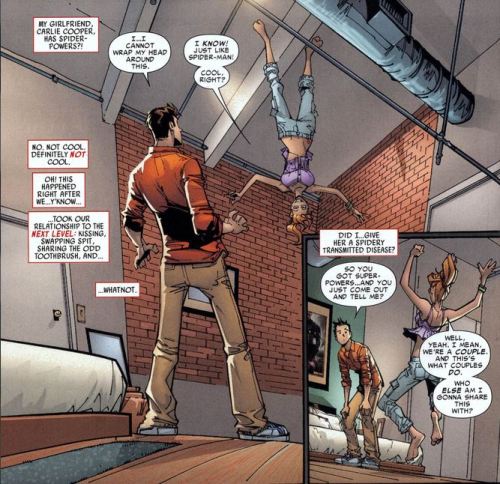
I'll be following the main comic as well, even though I'd stopped reading ASM once I realized that Dan Slott's interpretation of a twentysomething person doesn't go much further than rollerball and drunken tattoos and the hippin' and the hoppin' us darned kids do so much. Nevertheless, I have enjoyed Slott comics in the past, Humberto Ramos' art is perfect for such an over-the-top story, and if Carlie Cooper ends up getting herself killed after her apparent regression to the intellect of a 14-year-old fangirl with anime cat ears, I will be very relieved.

(And yes, this is probably the first time I've WISHED for a superhero's girlfriend to be stuffed in the fridge, but the major sin was in making the character so shallow and obnoxious that she actually interferes with her boyfriend's saving lives.)

Wednesday, August 11, 2010

Great Moments in Otherwise Terrible Comics?


Here's a question for you all to actively answer in the comments...

What are your favorite scenes in crappy comics?

To give you an example, I'll discuss the good stuff I found in The Other, the big Spider-Book crossover written by JMS ( whose Spider-Man I discussed earlier, after the above cat sat on my copies of his work ), Reginald Hudlin, and Peter David, with art by Mike Deodato Jr., Pat " the Transman " Lee, and the late, lamented Mike Wieringo...

-- There were a lot of excellent character moments with Peter and his supporting cast, both his family and his Avengers comrades. Peter's death sentence stirred a lot of drama to the surface, insights that we might not otherwise have seen. MJ gives a heartbreaking speech about how Peter subconsciously goes into battle half-cocked out of a death wish born of survivor's guilt. Aunt May internally curses Uncle Ben for not allowing Peter to move on with his life. And Peter himself has a great scene where he almost kills a villain, cursing how unfair it is that he's being punished for trying to atone for one mistake he made, and talking about being free to make another big mistake as he beats the hell out of the bad guy. Even after he came back ( one of many reasons why this was a stupid story ), there were some interesting points, like MJ talking about surviving Peter's ( believed ) death made her realize that she was a stronger person than she thought.

And we can't forget how Wolverine hit on the grieving MJ to distract herself from her despair, and how her words of thanks afterwards were along the lines of " I know you didn't hit on me on purpose because I'm so out of your league ".

-- Peter found some clever uses for his spider-powers after his resurrection. The spider-stingers in his wrist....well, there aren't words in human language to described how fucking ridiculous that concept is, even by superhero standards. But I liked the final issue with Peter experimenting with his powers. Seeing him find creative ways to use his abilities, like feeling the vibrations of a target through his webbing, or having a rescued child cling to his back the way he clings to walls, were pretty cool. If only he figured out how to use these without a contrived mystical experience.

-- Mike Wieringo's art was exceptional. Mike Deodato's work was good as always, and Pat Lee managed to be tolerable despite his continuing use of his trademarked " Dull Surprise " expression. But Wieringo was an exceptionally gifted cartoonist. Even with fewer lines than most superhero artists, he managed to exude character from his figures. Look at scenes like Cap tearing up upon Peter's death, Logan's reaction to MJ's aforementioned speech, and of course, Peter getting cornrows when visiting Africa. He is still very much missed. :(

These traits make this Big Lipped Alligator Moment of a story tolerable....well, almost.

So what are your picks?

Tuesday, June 15, 2010

Kitty Review: Allie Approves of JMS' Amazing Spider-Man


Admittedly, I was prompted to post this due to the camera photo opportunity of Allie, our lovable tabby cat, sitting on a stack of my comics. That he chose to sit on some of my Amazing Spider-Man Ultimate Collections ( large trade paperbacks collecting chunks of J. Michael Stracyinski's stories ) was appropriate, because I've been reading those thoroughly lately, and appreciating them a lot.

Discussions of JMS' Amazing Spider-Man tend to be myopic, focusing on the big events-- the totem stuff, the WTC tribute, Sins Past, the Other, the Iron Spider, and of course, the infamous One More Day. It is true that a lot of those stories were terrible-- I mean, there's no way to spin " Gwen Stacy had Norman Osborn's mutant love children before he murdered her " to sound like anything less than crap. Then again, most of the later stuff had a strong editorial hand, or was tied into crossover stuff. But to focus only on those is to undermine the excellent individual stories going on in between.

What I liked so much about JMS' Spider-Man was that he made the character of Peter Parker care. Even though Peter was still a working-class twentysomething, he lived his life to the fullest, and did everything he could. Having Peter become a high school teacher was a stroke of genius; despite low pay and unruly students, he realized that he could help kids feeling just as isolated and misunderstood as he was. When villains attacked him and his loved ones, he didn't just quip and dodge-- if needed, he'd go in there and fight until he blacked out from sheer pain and exhaustion. And when his marriage with Mary Jane was falling apart, he'd drag his ass all the way across the country to win her back.

JMS has been criticized for overly melodramatic writing, and in some cases that's a very accurate critique ( re: the WTC tribute, and the infamous tears from murderous despot Dr. Doom ). However, for Spider-Man JMS' voice worked very well. His stories worked to show us that Peter wasn't a superhero in the professionalized terms of modern comics ( i.e. anyone registered with the Initiative ), but a genuine hero. Compared to Ezekiel, who tried to seek power but never ended up using it for pure good, Peter's determination to do the right thing was all the more inspiring. Compared to his high school friend Charles Weiderman, who used his nerdy isolation to obsess over super-soldier fantasies, Peter was impressive for not giving into the bitterness of his lonely youth. Even Peter's family got in the act-- Aunt May became a staunch supporter of Spider-Man after finding out Peter's secret identity, helping in all the ways a seventy-something woman can help ( which is more than you'd think ), and Mary Jane tried to work out her difficulties being a superhero's wife like an adult.

Yes, " Adult ". Not adult in the sense of having more gore, but in facing consequences with responsibility and integrity. Post-JMS Spider-Man comics have been determined to show us that " twentysomething " means " slacker ", with Peter stumbling around blindly, mooching off his friends and family, and being Spider-Man reactively. These comics show us that for Peter, being Spider-Man isn't a choice he makes to do good in the world; it's a burden he's taken because he doesn't want to disappoint the big sky-daddy ( in his case, his uncle ). This Peter has the morality of a six-year-old, acting in accordance with internalized fear of being bad, while not really giving thought to hard choices and major progressions. As a twentysomething myself, it's grating that Spider-Man's fortysomething-plus writers see my generation like this-- especially if they're right, that this audience wants Spider-Man as a slacker who fights crime as an impulse/hobby.

But I digress...the point is that for all the melodramatic warts, and the stupid event stuff, JMS wrote great stories that were ethically driven and emotionally meaningful. They were more than just a bed for a cat wanting to nap in the sun.

( Though they serve that purpose well enough. )

Friday, December 11, 2009

In Light of Nemesis; The Blueprint for Pretty Much Every Mark Millar Comic

In light of the Nemesis news, which I hope is not more of the same

After nearly a decade of consistent popularity, Mark Millar has developed a finely tuned formula for what to expect from his comic writings. By " developed ", I also mean " has fastidiously stuck to with little if any deviation ". And I say this from someone who has absolutely loved his work in the past, particularly on the Authority and the Ultimate Marvel characters, and even his year-long runs on Spider-Man and Wolverine. But in the past couple years especially, Millar's comics have become based on a very tight blueprint that's good at the illusion of deep, challenging work. Unfortunately, after many years, it's become apparent how the magician is doing the trick. Again, and again.

For example;

-- The Mark Millar story is a superhero premise with a high concept twist. Emphasis on high concept; the twists are readily apparent and easily digestible. Examples include Wanted ( supervillains secretly rule the world, Joe Schmoe discovers he's heir to the deadliest of them all ), Kick-Ass ( comic book fan tries to be a costumed superhero in a world without powers ), War Heroes ( military develops super-power pills, soldiers use them for massive heist ), and now Nemesis ( Batman figure turns out to have Joker modus operandi ), If it's a run on a corporate-owned franchise, it's less likely to be so obvious, since Millar is putting in a longer story there. But even then Millar tends to write his stories as finite runs with clear premises, most notably with Civil War ( superheroes brawl over thinly veiled post 9-11 issues of freedom vs. security ), but also with Old Man Logan ( shell-shocked veteran Wolverine pulled out of retirement for one last big kill ), 1985 ( 80's supervillains attack real world of 1985 ), and even the Ultimates ( Marvel history rewritten for Bush-era America ). These at first seem like ideas so devilishly simple that you're surprised nobody's thought of it prior. The truth is that people have thought up these story ideas, they just were represented in more subtle and nuanced ways ( JLA villain Prometheus being created as an evil Batman, late 80's fantastic four dealing with superhero registration in a sane and reasonable fashion ). But if you want the blockbuster treatment...

-- The Mark Millar story never has a hero. Protagonists do things that may be labelled heroic, but it's clear that the motivations are never pure, and the results are never wholly successful. The closest character Millar can write to a hero is a character like his version of Peter Parker, who's simply so naive that he doesn't know there's more than a good vs. evil binary to the world. Otherwise, his heroes are zealots for a very fundamentalist notion of justice ( Civil War Cap, Ultimate Thor, Ultimate Xavier, possibly Kick-Ass ), or self-serving nigh-sociopathic individuals who happen to target the right enemies ( Wolverine, the Authority, the rest of the Ultimates, Civil War Iron Man, most of the Fantastic Four but especially Johnny Storm ). Nemesis will probably have the Millar version of the Gotham Police work under a similar paradigm.

-- The Mark Millar story always has a villain. Nobody is 100% good, but there are people who are 110% evil, so vile that they go beyond the normal possibility of 100. Wanted has its protagonist become utterly hedonistic and depraved once he receives power, scoffing about how he can " rape an A-List celebrity and not even have it make the news ". The Wolverine story " Enemy of the State " has the Gorgon, who mathematically disproved the existence of God and works towards the destruction of life PERIOD. The Authority faced a number of genocidal maniacs obsessed with rape. And while Norman Osborn has always been a complete monster, Millar gave him his worst act to date-- upon learning of the chronic illness of his prison guard's wife, made a cure for her, which made her temporarily healthier but then killed her even more painfully. Nemesis should, by the very definition, provide a villain with similar actions ( especially since Millar compares him to the Joker, the worst super-villain since super became attached to villain ).

-- The Mark Millar story almost always has a Morality Pet,a genuinely pure and good character who is there for no reason other than to offset the nihilism everywhere else in the story. Characters like Hawkeye's family in the Ultimates, the Vulture's terminally ill grand-son in Marvel Knights Spider-Man, Dave's hard-working widower dad in Kick-Ass, the kidnapped little Japanese boy in Wolverine: Enemy of the State, Cindy Sheehan analogue Miriam Sharpe in Civil War, and Wolverine's Little House on the Prairie brood come to mind. Toby from 1985 might qualify, because he's got divorced parents ( though it isn't used for much other than stock drama ), but he's a protagonist. These characters tend not to have any agency other than to show that the world isn't all bad. However, they also tend to either suffer or outright die, reinforcing the nihilistic premises. They aren't characters who draw sympathy so much as attempts to show that the worlds Millar writes aren't entirely unsympathetic-- but they're still outweighed by the Wesley Gibsons of the worlds. I'm not sure how this will appear in Nemesis, but I hope that the titular character doesn't justify murder and pillage by being a single father to a child with cystic fibrosis.

-- The Mark Millar story has an extensive amount of conversational dialogue filling in backstory, giving hints to a colorful history and universe-- without actually showing us said colorful history and universe. Professor X will write a book on Mutant Boom and Bust Economics, Tony Stark will have a history of suicide attempts, countless characters will have backstories that make them " cry themselves to sleep every night " ( Bruce Banner, Ben Grimm, Bobby Drake, and more ), and as I said before Wesley Gibson will be able to commit rape without consequence-- but we don't find out anything more about these story threads. It seems like a compromise between having big unique ideas without having to risk them not succeeding-- these asides don't go into Mutant Economics or Reed Richards' 100 ideas for a better society, so there's no chance of failure for expanding on those ideas-- but no change of the success that a really thought-provoking story could offer. They're just expanding on what's already there.

-- The Mark Millar story has a style of dialogue that is universally nasty and insulting. Every character will call someone else an idiot, a moron, a dumbass, a ( R-Word deleted ), or some other insult to their intelligence. Villains are especially insulting, and they relish in exposing their nemeses to depraved monologues. Heroes aren't disgusting, but they do tend to go past witty banter and into outright dissing their opponents. Even nice characters talk with this dialogue rhythm, and tend to sound very condescending as a result ( Aunt May, for example, jokingly chastising Peter at the end of Marvel Knights Spider-Man for his tired " I'm giving up being Spidey forever " monologues ). It's a series of memorable lines, but it doesn't really work as dialogue, and it doesn't show a lot of range; at least in Nemesis, the protagonist is a villain, so this should be appropriate for him.

-- The Mark Millar story is told in wide, letter-boxed panels designed to imitate big budget movies. Many contemporary writers use this format for their scripts, most notably Warren Ellis with his " Authority ", but Millar has made it the key to his style. His scripts are written with big " moments " in mind, massive panels displaying awesome images. Every artist he collaborates with delivers this, and they very from dramatic gestures ( Wesley breaking the fourth wall and addressing the audience in the end of Wanted ) to big action scenes ( Iron Man ripping open Captain America's face and years of borderline homoerotic bonding as a result ). Artists like Bryan Hitch, who are well known for drawing this sort of story, are called to be especially showy; Ultimates 2 ended with an orgy of splash pages as the Ultimates take down their third world enemies. Seriously, they had a six-page gatefold spread. These are most obvious in the endings to individual issues; typically there's a splash page ending with one ominous line of dialogue, like the first issue of Ultimate X-Men ( where we find that Wolverine is introduced as a Brotherhood assassin ).

-- The Mark Millar story has lots of references to pop culture and current events. Millar's stories tend to be very specific to the present ( exceptions occur like the Jenny Sparks history, Red Son, or 1985, but it's clear that Millar's preferred ouvere is dealing with the now ), and deal with headlines as they come up. His superhero comics tend to deal with the War on Terror in a very explicit fashion-- Ultimate X-Men has mutants cast in the role of Muslims ( though I have to give Millar a lot of credit for the fact that he was writing this series almost a year before 9/11, which makes " The Tomorrow People " arc almost prophetic ), Ultimates deals with America's concerns about homeland security, and Ultimates 2 is direct commentary on the " nation-building " tactic of Iraq. War Heroes also qualifies, since it was originally planned for Ultimates 3; Civil War was meant to, though it ends up being more of a really awkward version of the gun control debate. Pop culture also commonly appears; Kick-Ass is heavily influenced by the runaway popularity of internet video sites like YouTube, the fledgling mutants in Ultimate X-Men make constant pop culture references ( like how Iceman " should have been playing Metal Gear Solid like every other kid his age " ), the Ultimates has all its members become celebrity tabloid fodder, and many characters are actually based on popular celebrity likenesses ( most notably Wesley Gibson, based on rapper Eminem ). It's no wonder that the Ultimates had a scene with the characters chatting about who'd play them in a movie version.

I'm wondering if the fact that Iron Man movie actually DID get Samuel L. Jackson to be Nick Fury will further encourage this trend, and not just amongst Millar.

-- The Mark Millar story has blood. Lots of blood. People who watch Saturday Morning cartoons as an adult might wonder why they shoot lasers instead of bullets, why no civilians get hurt, and how someone can survive being hit by Superman. The sheer amount of collateral damage in the Mark Millar story is evidence why kids' versions of superheroes try to avoid that. It's logical, but it means that families in SUVs are incinerated when Electro goes rampaging towards Spider-Man, schoolyards of children are murdered when neophyte heroes screw up in Civil War, and people trying to be heroes without powers in Kick-Ass end up getting their faces worked into the shape and texture of a dog's breakfast. This shows up in Millar's Marvel work, even that which is intended to be towards a more general audience ( like Ultimate X-Men, initially ). His creator-owned work is even more egregious with this, being the " Too Hot for DC " version of his stories with franchise characters.

-- The Mark Millar story never has a happy ending. There's often a big party serving as an epilogue, as we saw in the Authority ( Apollo and the Midnighter's big gay wedding ), Ultimates 1 ( the White House party with Tony Stark about to cuckold George W. ), and the penultimate issue of Ultimate X-Men ( the opening of the Xavier School to the public ); even without the party, there's still always a sequence that indicates that it's not really the end. In Wanted, we get the immortal line " This is the look on my face as I'm fucking you in the ass " addressed to the audience; in Ultimates 2, we get a tragic flashback to the 1940's with Captain America promising his then-girlfriend that this will all be over soon. Civil War has Tony Stark kind-of bringing the world to order, though he does so in a very smug way that seems to invoke Wesley Gibson's parting lines. And while Marvel Knights Spider-Man is one of the few optimistic stories Millar has given us, it still ends on the note that the endless dance between Peter Parker and Norman Osborn is distracting him from doing anything meaningful in the world beyond being a costumed vigilante.

With this all said, I can envision a lot of Nemesis before it happens, and I'm hoping dearly that Millar will expand his repertoire. His formula has more often than not produced entertaining results. However, it's a formula, and it has limits. Many of Millar's contemporaries have their own stylistic quirks, but their stories have more range than this. Grant Morrison can do more than non-linear stories that read like hallucinations; Garth Ennis does genres other than just stories mercilessly satirizing religion, government, and spandex. Millar should be able to go beyond the super-cynical, super-violent, super-"hero" story. I have faith in him having the capacity to do so; I just hope he develops the inclination.