Ruby Nation

Ruby Nation
Ruby Nation: The Webcomic
Showing posts with label marvel comics. Show all posts

Thursday, February 20, 2014

My Response To The Michael B. Jordan Fantastic Four Casting


In response to the news HERE, though the Michael B. Jordan casting was known well before it was finalized today.

I do have misgivings with the castings (namely that Sue Storm was cast as Kate Mara, a white woman, when there are plenty of talented black actresses that have a harder time getting work and would've looked more like Jordan's sister), but the inevitable, often-racist shitstorm that comes with changing the race of 1960's characters for film is usually entertaining (if depressing) to watch. Especially when it's related to the Fantastic Four, a book that has struggled to be interesting and relevant ever since Jack Kirby left the book, barring a few standout periods (such as Byrne's run and the Waid/Weiringo stuff). 

Tuesday, December 24, 2013

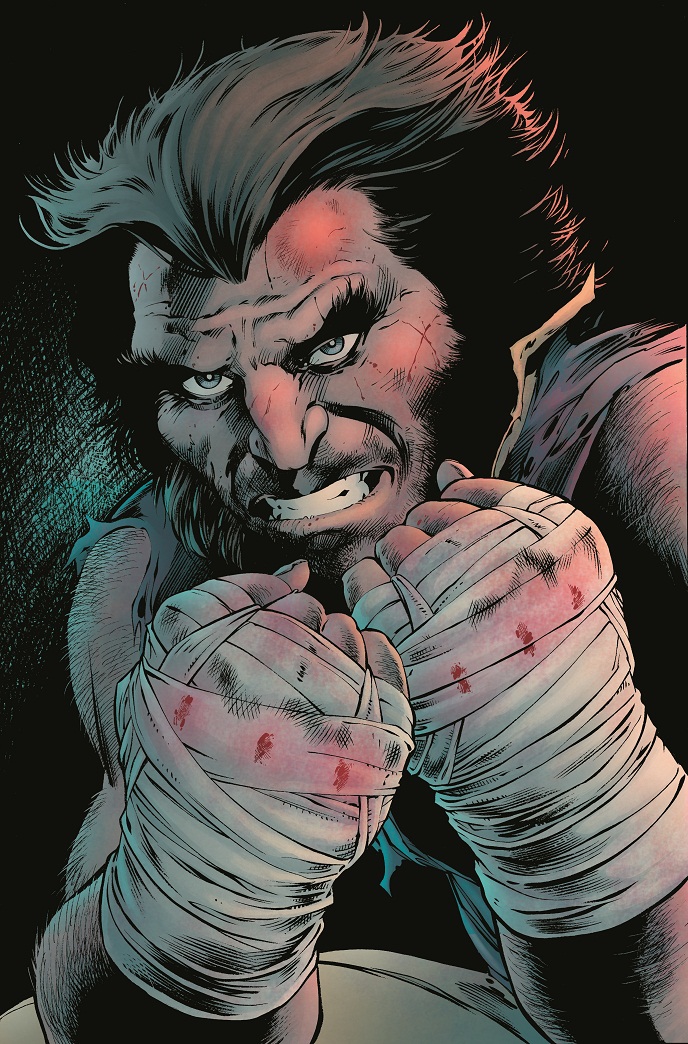
Wolverine By Paul Cornell and Alan Davis, Superhero Comic of the Year

This is the year where I finally put my money where my mouth is and drifted away from mainstream superhero comics. It wasn't because the books were offensively bad, just that most of them weren't really going anywhere that wasn't permitted by the dual demands of movie licensing and comics continuity. One of the comics that got around those and remained consistently memorable, however, was the new Wolverine book by Paul Cornell and artist Alan Davis.

On the surface, one could say that this was another case of a comic being an adaptation of its own adaptation, since the big hook for Cornell's story is Logan losing his healing factor and becoming Killable-- the thing that happened in the Wolverine movie, which I still have yet to see. However, Cornell has done exemplary work showing us how Wolverine is adapting-- or not adapting, rather-- with his newfound mortality. Without a mutant regeneration ability that can cure him of every ailment conceivable, from being drunk to being hit with Little Boy *, the list of new problems that Logan must face are endless. In the very first issue after a sentient virus burns out his healing factor, Logan realizes that he has to be careful with EVERYTHING-- he even considers buying a practice shaving razor, as his previous shaving techniques were much rougher. Logan is unparalleled at ignoring pain, but that's because pain is the body's signal that something is wrong, and there used to be nothing that Logan's magic healing flesh couldn't fix. Now he has to worry about not only normal human injuries, ailments, intoxications, and all-around mortality, but he also has to deal with the added disabilities of his other powers.

 Immediately after Logan is diagnosed as "mortal" by Hank McCoy, he's prescribed a drug to counteract the heavy metal poisoning of his adamantium skeleton, which would otherwise kill him rather quickly. The metal skeleton may be unbreakable, but it also makes him vulnerable to electro-magnetic attacks, and early issues imply that Logan's torn up his own ligaments against his metal bones in past berserker rages (just that he didn't notice because he immediately healed up). He can't use his claws without bleeding a lot, making his primary weapon a double-edged sword. And his heightened senses also make him more vulnerable to sensory attacks-- as seen when he's drugged by some ninja enemies, and starts tripping even harder than an ordinary man.

This is why the book has become so intense, even if Logan gets his healing factor back-- we finally see the character as VULNERABLE. There have been other stories where Wolverine has lost his powers**, but they haven't been nearly as brutal in showing Logan's emotional responses. Even his legendary stoicism is challenged, as everything Logan used to rely on to do his job is compromised, and he has to live his life with caution. If that weren't enough, his enemies are aware of his newfound mortality, and are using it to toy with Logan's emotional weaknesses as well as his physical ones. Mystique slips into his bedroom unnoticed to steal an heirloom sword, making it clear that she could kill him any time she wanted, but is just toying with him. Sure, Wolverine can put on a brave face and fight back, but it's becoming increasingly clear that his ability to overcome weakness with a manly man attitude has its limits. A lot of his actions now seem motivated by a desire to compensate for this and prove to others that he's still got it, such as picking a fight with the Black Panther (ex-husband of Wolverine's friend-with-benefits Storm), or going off on a quest in search of his stolen sword despite knowing it's an obvious trap.

Marvel seems to have realized how good this book is, and has heavily promoted the series' relaunch, which implies that Wolverine will become a super-villain, retraining himself by working alongside the super-powered crooks he used to turn into sashimi. The new costume is inspired by samurai armor, not just to protect Logan's weakened body, but to reflect his new mood. In this series, Logan has made several references to samurai culture, but with a more cynical edge than before; though he admires the ideal of bushido, he's sickened by the reality of the samurai culture, as mercenary dogs of the aristocracy. But that's what Logan might have to do now, if he wants to get his edge back. He could only fight his arch-enemies like Sabretooth to a standstill even when he had his healing factor, and now that he's lost such an advantage, he's got to find another way to stand up to the most despicable mass-murderers on Marvel's Earth.

The Nietzche line of "he who fights monsters" has always been a theme in Wolverine comics, as his innate brutality proves necessary to protect the innocent, but keeps him on the edge of becoming as bad as his foes. Now that Logan's lost his X-Gene crutch, he's much less stable, and may well fall off that edge. And even if he gets his healing factor back at some point, he may never atone for what he'll have to do to reclaim the level of viciousness needed to defeat Sabretooth.

This has been an excellent comic, and everything I look for in a Marvel book. Paul Cornell is superb at making Wolverine a sympathetic character, and the story is gripping from issue to issue. The art by Alan Davis needs to introduction, as Davis is unquestionably one of comics' legends. But the fill-in issues by Mirco Pierfederici were surprisingly good, even under Davis' shadow; he did a great job selling Wolverine's newfound vulnerability, as he finally is able to get drunk and ends up in a disarmingly weepy state. And new artist Ryan Stegman looks like he'll do another great job, fresh off his "Superior"*** work on Superior Spider-Man. I actually look forward to where this book goes next. You should too.

* From the Marvel Knights Logan series, by Brian K. Vaughan and Eduardo Risso. Wolverine was apparently at ground zero when Hiroshima was bombed, fighting against Imperial Japan and getting laid for the first time. Logan explicitly mentions the parallels between losing his virginity and entering the atomic age. I AM NOT MAKING THIS UP.
** Most notably in Larry Hama's epic run on Wolverine, in which his healing factor is burnt out by the strain of Magneto tearing out all the adamantium. This is unfortunately undercut by the fact that, after a year of being vulnerable and having to rely on bone claws, Logan's healing factor overclocks and turns him into a feral brute whose noseless face is covered by a pirate mask and has huge wads of forearm hair. Again, I AM NOT MAKING THIS UP.
*** Too easy, I know

Sunday, December 2, 2012

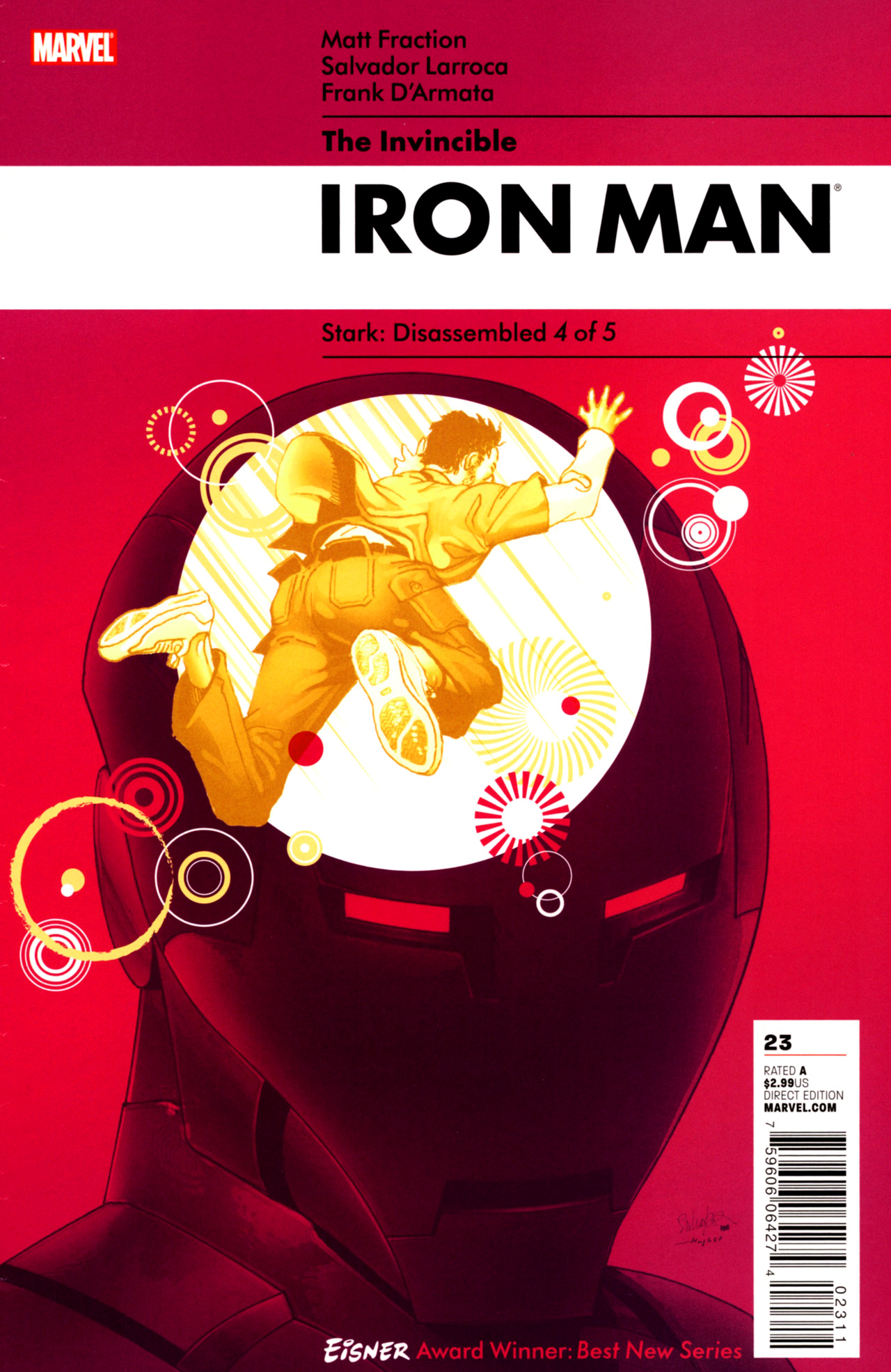
Matt Fraction Iron Man Retrospective: That's It? Hell Yeah It Is


Genre fiction tends not to be the place for subtle, complex emotions. With names like comedy, suspense, drama, and horror, genres in their purest form tend to cater to simpler desires, evoking simple yet visceral emotions if done well. This isn't a bad thing, as that's hard to do in practice and should be lauded when done successfully. However, the best works are the ones that augur more complex feelings, put you in emotional places that are all too real but rarely discussed in our fictional fantasies. This is the difference between, say, anger at a designated foe, and pervasive frustration over a lack of personal progress. A dramatic collapse into addiction followed by a heroic triumph of willpower, versus a realization that those compulsions have just been sublimated into other areas. Or even the difference between a triumphantly happy ending, and an ending where the hero left the world slightly better than he found it-- but only slightly.

Matt Fraction has been doing this with artist Salvador Larroca* on the Invincible Iron Man for four and a half years, taking the character into emotional territories seemingly beyond the scope of the superhero genre. As of October 2012, Fraction finished his tenure on the book with a surprisingly downbeat epilogue. After a penultimate issue of all action, where Iron Man teamed up with pretty much every non-Avenger ally available (and even some enemies) to stop the Mandarin, Tony returned to America after months in his arch-enemy's captivity. What Tony concludes, to his dismay, is that the world hasn't changed much in his absence, still stuck in the past.

Actually, that's not quite true; Tony's friends and colleagues were doing okay without him. Resilient, previously Stark Resilient, became fairly successful without its mega-celebrity founder, using the repuslor technology to make superior consumer goods without a single cent of military funding.Pepper Potts moved on with her life, eventually hooking up with dowdy but reliable Carson Wyche (one of Resilient's star inventors, whose career had previously been ruined by Tony during his decadent and petty pre-Iron Man days) and learning to live without the Rescue armor. The civilian works of Tony Stark continued without him or Iron Man-- his real legacy. But that's not something that Tony can really appreciate, so the only person really stuck in the past is him. Tony's company escaped the Marvel Universe's Nietzche-esque eternal recurrence, and are off doing good if rather dull work by making better, cleaned products that are presumably cheaper. But Tony is stuck in the same cycles of heroes and villains and will never escape them, thanks to the fact that his existence as a Marvel comic character is meant to sell merchandise first.**

The main theme of Fraction's run on Iron Man is the explicit question of wether or not the Iron Man is a good thing. Sure, Tony saves the world as Iron Man, but there are plenty of other superheroes who do that without all of Tony's baggage; who don't sponsor their super-powers with military-industrial blood money, who aren't responsible for thousands of civilian deaths at the hands of Stark weapons, and who aren't so wealthy that they can retreat into their addictions while shirking their responsibilities. Some might even say that Tony's decision to atone for his arms dealing sins as Iron Man served him far more than anyone else, giving him the visceral thrill of being a superhero and catering to his death drive impulses, instead of really cleaning up the Stark-branded messes left on battlefields across the world.

This theme was much easier for Fraction to express at the start of his run, when Tony was the Orwellian ruler of the world as Director of SHIELD. When Tony relapsed into the military-industrial complex full force after the events of Civil War, it was much easier to critique the problems in his imperialistic approach. The first twenty-four issues of the Fraction/Larroca Iron Man fired upon all cylinders, especially during Tony's atonement in World's Most Wanted (which kick-started the Handi-Capable blogging, as some of you may remember). After that it was more uneven, since the Heroic Age led to Tony Stark trying for a more pacifistic approach, which really wasn't condusive to serial superhero comics. (The Stark Resilient arc was particularly egregious, with its first half being entirely set-up for Tony's new company.)

Of course, that may have been the point, because a lot of life-- particularly recovery from addiction-- isn't earth-shattering drama. It's living day-by-day, paying your bills, managing your relationships, and trying to do a little better than you did the previous day. And this doesn't really work for Tony Stark, who risks his life on a daily basis and goes through more women than James Bond. In many ways, Tony still lives an addict's life, even if he's kept himself clean of alcohol; he lives a life of consumption, keeps others at arm's length, is frozen at the emotional maturity of a teenager, and doesn't place any value on his personal safety.*** This isn't really the kind of person you want as a responsible leader for a trusted brand, and when Tony fails, his companies tend to fail with him.

The final chapters, however, did have Tony save the day when nobody else could, by ultimately defeating the Mandarin-- who was quite cleverly played as a twisted mirror of Tony's own conspicuous consumption, a Kim Jong Il-style**** hedonist so obsessed with his self-mythology that he became enslaved by it (what with the rings actually controlling him). Just like in real life, weapons are a necessary evil some times, when you need to defend the just and the innocent. But Iron Man is still a weapon, and tying worship of weapons into the public sphere has grave moral consequences, as Eisenhower (correctly) warned. So this makes the ending, with Tony leaving his company and going off to find new adventures in space, an appropriate if bittersweet conclusion.

One of Tony's final lines to his former employees is "I'll do better next time". So much of fiction deals with character development in very broad strokes, either ignoring it or having characters Learn Lessons and Grow Stronger. Tony isn't a completely different person after all of his experiences in Fraction's stories, nor can one expect him to be. Nor is Resilient poised to dramatically change the world, in the broad "curing cancer and making cars fly" strokes too often shown in science fiction "utopias". They make cleaner cars and cleaner phone batteries. They're helping people live life a little better, and they're offering it to the public in a completely voluntary fashion; you don't choose a Stark phone because of a Dr. Doom-like edict sweeping society, you presumably choose it because it's just a better phone. The world is thus a little better, from this small bit of progress-- which is ultimately the best we can hope for in terms of lasting good. Humans and their societies can't change overnight, nor can they become perfect-- they can just move in the right direction, and that's what Tony's done.

It's a complicated message for a superhero comic, but a very powerful one when fully understood. I'm really going to miss Matt Fraction on Iron Man, and despite some misgivings about certain parts of this story, I have nothing but praise for the sum of those parts.

* Larroca's art deserves special mention, as he became better and better with each issue. His tech is always beautiful and inventive, but his characterizations are also superb; though he's often critiqued for relying too much on photo reference, his art uses such economy of line that those faces get life beyond their original inspiration. I'm going to buy the new Cable and X-Force comic just for his art. And Colossus, of course.
** Which isn't really a bad thing, it just is. This is also why creators who do such brilliant things with the franchise characters deserve special applause.
*** Illustrated beautifully in the .1 issue, where Tony recounts his entire history in the context of an Alcoholics Anonymous meeting. If you buy a single issue of Fraction's run, buy Invincible Iron Man 500.1
**** Which is why for a moment I was disappointed that Ben Kingsley was cast as the Mandarin in Iron Man 3, because I would've gone with the Kim Jong Il puppet from Team America World Police :P

Tuesday, July 10, 2012

The Goldfish's 10 Things Fiction Writers Need To Remember About Disability: The Spider-Man Movie People Should've Read This


One of the greatest essays I've read in the past few weeks online the Goldfish's 10 Things Fiction Writers Need to Remember About Disability. It's been broken up into Part One and Part Two, and both are well worth considering for any writer.

It's especially relevant to me because I read the first part the same week I saw the new Spider-Man movie, and while I liked that movie a lot, many of these things were ignored in regards to the film's antagonist. Of all the characters they could've picked, they chose Dr. Curt Connors, a.k.a. the Lizard. This character, who thought his amputated arm was such a disgrace that he would risk his own life to cure it (and, in doing so, turn himself into a giant reptile monster), represents several things on the Goldfish's list;

3. People with long-term impairments or chronic illness are not fascinated by their own condition or their own symptoms. While Connors doesn't natter on about statistics regarding amputated or malformed limbs, he is obsessed with curing his ailment, right down to his "World Without Weakness" rhetoric. Whatever sympathy he would've gotten for his handicap and his daily accessibility issues is lost when he starts using Eugenic language, and "weakness" is a term with further reaching connotations. Note that Connors is not dying, nor is his life completely ruined due to the lack of his arm. It's understandable that he would be frustrate with his limitation and admirable that he'd go into medical science, but using himself as a test subject shows a deeply internalized self-hating ableism. (And I get that he was feeling awful at the time, looking at being fired or even disappeared by Norman Osborn, but he'd been spouting the World Without Weakness rhetoric since his first scene.)


4. Disabled people are not all young, white, straight, affluent men. Connors is an older gentleman, so he at least beats the ageist part of that majority formula, but he's male, white, (presumably) straight, and lives comfortably. Then again, the Amazing Spider-Man movie only has a few female characters (albeit in important roles; Gwen Stacy is used superbly here as Peter's confidante as well as his girlfriend, and Emma Stone does a great job with the character. Aunt May is also used effectively, albeit with less screen time). It also has only one remotely significant character of color, that being Norman's henchman. And there are no gay, bi, or transgendered/intersexed characters. Not a surprise, and I can't hold it against this movie specifically, but it does illustrate the problem; young, white, straight, affluent, and abled men still control all the most visible narratives. 


Again, I liked Amazing Spider-Man a lot as a movie, and it's definitely in my top 5 of superhero films. But it's still a reminder that big budgets and blockbuster sales are rarely given to stories outside that very limited Hollywood narrative.


5. Disabled people go bad for a reason. There is a reason, but it's not a good one; surely Connors would've known that jamming himself full of reptile DNA wouldn't go well, either killing himself (a true act of weakness, regardless of physical or intellectual challenge) or turning himself into a monster. Since it's the latter, Connors is responsible for everyone the Lizard killed, in the same way that a drunk driver is accountable for the people they run over. Worse yet, even after Connors reverts back after his initial transformation, he's clearly gone evil by this point, addicted to the power of being the Lizard and chewing every inch of scenery.


6. There aren't many reasons for disabled people not to have sex. In the comics, Connors is (or was) married with a kid, so this was averted. Here, he seems to live alone and doesn't show any evidence of a romantic life. He's portrayed as completely sexless, though at least without a family, Connors doesn't betray those responsibilities. (And that might make the comic version worse, because in one of his most recent transformations, Connors ATE his son. Surely he'd rather have had a living son than a regrown arm, had he known what the Lizard serum would do?)


9. Disabled people know other disabled people. Connors is the only disabled character in the movie. Then again, if he'd talked to disabled people about his "World Without Weakness" nonsense, they might've been offended. I wish someone had asked him which is worse; not having an arm, or living in a world that makes you feel like a pariah without two arms? (this was done very well in X-Men First Class, when Mystique told off Xavier for trying to fit in with a bigoted world. By coincidence, that movie also had a major character try to cure his disability with science and fail miserably, with Hank McCoy's faulty mutant cure. That was even more foolish on Hank's part, because he wasn't physically limited beyond being forced to hide his simian feet, which was society's fault and not his own. Though he got off easier, because while the cure made him blue-furred, he did keep his mind, unlike Connors).


10. Disability is not a conflict that has to be resolved. Perhaps this is subverted because Connors is punished for trying to resolve that conflict, being sent to prison and not even keeping his regrown arm once he reverts to his human form. But the audience is supposed to sympathize with Connors for being an apparent "cripple", and for trying to cure his condition. And ideally, that sympathy would vanish once he acted on the feeling that he'd rather be dead or a monster than alive with one less arm than most. 


Again, thanks to The Goldfish for these great discussions!

Wednesday, April 4, 2012

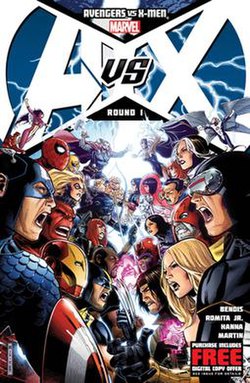
Avengers vs. X-Men #1 Thoughts: The I Hate Cyclops Fanclub


I honestly wasn't expecting this comic to be as good as it was, especially with Marvel clearly marketing it towards the battle boards types who don't care about plot, character, theme, style, draughtsmanship, design, or anything else but living vicariously through their favorite character being successfully violent. Thankfully, there was all of the above stuff in this first issue by Brian Michael Bendis and John Romita Jr. And the conflict started with a bang, strong enough to make me want to read more.

The most interesting part of the book is the fact that it's actually pushed Scott Summers to the point where all the previous books have only alluded; that he is actually a villain, the kind of crackpot megalomaniac to fill the void that the semi-reformed Magneto has left. His "training" of Hope represents the exact kind of cruel behavior that caused Wolverine to take half the team to the East Coast. In that scene both Magneto and Emma are dismayed by Cyclops' ruthlessness, as he's deliberately inflicting as much pain upon Hope as possible without causing any impairing injury. He claims that this was how Professor Xavier trained him, but nothing could be further from the truth. Xavier may have trained the young X-Men to fight, but he didn't make them suffer to get his point across.

In the argument between Cyclops and Captain America, Scott tells Steve Rogers that they've never done anything for the mutant species. He may have a point, but Scott's also made clear that he doesn't want anything to do with the human race, either. He's segregated all those willing to follow him on a banana republic floating away from humanity, and he's kept the X-Men out of most of the recent events in the superhero community; the X-Men didn't lift a finger to help during the Civil War or the World War Hulk stories, and they only defended their own borders during Secret Invasion, Dark Reign, and Fear Itself. Now he plans to doom all of human and mutant kind by trying to use the Phoenix, reborn in Hope, to revive the mutant species. Maybe he actually believes he can control the Phoenix, but more likely he's so obsessed with his goals that he doesn't even care about who dies.

All of which would still make him a sympathetic antagonist if he at least cared about the individuals who make up the species he'll do anything to protect. But Cyclops is now no better than Joseph Kony, treating anyone in his army-- no matter how young-- as an expendable weapon. His final line, that Hope no longer has any say over what happens to her, is very telling. Hopefully now that he's crossed the moral event horizon, he'll finally get what he deserves.

Thursday, January 26, 2012

Why Do Superhero Fans Fear Drama?


I've been simmering on this topic for a long time, but a recent video by Linkara (15 Things Wrong With Identity Crisis) took this frustration to a boiling point. The video itself wasn't so bad, as while I disagreed with Linkara on several points, I respect the thought and effort he puts into his critiques. What really bugged me was (with some exceptions) the circle jerk of fan reactions that followed, which tended to coalesce on the same theme; " Dark is bad, make superhero comics fun again", followed by the usual whining and crying about the state of modern comics.

Far be it for me to defend Identity Crisis, as I didn't like the book myself for several reasons covered in Linkara's review (most notably the rape). But the reasons people don't like it seem to revolve around the fact that certain characters were killed off and removed from the status quo, and certain characters were changed. The moaning is often associated with the loss of more light-hearted incarnations of the characters, such as Tim Drake when his dad was alive, or Ralph and Sue Dibny as a couple. This then goes into whining and crying about a lot of post-Identity Crisis comics like Countdown and Cry for Justice, using Brad Meltzer as the scapegoat for these comics (despite the fact that he didn't write them). Occasionally someone will try to say that dark isn't necessarily bad, but they'll follow it with a "but it doesn't make a story good", then point to examples of where a story is good without being dark. And you'll often see citations of the All Ages titles as examples of how to do these characters right, the titles that are meant for very young children and tend not to have much development or moral complexity.

If dark just means gratuitous, then I'm more sympathetic to this perspective. However, the critiques aren't just with the gore (which I agree is off-putting in most modern DC comics), but with the notion that these bad things happen. The cry is for "fun", and by "fun", they mean a specific status quo, a specific story structure (usually single issues with a happy resolution at the end), and a specific interpretation of characters. "Fun" is what they know and what they're comfortable with; the complaints tend not to come from people trying to broaden their horizons and challenge their expectations.

In one sense, I'm trying to show that it cuts both ways, this battle of light vs. dark. If stories can be told without mature content, they can also be told with mature content. If some superhero creators are obsessed with making the characters grow up with them, others perseverate over keeping them at the idealized status quo. But ultimately, the dark stories-- or, more precisely, the stories with substantial drama and risk for the characters-- are the ones that really succeed. The greatest stories for each character, the ones that are part of their canon, are the ones that really pushed them-- Frank Miller's run for Daredevil, Chris Claremont's run on the X-Men, etc. Without struggle the hero cannot show his or her heroism; if it's just a fight of the week, the ending is never in doubt, and there's no reason to care, other than as a brief escape from reality. Of course, these stories were printed before the internet, so their reputations escaped the constant bitching of fans with computers.

Unfortunately, a lot of superhero fandom seems to cling to the escape hatch, to hide from reality within their Silver Agey security bubble. Even creators will end up pandering to them, including creators like Darwyn Cooke and Greg Rucka who have done excellent dark stuff in the genre. But they still get on the "fun" bandwagon, as if disavowing their work in order to capture for themselves this pleasant navel-gazing. The meaning possible for the superhero is thus pissed away, leaving the result as a pleasant but unattainable ideal rather than a figure whose struggles inspire people to attain the ideals in their own lives.

In the end, while I still don't like Identity Crisis, I find it more favorable based on the fact that it prodded at people who need prodding out of their bubble. If people suffer so much from drama and tragedy in superhero comics, either their lives are very good and their only real problems are with their fiction, or they put a disproportionate need upon fiction as a coping mechanism. Fun is part of life; it is not all of life.

Monday, October 10, 2011

The Jeph Loeb Drinking Game


Note: Do not try this at home. This Avengers: X-Sanction preview alone will get you completely plastered.

--When a fight scene erupts for no clear reason other than to have a fight scene, take a shot. (Avengers vs. Lethal Legion)

--When a bunch of heroes or villains are assembled in an "iconic" arrangement, take a shot. (The Avengers are Marvel's Big Five-- Wolverine, Spider-Man, Iron Man, Captain America, the Hulk by way of the Red Hulk-- joined by the Falcon, presumably as a token. The Lethal Legion are veteran Avengers foes Living Laser, Grim Reaper, Whirlwind, and Radioactive Man. The latter of which hasn't been a conventional super-villain in a long time, instead acting as a loyal soldier for China).

--When a character makes a quip with the same amount of wit as a schoolyard taunt, take a shot. (Spider-Man: "Why is there never a jailbreak on nice, pleasant, warm nights in New York?" Wolverine: "Why is it you never shut up?")

--When a character goes into heavy-handed, mopey first-person caption narration, take a shot. (Cable's internal monologue about being a soldier).

--When the conflicts are revealed to be the acts of an ubermensch villain manipulating events with far more capability than they should be able to have, take a shot. (Not seen here, but with Loeb's history of using villains like Hush, Romulus, Ultimate Doctor Doom, The Intelligencia, and others, there's often a mastermind with unconvincingly extreme mastery).

--When a character is brought back to an "iconic" state in a way that defies everything previously established, take a shot. (This series is about bringing Cable back from the dead. Even though his absence wasn't exactly derailing the Marvel Universe.)

Now excuse me as I go into the ER for alcohol poisoning.

Tuesday, May 3, 2011

The Heroic Age And Its Discontents


One year ago, Marvel's big thing was the Heroic Age, returning to a place of heroes being heroes and villains being villains after years of Civil Wars and Dark Reigns. Today, this is giving way for Fear Itself, which so far has the Marvel Universe public returning to their usual state of apocalyptic panic and incompetent xenophobia. The age of the bright, cheery shared universe status quo is ending, in favor of Mighty Marvel chaos and trepidation.

And I, for one, am relieved by this development.

The Heroic Age reminded me of Civil War in the sense that the only good titles published under that banner were rebelling AGAINST the basic premise, wether intentional or not. When Civil War was going on, the framework set up by Mark Millar was so shoddy that every other writer ended up contradicting the original intention, as seen in stories where Iron Man is portrayed as an outright villain (which, to be fair, is the only thing you can do with the creator of Clor) instead of one of two morally relative sides, or stories where the heroes' attempts to capture actual wrong-doers are hobbled by bureaucracy and petty in-fighting. The Heroic Age doesn't suffer from the same problem in the sense that it's not a poorly built world-- the premise is pretty straightforward. The problem with the Heroic Age is that the setup is anti-dramatic.

Marvel's marketing of the Heroic Age was the kind of "everything's going to be alright" optimism seen during Obama's inauguration, and lost after reality set in. Because the Marvel Universe is fictional, the authors could convincingly sweep the recent past under the rug and move forward, as seen by Cyclops dodging any and all penalties for his sins in X-Force. But by the same token, peace and prosperity is NOT ideal for a fictional universe. Conflict is what motivates good drama, but the Heroic Age moved the Marvel Universe into a peacetime state, with the conflicts largely regressed back to isolated supervillain fisticuffs.

If this meant a return to books that were relatively self-contained with shared universe compatibility becoming optional, I would be all for the Heroic Age. But Marvel launched it as the new status quo for all the books. The new Director of SHIELD, a job whose occupant is required to appear in every Marvel book, is Steve Rogers. Since his reputation makes Abraham Lincoln look like a child pornographer, he'll never be caught doing the kinds of morally dubious things Nick Fury and Tony Stark had to do (and which gave Norman Osborn a hard-on). His Avengers are basically every hero under the sun, pro-registration and anti-registration alike (though that issue's been removed). And his enmity with Tony Stark was resolved in Avengers Prime, which amounted to an Asgardian adventure making Tony beg for forgiveness (despite having a good case for pro-registration, random acts of evil like Clor aside), and Steve forgiving him.

The X-Men's DeciMation dilemma was resolved, but in a half-assed way that swept the issue of the limited mutant population under the rug and exonerated Cyclops for unforgivable sins-- note how Steve Rogers doesn't seem to know about X-Force, the Legacy Virus strain in Secret Invasion, or other war crimes. Their first Heroic Age story basically ignored the hard questions and had them fight vampires, offering little more than inconsequential fight scenes and Twilight-bandwagoning*. Daredevil's descent into fanaticism would have been justified by what he'd been through and what the heroes had conveniently forgotten, but it turned out that it was just a demon using him as a meat-puppet. And the Secret Avengers' first mission (not sure about their later ones) hardly fit the tone that black ops requires, instead having them fight villains on Mars. As Ellis put it (IIRC), it's secret because nobody cares.

The books that have been genuinely compelling in the Heroic Age have been the ones questioning this optimism. Avengers Academy is the best example, because it deals with the kids traumatized by Norman Osborn's experiments, and has them counseled by the Avengers with the most baggage of their own. Captain America has made a big deal about how Bucky can't escape his past, especially when standing next to a living Steve Rogers. And the new X-Force, with Wolverine leading a team of hardened anti-heroes instead of child soldiers, openly acknowledges that some situations will require resolutions that can't be seen in the Heroic Age. Of course, these are all stories going against the nature of the Heroic Age's naive optimism. They're saying, don't let the bright marketing fool you-- the life of a hero still casts shadows.

What's been the most interesting example of the Heroic Age's tension is Stark Resilient, the first post-lobotomy story by Matt Fraction and Salvador Larocca. Thanks to erasing his brain (and the Registration Database with it), Tony doesn't remember any of his Civil War-era sins. But he's pieced together what he's done, and has almost completely stepped out of the military-industrial complex that informs modern superhero stories. Not only has he retired from his role as all-seeing police chief a la Major Zero**, but he's given up trying to engage in conflict unless provoked. His goal is to win wars preemptively by eliminating reasons for conflict, be it with the repulsor batteries threatening to replace oil, or by creating new jobs in the rebuilding of Asgard. Unfortunately, his engagement with the bad guys has gone beyond self-defense and towards an obstructive pacifism, as he simply tries to avoid conflict rather than resolving it (as seen by his show of faux-groveling in the Doc Ock story). He'll have to once more learn that sometimes force is a necessary solution, and that some enemies can't be coaxed with the promise of an improved quality of life.

Still, it's preferable to slugging vampires.

*Thank God Jubilee lost her original mutant powers, otherwise she'd be a Sparkling Vampire.

** If you've played Metal Gear Solid 4, you know just how well this comparison fits.

Monday, April 25, 2011

Thor's Discs= Kirby's Genius


After blogging about heavier subjects, I wanted to talk about something a bit more enjoyable. So let us discuss one of the omnipresent visual markers of one of Marvel's most beloved characters; the discs on Thor's shirt.

If you were asked to describe the Stan Lee/Jack Kirby interpretation of the Norse God of Thunder, the first things that might come to mind would not be those shiny discs on his manly chest. You'd certainly mention the hammer, the long glam-rock blonde hair, the winged helmet, or the cape. You might even discuss the symbols of his mortal identity, how his hammer turned into a gnarled walking stick when used by his mortal self of Dr. Donald Blake. But you probably wouldn't think of the discs. They'd come in last in your description, if at all.

Yet the discs have been included in every major iteration of Thor. Not only did the original costume endure for three decades without a change, but all the major updates* include these circles. This includes the Heroes Reborn look, the King Thor costume, the current Coipel costume, and the upcoming movie outfit. Even Ultimate Thor, who discarded or modified every other piece of Marvel Thor iconography, kept the discs on his leather outfit.

The late Jack Kirby had a simple, clean style, but his costumes tended to be ornate and unusual. It is a testament to his genius that his characters looked impressive instead of silly. This was especially noteworthy in his DC titles; Mister Miracle had his red-yellow-and-green ensemble, OMAC mixed bright blue and orange with the world's mightiest mohawk, and Darkseid hosted a short skirt and long boots worthy of a schoolgirl hentai. But none of them looked stupid under Kirby-- his stylings were so dynamic and energetic that he made the costumes work. And he also gave us characters of elegant simplicity like Black Panther, Silver Surfer, the Thing, and Captain America.

Thor, however, is more the former than the latter. The discs on his shirt serve no clear purpose; they're not even a clear symbol like the Superman "S" or Captain Marvel's thunderbolt. There's already a "T" symbol on Thor's belt, which under most artists would be enough. But the discs provide a nice disruption of the monotony; their shiny nature contrasts well with the black of Thor's tunic. And the six discs are arranged in perfect symmetry. It's both aesthetically comfortable and impressive, and served as the perfect look for an Asgardian Thunder God.

The discs become the kind of iconography that seems so perfect that you think you should have thought of it. But you didn't. Nobody did except Kirby. It's yet another proof of his unparalleled ability.

* Excluding the short-lived leather look from the Messner-Loebs run, which most of us would likely rather forget.

Thursday, January 20, 2011

An Open Letter To Mark Millar Re: Superior


Dear Mark Millar,

In the unlikely event that you have been reading this blog, you probably know my increasing dissatisfaction with your output in the past few years. This comes from a place where I once loved your work, back on the Authority and the Ultimate titles. There were innovative titles that were very entertaining and felt like genuinely modern takes on the superhero genre. Even in more recent years you've delivered some very good comics like Wolverine: Enemy of the State and the Marvel Knights Spider-Man. The frustration I feel with more recent works (particularly your ICON output and your Ultimate Avengers revamp) comes from the feeling that you are working well below your potential. Some part of me still held out hope that you'd do thoughtful works again, but after I read Superior #4, I realized that wouldn't be the case.

My experience with Superior was at first conflicted; on the one hand, I thought that the not-Superman Superman analogue was the worst cliche of creator-owned superhero writers, filing serial numbers off and calling it 'meta' rather than creating unique characters. One the other hand, I was impressed with how Simon's Multiple Sclerosis was handled. You made the character's suffering realistic and sympathetic, and you treated him as a major character rather than a pet to showcase others' greatness. And even while I'd lost interest in your other books, I still wanted to see this story progress, and see how Simon would live his life with super-powers.

But that's not what this story is about, is it? The backstory of Simon is scarcely mentioned in issues 3 and 4, and instead the story starts focusing on the Superman analogue. All the old tropes are trotted out, with Simon doing all the heroic Superman things with his Superior powers, and the world acting like he's a savior. The narrator even goes out to talk about Superman-- I mean Superior's origins, and how he inspired kids people during the 30's. This is a unique insight that everyone who's even heard of The Amazing Adventures of Cavalier and Klay already knows.

Admittedly, it's optimistic, which is a far cry from your previous Icon stories (which are about, respectively, a wannabe teen hero who pretends to be gay to get chicks, and an evil Batman analogue who impregnates his enemy's daughter with the sperm of his son and booby-traps her womb. But just because it's unique for you, doesn't mean it's unique for others. I've already seen stories that try to reintroduce wonder and hope to superhero comics. I've read Marvels, the "Heroes Return" Marvel books, Grant Morrison's JLA and All-Star Superman, Mark Waid's Fantastic Four, and other comics that believed that being traditional was revolutionary. Most of them weren't so self-conscious about it, though-- they also had inherently interesting stories to go with the nostalgia.

This would merely make it forgettable had I not read your afterword for the first issue, where you talk about the importance of creating new heroic characters for each generation, like Stan Lee and Jack Kirby and Steve Ditko did in the 60's. But a technicality doesn't make something new. Superior is Prime from Malibu's Ultraverse, who was Captain Marvel from Fawcett. If it was a story about a kid dying of multiple sclerosis, as in the actually GOOD opening parts of the comic, I would have loved it. But you couldn't divorce yourself from the superhero genre, and had to make MS the Culturally Noteworthy Tragic Backstory to inspire Simon when he becomes Superior. Which, in its own way, is again reducing the disabled character to a prop off which others look better.

The cliffhanger with the seemingly compassionate but actually evil Space Monkey giving Simon's bully powers did nothing to convince me that this story will be going anywhere. I'm just not going to bother, because if you've stopped caring about trying anything different, why should I care about what you do?

Hoping you'll write something interesting again,
-Neil Kapit

Monday, August 16, 2010

New Batman Costume is Bat-tastic and Manly


DC has released their November Solicits, with the information for Batman, Inc. Already we know that it has Bruce Wayne, back from his journey through time and merchandise-ready period costumes, franchising his identity out around the world. I have mixed feelings about this; as a general rule I don't like when multiple characters share a superhero identity, since it dilutes the importance of the main guy. Batman is a unique case because he's the result of Bruce Wayne toiling constantly to become the perfect weapon against crime, and Grant Morrison's own stories have shown that any attempts to replace him are either mixed at best ( Dick Grayson ) or catastrophic ( the new Red Hood, the three Bat-Cops, the future Damien who sells Gotham to Satan, etc. ). However, most of Morrison's stories on Batman have been utterly stellar, so I'll suspend judgment until the final product arrives.

What I can judge is the new look for the Bat-Suit, as shown on the covers by Yanick Paquette and Andy Kubert. Fortunately, it's quite a good look. It's still unmistakably Batman, but the little details have been refined and modernized. For one thing, the underoos are finally gone-- briefs over leggings are an obnoxious relic of the circus strongman roots of superheroes, and there was no reason Batman should have kept wearing them for so many decades. The darker swaths of fabric on the sides of the suit are an effective replacement, and give the look more texture, like it's an actual suit of armor instead of body paint ( since Batman is not bulletproof, it's good that we see him wearing some protection ). Ribbing on the boots and gloves has a similar effect, with the same success. And the yellow Bat-emblem returns after being simply a black pattern for years-- normally I'd prefer the original shirt, but since Batman's trying to make himself a brand, the logo takes on extra importance.

Time will tell if this design endures; unfortunately, complex costumes tend not to last. The X-Men stopped wearing leather to regress to colorful spandex, most of the Ultimates started wearing tights ( something they had never done before in that universe ) when Millar and Hitch left, and many characters in Brian Michael Bendis' Avengers have returned to their 70's looks ( not coincidentally, the era when Bendis started reading Marvel ). It's likely that Batman will be back in his undreroos in the near future, because " iconic " too often means " simplistic and bland ". But here's hoping he rocks the new look for a while.

Tuesday, July 20, 2010

Daredevil: The Best Disabled Character in Comics?


If judging which Marvel character was best based on the aggregate quality of their stories, most comic readers would probably say " Daredevil. " Thanks to a long and surprisingly consistent run of landmark stories, the horn-headed hero has gotten as close to becoming a great literary figure as any costumed crime fighter can become. Thanks to the works of creators like Miller, Mazuchelli, Sienkiewicz, Bendis, Maleev, Brubaker, Lark, Romita Jr., and others, Daredevil's developed a reputation for being the one Marvel franchise where writers don't hold back and the status quo isn't immediately reset. ( It's also developed the reputation of being an extremely depressing read due to the constant torment creators put Daredevil through, the comic book equivalent of Metal Gear Solid ).

He's also blind. Sure, the radioactive waste that robbed Matt Murdoch of his sight also enhanced his other senses a hundredfold, but he's robbed of the perception of sight, alienating him from most of the world. The fact that he can echolocate like a bat makes his experience isolated even from other blind people. And that's it for his superhuman powers-- the rest is just martial arts skill and back-breaking physical training. He's not particularly prominent in the Marvel Universe, rarely venturing beyond New York; a passage in Mark Millar's Wolverine even had the character mocking Daredevil, for being the pathetic crippled superhero the others joke about, while bemoaning the fact that Matt gets much more tail than the squat Canadian mutant. Yet this hasn't stopped him from being an engaging character for the audience.

So do I think Daredevil is one of the best disabled characters in comics, if not fiction in general? The answer is another question....

When was the last time you thought of Daredevil as blind?

Maybe you didn't forget that Matt can't see, but if you've been reading regularly, it probably wasn't the first thing you thought of about him. His handicap is only one part of his history, and doesn't begin to summarize the whole character. Being blind ( albeit superhumanly ) just informs the rest of his experience. Matt lost his sight as a preteen, well after his mother abandoned him and his failure of a father. His father did unethical mob enforcement jobs before Matt's accident, and Matt's handicap didn't dominate the dynamic ( re: no Jenny McCarthy " parent martyrs themselves for crippled child " claptrap ). Matt's accident was what led him to be trained by the blind sensei Stick, but he had pent-up aggression early on. And in his superhero identity, while it's apparent to people who look closely that Matt's devil mask is a blindfold, criminals don't think of him as a blind man overcoming adversity. They see him as the terrifying figure clubbing them into unconsciousness.

The major aspect of Matt's life where disability informs people about his experience is his civilian identity as a lawyer-- though he's one of the finest attorneys in New York, it does seem like part of that is the appeal of his hard-luck story. But ever since Frank Miller took over the character, Matt's life has become so complicated that the woes of his handicap are peripheral to his other problems. He's lost nearly a dozen girlfriends to murder and/or the trauma of being associated with him. He's had his career ruined by crooks who got ahold of his dual identity many times, to the point where it's public suspicion that Matt and Daredevil are the same guy. He faces some of the most outright monstrous, depraved villains in Marvel's history. And his " jurisdiction " is Hell's Kitchen, a run-down neighborhood that refuses to become safe no matter how many criminals he beats up, and a place largely ignored by other heroes. His actions, understandably, show an unstable nature only a nudge and a slap away from a complete breakdown.

The current storyline " Shadowland " has Matt Murdoch finally going through that breakdown and becoming an outright villain. He's stopped having a civilian identity, and runs a ninja clan that's turned Hell's Kitchen into a police state. The first issue of the story had Matt sic a dozen ninjas on his arch-nemesis Bullseye, to distract him so Matt could brutally and finally kill the bastard. And you'll note that in all of this the words " blind ", " disabled ", " handicapped ", and " crippled " don't even come up. Matt's arc as a fallen hero isn't contained by those labels, just informed.

That's how you represent disability in fictional characters. You make sure they have characters beyond their handicap. And anyone who argues that you can't say that of Daredevil simply hasn't been paying attention.

Saturday, May 1, 2010

Blogging Against Disablism: The Mighty Marvel Handicapped

Blogging Against Disablism Day, May 1st 2010

Today is Blogging Against Disablism Day, and I thought I'd seize upon the opportunity to bring this topic into a context that's dear to my own interests-- specifically, Marvel Comics, the company whose fictional superhero universe has inspired a larger portion of my life than I normally care to admit. But musing upon it in light of the issue of disablism, I figured out the core reason why it's such an appeal, and so obvious in My Own WorkMore than the power fantasies, the flashy visuals, the entertaining and sometimes brilliant stories, or even the the convoluted narratives that prey upon the obsessive mindsets of the autism spectrum.

The classic Marvel story is about a disabled character, disadvantaged physically and/or psychologically, forcing their way into society.

The X-Men are the most obvious example, because most of the mutant powers have an element of deformity to them. Some, like the Beast and Nightcrawler, look monstrous and are prejudged on that no matter how kind and heroic they act. Others have traits, like Archangel's wings or Rogue's life-draining skin, that they have to take pains to cover. Even the characters with powers that don't have an obvious drawback have to hide them in order to pass, being normal but realizing they're not being themselves. The villains of the X-Men tend to be bigots, using tactics ranging from giant mutant-killing robots to PR-friendly promises for a mutation cure ( Autism $peaks, anyone? ) Before the X-Men simply tried to prove their heroics as Robin-Hood type outlaw heroes, but since Grant Morrison came to the book, they've been out. The X-Men stand in front of the world for everything that they are, and everything that mutants can be. Like mutants or not, now you have to deal with them.*

Daredevil is another explicit example. As a boy, he was blinded by radioactive waste, but radioactive waste that enhanced his other senses a thousandfold. Mixing this with his martial arts training and analytical mind, Matt Murdoch became an ace lawyer by day ( who the public knows as blind ) and vigilante by night, cleaning up his crime-soaked childhood home. At the same time, even though he's not handicapped per se, Daredevil is disabled. The way he sees the world doesn't have any visuals, and the heightened impressions he gets from his other senses are difficult to block out. He's inherently alone in his perceptions, no matter how much good he does.

Then there's the heroes who received disabilities as a humanizing effect. Tony Stark pays for his war profiteering via the shrapnel to his chest; he builds a metal heart to survive and a suit of armor with which to redeem himself, but his source of power is prosthetic, and he's got a big, shiny, metal lump in his chest to remind him of his difference. Thor was punished by his father Odin for his arrogance by being forced to share an identity with a mortal, a doctor with a limp. Half of his life may be as an ass-kicking god of thunder, but the other half is as a man who lives with a handicap, but sees people with illnesses and imperfections every day, and must show them ( and possibly, himself ) compassion and understanding. And Bruce Banner, like Iron Man, paid for building WMDs by being caught in his gamma bomb test and carrying a borderline personality disorder in the form of a rampaging green monster that comes out when he loses his cool. It's a burden he, like many people with mental illnesses, has to struggle with on a day by day basis.

We can go down the list of prominent Marvel characters whose powers double as a disability metaphor all day. The first Captain America, a sickly young man in the Depression era who bravely risked his life taking a serum that made him America's best weapon against Hitler. The current Captain America Bucky Barnes, who fills the role to cope with his massive post-traumatic stress disorder ( he even has a prosthetic metal arm from a tremendous war injury ). Wolverine, whose healing factor means he has endured pains that would easily have killed anyone else, and has to live with that. We can even go by villains who represent forms of ableism; Doctor Doom, hiding his " imperfect " facial scars behind an ominous iron mask, preferring to be an emotionless machine than a flawed human; Magneto, taking mutant solidarity into a eugenic crusade against humans; Norman Osborn, who has displayed all seven deadly sins, but most commonly greed, his lust for power and his cruelty towards anyone without it ( and as we've seen, implicit hatred for his own weaknesses ).

The bottom line is that if you are a Marvel fan, your childhood heroes easily qualify as handicapped. And compared to most real people with disabilities, they have it better, because they have the luxury of attached super-powers. So overcome your prejudices; for those dealing with daily physical and psychological disabilities, and worse yet the societal stigmas imposed on such conditions, simply functioning can be an act of heroism.

Tuesday, April 20, 2010

Emo Narrative Captions: The Second Deadly Sin of Modern Comics


The Trend: The comic is told by caption boxes containing the protagonist's thoughts. These are not inherently better or worse than most storytelling tools, but the trend refers to when the captions have the character going into long internal monologues about their personal problems, talking about their tragic past/present relationship problems/fears about the future/whathaveyou in very elaborate prose. It's bad when it sounds so melodramatic and over-the-top it could have come from a high school English class, it's worse when these caption boxes are used so often that they crowd out the art in the panels, and it's worst when the information in the captions is something we could have easily figured out on our own ( like a character being punched in the face, grimacing, then having the narrative caption, " This punch to the face hurts worse than when my uncle used to beat me! " ).

The Culprits: Pretty much any solo superhero comic will do this to some extent, so I'll list the most egregious examples from the past ten years;

-- Geoff Johns' Green Lantern ( see above cartoon )
-- J. Michael Stracynski's Spider-Man ( especially the purple prose in the 9/11 tribute issue )
--Jeph Loeb's Superman/Batman ( for a particularly homo-erotic example, Clark and Bruce talking about how awesome the other is )
--Brad Meltzer's Justice League of America ( similar to Superman/Batman, except pulled across the entire ensemble cast, with each character getting their own narrative caption color )
--Chuck Austen's Uncanny X-Men ( Particularly the issues with Nightcrawler's thoughts on religion; " More people die of religion than cancer. And we try to cure cancer. " )

The Problem: In previous years, comics used thought balloons in the same excess, having the characters go on endless internal soliloquies. With thought balloons, anyone could go off on a long whine to themselves ( and to a lesser and more unfortunate extent, the audience ), even characters less important to the main plot. The gradual shift over to narrative captions over thought balloons seems to have been motivated by a need to focus the narration more by only giving us one character's thoughts. However, this didn't do anything to help or hurt the contents of the character's thoughts. A good writer would still give characters good internal dialogue, and a less-good writer would give them the same whiny, drawn-out nonsense. The fact that the thoughts were restricted to one or even a few characters only served to exacerbate the feeling that the heroes are gazing longingly into their own navels, making whatever problems they face irritating and contrived instead of dramatic and sympathetic. Horse carcass, meet spiked club, repeat.

( And for the sake of fairness, I should note that I've been guilty of this too.Since then, I've tried to ease up on internal narrations. )

The Solution: Don't make the contents narrative boxes so literal. The problem that thought balloons were accused of was that they didn't sound like something a person would actually think during a tense moment-- writers like Chris Claremont had a tendency to use them for obvious plot purposes, like telling us about a bit of character backstory informing the current scene, or giving us characterization in a very artificial context that treated it like an essay requirement ( " You have to tell us how Nightcrawler feels about this! " ). The latter can be communicated much more eloquently by the way the artist draws the character's facial expressions, and the former is rendered moot by recap pages. Instead, we should see things in the character's head that give us information we don't know. Just read any Ed Brubaker comic with a first person narrator*-- his characters only sound completely articulate and intentionally poignant when they're actually in a scene where they're alone with their thoughts. In the midst of an action scene, their thoughts will sound choppy and incoherent as befitting of someone busy, y'know, trying not to die.

Alternately, a simple framing device can do wonders to make melodramatic writing work. As obnoxious as Hal Jordan's green-boxed whining can get, his narrative in Secret Origin was much easier to tolerate, because he was recounting events from the past and talking about how he felt THEN. Grant Morrison gave us Xorn's narrative in an issue of X-Men as a letter to Professor X, which was pretty good then, but was later elevated to brilliant when we learned that Xorn was Magneto in disguise all along**. And one of Neil Gaiman's Death stories ( " The High Cost of Living " ) used internal narration to express what good writers tend to avoid-- that the character was LITERALLY a whiny, navel-gazing teenager with no serious problems.

And then there's Alan Moore, who does write caption boxes full of purple prose, but gets away with it because he's Alan Moore and he's that damned good. But unless you are Alan Moore, it's best to err on the side of caution.

* I'd recommend his and artist Sean Phillips' Sleeper for a particularly good example of this.
** I'm not going any further than that. You can't make me.

Thursday, March 11, 2010

How To Do Superhero Costumes Right: Hawkeye


With their costumes, superheroes create an easily digestible image of their character, what they're trying to say, and why we should care about them. In this way, the costume is a microcosm of the superhero genre in general, something that is inherently outlandish and will come across as either completely ridiculous or completely awesome to an audience. The clothes don't make the man, but for the spandex set they're a strong contributor-- Aquaman's long-tarnished name has not been helped by the fact that his iconic look is a scaldingly orange goldfish shirt. At the same time, Naruto ( a Japanese comic character who is very similar to a superhero ) is a ninja in a scaldingly orange jumpsuit, who has made it work in a capacity that not even Tim Gunn could have forseen.

With June's Hawkeye and Mockingbird series, artist David Lopez gives us a good example of how to do a superhero costume right. Clint Barton is a character who really relies on his clothes for his look-- he has no powers beyond his skills with archery and hand-to-hand combat, and most super-villains aren't going to be intimidated by him. At the same time, he needs a costume that's convincing as something he'd wear in a fight. Lopez gives us a design that shows a lot of thought, with the following traits--

* The classic Hawkeye color scheme and mask. The winged mask draws attention to his eyes ( and being " Hawkeye ", that's kind of important ), while the mix of blue and purple has become Clint's traditional colors. Clint is one of the most brash, ballsy-to-the-point-of-stupidity members of the team, and the fact that he's a manly man in purple cements this. It's a garish scheme, but he sells it. He even has a loincloth ( albeit one that is shortened so it doesn't look like he'd trip over it )

* The chainmail armguard. Since Clint relies on archery, it's important that the design call attention to it. So the arm he uses to grip to bow has extra protection, and gives a bit of interesting asymmetry.

* The quiver. The quiver is a flat shape that holds to his back in a nice diagonal fashion. The bow also folds conveniently inside the quiver, in a feat of design brilliance-- it all works. There are also some small wrist pouches for custom arrowheads, nothing

* The wrist cross-bow. I'm not sure this is entirely necessary, but it's a nice touch-- if Clint loses his bow, he can use the little wrist darts to maintain some semblance of effectiveness.

There's a lot of thought to function as well as form here, and it looks convincing while maintaining elements of the character's history. Easily the best Hawkeye costume he's had yet-- certainly better than his angst ninja look.

( EDIT: Somebody has reminded me that much of the design was taken from Olivier Coipel's Hawkeye design pre-Disassembled. Lopez stills deserves credit for the wrist-mounted dart-launcher and the foldable bow, but the armguard design is the invention of Coipel. My apologies ).

Tuesday, February 16, 2010

Red Hulk Volumes 1-3 Review: Gar for Rulk

The Concept: A new Hulk has emerged, one who is red-skinned, brutally intelligent, cheerfully merciless, and just as tough as his predecessor ( if not tougher ). Little is known about him, but he utterly hates the original Hulk and will stop at nothing to get revenge. If you thought that Bruce Banner's life was just one endless conga line of tragedy and degradation, this confirms it.

The Authors: Jeph Loeb ( writer ), Ed McGuiness ( main penciller ), Dexter Vines ( main inker ), with guest art by Arthur Adams, Frank Cho, and seasoned Hulk veteran Herb Trimpe.

The Assessment: The internet has recently spawned the word " gar ", which describes a character of such overwhelming masculinity that even the most culturally respectable of heterosexual men fall for them, a giggling schoolgirl by contrast. Urban Dictionary gives us a better definition, and the Red Hulk gives us a good example.

" Rulk " ( as he's more commonly called ) is gar incarnate. Every act he makes is a feat of ridiculously over-the-top masculinity. In his very first appearance, he kills the original Abomination with a handgun sized proportionally to massive Hulk hands. And that's just the start of his frenzy of hilarious beatdowns upon hero and villain alike. When he fights the Silver Surfer in an alternate universe, he drains the guy of his cosmic power, breaks his neck Steven Seagal-style, and flies away on his surfboard. And when the omniscient cosmic being known as the Watcher is drawn to observe Rulk's actions, Rulk punches the guy out to spare us his hypocritical speech about never interfering with the events around him.

If that paragraph has not convinced you that this makes for an entertaining story, there's nothing else I can say.

Characteristic to contemporary comics written by Jeph Loeb, the plot to Red Hulk is either thin or outright absent. If the rule of drama contradicts the rule of cool, the rule of cool wins. Why does Thor appear to battle Rulk? So Rulk can pull him into outer space and beat the shit out of him with his own magic hammer. Why does She-Hulk form a new " Lady Liberators " of superheroines to take down Rulk, when a unisex team would do just as well? So we can get Rulk battling a bunch of women in colorful tights ( though to Loeb's credit, this is not played for T&A, but as an opportunity for uncommonly-seen superheroine girl talk ). And why is there a story arc where cosmic gamesmasters reunite the original Hulk's old team of misfits, the Defenders? So Rulk can form his own team of villains, predictably called the Offenders. There's an ongoing plot about where the Rulk comes from and the larger gamma-science conspiracy behind him, but that's just window dressing for seeing a big red jerk beat up guys in tights while offering goofy banter.

There's little to nothing in the way of intellectual stimulation here. Fortunately, the series compensates in many other realms. It's got very funny dialogue, especially when the Green Hulk appears to offer his third-person sentence-fragment wisdom; you feel like the various Marvel guest stars are subconsciously aware of the absurdity this story has, and are acting accordingly. It has slapstick violence to the point of resembling an old Tom and Jerry cartoon, in an era where most superhero comics favor horror-movie levels of blood and guts. And it's got the perfect art; Ed McGuiness already skews entertainingly towards the cartoony, and the adventures of irradiated steroid freaks fit right into that category. Guest artists in Volume 2 Adams and Cho also get the memo to go as ridiculous as they can.

There's not much in the way of drama to Rulk-- which isn't to say that there aren't poignant moments ( the Green Hulk especially is portrayed in a sympathetic light, since while he's not much for brain power, he is treated as a genuinely good-hearted monster ), but that it's used as an inverse of comic relief ( since this is such a ridiculous story to begin with ). But if you want something that's silly-- and that's something that everyone needs sometimes--you can hardly do better. And for the heterosexual males who enjoy the Rulk's escapades-- he proves that male sexuality is a moving target, and that's okay.

Strongly recommended if you're reading with a sense of irony, mildly recommended if you're not.

Sunday, January 10, 2010

Joss Whedon, Cyclops, and Overcoming Brain Damage Through Willpower

Joss Whedon, accomplished writer of television, films, comics, and online musicals, has a lot to say about issues of identity. The good news is that he offers a genuinely unique perspective, and openly addresses identity politics ( particularly gender and sexuality ) in pop cultural spaces where others blissfully ignore them. The bad news is that his messages, as expressed by his ensemble casts of sci-fi anti-heroes, don't always succeed. Then again, this is another product of Whedon's constant experimenting; he'll follow Buffy Season Five with Buffy Season Six.

When Joss Whedon took on writing the X-Men with his artistic collaborator John Cassaday, it seemed as though he would be exploring identity issues thoroughly-- given how Marvel mutants have been used as a metaphor for any group to ever experience systemic oppression, this would give him ready-made tools to tell those sorts of stories. As it turned out, he and Cassaday preferred to tell their own version of the " classic " X-Men formula, which tends to put them on various sci-fi " vacation " adventures instead of dealing with their race's problems. But there was one disability-themed issue that was brought up by the text-- and then tossed aside in the final act, not to be picked up by his successors.

The question Whedon raised was; why can't Cyclops control his eye beams? Was it because of head trauma, or was it really because of a psychological block from childhood?

As anyone who has read/watched an X-Men story for a five minute interval knows, Scott " Cyclops " Summers' life has been one big conga line of tragedy and despair. Not only did he grow up in an orphanage, after his parents " died "* in a plane crash and his brother was adopted instead of him, but Scott's mutant powers manifested as force blasts that poured out of his eyes, unable to be contained except by his eyelids or his " ruby quartz "** eyewear. At times it has been suggested that Scott's mutant power would naturally have been something he could control, were it not for the head injury he sustained in that fateful plane crash. So, aside from the occasional plot deus ex machina temporarily healing his skull, Scott remains unable to control his optic blasts, and lives in a state of constant self-control and emotional repression.

What Whedon did was have his morally ambiguous new girlfriend/former enemy Emma Frost give Scott a psychic " therapy session ", where Scott was taken on a tour through his many insecurities and traumas, and was confronted with the truth about his lack of power control-- at some point in his childhood, Scott subconsciously decided to make his optic blasts uncontrollable, so he would be forced to stay constantly vigilant. At that point, Cyclops decides to make another choice, and switches his power to " Off "-- for most of the second half of Whedon's story, he's basically a regular human in an X-Men jacket, his eyes even returning to their natural brown instead of a red glow.

There are two ways to view this story; one, that Whedon had Scott really deconstruct why his abilities are such a convenient curse, and another, that Whedon is equating real physical brain damage with a psychological problem you can just " snap out of ". The latter would be a problem if it were a real person's medical history being misrepresented, instead of a fictional superhero with a science-defying power*** who's been around in 47 years of stories that often contradict each other and keep him from aging past 29. As it stands, I can accept that Scott's lack of control is due to deep-seated PTSD instead of brain injury, not only because I don't want to bother with the rigors of making it fit or not within continuity, but because it's " all in your head " doesn't make it any less real or painful. However, the deconstruction would only work if it was part of an ongoing story where Cyclops further learns about how to master his powers and his emotions alike.

Since Whedon was only writing the X-Men for two years' worth of stories****, he did not take Scott much further on the journey. No, what Whedon did-- which is the really troubling part-- is show that ultimately Scott could control his optic blasts without completely shutting them off, but all this amounts to is a surprise attack against an unsuspecting bad guy. As he explains to Emma later, it is possible for him to control his power, but it takes a tremendous amount of willpower, and too taxing despite the " clarity " he feels.

So what we have is not that Scott is unable to control his blasts because of physical disability or mental illness; the problem is that he can control his power, but it's just very hard and not worth the strain. Are we supposed to infer that Scott is now content having force beams that can smash a tank constantly pouring out of his eyes, held back only by gaudy red eyewear? Is it that he's too weak and/or lazy to want total control, despite his entire life being one desperate attempt to hold onto what little order he can find? Or is the message that Scott has accepted that there's an aspect to him that he can't control, and has found piece with it?

Whatever Whedon was trying to say with this story, it doesn't matter-- it's never come up again, and Scott's still forced to wear his mask 24/7. And since Whedon didn't really go deep enough into the issue to allow for any well-founded interpretation, it's just another interesting failure for the man's catalog*****, the exploration of trauma and recovery reduced to another ill-conceived sci-fi sub-plot.

* ( As any X-Fan knows, they didn't really die, but I try to keep the backstory minimal in these essays. With the X-Men, this is a Herculean endeavor. )
** ( Why ruby quartz? Co-creator Stan Lee thought it sounded cool. Things like this make the literary reader of pop culture increasingly self-conscious about their analysis. )
*** ( According to one of the Marvel handbooks, he doesn't have eyes so much as portals to another dimension that unleash energy, with a psychic field allowing him the experience of sight, or some such. I don't think he'd have a normal human brain structure to begin with if this is the case. )
**** ( Due to delays, it took twice that long. I'm pointing it out here before it's inevitably derided by someone else. )
***** ( Which also includes Willow going from curious about sexuality to a stereotypical self-proclaimed Wicca Lesbian, Spike struggling to prove that he can be good without a soul only to get one himself and void the discussion, and pretty much every episode of Dollhouse on a conceptual level. )

Wednesday, December 30, 2009

The Best Comics of 2009

After a long post of grousing, I felt it was needed to mention the stand-outs of 2009's comic books-- and there were plenty of them. There were a lot of books that genuinely excited me last year. The rise of the Norman Empire made Marvel's line all in all more interesting, and even DC had a few standouts amidst its usual mix of Silver Age nostalgia and relentless sadism. Meanwhile, the smaller publishers gave us a salvo of great new material-- from continually entertaining series like Dynamo 5 and Umbrella Academy, to new phenomenons like Chew and Beasts of Burden. Granted, there was still the influence of Sturgeon's Law upon the industry, but this year it seemed that the quality AND quantity of 2009's portion of good comics was an increase over last year.

So, the awards:

BEST SUPERHERO STORY ARC: World's Most Wanted, Invincible Iron Man, Matt Fraction and Salvador Larroca, Marvel. Not since Daredevil: Born Again has a mainstream superhero been torn apart so effectively. I could discuss how the story destroyed the entire empire of Tony Stark, down to the last soldering iron and broom closet. I could discuss how his supporting cast was forced to pick up his slack, and prove their worth against impossible odds. And I could even discuss the meticulousness of Tony's plans, which were so elaborate he could even pull them off with a barely working brain at hand.

But therein lies the greatest part of the story; Tony having to sacrifice his very intellect to fulfill his plans and atone for his sins. Many stories have been told with heroes on the run, and heroes like Tony Stark typically maintain a MacGyver-like aptitude for making solutions out of thin air. In this case, the deconstruction even went for his mind. An uncharacteristic level of sophistication was used for the treatment of Tony's degenerating brain, having the loss of knowledge occur in multiple areas in a randomized arrangement, and showing that he could still accomplish things without certain sections of ability ( as opposed to the linear model of IQ that is tragically common in pop culture ). Eventually, Tony would lose all of his function-- but the last thing to go was his heroism. Even at the end of the story, so addled he couldn't form a complete sentence, Tony tried to fight back against a superior and completely depraved enemy. His victory was phyrric in the practical sense, but in the moral sense, flawless-- would a lesser superhero subject themselves to a fate worse than death to fight off such an enemy? Or would such a story even occur to a lesser writer than Fraction?

The revelation that Tony had a back-up of his mind intended to be used by the other superheroes may somewhat mitigate the redemption of this story, but it was still a huge risk for the hero. And for the creative team, to take a whole year with a story that had the protagonist mentally deteriorating. But Fraction's brilliant scripting and Larroca's always excellent visual storytelling ( especially in regards to his renditions of technology ) pulled it off.

MOST IMPROVED SERIES: The Boys, Garth Ennis and Darick Robertson, Dynamite. At its launch, one might have dismissed the Boys as being a puerile spoof of superhero comics, much in the same vein of Mark Millars' Wanted. Superhero comic fans still do, but if they actually read the comic, they'd have less and less justification for their critiques beyond prudishness. What began as a continuation of Ennis' " The Pro " has actually been living up to the author's claim that it would exceed his magnum opus Preacher.

For all the gaudy spandex trappings, the Boys isn't really a superhero comic-- it's a scathing critique of the military-industrial complex, with the capes as the garnish. From the start we knew that the stereotypical superhero universe was just smoke and mirrors for a world of Caligula-like excess, but Ennis and Robertson drove the point home further and further. That the origin of all superhuman power is a compound developed decades ago through the Nazis' vivisection? That the United States' leadership is divided in a coup between the President, the Vice-President, and the military contractors responsible for the power of both? Or that the X-Men analogue " G-Men " is composed of children abducted at a young age and sexually abused to give them the right disposition? Even Norman Osborn in his flag-colored robot suit is nowhere near so cutting an instrument of satire.

Not that it's just unpleasant to read; it has all the great dialogue and dark humor characteristic of a Garth Ennis comic, and Darick Robertson's excellent character design is in full force here. There's even a love story at the heart that serves as an anchor amidst the relentless cruelty of the universe. What Preacher did as a satire of religion, the Boys appears to be doing as a satire of military culture; don't let the abuse of capes detract from that.

BEST SINGLE ISSUE: Captain America: Who Will Wield the Shield. Ed Brubaker, Butch Guice, Luke Ross. Marvel. This wasn't a good year for Cap, after an exceptional 2008; the big event of the year, the resurrection of Steve Rogers, was just an extended action scene with a pointlessly convoluted plot, harmed by the art of Bryan Hitch ( who has moved too far from energetic storytelling into hyper-rendered set pieces, with the story suffering for it. Fortunately, the one-shot epilogue to the series delivered in a very substantial way.

The question raised by the title is answered, but not conclusively-- the prediction was that with Steve Rogers back, his replacement Bucky would either meet a quick end or simply fade into the background. Steve metatextually agrees, hence how he responds to ominous visions by asking Bucky to stay as Cap. But Steve's not simply retiring; he's keeping active in the hero community, especially given how far it's gone to hell in his absence. The characterization is as sharp as ever under Ed Brubaker, but what really sold me on the issue was Steve's dialogue with Barack Obama.

Marvel writers tend to lean towards the left, hence why Marvel-Dubya has been stripped naked tortured by Magneto AND cuckolded by Iron Man. Given Obama's reputation, one would think he'd escape this scrutiny-- at least, last year, that's what one would think. But Barack's inability to make real change has not been unnoticed, and his talk with Captain America makes him almost a pathetic figure-- he's talking about how he doesn't agree with things like Superhuman Registration or HAMMER Director Norman Osborn, but how he can't do anything about it. One might even think that he actually voted for the Registration Act while he was a Senator, and is retrospectively downplaying this given the company he's with. Obama isn't the savior others made him out to be, and his office forces him to support the status quo that he knows should be changed-- so thus, he turns to Captain America.

It's really interesting since the Dark Reign was conceived during Dubya's reign of error, and the Marvel Universe finally appears to be catching up to current politics. If Tony and later Norman represented the Bush administration, Steve is now Obama-- the figurehead for change and hope. I'll enjoy seeing how well he holds up under this level of pressure.

BEST NEW SERIES: Chew, John Layman and Trevor Guillory, Image. The moment this appeared in the solicitations, it looked like a huge conceptual gamble-- something that would be wonderful or terrible. Certainly the ideas represented were way out of the audience's experience. A detective with a psychometric sense of taste, who can read the past of what he eats? A job that forces him to eat all manner of awful things? A food-themed alternate America where the FDA rules with an iron fist and poultry is banned?

And then you get to the series itself, beyond the first issue. The character designs are extremely bizarre and exaggerated; the character of Mason is described by the artist as " the love child of Orson Welles and a grizzly bear ". The stories involve all sorts of food-themed bizarreness, such as a woman who can empathically influence people with her writing about food. And there's a meticulous constructed plot here about the Bird Flu scare, and the truth about it. Yes, this is an ongoing series with very dark undercurrents about a detective who psychically reads what he eats ( except beets, which somehow block his power ). It would either succeed spectacularly or perish pathetically.

And guess what? It succeeded. So suck it.

BEST MINI-SERIES: Beasts of Burden, Evan Dorkin and Jill Thompson, Dark Horse. It's no secret that I love animals, especially dogs and cats. I love seeing comics about animals being animals; anthropomorphized enough to talk, but not enough to stand, wear clothes, or have human-type anatomy ( I'm NOT going any further with that ). Unfortunately, it's hard to find that balance in a way that's convincing. We3 was a triumph in this arena, but beyond that, good treatments of animal characters are few and far between.

Beasts of Burden delivered this. It's a great comic about household pets solving neighborhood supernatural crimes. The series is still relatively new-- it has some backstory as an online strip and only four issues on the stands-- and admittedly many of the characters seem identical. But the dogs and cats are wonderful creatures, who show depth beyond the story structure requirements when given a chance. Here, they aren't animals acting like their human masters; they're animals who have far more going on than their masters assume, but in a uniquely non-human way; the dialogue is in English, but the perspectives feel like they're from a different species with their own religious traditions. There are many stories about evil in suburban backyards, but few where the animals hold the line.

What's more, it's not a simple funny story. It has a strong element of horror, and sadly, that horror isn't always from the monsters-- the worse scenes involve human treatment of the pets. Issue 2, which had a ghostly dog trying to find justice for the deaths of her puppies ( coldly thrown in a lake ), was just brutal. And issue 4 was just as gripping.

They've only begun to scratch the surface of the Beasts of Burden's world, but Dorkin and Thompson gave us so much, that I demand more in 2010.

And the Person Of The Year: Brian Michael Bendis, for New Avengers and Dark Avengers. The series of essays I did for New Avengers' five-year-anniversary illustrate better how I feel about Bendis' work on the Avengers as a whole, but the Avengers books were the comics I followed closest this year. Intellectually pretentious fans may bitch about crossovers, and lord knows I've done it too; however, I can't deny how much I've enjoyed Dark Reign, especially in the aforementioned Iron Man comic and the Avengers books.

Bendis' Avengers have steadily been improving since the rough start of Avengers Disassembled, and really hit their stride when he started writing the second book Mighty Avengers as well. The idea of two duelling Avengers teams was a welcome one, but then the two teams were holding back against each other due to their former friendships. Now, we have the dynamic consolidated, with one book for the heroes, and one book for the newly-marketable villains. The way both of Bendis' books tie into each other is a unique dynamic, and I have to admit, one that could only work in a super-consolidated shared universe.

In New Avengers, we've seen many improvements. The Secret Invasion conspiracy stories are over, so the dangling plot threads have been reduced. The character dynamics have been developed further, with Luke Cage and Jessica Jones really starting to see how impossible it is to raise a child as vigilante metahumans, Clint Barton's nervous breakdown getting more and more extreme, and Captain Bucky joining with the disposition of a kid trying to fit in with his older brother's friends. Also, Stuart Immonen's art has turbo-charged the enjoyment of the book, and the stories have become more focused without the rotations and flash.

Meanwhile, Dark Avengers is just great. Norman Osborn, a complete monster in other comics, actually receives some sympathy in the comic series that is basically his. He's joined by the rest of his EllisBolts buddies, also dressed as heroes and trying/failing to restrain their psychopathic tendencies. The team isn't all evil, as Ares ( more of a Chaotic Neutral figure in the D&D alignment schema ) and the impressionable Sentry are on the staff, but it's still very much a villain book. The entertainment is in watching how long they can keep it up, and from all indications, it's falling apart. Also, Mike Deodato Jr. is on the art duties, and he's the artist who's given us the definitive version of Norman since he drew the guy's sex-face.

I hope that once Dark Reign ends early next year, the two-book dynamic will be kept up, because I've enjoyed it so much this year that reverting to a single Avengers faction with a unified heroic mission would be a let down. Kudos, BMB.

Here's to 2010 being even better.