Ruby Nation

Ruby Nation
Ruby Nation: The Webcomic
Showing posts with label avengers. Show all posts

Friday, January 10, 2014

I Got Issues Comic Reviews Week of 1/8/2014: Sex Criminals, Kamala Khan, Sad Wolverine, and the Colonial Iron Man


Trying a new format for reviewing comics, so these aren't going to go over two paragraphs each; I'm going for expedience as well as quality critique. So here's what I read this week...

Sex Criminals #4: Matt Fraction and Chip Zdarsky's painfully realistic story about people who stop time when they fuck continues. In this issue, Jon and Suzie meet even more people with their "condition", albeit a peacekeeping force who apprehend the Quiet's so-called "Sex Criminals"(TITLE DROP!). While I'm not entirely sold on the world-building of the Sex Police, that's not really the point; this is still Suzie's story, and about how her condition adds even greater complexity to the already nigh-incomprehensible territory of human intimacy. The best parts are still Suzie's narration, as she talks about her past and what sorts of things she did during the Quiet (including her first illegal activity, using the time freeze to frame her friend's rapist college boyfriend for marijuana possession-- a morally ambiguous approach with a similarly ambiguous outcome).

With Fraction's script and Chip Zdarsky's expressive art and detailed backgrounds (including some of the greatest ambient detail ever depicted for a store called "Cumworld", Sex Criminals continues to be the frank, mature sex talk the medium so badly needs. STRONGLY RECOMMENDED.

Wolverine #13; The finale of Killable, setting up the new direction for the supervillainous relaunch. As expected, Wolverine has no chance against Sabretooth without his healing factor. Sabretooth doesn't kill Logan, but instead takes the opportunity to rub Logan's mortality in his face, lecturing him on how they're not so different and how Logan's moral hypocrisies are unavoidable without his regenerative crutch. It's a brutal scene, and one of the few effective uses of the Origin continuity that I've seen, since Sabretooth calls attention to the fact that underneath his stereotypical man's man demeanor, Logan was still born as sissy nobleman's son James Howlett, and his attempt to be the blue collar hero falls apart given his privilege (both the initial wealth and the later, now absent mutant indestructibility). I hope that Sabretooth gets his not-so-inevitable comeuppance from Logan, though; similar to the Joker or the Green Goblin, Sabretooth is the kind of Complete Monster arch-villain who enjoys the kind of invincibility only a shared universe allows, and the fact that such rotten characters haven't been killed (in a permanent manner, at least) demonstrates an inherent futility to the nature of the shared universe superhero. At least Logan's killed Sabretooth before (though it obviously didn't stick), but the guy is one of the most successful characters in the Marvel Universe, and he owes it largely to his complete lack of moral restraint. "The best lack all conviction, and the worst are filled with passionate certainty", as Yeats would put it.

Perhaps once Logan becomes a super-villain himself, he'll learn that being a bad guy is the way to go in a world where nobody important to Marvel's bottom line really dies, healing factor or not. Until then, it's a powerful story, made all the more powerful by the choice the badly injured Logan is given towards the end. It's another moment that's simultaneously easy to predict in terms of logic but difficult to prepare for as an emotional response. Another great issue from Paul Cornell, and sadly the final issue with Alan Davis drawing-- there's a reason he's a legend in comics, and that reason is seen in effortless nature of this issue's storytelling. STRONGLY RECOMMENDED.

IRON MAN #20: Easily the weakest book I read this week, though that's partly because everything else was so great. Still, the Kieron Gillen run on Iron Man continues to underperform, competent but not at the level I'd expect from the one writer to make modern Cyclops into a sympathetic character.  There have been many extenuating factors, most notably the immediate shadow of Matt Fraction's brilliant run, the wretched Greg Land art plaguing the first year or so, but also the fact that most of it was stuck out in space due to the Guardians of the Galaxy status quo, and the fact that the Secret Origin story was resultantly told light years away from Tony's home planet. Not to mention thirtysomething years away from a point where the events within the origin story might have actually been relevant, as Tony had plenty of nurture to overcome whatever hypothetical genetic tampering would've been done to him in vitro, but I digress.

This current storyline is a mixed bag. On the one hand, there's the strong central idea of Tony building his own city over the ruins of the Mandarin's old regime, trying to create a test-bed for modern living. But it's told in such a way that it's hard to sympathize with Tony's goals. It's clear that Tony's overcompensating with this project to avoid dealing with the news that he was adopted, but we haven't really seen anything to indicate why the city is so great, other than Tony telling us that it is The City of the Future and not just a way for him to hide from his real problems within his toybox. There's the obviously problematic symbolism of Tony building a city over foreign soil without foreign consent, and the story itself acknowledges this-- but through the mouthpiece of Abigail "Red Peril" Burns, a one-dimensional anarchist strawman villain, devoid of anything but buzzwords and firepower. There's an impressive fight scene with Tony facing her using a battery of remote units (with the help of his new "brother" Arno Stark), as well as Tony cleverly wearing an invisible Iron Man suit over his street clothes. The art by Joe Bennett helps as well, and not just because it's not Greg Land. Bennett offers a strong cinematic flair reminiscent of Bryan Hitch.

I think my central problem with the current Iron Man volume is that it's obviously using a movie-style take on the character, where we're supposed to interpret the protagonist's complete disinterest in the consequences of his actions as roguishly charming. I'm much more interested in Arno's story, and the implication that he chooses not to rebuild his Iron Lung into something capable of mobility. Perhaps he's reticent to go out into the world after spending his entire life hiding, due to his comment earlier on how people tend to see people like him (i.e. handicapped geniuses) as villainous. Then again, that may be in part an excuse for the fact that such a transition would be frightening. It's a believable and sympathetic approach to a character potentially "overcoming" a disability, even if it's in going from an Iron Lung to an Iron Exoskeleton. Too bad it's not the main story. Overall, MILDLY RECOMMENDED.

ALL-NEW MARVEL NOW POINT ONE: Now this was a pleasant surprise. Six strips, and not a stinker in the bunch. I'm not going to buy all of these books, but all of the prologue stories were strong examples of craft. I'm probably not going to get the Invaders series by James Robinson and Steve Pugh, given my lack of interest in the Invaders, but it did look like a good hook for a traditional super-team comic. The Black Widow story by Nathan Edmonson and Phil Noto was also pretty good, especially the art, even if the script was a bit predictable in its portrayal of Natasha as a conflicted assassin. I'm more interested in the Loki series by Al Ewing and Lee Garbett, which has a strong grasp of the character (at least the Tom Hiddleston version that will likely be the default take from here on out). And the Avengers World strip by Jonathan Hickman, Nick Spencer, and Rags Morales could lead to something really great, provided that the writing is influenced more by Spencer than Hickman. Spencer has a strong flair for character work, which can be true for Jonathan Hickman but usually isn't, due to his greater interest in writing stories as meticulous chess games with complex plotting and strategizing taking precedence over a dramatic hook. (His Avengers is especially guilty of this, but it was foreshadowed in his Ultimates series, which started strong but quickly regressed into a demonstration of how awesome the villainous Reed Richards could be).

The two books I will definitely be buying after reading this comic are Silver Surfer by Dan Slott and Michael Allred, and especially Ms. Marvel by G. Willow Wilson and Adrian Alphona. I enjoy Dan Slott's writing quite a bit, and I like the idea of Silver Surfer getting a Doctor Who-style companion so he has someone to talk to besides his crippling sense of self-pity (and Slott uses it to his advantage by playing the Surfer's seriousness as comical in contrast to everything around him). The art by Michael Allred is beautiful as always, and the pop art charms are most important when we see the Surfer fighting a bunch of anthropomorphic sea-predator pirates. The Ms. Marvel story deserves special praise, and not just because it pisses off the right kinds of people. New 16-year-old Muslim superheroine Kamala Khan immediately shows the kind of conceptual strength right off the bat that most teenage heroes only dream of acquiring. She's a shape-shifter as a metaphor for a child of multiple cultures and demands, growing up in New Jersey under Pakistani-American parents, with both mother and father having their own sets of well-intentioned demand (the mother for the right marriage, the father for the right career). She's definitely an eccentric young woman who's immediately figured out creative uses for her powers, but there's not much room for her to express her abilities; her first superfight is limited to a monster in a junkyard, and even that's interrupted by a call from her mother. The art by Adrian Alphona is perfect, as I would expect from the artist of Runaways; he's especially good at showing Kamala's powers in action, and how awesome being able to stretch one's body and limbs can be. Too bad it doesn't help her larger identity issues, or in Kamala's words; "I can change my face, but I wear a mask instead. There are LAYERS of unpackable crazy up in here."

Based on the overall quality but also the strength of the Ms. Marvel story, STRONGLY RECOMMENDED.

Sunday, December 2, 2012

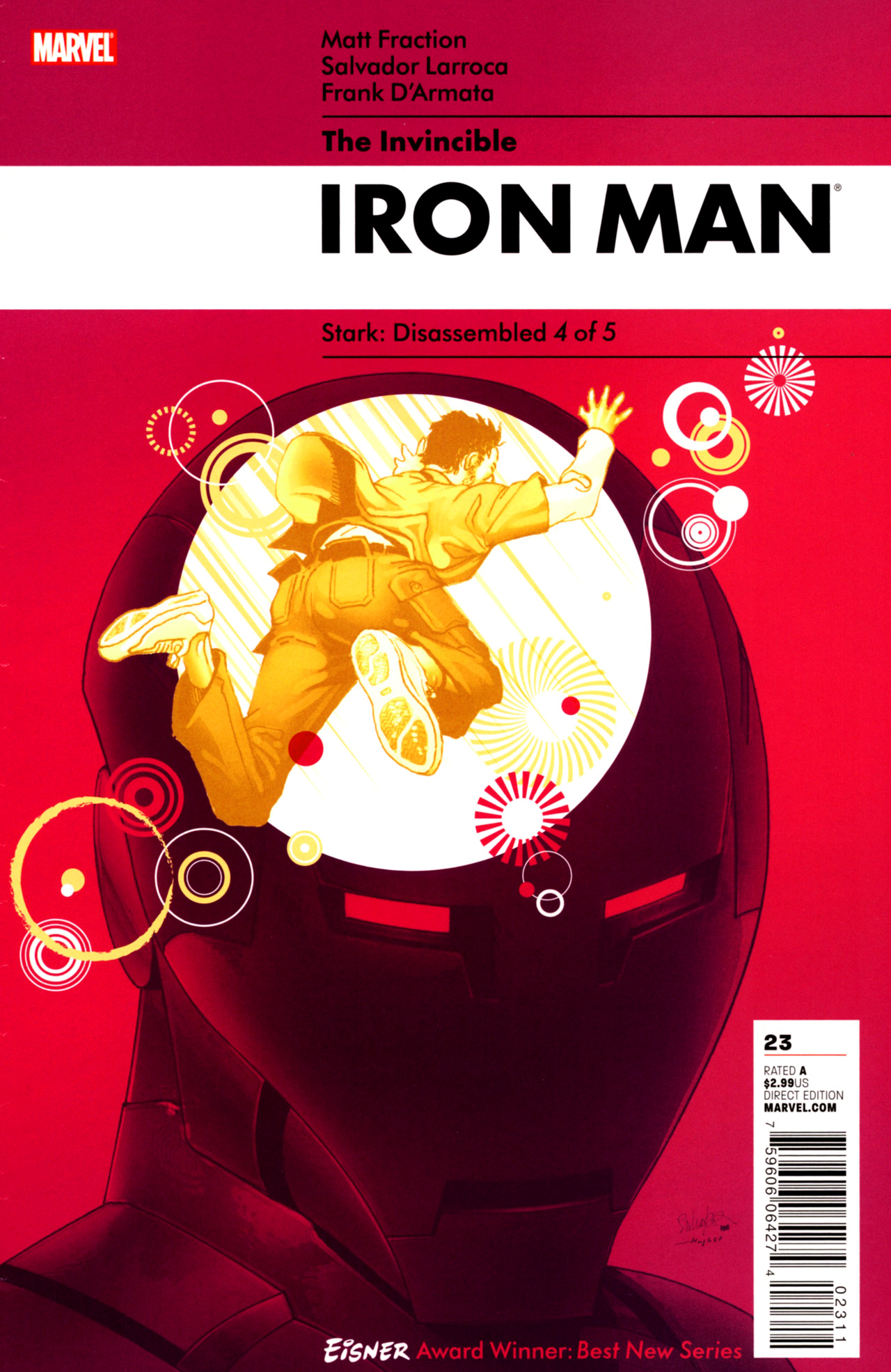
Matt Fraction Iron Man Retrospective: That's It? Hell Yeah It Is


Genre fiction tends not to be the place for subtle, complex emotions. With names like comedy, suspense, drama, and horror, genres in their purest form tend to cater to simpler desires, evoking simple yet visceral emotions if done well. This isn't a bad thing, as that's hard to do in practice and should be lauded when done successfully. However, the best works are the ones that augur more complex feelings, put you in emotional places that are all too real but rarely discussed in our fictional fantasies. This is the difference between, say, anger at a designated foe, and pervasive frustration over a lack of personal progress. A dramatic collapse into addiction followed by a heroic triumph of willpower, versus a realization that those compulsions have just been sublimated into other areas. Or even the difference between a triumphantly happy ending, and an ending where the hero left the world slightly better than he found it-- but only slightly.

Matt Fraction has been doing this with artist Salvador Larroca* on the Invincible Iron Man for four and a half years, taking the character into emotional territories seemingly beyond the scope of the superhero genre. As of October 2012, Fraction finished his tenure on the book with a surprisingly downbeat epilogue. After a penultimate issue of all action, where Iron Man teamed up with pretty much every non-Avenger ally available (and even some enemies) to stop the Mandarin, Tony returned to America after months in his arch-enemy's captivity. What Tony concludes, to his dismay, is that the world hasn't changed much in his absence, still stuck in the past.

Actually, that's not quite true; Tony's friends and colleagues were doing okay without him. Resilient, previously Stark Resilient, became fairly successful without its mega-celebrity founder, using the repuslor technology to make superior consumer goods without a single cent of military funding.Pepper Potts moved on with her life, eventually hooking up with dowdy but reliable Carson Wyche (one of Resilient's star inventors, whose career had previously been ruined by Tony during his decadent and petty pre-Iron Man days) and learning to live without the Rescue armor. The civilian works of Tony Stark continued without him or Iron Man-- his real legacy. But that's not something that Tony can really appreciate, so the only person really stuck in the past is him. Tony's company escaped the Marvel Universe's Nietzche-esque eternal recurrence, and are off doing good if rather dull work by making better, cleaned products that are presumably cheaper. But Tony is stuck in the same cycles of heroes and villains and will never escape them, thanks to the fact that his existence as a Marvel comic character is meant to sell merchandise first.**

The main theme of Fraction's run on Iron Man is the explicit question of wether or not the Iron Man is a good thing. Sure, Tony saves the world as Iron Man, but there are plenty of other superheroes who do that without all of Tony's baggage; who don't sponsor their super-powers with military-industrial blood money, who aren't responsible for thousands of civilian deaths at the hands of Stark weapons, and who aren't so wealthy that they can retreat into their addictions while shirking their responsibilities. Some might even say that Tony's decision to atone for his arms dealing sins as Iron Man served him far more than anyone else, giving him the visceral thrill of being a superhero and catering to his death drive impulses, instead of really cleaning up the Stark-branded messes left on battlefields across the world.

This theme was much easier for Fraction to express at the start of his run, when Tony was the Orwellian ruler of the world as Director of SHIELD. When Tony relapsed into the military-industrial complex full force after the events of Civil War, it was much easier to critique the problems in his imperialistic approach. The first twenty-four issues of the Fraction/Larroca Iron Man fired upon all cylinders, especially during Tony's atonement in World's Most Wanted (which kick-started the Handi-Capable blogging, as some of you may remember). After that it was more uneven, since the Heroic Age led to Tony Stark trying for a more pacifistic approach, which really wasn't condusive to serial superhero comics. (The Stark Resilient arc was particularly egregious, with its first half being entirely set-up for Tony's new company.)

Of course, that may have been the point, because a lot of life-- particularly recovery from addiction-- isn't earth-shattering drama. It's living day-by-day, paying your bills, managing your relationships, and trying to do a little better than you did the previous day. And this doesn't really work for Tony Stark, who risks his life on a daily basis and goes through more women than James Bond. In many ways, Tony still lives an addict's life, even if he's kept himself clean of alcohol; he lives a life of consumption, keeps others at arm's length, is frozen at the emotional maturity of a teenager, and doesn't place any value on his personal safety.*** This isn't really the kind of person you want as a responsible leader for a trusted brand, and when Tony fails, his companies tend to fail with him.

The final chapters, however, did have Tony save the day when nobody else could, by ultimately defeating the Mandarin-- who was quite cleverly played as a twisted mirror of Tony's own conspicuous consumption, a Kim Jong Il-style**** hedonist so obsessed with his self-mythology that he became enslaved by it (what with the rings actually controlling him). Just like in real life, weapons are a necessary evil some times, when you need to defend the just and the innocent. But Iron Man is still a weapon, and tying worship of weapons into the public sphere has grave moral consequences, as Eisenhower (correctly) warned. So this makes the ending, with Tony leaving his company and going off to find new adventures in space, an appropriate if bittersweet conclusion.

One of Tony's final lines to his former employees is "I'll do better next time". So much of fiction deals with character development in very broad strokes, either ignoring it or having characters Learn Lessons and Grow Stronger. Tony isn't a completely different person after all of his experiences in Fraction's stories, nor can one expect him to be. Nor is Resilient poised to dramatically change the world, in the broad "curing cancer and making cars fly" strokes too often shown in science fiction "utopias". They make cleaner cars and cleaner phone batteries. They're helping people live life a little better, and they're offering it to the public in a completely voluntary fashion; you don't choose a Stark phone because of a Dr. Doom-like edict sweeping society, you presumably choose it because it's just a better phone. The world is thus a little better, from this small bit of progress-- which is ultimately the best we can hope for in terms of lasting good. Humans and their societies can't change overnight, nor can they become perfect-- they can just move in the right direction, and that's what Tony's done.

It's a complicated message for a superhero comic, but a very powerful one when fully understood. I'm really going to miss Matt Fraction on Iron Man, and despite some misgivings about certain parts of this story, I have nothing but praise for the sum of those parts.

* Larroca's art deserves special mention, as he became better and better with each issue. His tech is always beautiful and inventive, but his characterizations are also superb; though he's often critiqued for relying too much on photo reference, his art uses such economy of line that those faces get life beyond their original inspiration. I'm going to buy the new Cable and X-Force comic just for his art. And Colossus, of course.
** Which isn't really a bad thing, it just is. This is also why creators who do such brilliant things with the franchise characters deserve special applause.
*** Illustrated beautifully in the .1 issue, where Tony recounts his entire history in the context of an Alcoholics Anonymous meeting. If you buy a single issue of Fraction's run, buy Invincible Iron Man 500.1
**** Which is why for a moment I was disappointed that Ben Kingsley was cast as the Mandarin in Iron Man 3, because I would've gone with the Kim Jong Il puppet from Team America World Police :P

Thursday, August 9, 2012

The Fall of Hank Pym, The Avengers' Greatest Failure


It's occurred to be before that the controversy around the character of Hank Pym (a.k.a. Ant-Man/Giant-Man/Goliath/Yellowjacket/Wasp) has a mental illness component that's rarely addressed. The character has polarized Marvel readers since that 1981 issue where he struck his then-wife Janet Van Dyne (a.k.a. the Wasp)*. That issue, and the larger storyline to which it's connected, has been out of print for years, so the actual context of the event has been largely divorced from that one panel of Hank hitting Jan. But since the whole story has finally been reprinted in the Avengers: Trial of Yellowjacket trade paperback release (which I strongly recommend), there's finally the opportunity to examine Hank's deeds with closer scrutiny.

On the one hand, Hank does behave badly, and he's not so far gone that he loses responsibility for his actions. Having just re-joined the Avengers after an unsuccessful return to his scientific work (during which Jan tayed on the team), Hank's an unstable nervous wreck, and he takes his frustrations out on Jan. Jan, trying to be the good wife, tries gently reasoning with him, even though he's snapping at her over every perceived slight. What's important to note is that while the physical abuse of Jan is often brought up, the verbal and psychological abuse is downplayed, but that played just as much of a role in their divorce. At one point, when Jan's trying to decide which of her Wasp costumes she should wear to the Avengers meeting, Hank uses his Yellowjacket suit to blast one out of her hand. He's using a deadly weapon to destroy her property, and thus issuing an implicit threat. Jan doesn't say anything in response, still under the impression that she can help him (and thus continuing to enable his use of her as a scapegoat, as is so often and sadly the case).

Hank's behavior is reprehensible, and it goes beyond a domestic dispute and into nearly manslaughtering the entire Avengers. He creates a robot to attack the Avengers so he can shut it down and appear to have saved the day, but like all robots in these stories (most notably, Hank's accidental creation of Avengers arch-nemesis Ultron), it goes berserk, everyone sees through Hank's ruse, and Jan ends up shutting it down. It would be kind of hard for him to plead insanity when he had enough rational ability to make a giant killer robot, even if it ultimately couldn't be controlled. Looking closely at Hank's behavior, he's aware that he's doing the wrong things, but he ends up doing them anyway because he can't control his impulses and is so desperate to prove his worth. He doesn't try to win back the Avengers or his wife after these events, realizing the immensity what he's done; he doesn't even accept any charity, despite the fact that he was living off of Jan's trust fund and is otherwise penniless.

So yes, Hank is responsible for his sins. But while he could have controlled himself even in the context of his nervous breakdown, the event did not occur in a vacuum. Hank had previously been unstable, due to his own low self-esteem, his unhealthy relationship with Jan (a younger woman who he had nothing in common with, other than her resemblance to his dead first wife), his guilt over the creation of Ultron**, and the adverse psychological side-effects of his powers. And during this whole time, the Avengers were right there, watching but doing virtually nothing. Nobody on the team asked Hank what was bothering him. Nobody suggested therapy for him or Jan, together or separately. Nobody was worrying about his long-term mental stability, even when he fell into delusions where he thought he was another, more aggressive man. His marriage to Jan occurred when he was high on Science Chemical Fumes and called himself Yellowjacket, believing himself the murderer of the original Hank Pym. The great fraternity of superheroes was nothing more than a Greek Chorus bearing passive witness to the downward spiral of one of their founding members, up until his baggage became a physical threat.***

It's worth noting that this story happened right before the similar downward spiral of another Avengers founder; Tony Stark, a.k.a. Iron Man. At this point, most of the Avengers didn't know Tony's secret identity, and when he ended up dating Jan shortly after her divorce, she wasn't aware that she was dating one of her (and Hank's) co-workers. Tony fell for her and couldn't bring himself to tell her the truth, at least until Captain America guilt-tripped him into doing so. The result was a messy break-up that fuelled Tony's own depression, until he outright disappeared from the Avengers. This was due to the story in his own book, where the psychological warfare of Obadiah Stane caused him to sink into an alcoholic relapse. Tony's storyline was controlled by the Iron Man creative team, but you could see Tony fraying at the edges bit by bit in the Avengers, withdrawing from interacting with the team (and his ex), with nobody doing much to check in with him.

The Avengers have an absolutely abysmal track record taking care of their own. Hank is only one of the heroes to have a catastrophic nervous breakdown while on the team; the list of fallen heroes on the Avengers roster include the aforementioned Tony, Wanda Maximoff, Pietro Maximoff, Simon Williams, Clint Barton, Bruce Banner, Carol Danvers, and more. But as far as he fell, Hank managed to pick himself up. He earned Jan's forgiveness (and even a few reconciliations, however temporary), he earned his place back in the Avengers, and everything he's done since has been an act of atonement. He's not entirely stable, but nobody is immune to stress, especially not as a superhero.

Can't he get fandom's forgiveness?

*(It's worth noting that the writer of the original story, Jim Shooter, wrote the scene as Hank pushing her away with more force than intended, but the artist drew it like just another superhero fight scene; hence, an isolated incident became a scarlet letter.)
**(Who's actually killed millions of people. How come Hank gets more grief for one slap than for creating a genocidal anti-organic monster? )
***(Joe Casey's excellent Earth's Mightiest Heroes mini-series portrayed the wedding in a much darker light, where Jan and everyone else was playing along with Hank's delusion to avoid an even greater meltdown. Not sure if this makes the Avengers look better, or much, much worse.)