Ruby Nation

Ruby Nation
Ruby Nation: The Webcomic
Showing posts with label dark reign. Show all posts

Thursday, June 17, 2010

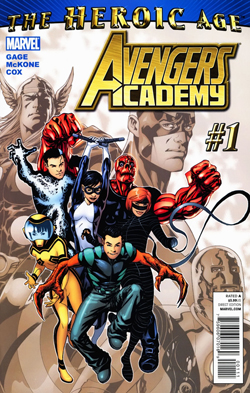
Avengers Academy #1: Arkham Asylum Youth Outreach Program


Mental illness tends not to be treated well in popular culture. Crazy and evil are synonymous; heroes may have their problems, but serious, debilitating mental problems tend to be the province of villains-- characters who are simply irredeemable. One need only look at how " mad scientist " is used to see this problem-- being emotionally unbalanced translates well into carving up people for fun and profit. In truth, many of the worst actions in human history were justified with perfectly rational ( if hideously unsympathetic ) thoughts, but it's easier to accept an evil figure who wears it on their sleeve.

And nobody knows this better than the Avengers themselves, since not only do they fight crazy evils on a regular basis, but many amongst their members have been crazy in an evil fashion on more than one occasion. This informs the premise of Avengers Academy, the new teen superhero team by Christos Gage and Mike McKone. Six teenage heroes assembled by a faculty of veteran Avengers are told that they're being groomed to be the next generation of heroes. By the end of the issue, they find out that they were picked because they were the most psychologically troubling of superhumans, and the adults are playing damage control lest these kids become a new pack of Norman Osborns.

It's a really strong start, because unlike most teams of teenagers, they don't have typical kid problems. These are the most damaged goods you can get, and most of them suffer from the same conditions that give them superhuman abilities. The POV character, Maddy " Veil " Berry, is gradually turning into gas. Another girl, Haz-Mat, has to live her life in a radiation suit lest she poison everyone around her. The boy Mettle is a giant crimson metal humanoid with a skull face. And while we don't know as much about the other two's respective baggages, the girl Finesse-- the one who appears normal on the surface-- is a hypercompetent polymath with no social graces or basic empathy, described as " Rain Man meets Ninja Assassin ".*

At the same time, they're more sympathetic than the adults, who could be set up as the antagonists. Note that these are Avengers with specific histories of trauma and failure-- of them, Justice is the only character who appears sympathetic to the class**. The cast is round out with promiscuous running joke Tigra, former S&M angst master Speedball, Magneto's bastard son Quicksilver, and Hank Pym ( who is currently calling himself the Wasp after his dead ex-wife's hero name, and needs no introduction beyond that ). They're trying to keep the truth from the new Avengers, and maintain the illusion that these kids can become great heroes. And it's ultimately set up to fail, because if there's one thing teenagers don't like, it's being patronized. However, what we don't know is if learning about how the adult Avengers are treating them as literal time bombs is going to galvanize the kids' resolve-- or be the incident that finally drives them over the edge.

Needless to say, I'm very interested in where this series is headed, because not only is it well-written and well-drawn, but it sets up one of the best premises I've seen from a Marvel book in many years.

* ( If she's actually autistic isn't stated, but hopefully if an actual diagnosis is given, it won't be attached to her being portrayed as a complete sociopath. )
** ( It helps that Justice is one of the two adults in the book actually close to the kids' age, but Maddy goes so far as to describe him as Dr. Phil with Robert Pattinson's looks. I swear, between this and his apperances in the Initiative, the guy could get a crowd of girls to swoon over him even if he was picking his nose and eating the boogers. )

Sunday, March 28, 2010

War Machine 1 & 2 Graphic Novel Review: Military-Angst Complex


The Jist: When James " Rhodey " Rhodes was a lower-middle class black boy growing up in South Philidelphia, expectations for what he'd grow up to be were low. But as an adult, Rhodey's been a decorated US Military hero, the private pilot and bestest boyfriend of Tony Stark, a substitute Iron Man for years, and eventually his own armored hero as War Machine. Now, rebuilt with cybernetic parts after being blown up on a mission, he's a literal machine. And as his name suggests, he wants to declare war-- in this case, on every petty warmonger on the planet.

The Crew: Greg Pak ( writer ), Leonardo Manco ( artist Vol. 1 and issue 8 ), Wellington Alves, Mahmud A. Asrar, Allan Jefferson, R.B. Silva, and more( artists vol. 2 )

The Verdict: To start with, I want to say that War Machine's redesign for this series may be the least inspired costume design I've seen yet. Not the worst, mind you, but the least original and unique-- it's basically a greyscale Iron Man with an assload of weapons hanging off his back. Which is the most exact description you can give of War Machine's looks, but I would have liked to see a bit more thought than " Iron Man with attached 90's style armament porn ". He looks like a robotic version of Big Shot, the Punisher spoof from the Tick cartoon who carried a huge box of guns on his back and fired at anything until he ran out of bullets, in which he'd start sobbing about how his mother didn't love him. Re: A SPOOF character, not appropriate for a comic that takes itself seriously.

Of course, there are a lot of things I would have liked to see from this series that I didn't. That description of Leonardo Manco's War Machine design describes how I feel about the book in general-- it's not_that_bad as a whole, but it's definitely an underperformer, especcially given the quality of the creative team.

The central problem with this comic is that it's trying for a balance of real-world commentary and Marvel Universe exploration, and doing it in a very sloppy fashion. This is most obvious in the first trade, where Rhodey takes his cyborganized body to several Marvel Universe third-world military juntas to kill all the " real " bad guys. I'm not terribly opposed to seeing guys who torture and kill innocent civilians getting a bullet in the head, but these are a shamelessly superficial rendition of real-world despots. " Santo Marco " is not Columbia; it's the country Marvel writers use when they want to say something about Columbia ( or other South American nation torn apart by civil war ) but don't want to bother researching the complexities of real-world Columbian politics. So they bring in Santo Marco with its endless supply of two-bit genocidal thugs, and have Rhodey try to solve the country's problems by killing every person with a " kill number " ( something that his cyborg operating system attaches to everyone he sees, based on how many deaths they've willfully caused ).

If you're wondering how flying in to cap warlords in the head is a heroic action ( or even one with any long-term benefit; is the word " power vacuum " even in Rhodey's databanks? ), it's not. Greg Pak has called his approach to this series " Iron Man meets the Punisher ", but he's still playing Rhodey as a sympathetic character, one who is trying to do the right thing, even justifying it by talking about how his cybernetic brain won't let him even temporarily forget every murder and rape he's witnessed. Except that the Punisher isn't a sympathetic character, and especially since Garth Ennis got to him, he's been portrayed as a monster who happens to point his bullets at other monsters. Ennis' stories with the character, especially the ones where he was involved in real-world struggles ( most notably the Irish civil struggles of Ennis' own background ), never suggested that Frank's solution was the right one or even a right one.

Also worth noting about Ennis' real-world commentaries in the Punisher is that he didn't bring in other Marvel characters to make them-- his Frank Castle existed in an independent space, and whenever superheroes wandered in, they were embarrassingly ill-equipped to deal with it. Rhodey, on the other hand, is dealing with military juntas, tribal genocides, and frequent rapes in the Marvel Universe. In Santo Marco, one tribe uses a hacked Sentinel to genetically weed out and kill members of the other tribes. In Aquiria ( a.k.a Marvel's ersatz Middle Eastern theocracy ), he's fighting a private military contractor named " Eaglestar " using appropriated tech from the alien robot Ultimo. And in the opening strip from Marvel's website, Rhodey fights a Roxxon ( a.k.a. Marvel's ersatz corrupt oil conglomerate ) executive trying to eliminate Inuit tribes from ideal drilling space with cyborg bears. Pak wisely knows to have occasional asides from the characters where they recognize how absurd this shit is, but we're still getting world politics shoe-horned into the Marvel Universe in a manner that can't be taken seriously-- and when you have open acknowledgement that one of the female characters was beaten and raped by prison guards, following with a dramatic entrance by Ares, Greek God of War, seems horribly inappropriate.

If I seem overly upset with this comic, I have to admit that part of it is because I really like Jim Rhodes as a character, and think that everything I like about him is absent here. When Rhodey debuted as Tony Stark's best friend, he was a perfect and immediate fit because he offered an intrinsically human counterpart to Tony's ubermensch futurism; he was Wilson to Tony's House, down to the unfortunate enabling of Tony' addiction. As the substitute Iron Man and even as the ( unfortunately named ) War Machine, he was a likable character, because he was a hero as a soldier long before he met Tony, and wearing Iron Man armor was a right that he genuinely earned. His conflicts came from the fact that he was deeply uncomfortable with making the kinds of hard moral decisions that Tony has to make on a regular basis-- but all of that's absent here. He can't appear in regular human settings because he's a disfigured cyborg, but if you're wondering how much his condition lowers his quality of life ( and from the looks of it, his new body has all the " armament " of a Ken Doll ), we don't get any answers. All we know is that he's ugly, he's mad, and he's taking it out on everyone his databanks give a kill number. Quite the character reduction.

To the War Machine creative team's credit, the book improves dramatically with the second and final collection, when Rhodey sets his sights on Norman Osborn and his Dark Reign. It doesn't become great, mind you, but it develops the makings for an enjoyable mid-tier superhero book. The supporting cast is expanded on, bringing a " Team War Machine " together from various Iron Man supporting characters, including Rhodey's mother. The opposition is shifted from one-dimensional takes on real world monsters to Norman, and while it's hard to ever believe that the substitute Iron Man is going to be the one out of all the heroes to take Norman down, the guy's scenery-chewing brand of theatrical villainy is always entertaining. And while the art team shifts from Leonardo Manco to various fill-in pencillers and inkers, that actually works to the book's benefit. Manco's dark, gritty style was great when he was working with Andy Diggle on the urban fantasy Hellblazer, but his more realistic rendering only served to illuminate how ridiculous the stories were. The more conventional superhero art the later teams offered played well to the series' tone.

But as they said about J. Edgar Hoover's attentions to the economy-- too little, too late. The book's first arc was an obnoxious throwback to the worst parts of 1990's comics*, and readers picked up on that. It's luck that let War Machine last a whole year, and even with the character getting a big push thanks to Iron Man 2, it may be a while before Rhodey gets another solo series. On the plus side, Pak started the series by showing that Tony Stark had cloned Rhodey a fresh body, and ends it by transferring Rhodey's mind there. No longer a scowling, trigger-happy eunuch, War Machine is in a position where a new creative team can do something really good with him.

While there are some merits to the series and it picks up in the second half, overall it was a failed experiment that left a bad taste in my mouth, so I'll have to give it a Not Recommended.

Wednesday, December 30, 2009

The Best Comics of 2009

After a long post of grousing, I felt it was needed to mention the stand-outs of 2009's comic books-- and there were plenty of them. There were a lot of books that genuinely excited me last year. The rise of the Norman Empire made Marvel's line all in all more interesting, and even DC had a few standouts amidst its usual mix of Silver Age nostalgia and relentless sadism. Meanwhile, the smaller publishers gave us a salvo of great new material-- from continually entertaining series like Dynamo 5 and Umbrella Academy, to new phenomenons like Chew and Beasts of Burden. Granted, there was still the influence of Sturgeon's Law upon the industry, but this year it seemed that the quality AND quantity of 2009's portion of good comics was an increase over last year.

So, the awards:

BEST SUPERHERO STORY ARC: World's Most Wanted, Invincible Iron Man, Matt Fraction and Salvador Larroca, Marvel. Not since Daredevil: Born Again has a mainstream superhero been torn apart so effectively. I could discuss how the story destroyed the entire empire of Tony Stark, down to the last soldering iron and broom closet. I could discuss how his supporting cast was forced to pick up his slack, and prove their worth against impossible odds. And I could even discuss the meticulousness of Tony's plans, which were so elaborate he could even pull them off with a barely working brain at hand.

But therein lies the greatest part of the story; Tony having to sacrifice his very intellect to fulfill his plans and atone for his sins. Many stories have been told with heroes on the run, and heroes like Tony Stark typically maintain a MacGyver-like aptitude for making solutions out of thin air. In this case, the deconstruction even went for his mind. An uncharacteristic level of sophistication was used for the treatment of Tony's degenerating brain, having the loss of knowledge occur in multiple areas in a randomized arrangement, and showing that he could still accomplish things without certain sections of ability ( as opposed to the linear model of IQ that is tragically common in pop culture ). Eventually, Tony would lose all of his function-- but the last thing to go was his heroism. Even at the end of the story, so addled he couldn't form a complete sentence, Tony tried to fight back against a superior and completely depraved enemy. His victory was phyrric in the practical sense, but in the moral sense, flawless-- would a lesser superhero subject themselves to a fate worse than death to fight off such an enemy? Or would such a story even occur to a lesser writer than Fraction?

The revelation that Tony had a back-up of his mind intended to be used by the other superheroes may somewhat mitigate the redemption of this story, but it was still a huge risk for the hero. And for the creative team, to take a whole year with a story that had the protagonist mentally deteriorating. But Fraction's brilliant scripting and Larroca's always excellent visual storytelling ( especially in regards to his renditions of technology ) pulled it off.

MOST IMPROVED SERIES: The Boys, Garth Ennis and Darick Robertson, Dynamite. At its launch, one might have dismissed the Boys as being a puerile spoof of superhero comics, much in the same vein of Mark Millars' Wanted. Superhero comic fans still do, but if they actually read the comic, they'd have less and less justification for their critiques beyond prudishness. What began as a continuation of Ennis' " The Pro " has actually been living up to the author's claim that it would exceed his magnum opus Preacher.

For all the gaudy spandex trappings, the Boys isn't really a superhero comic-- it's a scathing critique of the military-industrial complex, with the capes as the garnish. From the start we knew that the stereotypical superhero universe was just smoke and mirrors for a world of Caligula-like excess, but Ennis and Robertson drove the point home further and further. That the origin of all superhuman power is a compound developed decades ago through the Nazis' vivisection? That the United States' leadership is divided in a coup between the President, the Vice-President, and the military contractors responsible for the power of both? Or that the X-Men analogue " G-Men " is composed of children abducted at a young age and sexually abused to give them the right disposition? Even Norman Osborn in his flag-colored robot suit is nowhere near so cutting an instrument of satire.

Not that it's just unpleasant to read; it has all the great dialogue and dark humor characteristic of a Garth Ennis comic, and Darick Robertson's excellent character design is in full force here. There's even a love story at the heart that serves as an anchor amidst the relentless cruelty of the universe. What Preacher did as a satire of religion, the Boys appears to be doing as a satire of military culture; don't let the abuse of capes detract from that.

BEST SINGLE ISSUE: Captain America: Who Will Wield the Shield. Ed Brubaker, Butch Guice, Luke Ross. Marvel. This wasn't a good year for Cap, after an exceptional 2008; the big event of the year, the resurrection of Steve Rogers, was just an extended action scene with a pointlessly convoluted plot, harmed by the art of Bryan Hitch ( who has moved too far from energetic storytelling into hyper-rendered set pieces, with the story suffering for it. Fortunately, the one-shot epilogue to the series delivered in a very substantial way.

The question raised by the title is answered, but not conclusively-- the prediction was that with Steve Rogers back, his replacement Bucky would either meet a quick end or simply fade into the background. Steve metatextually agrees, hence how he responds to ominous visions by asking Bucky to stay as Cap. But Steve's not simply retiring; he's keeping active in the hero community, especially given how far it's gone to hell in his absence. The characterization is as sharp as ever under Ed Brubaker, but what really sold me on the issue was Steve's dialogue with Barack Obama.

Marvel writers tend to lean towards the left, hence why Marvel-Dubya has been stripped naked tortured by Magneto AND cuckolded by Iron Man. Given Obama's reputation, one would think he'd escape this scrutiny-- at least, last year, that's what one would think. But Barack's inability to make real change has not been unnoticed, and his talk with Captain America makes him almost a pathetic figure-- he's talking about how he doesn't agree with things like Superhuman Registration or HAMMER Director Norman Osborn, but how he can't do anything about it. One might even think that he actually voted for the Registration Act while he was a Senator, and is retrospectively downplaying this given the company he's with. Obama isn't the savior others made him out to be, and his office forces him to support the status quo that he knows should be changed-- so thus, he turns to Captain America.

It's really interesting since the Dark Reign was conceived during Dubya's reign of error, and the Marvel Universe finally appears to be catching up to current politics. If Tony and later Norman represented the Bush administration, Steve is now Obama-- the figurehead for change and hope. I'll enjoy seeing how well he holds up under this level of pressure.

BEST NEW SERIES: Chew, John Layman and Trevor Guillory, Image. The moment this appeared in the solicitations, it looked like a huge conceptual gamble-- something that would be wonderful or terrible. Certainly the ideas represented were way out of the audience's experience. A detective with a psychometric sense of taste, who can read the past of what he eats? A job that forces him to eat all manner of awful things? A food-themed alternate America where the FDA rules with an iron fist and poultry is banned?

And then you get to the series itself, beyond the first issue. The character designs are extremely bizarre and exaggerated; the character of Mason is described by the artist as " the love child of Orson Welles and a grizzly bear ". The stories involve all sorts of food-themed bizarreness, such as a woman who can empathically influence people with her writing about food. And there's a meticulous constructed plot here about the Bird Flu scare, and the truth about it. Yes, this is an ongoing series with very dark undercurrents about a detective who psychically reads what he eats ( except beets, which somehow block his power ). It would either succeed spectacularly or perish pathetically.

And guess what? It succeeded. So suck it.

BEST MINI-SERIES: Beasts of Burden, Evan Dorkin and Jill Thompson, Dark Horse. It's no secret that I love animals, especially dogs and cats. I love seeing comics about animals being animals; anthropomorphized enough to talk, but not enough to stand, wear clothes, or have human-type anatomy ( I'm NOT going any further with that ). Unfortunately, it's hard to find that balance in a way that's convincing. We3 was a triumph in this arena, but beyond that, good treatments of animal characters are few and far between.

Beasts of Burden delivered this. It's a great comic about household pets solving neighborhood supernatural crimes. The series is still relatively new-- it has some backstory as an online strip and only four issues on the stands-- and admittedly many of the characters seem identical. But the dogs and cats are wonderful creatures, who show depth beyond the story structure requirements when given a chance. Here, they aren't animals acting like their human masters; they're animals who have far more going on than their masters assume, but in a uniquely non-human way; the dialogue is in English, but the perspectives feel like they're from a different species with their own religious traditions. There are many stories about evil in suburban backyards, but few where the animals hold the line.

What's more, it's not a simple funny story. It has a strong element of horror, and sadly, that horror isn't always from the monsters-- the worse scenes involve human treatment of the pets. Issue 2, which had a ghostly dog trying to find justice for the deaths of her puppies ( coldly thrown in a lake ), was just brutal. And issue 4 was just as gripping.

They've only begun to scratch the surface of the Beasts of Burden's world, but Dorkin and Thompson gave us so much, that I demand more in 2010.

And the Person Of The Year: Brian Michael Bendis, for New Avengers and Dark Avengers. The series of essays I did for New Avengers' five-year-anniversary illustrate better how I feel about Bendis' work on the Avengers as a whole, but the Avengers books were the comics I followed closest this year. Intellectually pretentious fans may bitch about crossovers, and lord knows I've done it too; however, I can't deny how much I've enjoyed Dark Reign, especially in the aforementioned Iron Man comic and the Avengers books.

Bendis' Avengers have steadily been improving since the rough start of Avengers Disassembled, and really hit their stride when he started writing the second book Mighty Avengers as well. The idea of two duelling Avengers teams was a welcome one, but then the two teams were holding back against each other due to their former friendships. Now, we have the dynamic consolidated, with one book for the heroes, and one book for the newly-marketable villains. The way both of Bendis' books tie into each other is a unique dynamic, and I have to admit, one that could only work in a super-consolidated shared universe.

In New Avengers, we've seen many improvements. The Secret Invasion conspiracy stories are over, so the dangling plot threads have been reduced. The character dynamics have been developed further, with Luke Cage and Jessica Jones really starting to see how impossible it is to raise a child as vigilante metahumans, Clint Barton's nervous breakdown getting more and more extreme, and Captain Bucky joining with the disposition of a kid trying to fit in with his older brother's friends. Also, Stuart Immonen's art has turbo-charged the enjoyment of the book, and the stories have become more focused without the rotations and flash.

Meanwhile, Dark Avengers is just great. Norman Osborn, a complete monster in other comics, actually receives some sympathy in the comic series that is basically his. He's joined by the rest of his EllisBolts buddies, also dressed as heroes and trying/failing to restrain their psychopathic tendencies. The team isn't all evil, as Ares ( more of a Chaotic Neutral figure in the D&D alignment schema ) and the impressionable Sentry are on the staff, but it's still very much a villain book. The entertainment is in watching how long they can keep it up, and from all indications, it's falling apart. Also, Mike Deodato Jr. is on the art duties, and he's the artist who's given us the definitive version of Norman since he drew the guy's sex-face.

I hope that once Dark Reign ends early next year, the two-book dynamic will be kept up, because I've enjoyed it so much this year that reverting to a single Avengers faction with a unified heroic mission would be a let down. Kudos, BMB.

Here's to 2010 being even better.

Saturday, November 28, 2009

Maybe It Just Hurts To Be Me; Wolverine and Chronic Pain

An interesting reinterpretation of Wolverine's mutant healing factor occured in Jason Aaron and Ron Garney's story " Get Mystique ", where one of his strategies involved faking his death with a car bomb-- which, thanks to his regenerative abilities, allowed him to make it even more convincing by blowing himself up along with the car. Logan's inner monologue explained that people assume that he doesn't feel pain because he can recover from these massive injuries, whereas in fact the reverse is true-- not only does he feel pain, but the trauma sticks with him psychologically. With everything Logan's endured in his hundred-some years of life, the worst of which being the Weapon X procedure that forcibly bonded metal to his bones and claws ( something which gives him continual heavy metal poisoning, but does not debilitate him thanks to the healing factor ), the pain he feels is as chronic as it is severe, and he has had to accept that nothing will remove the pervasive discomfort.
r
This is an interesting wrinkle because it makes Wolverine a chronic pain sufferer, and he's far from the type of personality that most in Western culture would associate with chronic pain. At his most simplistic, Wolverine is a superhero who collects every adolescent male power fantasy cliche'. When he's not out chopping up bad guys with his claws, he's smoking cigars, drinking beer, tooling around with motorcycles, and bedding women with his ( literal ) animal magnetism. He endures a lot of suffering from being stabbed/shot/poisoned/blown up/steamrolled/etc ( writers get more and more inventive with what to throw at him for this reason ), but he always heals from it and comes back swinging, a superhuman metaphor for the all-American notion of " playing through the pain ". These are not the acts of a victim bedridden by physical and psychological suffering; Logan can't even be seen as an abuser of pain-relieving drugs, since his healing factor nullifies the effects of all poisons ( including the kind that are socially desirable, like alcohol and nicotine; he must just like the taste of beer, for some reason. ).

If Wolverine is in constant discomfort, it doesn't manifest as a handicap, unless being grouchy and temperamental is a disability. But the hyper-masculine activities that Logan engages in on a regular basis aren't necessarily evidence that he can overcome incomprehensible trauma; it's also been suggested that his adventuring is a compulsion to avoid being alone with his thoughts and feelings. Another great Wolverine story by Aaron started out by spoofing Logan's massive overexposure in Marvel comics by showing how tiring it is for him to fit all his adventures and team-ups with other heroes into a given week, but took a serious tone when Logan finally explained why he puts himself through so much stress-- he doesn't want to be alone with himself and his past. The past Logan refers to is the sins he's commit in his many years prior to being a superhero, but the same logic could be applied to the way he feels about his trauma. It's not something he wants to acknowledge, let alone confront.

Yet many Wolverine stories end up forcing Wolverine acknowledge his inner turmoil, even if he doesn't " overcome " it. The prevalence of Japan in Wolverine's backstory is more than an excuse for Logan to fight ninjas or angst over his dead princess fiance'-- to him, it's a place of peace and contemplation, where he can reach clarity through meditation. Logan doesn't specify a religion, and has even been portrayed as an atheist when it comes to the Judeo-Christian God, but he has a strong ( if also abstract ) sense of spirituality. In his quiet moments, Logan looks to ( admittedly not too specified ) Eastern religion, suspending judgment and finding emotional clarity. Logan can never overcome all of his trauma, but he does find ways to cope with it so he can function as a human being, instead of an injured beast.

Which, ultimately, is why Logan is one of the most heroic figures in the Marvel Universe. That he uses lethal force obscures this for many ( not me, but the whole should heroes kill debate is for another post ), but based on what he's endured, choosing to be a superhero carries much more weight. Logan has lived over a century and endured more pain, suffering, loss, and guilt than any other human or mutant. His healing factor ensures that he cannot age or die, but it also means that suicide is not an option for removing his constant trauma. To cope with his pain, he would have every excuse to be a complete hermit living in the woods, or even a heartless mercenary like his arch-nemesis Sabretooth. But he has chosen to protect innocents and fight evil, even though it means acquiring more pain and suffering.

Thursday, November 19, 2009

Iron Man and the Nature of Power

From a post on the Iron Man Message Board, in response to the removal of Tony Stark's innate bio-abilities

If Iron Man retained the Extremis nanotech capabilities, but kept fighting super-villains, he'd trounce them easily. Not only would the already troubled dramatic tension of franchise superhero comics be further reduced, but Tony would almost come across as a bully for only fighting weaker enemies. Fiction favors the underdog-- another reason Tony is hard to write, because he's a rich genius who built his empire on military-industrial blood money.

This is why once Tony became Extremis enhanced, he stopped fighting villains ( except for cases like the Inevitable, which was meant to prove that he couldn't be bothered with costumed thugs anymore ) and went to bigger challenges; instead of just saving the world, he was trying to fix it. The Project ARGONAUT team of remote-controlled Iron Men was a precursor to this mentality, but the Director of SHIELD role was even more ambitious-- he'd gone from making Iron Man security for Stark International to security for the world. Which made the threats he faced even greater-- Ezekiel Stane being the harbinger of the new era, someone who spread super-terror on a level that not even Tony's awareness could match.

Of course, Tony DID match Zeke, but only by destroying his company and killing several of Zeke's cohorts. Which really unsettled Tony-- that story ended with him realizing that in order to fight that kind of brutality, he'd have to become more brutal himself. It's not about him being a human who uses the best of his species' abilities to compete with gods and monsters, but about a human who excises his species' innate capacity for good to compete. Note how this is the way many of Marvel's great villains started; Doom, Magneto, the Ghost, and others had good intentions, but they perverted themselves to the point where they couldn't even act decent any longer.

The problem with power is that even if you try to amass it for good reasons, somebody else is going to amass more of it in response, and then it becomes a vicious cycle. With Tony, this is mixed in with his self-loathing ablism-- wether he admits it or not, he wants the progressively increased strength of the Iron Man to compensate for his own failings. It's no coincidence that his greatest invention is a human prosthesis, that enhances his capabilities but hides his humanity. With the Iron Man, and especially with the Extremis enhancile that eradicated the barrier between man and armor, Tony used technological power to eliminate weakness, as opposed to accepting it. And hence, greater power leads to greater opposition.

Now, Tony Stark's failures have given us Norman Osborn's empire-- a man who has basically become a homunculus of Tony's sins. The system of SHIELD directors went from Nick Fury, who had to make hard decisions but whose sympathies ultimately lay with his constituents ( especially his troops ), to Tony, who made even more controversial decisions in the name of an ambiguous " better tomorrow ", to Norman, who does horrible things simply to serve his own ego. The Marvel power struggle in which Tony was so instrumental created an environment where a madman could become America's greatest hero through clever PR. Which left Tony a disgraced fugitive, feeling responsible.

This makes Tony's self-destruction in the current storyline an attempt to find a different solution, since gaining power had failed him and endangered others. Tony's new plan inverted his previous methods in an almost religious fashion-- stripping himself of all abilities until he's completely helpless. Not only because he didn't want his nanotech-enhanced brain falling into Norman's clutches, but because he wanted to break the cycle. On an ideological level, it worked very well-- his televised conflict with Norman had him severely handicapped, unable to speak in complete sentences, unable to operate any Iron Man except for the crude Afghanistan prototype, and barely aware of what was going on. By contrast, Norman appeared to the world as the complete monster the heroes and the audience know him to be, and without the Green Goblin persona to deflect his cruelty. When Norman beat the impaired Tony half to death, his power lost much of its meaning-- viscerally, there's no way for him to spin that kind of sheer cruelty.

I expect that once Tony's mind is put back together, he'll go back to being a man in a suit, without all the nanotech enhancements. He won't be as powerful as he used to be, though he won't be intellectually impaired either. But as a symbol, he'll be closer to what he wanted to be-- a man who uses his machines to oppose those who would kill and oppress others, instead of a man who uses machines to make more powerful machines for intangible benefits.

Sunday, November 8, 2009

New Avengers Five Years New Retrospective: My Bottom 10

When I started chronicling the ten things I liked best about Bendis' Avengers, I knew that in fairness, I would have to write a list of things that I thought were mistakes. Earlier I compared Bendis' Avengers to Chris Claremont' old X-Men, and the biggest strength of both is also their biggest weakness; they produce a massive output of writing and take a lot of chances. Not all of these risks will pan out, otherwise there won't be risks. But even though Claremont did many ill-conceived things like a year of stories following the wanderings of the individual members of a disbanded X-Men, he also made the team the It superhero team comic for many years. I feel that Bendis is very similar in the way he approaches the Avengers.

That said, here are the ten things about the Bendis Avengers that bombed, again in no particular order...

10.) The return of the 70's and 80's looks. Since Marvel writers are basically doing professional fan fiction, they're definitely going to bring in the trappings of their favorite eras. In Bendis' case, this is sometimes good, and has resuscitated characters like Luke Cage, Jessica Drew ( at least, the one we THOUGHT was Jessica Drew ), Mockingbird, Namor, Brother Voodoo, and even characters handled by collaborating writers like Ms. Marvel. The downside is that most of them have returned in their nostalgic looks-- looks which were better left in the Bronze Age. Simple looks involving skintight fabric and bright colors in solid patterns worked back then, but the era of hyper-rendering superhero artists has called for more intricate designs, and the era of identity-politics-conscious writers makes the notion of wearing a costume a special statement and not a default wardrobe. . Ms. Marvel, an Air Force woman and outspoken feminist, wouldn't be prancing around in a swimsuit and hooker boots. Namor, the king of Atlantis, should have better fashion sense than a black wetsuit with a disco-style open chest. And there is little to nothing that says " Spider " about Spider-Woman's costume, a rather bland red number. Thank the Flying Spaghetti Monster that Luke Cage isn't wearing the tiara and puffy yellow jacket again...

9.) Jessica Drew's return. I praised the revelation that the Spider-Woman who joined the team earlier was really the Skrull Queen in disguise. I'm not going to praise the return of the original, who has been Lost in Space all this time and is now moping about being usurped by an alien empress. I wasn't terribly fond of the issues of her solo comic which I read, but she's just a waste of whiny space in New Avengers.

8.) Ronin. Bendis and Joe Quesada designed a great superhero ninja look that to this date hasn't found an appropriate character. If Ronin were Daredevil as was originally planned, it would be a great fit. But the changes ended up making the character Maya Lopez with padded masculine muscles, and then proceeded to drop that plot for almost a year. When Ronin returned, it was worn by an even less appropriate character-- Clint Barton, formerly Hawkeye. It's bad enough that a Japanese-style ninja costume be taken by a non-Japanese character ( and seriously, we need more Asian and Asian American heroes and heroines besides stereotypes like Sunfire.. Secret Identities shows us how much potential there is in that identity space ), but at least Matt Murdoch and Maya Lopez have prior background in Japanese culture and ninjutsu. This is a completely different skill set from a backwoods American carny who trained in archery and hand-to-hand-combat, who now is apparently a master of the katana. I buy that about as well as I buy Chris Farley as a ninja, but at least that was meant to be funny.

7.) Secret Invasion-era New and Mighty Avengers issues. I loved the main Secret Invasion series, but it rendered the Avengers books themselves as repositories for tie-in material. Some of this was good work that illuminated the seeds planted for the Skrulls' Invasion. Most of it was, as befits most tie-ins to crossovers, filler material that didn't advance anything dramatically and just served to keep the titles going. I'm glad that for Captain America's book, they're focusing exclusively on the Reborn even until it finishes ( even if it's still looking to replace the improved Cap with the old model...but more on that in another post ).

6.) House of M. I've already mentioned how this crossover kneecapped the X-Books, but it just wasn't good as a story in and of itself. it starts promising enough, with the Avengers and X-Men teaming up to take care of the Scarlet Witch situation ( one way or another, creating an interesting ethical dillema )....but then we go into Wanda's Bizarro world, and the next six issues have the heroes puttering around the alternative universe like fools, gradually regaining their original memories only to completely fail to put the world back. In the end, Wanda causes the problem and Wanda fixes it; everyone else is just peripheral. For the first mega-crossover in years, it was a tremendous letdown.

5.) Dr. Strange. Similar scenario, where the heroes do nothing but hand-wring until the climactic moment where they fail. To this date, Dr. Strange failed to detect Wanda's madness, failed to cure it once it became epidemic, chickened out of the Civil War, and used dark magic to fight the Hulk only to get smacked down himself. As far as Sorcerer Supremes go, he went from being the New York Yankees of magic to the New York Mets. Thankfully, Brother Voodoo has taken his place so he may retire with dignity.

4.) The reasoning presented behind Wolverine's Avengers membership. I actually like having Logan on the Avengers-- he's a cosmopolitan character who can work in a lot of settings, and on a team book the writers are less likely to wallow in his nonsensical spider web of a backstory. But Tony Stark brought him onto the team because he's " able to get to a place where we can't "-- i.e., killing the bad guys. This is really wrong for two reasons; one, because heroes should consider lethal force the last resort, not the pre-emptive one. And two, because neither Tony or Captain America needs to get their new Canadian friend to do their dirty work. Cap had to kill plenty of Nazis in The Deuce, and Tony's origin involved him burning his way out of the POW camp in Vietnam/now Afghanistan/eventually Iran. Neither man likes doing it, but they aren't chicken about it either.

3.) The Hood's return. Because this character isn't the Hood. The Hood we know and love, the one created for the MAX imprint by Brian K. Vaughan and Kyle Hotz, was a realistically dysfunctional young man with a deeply messy personal life, who lucked into magic powers as a means to make something of his life. He was a unique and deep character....the one who appeared in New Avengers is just a Kingpin substitute, with dialogue far more melodramatic than a nineteen-year-old petty crook who never finished school would have. It would have been much better to get a new character, as opposed to taking one who doesn't fit the role at all and diluting him.

2.) The Sentry. Yes, we know he's Superman as a schizophrenic agoraphobe, and I admit that's a really compelling hook...or, at least, WAS a really compelling hook. But in practice he's just been a hindrance, a deus ex machina who occasionally doesn't come into play because he's huddled in a fetal position due to a psychotic episode. His own wife said " find a way to power him down, or kill him before he kills us all ". Now if only someone would GET AROUND TO DOING THAT, that would be a good sentiment.

And the number one worst thing to happen in New Avengers ( which actually IS the worst thing... )

1.) Clint Barton's return. Had Hawkeye stayed dead in Avengers Disassembled, it would have been a satisfying heroic sacrifice. Since he's come back from the dead--twice consecutively-- he's just been a morally defective wanker. He slept with an amnesiac Scarlet Witch, didn't tell her who he really was, then ditched her the next morning-- given her mental situation, an act that could/should get him convicted for rape. He returned in the Ronin costume simply because it was there, and hasn't stopped wearing it despite having no background in ninjutsu. And he's gone after Norman Osborn in the most ineffectual way possible, first by ranting at him on the television with all the airtight debating strategy of a man with a " End of the World " sandwich board, then by trying to pull a hit on the guy, as if murdering an appointed official ( even an evil one ) would solve anything in the long term. I literally laughed out loud when Clint got the crap kicked out of him in his attempt to assassinate Norman; since I used to like the character, I wish I could enjoy him for more than schadenfreude.

One more essay to go, then I'll have five essays for five years...

Tuesday, November 3, 2009

New Avengers: Five Years New Retrospective-- 10 Things that Worked

( Note; this will be the third in a series of five essays, celebrating five years of New Avengers. I presume I could do more, or less for that matter, but I like symmetry. So there.

A friend of mine, in response to the first Five Years New essay, wrote a thoughtful response onhow New Avengers relates to Avengers history, and how it now IS Avengrs history. Realizing that Brian Michael Bendis has been writing the comic for five years leads me to two conclusions;

1.) I'm getting old, since I remember an era when the Avengers was just called the Avengers, Clint Barton called himself Hawkeye, and we were almost going to call John Kerry president, and

2.) New Avengers has been around so long now that even if Bendis leaves the title, it's still become entrenched in the comic's history, and the book is not going to go back to the way it used to be.

In other words, the people still whining about Bendis being the worst Avengers writer ever had the final nail put in the coffin of their hopes for a retro revival. For many readers, New Avengers IS the Avengers. If they started reading with Bendis, their first frame of reference for the comic is a team with Wolverine and Spider-Man. If they were long-time Avengers fans who have been following the book, they've gotten further and further away from a point where bringing back a team of familiar second-stringers would be a viable choice. This isn't a statement about the New Avengers' quality, so much as an assertion of fact; New Avengers isn't going anywhere.

As for assertions about the book's quality; well, I'm going to do this in two parts. The first part here is a discussion, Letterman-style, of the ten things that Bendis has done right with the title. The second part will be the ten things he's done that I didn't think succeeded. Positives first though, since that's an inherently rebellious act on the internet.

The Top 10 Best Contributions Brian Michael Bendis has made to the Avengers

10.) Veranke. From the start of the reboot, new recruit Spider-Woman's loyalties were in question, and readers were asked to wonder wether or not she was really on the Avengers' side. Based on the information given, the answers available were; no, yes, kind of, and No To The Millionth Power. The latter occured when it was revealed that she was not actually Spider-Woman, but Queen Veranke of the Skrull Empire in disguise. Even if you didn't believe that Jessica Drew was doing things for the right reasons, we were given plenty of evidence to believe that at least she wasn't a Skrull impostor. That she was, and that still it made sense in hindsight, was an impressive feat-- and gives re-readings of older New Avengers issues a really creepy undercurrent.

9.) Bendis-speak. Bendis' unique style of dialogue, admitted by the author as influenced by David Mamet, tends to be polarizing-- you either love his back-and-forths or hate it. I'm in the love category, because he pays more attention to conversational rhythm than most comic book scripters. Individual quotes may not be as spectacular, but dialogues flow marvelously-- and while others have criticized the way he writes characters from a non-American-lower-middle class background, I think it's a strength of his-- characters like Namor, Ares, and even Dr. Doom sound like they're actually engaging with the person they're talking to, instead of just going into monologue and tying it into whoever's nearby.

8.) The Cabal.While a secret society of heroic metahuman kings and visionaries proved to be a huge mistake on the part of the characters ( and IMO, a mistake on the part of the writers ), Norman's own group worked much better. Like Jesus if the Son of God were about sinning in every way possible instead of the other way around, Norman has united many different groups for a common cause-- ruling the world. Of course, the various megalomaniacs in Norman's Inner Circle don't like being subordinate to the once and future Green Goblin, so their secret meetings are always an entertaining display of tension and disdain. Thus far two of Norman's Cabal have betrayed him, and there's three more to go-- and from what the solicitations, Victor's the next, leading to a war of the tin tyrants.

7.) The Luke Cage/Jessica Jones marriage. Amidst the overwhelming darkness of the past few years of Marvel, this has been one of the great bright spots. The fact that it's Marvel's first mixed-race marriage isn't important ( well, it's a great thing for representations, but it's just background that doesn't overshadow the characters' individual depths ), here we have two heroic characters who've had hard lives finding solace in each other. Their marriage has been troubled by the shit they've had to deal with as outlaws, especially with their baby involved-- but they've ultimately managed to become closer due to the adversity, not drift apart. If Spider-Man remembered that he was married at one point, he'd regret selling that to the devil after seeing Luke and Jess as a dynamic and likable 'ship.

6.) Avenging Ares. The moral complications of the Marvel Universe have made it so that a public Avengers team can not only have a villainous God of War on the team, but have him in a capacity where he doesn't even need to feign recriminations. Michael Avon Oeming made Ares a complex character, and Bendis gave him the spotlight-- and in a capacity where his love of battle and gratuitous violence always steal the show. Tony Stark called him a mix between Wolverine and Thor, but he's more like the video game character Kratos-- angry and dangerous but more often than not pointed at people who deserve it ( as opposed to that game's Ares, who's more like the old Marvel Ares )At the same time, he does have redeeming qualities beyond pointing his axe at the right targets-- he's trying to be a good single father and do honest work, even if it's for a reprehensible human being like Norman Osborn. Hopefully when Norman falls, Ares won't go with him.

5.) The Iron Patriot. Say, for a moment, that evil is analogous to sugar content, and villains are deserts. Norman Osborn as the costumed maniac Green Goblin is like a good solid milk chocolate bar. Norman as a more realistic corporate shark is like a Nutrageous, loaded with extra peanut butter and caramel. Norman dressed up in a patriot-colored Iron Man suit and swindling the public into thinking that he's America's greatest hero is a Godiva Chocolate Cheesecake. And that Norman combined with the fact that he now believes he's America's greatest hero without acting any less depraved? That's like getting high fructose corn syrup injected directly into your jugular vein.

4.) Iron Man's rise to power. In recent years, Iron Man has gone from a dependable B-Lister to Marvel's A-List. Obviously the excellent movie and RDJ are the main causes, but he's also gotten a lot of great writing in recent years ( even amidst Civil War, when more than half of Marvel's staff felt that he needed a swastika on his armor ). Bendis may not write Tony's solo book, but he always wrote a dynamic Iron Man in the Avengers-- a character whose mistakes come from the fact that he's trying to do good on a much greater scale than any other hero. One of the best scenes in Bendis' run is the moment in New Avengers where he solemnly addresses Luke Cage's team, asking them if they have a better idea how to help the world than him. Unfortunately for him, they don't/can't answer.

It's also worth noting that Bendis' Iron Man scenes are written with a unique display of Tony in the armor-- they show him as a floating VR self in a womb of monitors. Sometimes artists make it look like he's a little fairy floating in a hollow suit, but overall it's a clever way to display the character's abilities.

3.) Luke Cage. It is a great thing that a hero who started out as a Hero For Hire with a tiara, poofy yellow jacket, and endless supply of stereotypical one-liners ( " Where's my money, honey? " ) could eventually take up the reins of Captain America. Luke 's easily the most heroic of the New Avengers, and he often does so simply through stoicism-- refusing to give in, be it to misguided heroes or outright bastards. In the latest issues, he's stood up to Norman while dying of a heart attack.

2.) The Dark Avengers. A perversely entertaining outgrowth of not only Warren Ellis' excellent Thunderbolts, but the direction of the Marvel Universe in general. In Civil War, the super-villains took an unfortunate backseat to the heroes' petty squabbling. Now they've come back at full force, even stealing their enemies' intellectual properties. Not only is Dark Avengers a great series, but it's helped several characters get a new lease-- it's good to see Bullseye moving his agenda beyond killing Daredevil's girlfriends.

And the Number One Good Thing;

1.) Luke Cage in the Elevator, Circa the Ronin Arc. Thrown out a skyscraper window by ninjas, Luke must get back to the upstairs fight-- but first he must take the elevator and listen to a rendition of Matthe wWilder's biggest and debatably only musical hit, Break my Stride. Normally music flops in comics, but this scene used the lyrics to add insult to Cage's injury.

Okay, it's not in a particular order, but these are still the things I liked.

Thursday, October 22, 2009

Those Who Use the R-Word: Iron Man and Disability Follow-Up

( CAUTION: SPOILERS FOR INVINCIBLE IRON MAN #19 )

The themes of disability that have always been a thematic in Iron Man have become more prominent than ever in the past year's story, involving Tony Stark systematically lobotomizing himself to keep his mind's brilliance out of the wrong hands. Yesterday's issue saw the climax of the story as Norman Osborn, who I discussed in another previous essay, finally catches Tony. The confrontation is profoundly one sided; Norman is equipped with his cynically marketing-driven Iron Patriot suit, a powerful war machine based on Tony's stolen technology. Tony, on the other hand, has lost so much brain function that he can't even speak in complete sentences, and has only the flimsy protection of the original Iron Man suit he built in an Afghani POW camp ( see the Iron Man movie for more ). Upon seeing how handicapped his foe is, Norman starts beating the hell out of Tony, and screams..

"I don't care how retarded you've gone and gotten yourself-- you're not going to ruin this for me!

Sadly the symbolism here is going to go over many readers' heads, as they probably consider the R-Word a medical term and even an acceptable colloquial insult. To anyone with a developmental disability, or for that matter anyone with a loved one with a developmental disability, the R-Word is hate speech. Many have admirably decided to pledge against its use as disparaging term ( myself included ); many still use it obliviously, especially in pop culture ( where " not being PC " is too often used as an excuse to hurt ). It's very telling that the only time writer Matt Fraction has used the word in this story is coming out of the mouth of Norman, an avatar of everything evil in the human condition.

You could even go so far as to read the confrontation from a disability rights perspective. Tony Stark is a good man who has dealt with several disabilities, but each time has treated himself with self-loathing for it, trying to use his engineering genius to create a " fix " ( and sometimes worsening his well-being as a result ). Norman Osborn is a petty crook with an insatiable hunger for power, first from the super-soldier formulas that made him into the Green Goblin, now with the prosthetic skin that is the Iron Man technology. After Norman's rise to political power ( based on excellent PR and seizing opportunities from Tony's mistakes ), Tony realized he had to destroy his intellectual properties to the point of shutting down his brain so they wouldn't get into those wrong hands; in the process, he discovered a newfound sense of inner peace as he lost his intellect. But Norman could never accept any sign of weakness, and lashes out at Tony with sadistic glee, even attributing his inability to fight back to a lack of masculinity. The common childhood axiom that bullies simply take their insecurities out on those weaker than them is obvious here, except that Norman is a grown man doing this with full knowledge of, and satisfaction with, the consequences of his actions.

Fortunately, Norman's plans do not succeed. Tony's brain deletion sequence concludes, and with a look of emotional clarity and the utterance of " I win ", he falls to the ground comatose. Not only does Norman not get ahold of Tony's secrets, but he is caught on world news beating an invalid man half to death, something even he will have trouble spinning in his next press conference. It's the very definition of phyrric victory for Tony, but it's also a fitting end for the hero; he dies feeling okay with himself, even if in a severely addled state, and keeps his inventions safe from being abused. Not a happy ending, but excellent as the conclusion to a tragedy; Tony's inventions could not be used responsibly by the world, but in death he became a martyr for strength of morals, and did so without any of his intellectual genius.

Of course, the story ends with Tony's friends in the superhero community taking his body and planning to restore his mind; it would be foolish to expect Marvel Comics to put a permanent end to one of their most merchandisable characters. As much as I have loved the character, I find myself almost wishing the series had ended here, to preserve the power of this statement.

Friday, October 16, 2009

Norman Osborn, Pride of the Pharmaceutical Industry

“ I was suffering from a severe chemical imbalance. One I was born with. Like millions of Americans. And in my terrible state I was taken advantage of...as you can see now, I am a well man. I have signed documents by Nobel Prize-winning doctors to back that up. I am well. And really, do you think for a second that the president of the United States and the Joint Chiefs of Staff would allow a murderous costumed maniac to lead an important initiative in this, the most important time in our history? “
-- Norman Osborn in a live TV interview, Dark Avengers #5

“ Revenge doesn’t need strategic or political or military virtue...revenge is its OWN virtue! “-- Norman Osborn in private, Dark Reign-The List: X-Men #1

There’s a unusual and disturbing trend in superhero comics to reference heavy-duty psychiatric medication as a fix for troubled characters. For no super-character is this more obvious than with Norman Osborn, the former Spider-Man villain Green Goblin who has used the power of a good PR department to become a political powerhouse and patriotic hero. Norman’s past as a serial killer in a Halloween mask, if you believe the way he tells it, is the result of a chemical imbalance. Through his faith in Jesus and his heavy regimen of antipsychotics, he has become a dutiful public servant. Of course, this is all fabricated, and the medications have done nothing to keep the American people safe from him.

In the hands of writers like Warren Ellis and Brian Michael Bendis, who have moved the character from being a legitimate businessman who moonlights as a Spider-Man villain to a deeply unhinged politician with dark designs on all the heroes, Norman has reached a new high ( or low ) for cruelty. He’s not just a bad man, but an avatar of everything vile about politicians. To use Harry Potter analogies, he started out as a Voldemort, a cliche’ Dark Lord who was easy for anyone to label as a villain. Now he’s become a Y-chromosome Dolores Umbridge, who uses the systems of military, capitalism, and patriotism as implements of oppression. He even shifted his super-suit from the Halloween get-up of the Green Goblin to a stolen Iron Man suit in red-white-and-blue colors, which he calls the “ Iron Patriot “. And the psych meds he downs with Gregory House-levels of vigor are enabling his ability to maintain power.

Whatever cocktail of pharmaceuticals Norman’s been flooding his veins with has had effect-- it keeps him from being an overt super-villain who personally murders Spider-Man’s girlfriends for kicks. But they do nothing for Norman’s morals; he’s still a domineering and abusive patriarch to his son Harry ( Spider-Man’s best friend, who even became a Green Goblin himself due to Norman’s secret brainwashing ), a ruthless military general who puts the country’s safety in the hands of fellow unrepentant super-murderers like Bullseye and Venom, and a corrupt corporate executive who made his fortune designing biological weapons. Thanks to the pills, Norman can do all his evil deeds without getting himself caught through a psychotic episode; every time he starts slipping, he can drown out his Goblin impulses with pills.

To discuss the practical workings of the drugs in Norman’s system would be futile-- we know that he’s altered his bio-chemistry with his company’s super soldier formulas, so he may be immune to the many side-effects of antipsychotics. To discuss the cultural meaning of Norman’s pill-popping is a bit trickier. Norman is not a commentary on the kind of person who takes medication-- the stigma attached to the drugs is something Norman avoids, because he’s upfront with the American people about his “ chemical imbalance “ and his need to correct it. He instead seems to be a commentary on the limits of such pharmaceutical influence-- his whacked-out Goblin impulses may be restrained, but his contempt for everything but the Church of Norman remains. Medication can help people change their habits, but not their nature; reforming people who make the conscious choice to hurt is harder.

My personal experience with antidepressants has given me understanding of both aspects to medication-- they can help some people reach a level of mental clarity that allows them to function, and they can plague other people with a laundry list of debilitating side-effects. The bottom line is that psych meds are a medical tool, with pros and cons like any other, that should be used responsibly and appropriately. That Norman can use them as a get out of jail free card seems to be the writers’ commentary on the overinflated cultural capital pharmaceuticals have; the public of the Marvel America trust that pills and Jesus are enough to redeem their political hero. In fact, it seems that Norman’s profoundly disingenuous faith is a mirror for his psychiatric “ condition “-- he’s using a semiotic shortcut towards reform, and nobody except the superheroes seems to question it.


The current line-wide story with Norman in charge has had its ending telegraphed from the start-- even with the pills, Norman is not a stable man. Marvel’s writers portray him as a mix of George W. Bush’s post-9/11 public persona with Richard Nixon’s paranoia and delusions of grandeur; the meds are what help him pretend to be more the Good Ol’ Boy W.-type than the enemy-list-making Tricky Dick. But he’s just delaying the inevitable breakdown. My hope is that when Norman falls, it is in part a result of his gratuitous self-medication. At some point the abilities of the pharmaceutical corporations will stop working, and we’ll see that no amount of chemical enhancements can fix a man’s morals-- or lack thereof.

Saturday, October 3, 2009

Compensating With Repulsor Power: Iron Man and Disability Politics

Veteran Iron Man fans currently reading his comic strip, written by Matt Fraction and illustrated by Salvador Larroca, have been put in a very uncomfortable position. Their knight-in-mechanical-armor, the inventive genius and veteran superhero Tony Stark, is quickly losing the intellectual abilities that empower him in the first place. Using his nanomachines to systematically delete his brain to keep its secrets out of the hands of those too powerful for him to fight directly, Tony’s mind has severely deteriorated; he’s not just an average mind, but quite obviously impaired. Large portions of his long-term memory are gone, he’s finding lapses in his short-term memory and difficulty pronouncing multi-syllabic words, and his reduced manual dexterity has forced him to downgrade to older and cruder Iron Man suits. Even more surprising is that Tony does not seem as upset about his decline as one might expect, instead finding peace in this reprieve from a constantly active mind. Reviews of the current strip by critics have been excellent ( as well they should be ), and the creators won a coveted Eisner award, yet vocal segments of fandom are angry. You’ll see complaints that they have ( R-word I will not use )-ed Tony Stark, the very idea of seeing their hero mentally disabled troubling them beyond the normal topics of online fan whining.

The stereotypical online superhero fan can have a sometimes fetishistic preoccupation with character power, and Iron Man’s fans seem particularly egregious. Like Batman, Tony Stark is a genius who can invent a solution to any problem. His origin had him build the original Iron Man out of scraps in an Afghani cave, which speaks to the incredible power of later models funded by a multi-billion dollar personal fortune. If Tony has time to prepare, he can defeat any enemy; all he needs to do is tinker with his suit. His power is predominantly intellectual, allowing him to overcome limitations.

Yet overcoming limitations is only part of Iron Man’s character arc; the other part is the hatred Tony feels towards the very notion of his limits. Ever since it debuted in the 60’s, the strip has explicitly dealt with themes of disability. The particular afflictions Tony has faced have varied by era and writer, and he’s not tied to one particular visual marker, as opposed to a character like the blind hero Daredevil or the wheelchair-bound Professor Xavier of the X-Men. But the emotions behind the character deal constantly with feelings of impairment. Physically, intellectually, and morally, Tony Stark comes from a place where he feels he is inadequate, and must constantly improve himself. The fact that his power is a prosthetic metal skin is very telling in and of itself.

What makes Tony’s identity as a disabled character so unique is that he works to either completely fix his perceived defects, or hide them and pass for normal. The hook that Stan Lee and Don Heck envisioned for Tony was that he looked like he had everything a red-blooded American man could want, money and brains and good looks as well as adoration as a hero, but was secretly a tragic figure due to his metal heart. The sixties stories tended to use Tony’s heart problems for convenient dramatic tension, more often as a physical weakness in the vein of Superman’s kryptonite. But even then there was evidence that the defect had impaired his personal life; obviously he could not be sexually active with a large metal plate constantly attached to his chest, and the potential strain on a damaged heart kept him from recreational physical activities ( except for Iron Man, but in that case it was the prosthetic metal skin doing all the work ). Factoring in the need to constantly recharge his heart, and Tony strongly perceived himself as a cripple, and kept himself from making any romantic connections because he felt it would be cruel to attach a woman to an invalid man. Once Marvel’s writers got tired of doing stories around the pacemaker, Tony hurried to get a heart transplant and never looked back.

But the hook of the character as a handicapped hero remained so strong that it resurfaced in multiple forms. In the 1980’s, Tony Stark battled with alcoholism, often finding the liquid that dulled his mind more palatable than his responsibilities, and paying dearly as a result. In the early 1990’s, the problems were moved to Tony’s nervous system, starting with being paralyzed due to a stalker’s gunshot and unable to walk without the Iron Man’s assistance; Tony hastily volunteered for an experimental treatment that fixed his spine, unaware that it would later eat away at his central nervous system and cause even more debilitating pain. In the mid-2000’s Tony made a gesture to overcome his physical frailties once and for all, by using nanotechnology to upgrade his physical body and wire the Iron Man directly into his central nervous system. At first this made him far faster and stronger than ever before, but the difficulty he had coping with his enhanced thought speed resulted in paranoid episodes and fugue states, moving his handicap from the physical space to the psychological.

The pattern here seems to be that Tony cannot stand the notion that he is somehow disabled, and will do whatever he can to improve despite the long-term consequences. Other superheroes with physical differences make peace with them; Daredevil has learned to accept his blindness ( though since the radioactive waste that damaged his eyes also turbo-charged his other senses, he’s hardly impaired ), and Professor Xavier has more pressing concerns than bemoaning the loss of his legs. Tony Stark tries to excise them like a tumor. His talent as an engineer makes him look for practical solutions to his problems, but it’s always been clear that Tony has a very low opinion of himself.

A 1990’s story about Tony’s childhood by the vastly underrated Iron Man writer Len Kaminski gives quite a bit of insight into this, even more than the common explanation of Iron Man being Tony’s attempt to atone for years of munitions manufacture. Young Tony was a shy, bookish child who preferred dealing with machines over people, finding life easier to cope with in technological terms. His father was a cold-hearted tycoon, a distant patriarch and an abusive drunk; he saw Tony’s intellectual pursuits as soft and weak, and eventually sent the boy to boarding school. Howard Stark’s plans worked to make Tony a success in the world, and Tony became respected in the social world and the business world as well as the technological. At the same time, Tony’s attempts to please his father left him even more emotionally distanced.

In many ways, the Kaminski origin casts Tony as a potentially autistic protagonist, albeit a very high-functioning one; he was born with superior talents in a singular area, but his abilities were seen as a sign of difference and weakness. In his young adulthood, Tony attempts to fit by following his father’s path, becoming a philandering socialite and successful munitions manufacturer. When he is knocked off the path by his trauma in Afghanistan, he reinvents himself once more-- but this time the self he makes is Iron Man, a superheroic machine suit in line with who Tony wanted to be as a boy. Iron Man becomes the hero who Tony always wanted to be, while the man inside retains the feelings of weakness and difference that his father inculcated, even if he’s not consciously aware of it. This informs all his decisions, for good or ill; Tony wants not to be infirm, be it inside his body or outside in his world. Hence the superhero tasks of saving lives and stopping super-threats, creating pacifistic technology to lead the world away from war, and even ( in the Civil War storyline ) trying to take over the government to impose his own order on the world.

But in the current strip, Tony-- that is, Tony at a small fraction of his mental capacity-- is as heroic as ever. He’s disabled in the most profound way Tony Stark could be disabled, where he can’t just build a specialized Iron Man unit to compensate; the symbolic meaning of his downgraded armor is profound, giving up sophistication and versatility simply to accommodate his limited cognitive abilities. Tony’s successes in his addled state are based on his human decency and courage; even when he loses sight of where he’s going, he keeps moving and pushing forward. And though his mission is one of suicide, it has given him rewards that he might not have claimed at full capacity. His relationship with long-suffering assistant Pepper Potts has finally developed; it is strongly implied that Pepper and Tony consumated, and Pepper did so not when Tony was a suave playboy with a long list of one-night stands, but in an impaired yet completely honest state.

Given the nature of franchise superhero comics, we know Tony will regain his full intellect; I doubt that we will still be reading about a neurologically handicapped hero when the second live action Iron Man movie debuts. But this story represents a profound shift for Tony. Prior to this story, the character’s arc was about overcoming weakness through technological solutions. Now that Tony has lost the ability to do so, there’s a pattern of acceptance of disability and infirmity. When he emerges from his brain damage state, he will be stronger for it, because he will not see his imperfections as signs of failure.

Monday, September 28, 2009

Uncanny X-Men 515; What Cyclops Needs

As the X-Men emerge from the Dark Reign crossover Utopia, now as an isolationist nation with an almost entirely mutant population ( a good summary can be found in Newsarama's review here ), I continue to be baffled as to what writer Matt Fraction is trying to do with the X-Men's leadership. And this generally isn't a good sign for an ongoing superhero comic in the traditional model, when you have no idea if you're supposed to be reading the book ironically; is Scott Summers supposed to be a brave leader in charge of tough decisions, or is he a blundering fool?

The presentation of the character in the last issue makes him seem especially unclear. Mere moments after securing his borders, Cyclops is finally getting around to making the X-Men's island a place that can actually support a population. He's just getting to giving orders to set up food and water and power, and it's clear that the other X-Men are quickly losing faith in him. At the same time, he's acting as though he's in charge and knows what he's doing, requesting that the other mutants have faith in what he's doing. He even tells his old mentor Charles " You had a dream, I have a plan ". Except that he hasn't had a plan, he's just been stumbling around from crisis to crisis, barely breaking even.

We see that Scott Summers is breaking under the pressure of being the mutant messiah; his few quiet moments show the man completely wiped out, like he's a feather's tap away from a nervous breakdown. But he's still acting as though he's the strong, confident leader. He's making decisions, they're just really sloppy, spur-of-the-moment ones. It's like he went completely mad years ago and nobody told him.

Which makes sense given the character's backstory-- this is a man who constantly has to be careful of the death rays coming from his eyes, who was orphaned at a young age and taken in by a strange telepathic teacher who molded him into a soldier ( instead of a son ), who has been in love with one woman to the point of being with three alternate versions of her, and who recently betrayed that woman to give into a mistress ( Emma ) that appealed to his repressed desires. Except that the " Cyclops is too riddled with PTSD to be a credible leader " plot has been going on for years now. And the other X-Men haven't done jack or shit about it; they're clearly questioning his ability to save the mutant race, but they still follow him.

It's a tremendous elephant in the room, and it's going from being interesting to being maddeningly frustrating. I think at this point, the other X-Men should stage an intervention for the guy, all of his closest friends confronting him on just how damaged he is. Instead of Hank being catty ( okay, pun intended ) about Scott's poor choices, or even leaving the team in a hissy fit, how about Hank telling Scott about how he hasn't dealt with his problems? Instead of Logan slapping Scott in the face every time X-Force gets another insane murder mission, how about Logan invoking Jean Grey's name to remind Scott of how far he's fallen?

It'd certainly be better to see one of the series' most important characters build back up, instead of remaining broken and pretending otherwise.