Ruby Nation

Ruby Nation
Ruby Nation: The Webcomic
Showing posts with label superheroes. Show all posts

Monday, December 31, 2012

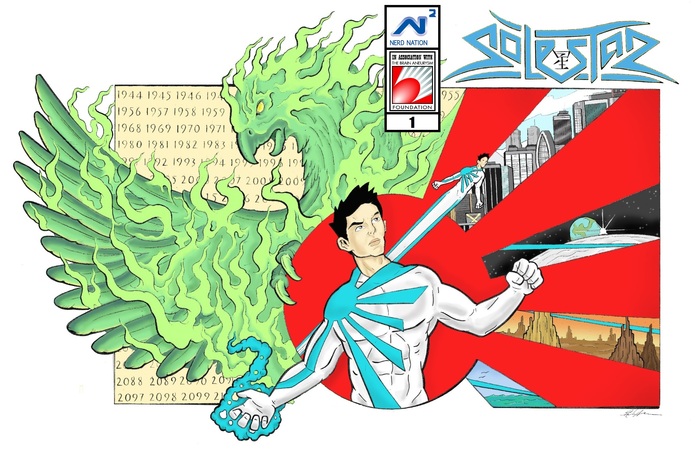
Solestar: Support The Greatest Comic Of 2013!


If there's one comic I'm most excited for in the coming year, it's Solestar. It's currently in the Kickstarter phase, but it deserves your attention and your support.

Writer/creator Siike Donnelly is a friend of mine, who I met first on Facebook and later in person at Golden Apple Comics in Los Angeles. Siike is a survivor of a brain aneurysm, a cerebral eruption that left him severely debilitated. Despite this, he's managed to relearn basic functions that most of us take for granted, such as walking and talking. He's also kept very active in the comics community, having written a few novels, doing a regular Nerd Nation podcast with Gene Hoyle , adopting an adorable stray dog named Echo, and even doing some real-life superheroing.

Usually discussions of people "overcoming" disability are incredibly patronizing, treating the disabled subject as an object of pity, and using the narrative to shame able-bodied/minded people in a way that has the opposite effect (i.e. "this person can't walk but has done so much with their life, therefore you should be able to do even better than this cripple"). They also tend to gloss over the actual challenges of disability by treating them like a super-villain that can be conquered. I'm trying to avoid that here, because I know that Siike struggles on a daily basis, and lives with a lot of pain. His many achievements do not lessen what I know he has to endure, but they do show a man who's become much stronger than most for his hardships. I believe the two defining characteristics of any person are their compassion and their willpower, both of which transcend any physical or cognitive difficulties. Siike has plenty of both.

And Solestar is the culmination of Siike's achievements, a story about a superhero's final days. It's a charity project for the Brain Aneurysm foundation, with all proceeds helping that organization and by extension the people who have suffered that insidious condition. It started as a pitch for a Superman story, but was later reworked into an original character's saga, and came out even stronger for it. And it's got artwork by over 60 people, including yours truly. (Siike gave me a script for a page that was written to my talents, so expect to see a lot of kitties doing kitty things). The artist roster has a wide array of men and women, all of them with unique abilities but each bringing their own voice to the project. There are even some big names in the mix, such as Bill Morrison of Bongo Comics, Sean "Cheeks" Galloway, and Ninja Turtles co-creator Kevin Eastman.

I've read part of the script for this and really want Solestar to be published. Solestar is co-titled "the Naive Project", due to the inherent naiveté of trying to change the world with art and comics. But it's only naive if we let it be naive. Please consider adding some funds to the Kickstarter to bring Siike's story to the entire world.

Here's the link once again.

Monday, October 29, 2012

Ruby Nation Chapter 3 Complete!

Finally, the first major arc of Ruby Nation is complete! The story that started with Chapter One exactly last year finished over the weekend, with two extra strips.

It's good to see things on the move; this story has been in the works since October 2011 if you're starting from Chapter One, August 2011 if you're counting the prologue, and AUGUST FRICKIN' 2008 if you count the original, primitive Ruby's World series. And there's still more planned! Much, much more!

As always, feedback is deeply appreciated.

Friday, March 16, 2012

Change Your Tights: Comics Without Frontiers on Superheroes and Drama


While it might not exactly be praise, it was flattering to see my earlier post about superhero fans fearing bad things happening to their favorite characters referenced by Miguel of Comics Without Frontiers. Miguel's blog is always great, thought-provoking reading, but this is an especially good piece.

The just of Miguel's post is a comparison between the drama of Mutant Massacre (one of my favorite comics of all time) and the drama of Fear Itself (the absolute height of mediocrity, without even the entertaining terribleness of Ultimates 3 or Cry for Justice). THere are many great points here, especially the observation that the Avengers never remove their costumes in Fear Itself. They're in their tights the whole mission, without showing any life outside of their battles and missions. You'd figure they'd at least change clothes to ward off the inevitable jock itch of sweaty spandex/leather/latex/armor.

I remember Mark Millar, when he was doing the Ultimates, commenting how he didn't like when Iron Man attended social functions in full armor. This is clear from the Ultimates series, where Tony (and the rest of the cast for that matter) spend as much time in their civvies doing normal-person things as they do on the battlefield in their action suits. Unfortunately, Millar fell victim to the no-life-outside-tights problem in Civil War, where most of the characters just hang around in their tights the whole story, and tense meetings have their drama undercut by the fact that characters are wearing their bird/bee/banana yellow wolverine costumes.

Sunday, March 28, 2010

War Machine 1 & 2 Graphic Novel Review: Military-Angst Complex


The Jist: When James " Rhodey " Rhodes was a lower-middle class black boy growing up in South Philidelphia, expectations for what he'd grow up to be were low. But as an adult, Rhodey's been a decorated US Military hero, the private pilot and bestest boyfriend of Tony Stark, a substitute Iron Man for years, and eventually his own armored hero as War Machine. Now, rebuilt with cybernetic parts after being blown up on a mission, he's a literal machine. And as his name suggests, he wants to declare war-- in this case, on every petty warmonger on the planet.

The Crew: Greg Pak ( writer ), Leonardo Manco ( artist Vol. 1 and issue 8 ), Wellington Alves, Mahmud A. Asrar, Allan Jefferson, R.B. Silva, and more( artists vol. 2 )

The Verdict: To start with, I want to say that War Machine's redesign for this series may be the least inspired costume design I've seen yet. Not the worst, mind you, but the least original and unique-- it's basically a greyscale Iron Man with an assload of weapons hanging off his back. Which is the most exact description you can give of War Machine's looks, but I would have liked to see a bit more thought than " Iron Man with attached 90's style armament porn ". He looks like a robotic version of Big Shot, the Punisher spoof from the Tick cartoon who carried a huge box of guns on his back and fired at anything until he ran out of bullets, in which he'd start sobbing about how his mother didn't love him. Re: A SPOOF character, not appropriate for a comic that takes itself seriously.

Of course, there are a lot of things I would have liked to see from this series that I didn't. That description of Leonardo Manco's War Machine design describes how I feel about the book in general-- it's not_that_bad as a whole, but it's definitely an underperformer, especcially given the quality of the creative team.

The central problem with this comic is that it's trying for a balance of real-world commentary and Marvel Universe exploration, and doing it in a very sloppy fashion. This is most obvious in the first trade, where Rhodey takes his cyborganized body to several Marvel Universe third-world military juntas to kill all the " real " bad guys. I'm not terribly opposed to seeing guys who torture and kill innocent civilians getting a bullet in the head, but these are a shamelessly superficial rendition of real-world despots. " Santo Marco " is not Columbia; it's the country Marvel writers use when they want to say something about Columbia ( or other South American nation torn apart by civil war ) but don't want to bother researching the complexities of real-world Columbian politics. So they bring in Santo Marco with its endless supply of two-bit genocidal thugs, and have Rhodey try to solve the country's problems by killing every person with a " kill number " ( something that his cyborg operating system attaches to everyone he sees, based on how many deaths they've willfully caused ).

If you're wondering how flying in to cap warlords in the head is a heroic action ( or even one with any long-term benefit; is the word " power vacuum " even in Rhodey's databanks? ), it's not. Greg Pak has called his approach to this series " Iron Man meets the Punisher ", but he's still playing Rhodey as a sympathetic character, one who is trying to do the right thing, even justifying it by talking about how his cybernetic brain won't let him even temporarily forget every murder and rape he's witnessed. Except that the Punisher isn't a sympathetic character, and especially since Garth Ennis got to him, he's been portrayed as a monster who happens to point his bullets at other monsters. Ennis' stories with the character, especially the ones where he was involved in real-world struggles ( most notably the Irish civil struggles of Ennis' own background ), never suggested that Frank's solution was the right one or even a right one.

Also worth noting about Ennis' real-world commentaries in the Punisher is that he didn't bring in other Marvel characters to make them-- his Frank Castle existed in an independent space, and whenever superheroes wandered in, they were embarrassingly ill-equipped to deal with it. Rhodey, on the other hand, is dealing with military juntas, tribal genocides, and frequent rapes in the Marvel Universe. In Santo Marco, one tribe uses a hacked Sentinel to genetically weed out and kill members of the other tribes. In Aquiria ( a.k.a Marvel's ersatz Middle Eastern theocracy ), he's fighting a private military contractor named " Eaglestar " using appropriated tech from the alien robot Ultimo. And in the opening strip from Marvel's website, Rhodey fights a Roxxon ( a.k.a. Marvel's ersatz corrupt oil conglomerate ) executive trying to eliminate Inuit tribes from ideal drilling space with cyborg bears. Pak wisely knows to have occasional asides from the characters where they recognize how absurd this shit is, but we're still getting world politics shoe-horned into the Marvel Universe in a manner that can't be taken seriously-- and when you have open acknowledgement that one of the female characters was beaten and raped by prison guards, following with a dramatic entrance by Ares, Greek God of War, seems horribly inappropriate.

If I seem overly upset with this comic, I have to admit that part of it is because I really like Jim Rhodes as a character, and think that everything I like about him is absent here. When Rhodey debuted as Tony Stark's best friend, he was a perfect and immediate fit because he offered an intrinsically human counterpart to Tony's ubermensch futurism; he was Wilson to Tony's House, down to the unfortunate enabling of Tony' addiction. As the substitute Iron Man and even as the ( unfortunately named ) War Machine, he was a likable character, because he was a hero as a soldier long before he met Tony, and wearing Iron Man armor was a right that he genuinely earned. His conflicts came from the fact that he was deeply uncomfortable with making the kinds of hard moral decisions that Tony has to make on a regular basis-- but all of that's absent here. He can't appear in regular human settings because he's a disfigured cyborg, but if you're wondering how much his condition lowers his quality of life ( and from the looks of it, his new body has all the " armament " of a Ken Doll ), we don't get any answers. All we know is that he's ugly, he's mad, and he's taking it out on everyone his databanks give a kill number. Quite the character reduction.

To the War Machine creative team's credit, the book improves dramatically with the second and final collection, when Rhodey sets his sights on Norman Osborn and his Dark Reign. It doesn't become great, mind you, but it develops the makings for an enjoyable mid-tier superhero book. The supporting cast is expanded on, bringing a " Team War Machine " together from various Iron Man supporting characters, including Rhodey's mother. The opposition is shifted from one-dimensional takes on real world monsters to Norman, and while it's hard to ever believe that the substitute Iron Man is going to be the one out of all the heroes to take Norman down, the guy's scenery-chewing brand of theatrical villainy is always entertaining. And while the art team shifts from Leonardo Manco to various fill-in pencillers and inkers, that actually works to the book's benefit. Manco's dark, gritty style was great when he was working with Andy Diggle on the urban fantasy Hellblazer, but his more realistic rendering only served to illuminate how ridiculous the stories were. The more conventional superhero art the later teams offered played well to the series' tone.

But as they said about J. Edgar Hoover's attentions to the economy-- too little, too late. The book's first arc was an obnoxious throwback to the worst parts of 1990's comics*, and readers picked up on that. It's luck that let War Machine last a whole year, and even with the character getting a big push thanks to Iron Man 2, it may be a while before Rhodey gets another solo series. On the plus side, Pak started the series by showing that Tony Stark had cloned Rhodey a fresh body, and ends it by transferring Rhodey's mind there. No longer a scowling, trigger-happy eunuch, War Machine is in a position where a new creative team can do something really good with him.

While there are some merits to the series and it picks up in the second half, overall it was a failed experiment that left a bad taste in my mouth, so I'll have to give it a Not Recommended.

Sunday, February 28, 2010

Kick-Ass Graphic Novel Review: Itching and Scratching


The Jist:Dave Lizewski is your typical American teenaged boy, from a very pessimistic perspective. His hobbies include reading comic books, playing video games, furtively masturbating, and pretending to be gay to attract girls. In order to give his life some meaning, he decides to take a page from his favorite comics and become a costumed vigilante in his New York City neighborhood. Since he has no super-powers, this doesn't go well for him-- but once footage of him goes online, it starts a trend...

The Crew:Mark Millar ( writer ), John Romita Jr. ( penciller ), Tom Palmer ( inker ), Dean White ( colorist )

The Details:Since Mark Millar's name is on the credits, it's very much a Mark Millar story. Fortunately, it's one of the best ones he's done.

Part of the reason I like Kick-Ass so much is because it's much more humanized than other Mark Millar stories. The fact that it's set in the real world instead of a superhero universe helps this, thought that isn't to say it's realistic-- this is a universe where a ten-year-old girl has the physical strength to slice through a grown man's skull with a katana with one swing, after all. It's about as realistic as an Itchy and Scratchy short on the Simpsons, but without the science-fiction genre tropes offering convenient deus ex machinas, the focus is more on the characters-- and they're well-realized, if thoroughly unlikable.

People have compared the original Peter Parker to J.D. Salinger's Catcher in the Rye, but Dave ( Kick-Ass ) is much more of a Holden Caulfield than Spidey-- which is to say that he's a whiny, selfish prick who comes across as pathetic to anyone over the age of 17. He's not a costumed vigilante because he wants to help people and stop crime; he never even had any contact with crime prior to putting on his costume. Kick-Ass is him taking his adolescent power fantasy way too far, putting himself at risk and worrying his widowed father needlessly. And it doesn't make him reform from the little weasel he is in his " civilian " identity, who will claim that he's slightly autistic to avoid getting a richly-deserved punch in the face*. At the same time, he does show rare displays of genuine courage and selflessness when caught up in the moment, running into a burning building to save a woman's " child "**. One thing that's common in Millar's comic is the notion that even good people can do horrible things; it's nice to see the reverse here.

The other characters, as a pleasant surprise, are equally interesting. Shortly after becoming Kick-Ass, Dave is joined by other costumed vigilantes-- and they're all as messed-up as him. They come across as messed-up in different ways, though, and offer a pretty diverse cast based on the notion of the adolescent power fantasy gone awry. Hit-Girl, the ten year old swordsmaster ( and the most surreal character in the comic ), doesn't know anything other than a power fantasy. Big Daddy, her costumed partner/father, enforces his power fantasies upon his daughter, and tries to convince himself that he's doing her a favor. And the villain is a perfect " dark reflection " of Dave-- and since Dave's not a nice guy to begin with, he's entertainingly pathetic in his deviance.

It's still very much a Mark Millar story, with profanity and violence and cynicism everywhere, but it's a very good one. John Romita Jr. deserves a lot of credit for that; his cartoony, sketchy style suits the story perfectly, and goes to exaggerate the violence and the humiliation instead of try to humanize it. Millar's more recent collaborators have tended to be hyper-detailed realists like Bryan Hitch and Steve McNiven, and the results for those stories haven't worked for me because they've just illuminated the ridiculousness. But Romita Jr. makes the teenagers look awkward and goofy, the costumes look ridiculous and home-made, and the violence look like-- well, Itchy and Scratchy. The result is a collaboration that won't change anyone's mind about Mark Millar, but it's one of his best, and strongly recommended for fans of dark humor.

* ( I had a real problem with this scene, because even though it was meant to show that Dave is a coward, it's going to be taken out of context. To too many people, Asperger's is a self-diagnosis people use to excuse their failings. In reality, the people who would actually diagnose themselves with it would either have the condition, or have enough mental problems that a label is appropriate, even if not one on the autism spectrum. Autism is NOT a label that makes life easy; often, it makes life even harder for the stigma. And lines like this make the problem worse, with the comedic tone obscuring the problem. )

** ( He saves the woman's cat, and is frustrated that he's risking his life for a cat. I'd personally be happier with saving a cat than a baby... )

Monday, September 28, 2009

Uncanny X-Men 515; What Cyclops Needs

As the X-Men emerge from the Dark Reign crossover Utopia, now as an isolationist nation with an almost entirely mutant population ( a good summary can be found in Newsarama's review here ), I continue to be baffled as to what writer Matt Fraction is trying to do with the X-Men's leadership. And this generally isn't a good sign for an ongoing superhero comic in the traditional model, when you have no idea if you're supposed to be reading the book ironically; is Scott Summers supposed to be a brave leader in charge of tough decisions, or is he a blundering fool?

The presentation of the character in the last issue makes him seem especially unclear. Mere moments after securing his borders, Cyclops is finally getting around to making the X-Men's island a place that can actually support a population. He's just getting to giving orders to set up food and water and power, and it's clear that the other X-Men are quickly losing faith in him. At the same time, he's acting as though he's in charge and knows what he's doing, requesting that the other mutants have faith in what he's doing. He even tells his old mentor Charles " You had a dream, I have a plan ". Except that he hasn't had a plan, he's just been stumbling around from crisis to crisis, barely breaking even.

We see that Scott Summers is breaking under the pressure of being the mutant messiah; his few quiet moments show the man completely wiped out, like he's a feather's tap away from a nervous breakdown. But he's still acting as though he's the strong, confident leader. He's making decisions, they're just really sloppy, spur-of-the-moment ones. It's like he went completely mad years ago and nobody told him.

Which makes sense given the character's backstory-- this is a man who constantly has to be careful of the death rays coming from his eyes, who was orphaned at a young age and taken in by a strange telepathic teacher who molded him into a soldier ( instead of a son ), who has been in love with one woman to the point of being with three alternate versions of her, and who recently betrayed that woman to give into a mistress ( Emma ) that appealed to his repressed desires. Except that the " Cyclops is too riddled with PTSD to be a credible leader " plot has been going on for years now. And the other X-Men haven't done jack or shit about it; they're clearly questioning his ability to save the mutant race, but they still follow him.

It's a tremendous elephant in the room, and it's going from being interesting to being maddeningly frustrating. I think at this point, the other X-Men should stage an intervention for the guy, all of his closest friends confronting him on just how damaged he is. Instead of Hank being catty ( okay, pun intended ) about Scott's poor choices, or even leaving the team in a hissy fit, how about Hank telling Scott about how he hasn't dealt with his problems? Instead of Logan slapping Scott in the face every time X-Force gets another insane murder mission, how about Logan invoking Jean Grey's name to remind Scott of how far he's fallen?

It'd certainly be better to see one of the series' most important characters build back up, instead of remaining broken and pretending otherwise.