Ruby Nation

Ruby Nation
Ruby Nation: The Webcomic
Showing posts with label rosechu. Show all posts

Friday, April 13, 2012

Chris-Chan Loses Virginity, Cosmic Order Somehow Survives


I've largely stopped covering Chris-Chan's antics on this blog, partly because he hasn't done much comic-related stuff in the past few years (with his saga now focused more on his real-life antics and the constant troll surveillance that lets us see all his failings), but mostly because I didn't want to give people the wrong idea about why he's so hilarious. I wanted to make clear that autism has no more to do with his unique lifestyle and personality than anything else, be it his sheltered upbringing, his inflated ego, the trolls manipulating him into getting wackier and wackier, or his general fear of change. Unfortunately, that doesn't seem to have any effect on people who still use autism as an insult against him, especially since Chris-Chan seems to determined to perpetuate his identity as a " high-functioning autistic " (and thus, shaming everyone on the autism spectrum).

Still, there is something that might be big news for those still following Chris-Chan's saga; he finally lost his virginity. Since most of his antics were motivated by his Love Quest, the desire to find a woman that fits his criteria (re: the body of a Barbie doll with the mind of his mother), this means that the great saga of his life up until now is over. No longer is he a virgin with rage. However, Chris-Chan clearly didn't get a girlfriend, but a call girl with an all-time record in low standards. The comments about her being in her early-20's, praising him for being "bigger" than her last hook-up, and that he won't tell everyone the details except his "Sweetheart-to-Be" (who I presume is Jackie Romy, the poor girl) suggests that it was a one-time hookup. And since he's Chris-Chan, a pock-marked obese balding thirty-year-old who dresses like a fifteen-year-old girl, I assume it had to involve a large financial gain on her part, out of the pocket of the State of Virginia.

All this proves is that virginity and maturity have no correlation.

Chris-Chan didn't "achieve" anything by having sex for the first time. He is no more of a man than he was before, by which I mean a horribly egocentric and depraved man-child. He's probably even less of a man, because he spent money that could've gone towards something useful on what he calls "China". There is no shame being an older virgin, but there is plenty of shame in talking about it constantly, harassing women at every corner, and becoming internet-famous with a largely plagiarized webcomic in order to get laid (the most misguided attempt at becoming desirable in human history).

Of course, there's also the possibility that he just made the whole thing up, making the whole situation even more pathetic. Even so, unless he goes down the prostitution route again (or for the first time), Chris-Chan's only sexual outlet will remain the horrible BDSM marriage of Sonichu and Rosechu.

Saturday, October 30, 2010

Sonichu Episode 9 Critical Review: Dark Graduation


Psychological Hang-Ups The Way You Like Them Here

The Chris-Chan/Sarah Hammer/Wes Iseli love triangle continues this issue, as Christian Weston Chandler continues to bend time and space towards a favorable reality. And in doing so, he introduces the arch-villain of Sonichu, Count Graduon, whose name is a reference to Christian Weston Chandler's high school graduation.

The fact that a story about one man's refusal to grow up and take responsibility for his life would have a villain named after a rite of passage into an adulthood is stupefyingly appropriate.

Count Graduon is represented as a purple staff containing an evil spirit-- the Cherokee and Wasabi clans apparently teamed up to banish him to an inanimate prison. While the symbolism inserted by Chandler doesn't go further than the name, the meaning attached to Graduon runs much deeper, like everything else about Sonichu. Graduon is a perfect representation of the personal and cosmic forces that Chandler believes oppose him; while he has a name, he does not have a body. He is a force that is attached to an inanimate object. But he directs the efforts against Chandler, coordinating efforts of the Jerkops, Mary Lee Walsh, and the other " trolls " who deny Chandler immediate pleasure and ask him to do things that might cause pain.

The symbolism is even more telling ( and horrifying ) due to what Chandler attributes to his high school graduation. He sees it as the turning point in his life, the point where things started to go downhill. Chandler has said that he expected to receive an award for his art at the ceremony, and when he didn't, he started crying. It is certainly understandable that a young person, especially a socially awkward one who'd been coddled by his parents due to his " special needs " labeling**, would become visibly upset if they did not receive the recognition they felt due. However, the disappointments in our life are the moments where we are given opportunity to show our true strength. At that moment, Chandler could have,

A.) Done what every person ( autistic or not ) has to do, intellectually accept that life isn't fair, and try to make the best of his situation, or

B.) Create a comic strip universe inhabited by childhood heroes where he is treated like the very special flower he wants to believe he is, and refuse to leave there.

Guess which one he did? Instead of pushing back against the circumstances of graduation, Chandler DID bottle them up in a cartoon super-villain, and constrict their overt activities to sending giant golem monsters after CWCVille. Except that adulthood is too big a concept to be adequately summarized as a single bad guy, shaped like a glowing purple dildo***.

But that's the unwitting central conflict of Sonichu-- Chandler tries to create a paradise where adult problems become manageable villains, but only creates more problems for himself as he tries to simplify/ignore his challenges. The triangle between Chris-Chan, Sarah Hammer, and Wes Iseli is another example; Sarah dumps Wes for attacking her " best friend ", and teams up with Chris-Chan to fight Graduon's monster. But Wes is still around, acting mopey and hopeless until Chris tells him to snap out of it ( because Chris-Chan's ephemeral infatuations are apparently a worse loss than Wes actually being dumped by a woman with whom he was in an adult relationship ). And after the battle, when the two take a taxi home****, Chris-Chan makes a point of " being there " for Sarah, listening to her talk and playing the best friend ( while obviously waiting for her to jump his bones ) only to find that she still regards him as nothing more than a friend. Because being honest about his feelings would be a risk for Chris-Chan, and CWCVille is a place which is supposed to be free of risks-- even if that keeps Chris-Chan from the female contact he so badly wants.

The sad part is that is that Chandler ends the chapter with a tribute to the real world Sarah Hammer, his childhood friend. Uncharacteristically, he's actually acknowledging the good times they had together as kids, and mentioning specific instances that he fondly remembered. This is emotion that evokes a genuine feeling of loss, untainted the sexual frustration that warps everything else in Sonichu. It's also a reminder that underneath his outer shell of childhood trappings and adolescent libido, there are redeeming qualities that remain in Christian Weston Chandler. Of course, every time they surface, he immediately buries them under more outlandish behavior, and never learns any lessons.

* Who I'll get to in the review of the next sub-episode.

** There isn't a hell painful enough for Bob and Barbara Chandler, whose enabling of Chris catastrophically ruined a child who had as much chance of success as any. It's known that Chandler's mother buys his clothes for him, and speculated that she picks those ridiculous clown colors so that he'll appear more " special " and thus won't face adult repercussions for his actions. It's also known that Chandler's father encourages him to remain on welfare for disability, despite a lack of any known impairments that couldn't be corrected by a tall glass of Grow The Fuck Up. Chandler at least garners pity; these people are simply reprehensible.

*** This is one of many things that makes Chandler's homophobia doubly hilarious.

**** In a badly drawn taxi so lopsided that it could never roll in a straight line. Like Greg Land, Chandler's drawings liberally borrow/plagiarize from other sources; unlike Greg Land, he can't even copy his references accurately.

Thursday, October 21, 2010

Sonichu Episodes 4-6 Review: The Black Sonichu Saga And The Vestigial Remnants of Sonic


Read Here

I'm reviewing " the Black Sonichu Saga " as one lump installment because, frankly, there's not much to say here. This is still the point where Chris-Chan's Caligula-like reign over CWCVille doesn't totally dominate Sonichu, and as such, the stories can be read as just another awful fanfic crossover, instead of a surreal documentation of Christian Weston Chandler's ongoing nervous breakdown. Everything here is plagiarized; Black Sonichu is an inferior copy of Shadow the Hedgehog, himself a transparently grim-and-gritty copy of Sonic the Hedgehog. His construction was a joint effort by the Pokemon villain Giovanni ( leader of Team Rocket ), and Sonic's arch-nemesis Dr. Robotnik. His black shade is explained as accidental, as his creator Bill the Scientist spilled Cherry Cola over the Sonichu DNA.*

So yeah, there's no gripping narrative here, intentional or not. The swindled Sonic and Pokemon villains make an evil Sonichu clone, said evil Sonichu clone kidnaps Rosechu, Sonichu and Sonic the Hedgehog ( also swindled from his copyrighted environment ) team up to fight Black Sonichu and Metal Sonichu ( a derivative of Metal Sonic, another evil Sonic doppelganger ). The day is saved, with Black Sonichu defeated, Metal Sonichu retreating to the moon, and Rosechu getting to have girl talk with Amy Rose.

Christian Weston Chandler has repeatedly tried to counter accusations of plagiarism by saying that Sonichu is a parody. But this isn't making fun of Sonic or Pokemon, or even using them to try and make some sort of point. This is just a poorly written, poorly drawn regurgitation of those series' formulas. The worst fact is that even though both Sonic and Pokemon have comic adaptations, Chandler chose to plagiarize from the animated medias, the games and the cartoons. He has no grasp of sequential storytelling; he uses massive text walls to dump information upon his readers, and those salvos of Comic Sans MS usually don't even have full figures attached-- he cheats and has the speaker be a severed head floating in white space. He takes on the Pokemon style of having characters scream the names of their moves while they attack, but instead of utilizing the page space for dramatic angles, Chandler crams the action into little panels the size and ( poorly approximated ) shape of a Game Boy screen. Presumably he doesn't use a ruler, or even use the line tool in Photoshop to create borders.

The only thematic value the " Black Sonichu Saga " has is that Black Sonichu becomes a major character later on, and there's some interest in having the original Sonic the Hedgehog meet his his hideous half-Pokemon counterpart. To Chandler's credit, Sonichu holds up okay as a character when compared to his inspiration. Of course, given how Sonic's games have been infected by superfluous and uninspired supporting characters over the past decade or so, that's not a compliment to Chandler so much as an insult to Sega. Were he divorced from Chandler's problems, Sonichu would fit right in with Amy Rose, Shadow, Big the Cat, Silver the Hedgehog, Rouge the Bat, Cream the Rabbit, and any number of other annoying spin-offs.

Sunday, October 17, 2010

Sonichu Episode 2 Critical Review: The OTP Syndrome, Electric Hedgehog Style


Sonichu Episode 2 continues to set up the world of CWCVille, and while it's still relatively benign in its content, it predicts the relationship dynamics that would help make Sonichu an ironic favorite. What's unfortunate is that the " chemistry " between Sonichu and Rosechu is NOT a problem exclusive to Christian Weston Chandler's personal problems.

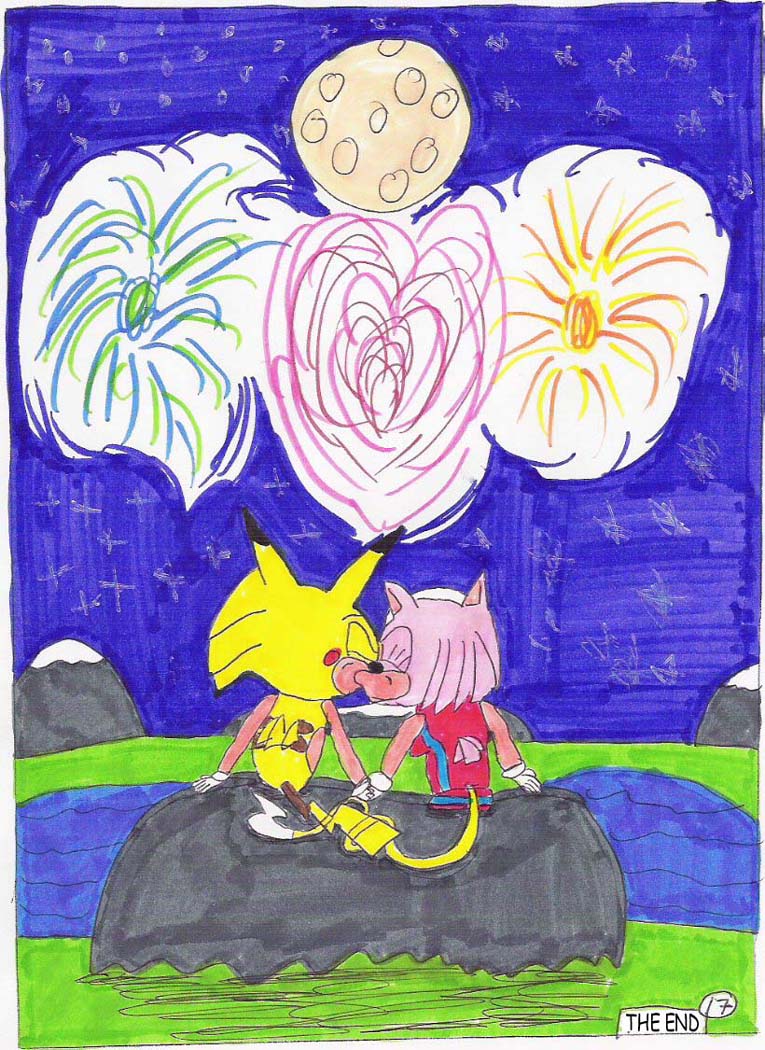
Like most Sonichu stories, the plot of episode 2 is about as deep as a wet piece of paper. While looking for food for his new, larger body, Sonichu realizes that he's lonely and needs a mate. At that exact moment, Rosechu walks by and Sonichu is immediately smitten. Later, Rosechu is talking with her Pokemon trainer Kel about how she needs a mate; they are conveniently interrupted by Sonichu arriving at the door. Not in the least bit perturbed by Sonichu having followed her home, Rosechu invites Sonichu in for dinner. A few days later, Sonichu and Rosechu look at the night sky together, exchange some truly awkward confessions of love, and kiss.

There is no conflict in Sonichu and Rosechu's relationship, even when they first meet. Their personalities complement each other and their goals are identical. The entire basis for the coupling is because Chandler considers them the One True Pairing. After all, Chandler is as much fan as creator, so if he wants to live vicariously through Sonichu, he'll make sure that the character has what Chandler considers an ideal relationship-- one based on " true love " and not any shared interests or experience.

Almost everything in Sonichu is lifted from other sources, and Rosechu is no different-- she is based on Amy Rose, the pink female hedgehog from the Sonic series. However, while Amy is smitten with Sonic, Sonic has never returned Amy's affections-- in canon, at least. Their dynamic is very much like a gender-flipped Pepe Le Pew cartoon, and Sonic's only kindness towards Amy is being willing to save her life when her stalkerish activities put her in danger. In other words, the canon Sonic/Amy dynamic is a relationship meant for comedy. But Chandler is just one of several fans who see an actual relationship between the two, with Sonic eventually returning the affections. In Chandler's " adaptation ", the variants of Sonic and Amy do not have any dramatic tension interfering with their romance. That they have romance is enough.

Any fandom will have readers who view the stories in context of the relationships, and wether or not they fit the reader's individual tastes a la a bingo game. They need not even have any basis in canon, and often don't; Sonic has the aforementioned Sonic/Amy, Avatar: The Last Airbender has Kitara/Zuko*, and Metal Gear Solid has Snake/Otacon**. The most egregious example may be Harry Potter, where Harry/Hermione 'shippers even threatened to boycott the books if Harry ended up with Ginny. It's worth noting that regardless of the pairings, NONE OF THESE SERIES ARE BASED EXCLUSIVELY ON ROMANCE. The interest in shipping comes from the personal baggage the fans collectively bring to the forums.

This is an odd phenomenon, and unfortunately, it's one that threatens to derail drama and creativity-- instead of reading stories because they're curious where the characters will end up, fans have strong preconceived notions of what they want to see, and won't accept anything else. It doesn't matter for Chandler that nobody cares about Sonichu and Rosechu's true love but him, because this world is his escapist paradise. Unfortunately, the phenomenon isn't restricted to the mass of neuroses and perversions that is Christian Weston Chandler-- just take a glance at the majority of fan fiction.***

One of the most interesting relationships that I've read in a mainstream comic is the X-Men pairing of Scott Summers and Emma Frost. This is because it's an active deconstruction of the nature of the OTP. While Scott and Jean Grey were the official pairing of the X-Men****, Grant Morrison had Scott come to realize that after all the hardship he'd been through in his life, he didn't want a perfect relationship. He found himself more comfortable with tempestuous ex-villainess Emma Frost, whose sins made her more relatable. The relationship began with an affair and was cemented with a kiss over Jean Grey's corpse, but so what? These are mutant pariahs whose profession has a high mortality rate. They aren't part of the culture that sets the terms for what acceptable love is, they aren't necessarily going to be drawn to conventional notions of relationships, and they're going to seize any chance at happiness they can get. Of course, this is antithetical to fandom logic, but it allows for more story options.

* Of course, because Aang/Kitara was an Official Coupling done with all the subtlety of a sledgehammer and logic of a fanfic parody, I can understand this.
** And Hideo Kojima has all but made this canon, since MGS4 ends with Snake living out his final days with Otacon and their adopted daughter Sunny. I can't even call Metal Gear a homoerotic series anymore, because between this, Ocelot being a secret hero motivated by his gay love for Big Boss, and the Big Boss/Miller slashfic missions in Peace Walker, Kojima is basically pre-empting the fandom with homosexual pairings.
*** There are many great fan fics, mind you. I want to make clear that just because the medium is used by terrible writers doesn't mean it has exclusively terrible writers. Some are even more inventive than the canon creators.
**** I often think of the main 'ship in my own comic as a reconstruction of the Scott/Jean dynamic, with genuine devotion and love being constantly challenged by the fact that Ruby and Jiro are two outcasts with troubled histories and no other real options.

Saturday, October 16, 2010

Sonichu Episode 1 Critical Review: A Postmodern Masterpiece Begins


I've discussed the fascinatingly pathetic phenomenon of Sonichu before, in context of the hilarious parody Asperchu. For something so utterly terrible, Christian Weston Chandler's much-derided webcomic has drawn more interest than many genuinely good stories. Most likely this is because Chandler* is so ready and unwittingly willing to embarrass himself, and the internet is quick to seize upon the bizarre and novel. But I think there's something to Sonichu that's more compelling than simply being a bad comic by a truly disturbing individual.**

Academia enjoys its alternate readings of works, and Sonichu need not be any different. Reading it as Chandler intended, as a children's adventure comic, means getting a badly written, badly drawn expression of an author's neuroses for an audience that could care less. But reading Sonichu as a parody ( and not " parody " in the way Chandler intends, as an excuse to swindle copyrighted characters ) shows a genuinely interesting psychodrama. Sonichu is an unintentionally brilliant commentary on genre fiction and its fans, and how people use stories and characters to cope with a complex world. Everybody does this, but Chandler's excesses illuminate fandom in a less-than-flattering light.

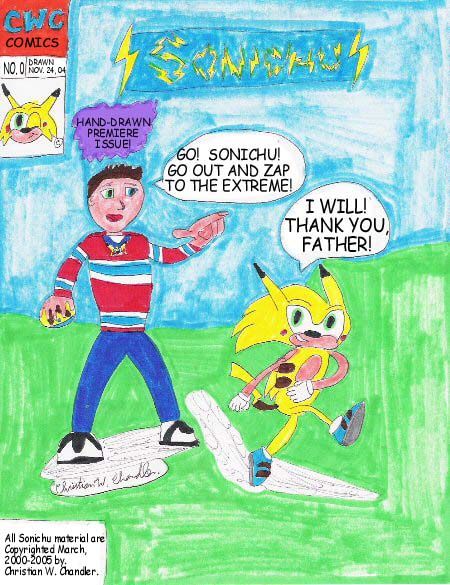
Even from the first Sonichu story, we see that the " electrical hedgehog Pokemon " is not the star of his strip. The very cover of " Issue Zero " has comic Chris-Chan telling Sonichu to " Zap out to the Extreme ", and Sonichu thanking his " father " for the instruction. The dynamic between Chris-Chan and Sonichu is meant to be father and son, but it goes without saying that biology would not allow a virgin birth of a cartoon animal to a human male. Instead, Sonichu serves as Chandler's idealized avatar-- if the Chris-Chan who appears in the comic is meant to represent Chandler's " dogged nice guy " conception of himself, then Sonichu is who Chandler wants to be, the children's hero who thrives within a never-maturing status quo.

Not only does Chris-Chan hog the cover, but he serves as the narrator for the debut story. He frames the story as its " intrusive creator ", telling us how the unwitting influence of Super Sonic transformed a Pikachu into Sonichu, and a Raichu into his female counterpart and girlfriend Rosechu. The Pikachu is literally just sitting there, about to be eaten by a monster, when he is transformed into Sonichu. After the transformation, he immediately fights and defeats the monster. He's cheered by the public, is impressed by his newfound power and ability to speak, and does not hesitate to rename himself " Sonichu ". Chris-Chan starts and ends this sequence, reminding us that Sonichu is his creation-- Chandler not only lives vicariously through Sonichu, but feeds off of the hypothetical adulation Sonichu receives, hoping that there will be a trickle-down fandom from his creation to him. He's creator and fan in one.

The episode concludes with a " Who's Who " list, involving Sonichu, Rosechu, the " Chaotic Combo " of other recolored hedgehog characters, the villains ( based on Chandler's real-life antagonists ), and three mysterious new Sonichus. There's not much to say about this as writing, since it's clearly telling and not showing. But it does reinforce the idea that Sonichu is about a status quo-- and in later chapters, that status quo finds itself under threat and has to resist.

More to Come..

* I'm referring to the real world Christian Weston Chandler by his last name, while the in-comic CWC will be called " Chris-Chan ".
** And this is NOT because of his autism. While Chandler may use his autism diagnosis as an attempt to excuse his problems, too many people bash him in context of his condition. Autism does not make people do any of the things Chandler has done, and calling him things like " that autistic fuck " or " autistic man-child " in the comments will not be tolerated.