
Showing posts with label webcomics. Show all posts
Showing posts with label webcomics. Show all posts
Thursday, December 27, 2012
Possibly the Greatest Image in Internet History


Monday, May 28, 2012
Ruby Nation: Chapter 2 Talkback!

1.) How do you feel about Ruby Nation thus far?
2.) How do you feel about the ending of Chapter 2?
3.) How do you feel about the existence of the Ruby Nation Wiki/About Page?
4.) Do you have a favorite character so far? Why?
5.) Do you have a least favorite character? Why?
6.) What would you like to see in the coming strips?
Thank you in advance. You can email me any further comments and questions, as well.
Thursday, May 10, 2012
I Can Has New Comix: Poet Kitties!

An attempt to subvert the pidgin English of LOLCats and give cats the kind of language they feel they deserve, Poet Kitties will update with new strips at least twice a week, on Mondays and Tuesdays. You
can see the site HERE.
And for fans of Ruby Nation; well, all three of you should be happy to know that this side project won't impede that story's progress.
Monday, April 9, 2012
Autism ACCEPTANCE Month: Fuck Your Awareness

Since it's Autism Acceptance Month (a rewording of Autism Awareness Month, from neurodiversity proponents who want to take the month back), I wanted to explain what Autism Acceptance means to me, and what I hope for the future of me and other autistics I know and love.
Autism Awareness is a term used in the same vein as Breast Cancer Awareness, Kony 2012, and other "slactivist" campaigns. It means being involved only so far as sharing a link on Facebook or buying a shirt. It means endorsing a superficial understanding of the issue, but not actually trying to understand what it means (especially for the people directly involved). It may be better than being completely oblivious, but it's not enough. Where "Autism Awareness" is concerned, it's especially troubling because it speaks of the disability in the same vein as a terminal illness. The autistic person then is reduced to an object to be pitied, with the condition treated as a bogeyman that captures the "real" person underneath, rather than a factor that influences their larger individual personality.
Autism Acceptance means actually understanding that autistic people, and for that matter other people who aren't physically or mentally normal (re: everyone), are simultaneously influenced by their conditions but not defined by them. It means looking at such differences as a part of life that can't be erased, no matter how much money we pour into medical research for a "cure". It means trying to understand and negotiate with people who have different behaviors, and see what they can contribute to society on their terms.
In a world of Autism Acceptance, people on the spectrum will be able to find work based on their talents, not their disabilities. Autistic celebrities will not just be people that promote themselves for "overcoming" autism, but people with actual occupations as well. The world of Autism Acceptance will be a world where we have openly autistic doctors, teachers, scientists, politicians, athletes, journalists, artists, CARTOONISTS, and others. As Ari Ne'eman (IIRC) puts it, we'll have fewer professional autistics, and more autistic professionals.
In a world of Autism Acceptance, neurological disabilities will not be treated as an inherent stigma. The R word will be treated as hate speech, just like the N word or the other F word. "Don't be so autistic" won't be treated as a colloquial insult, and autistic people who behave like total assholes won't reflect on everyone on the spectrum. The likes of Christian Weston Chandler will be treated as a reflection of nothing but internet weirdos.
In a world of Autism Acceptance, neuro-atypical characters will abound on television and literature and be acknowledged as neuro-atypical. They will come in all shapes and sizes, not just the stereotypes of the inspirationally disadvantaged, the special needs morality pet for the martyr parents, or the autistic sociopath. We'll no longer need to make do with diagnosing fictional characters like Reed Richards or Hal "Otacon" Emmerich who probably fit the criteria.
In a world of Autism Acceptance, discussion of autistic peoples' handicaps will be focused on practical accommodation, not fanciful cures. Discussions about the "autism epidemic" and its causes will be dismissed, inconsequential compared to the people here right now. Instead of talking about sweeping, badly-researched gestures like gluten-free diets or chelation therapy, treatments will try to stick to the individual and how to treat their specific symptoms, not the "bogeyman" of autism.
In a world of Autism Acceptance, no moral ambiguity will be put into debates over news stories like the murder of George Hodgins by his mother. The focus will be on the victim, whose life was tragically cut short by the person he should've been able to trust the most. There will be no sympathy given to the mother who murdered him, because no matter what difficulties she had raising a special needs child, nothing can excuse taking an innocent life. The caregivers who murder their charges (and this is way too common) will be treated as that-- murderers, the likes of whom can and will burn in hell.
Finally, in a world of Autism Acceptance, the kids I work with at my residental facility day job will see all of these things happen, and be able to navigate a world even slightly less harsh and narrow-minded.
Friday, February 3, 2012
Pipe Dope by Jon D Witmer, The Greatest Webcomic of 2011!

I am always looking for stories that move me to tears, even though I'm bitter enough that it rarely happens. Still, there have been works across multiple mediums that were powerful, tragic, and heartwarming enough to trigger the waterworks. For me this is particularly true for comics, where I teared up at the ending to Preacher, the World's Most Wanted arc of Matt Fraction's Invincible Iron Man run with Tony Stark's Algernon-style degeneration, the heartwarming final issue of Planetary, and now, Pipe Dope.
A recently concluded blog-comic by Jon D. Witmer, Pipe Dope is a formally innovative and emotionally profound memoir about the author's father. The comic's conclusion, like all biographies, is forgone, as David Witmer tragically died from lung cancer when his son was still a teenager. What is not forgone is the way Jon Witmer memorializes his father, with a serial comic that takes full advantage of the medium to show us just what David meant to him.
The strip is formatted as a blog, with each entry featuring a Far Side-style single panel. Each entry encapsulates a key moment in David Witmer's life, and its impact on Jon. The content is as varied as the man himself; some strips show us David's own childhood, and the lengths he took to court Jon's mother. Others show Jon's childhood memories of David, the lessons David taught him from the practical (where the title comes from) to the bizarrely profound (the axiom, "never kiss a girl who smokes"). The little mannerisms and routines of David's life are captured, as well as the struggles (particularly the haunting images of David's chemotherapy, such as a head-first view of a CT Scan machine). Most interesting, however, is the AAF-- characters who best encapsulate the influence and importance of comics upon this particular narrative.
The AAF, or Animal Air Force, are the adventures of David's stuffed animals, which were passed down to and continued by Jon. Characters like Genroo the stuffed dog and Blue Peep the stuffed chick were sent on wacky imaginary escapades that portended the future of both Witmers, all the while bickering in broken English a la characters from Pogo. The AAF went on epic air and sea missions that inspired David's later career in the Navy, showing how play, fiction, and imagination helped a child formulate a great path as an adult. They later resurfaced in young Jon's life, their stories told from one Witmer to another, and even gave a surprisingly moving wake to the departed David. The actual AAF stuffed animals were on Jon's desk during the creation of the comic, as a reminder of the shared legacy between father and son.
Stuffed animal adventures may seem like a silly way to interconnect a narrative about a man dying of cancer, but the trappings are less important than what they symbolized for both men, and how they formed a permanent and inspiring legacy. Pipe Dope is a superbly written and drawn example of the form, and one of the most moving comics I've yet read. Do yourself a favor and read it Here.
Sunday, August 28, 2011
Ruby Nation: New Webcomic, Same Great Continuity!
After several moons' absence, the story that began in Ruby's World finally returns. Ruby Nation picks up three months after the end of World, with Ruby and her team actively working to build their super-soldier refugee state while having to maintain their morals in light of the circumstances (and what they'll be forced to do)
If you didn't read Ruby's World, you can do so any time you like, but you don't have to. The purpose of this "reboot" was as a jumping-on point for new readers. The prologue hits the ground running, but all the details should become apparent in the coming weeks for those just coming to the party. As a longtime reader of superhero comics, I'm aware both of the richness that an established history can bring, and the downsides that come with its misuse. When the history becomes too prominent, it keeps new readers from being able to understand what they're seeing. And even if the continuity is explained, it's like being told about a great story secondhand, rather than actually seeing the story. I'd rather not subject people to my personal nostalgia (except for the Halloween cosplay sketches).
There is a middle ground between having a past and being enslaved by it, however. Many of the greatest series I've read/seen/played have clearly defined backstories. The X-Men didn't become popular until the International team debuted in the 70's, keeping parts of the original iteration but forging a new path. Buffy, the greatest fantasy show ever, was based on the backstory of an utterly terrible movie attempt. And Metal Gear Solid's postmodern mastery has its roots in the plain old Metal Gear games for the MSX, before the series had extensive cutscenes, horribly tragic fates, and homoerotic subtext bordering on actual text. Wether intentional or not, it seems like all these series had a rough start that nevertheless allowed them to grow and change into something great. Stories, as well as their storytellers, have to learn by doing.
TLDR; Ruby Nation will be to Ruby's World what Metal Gear Solid is to MSX Metal Gear.
Anyway, I'll be delivering more of these musings as the series progresses, as the simple act of creating a piece of art and putting it out there is an act of ego, so I might as well take it further and show you my process as well.
If you didn't read Ruby's World, you can do so any time you like, but you don't have to. The purpose of this "reboot" was as a jumping-on point for new readers. The prologue hits the ground running, but all the details should become apparent in the coming weeks for those just coming to the party. As a longtime reader of superhero comics, I'm aware both of the richness that an established history can bring, and the downsides that come with its misuse. When the history becomes too prominent, it keeps new readers from being able to understand what they're seeing. And even if the continuity is explained, it's like being told about a great story secondhand, rather than actually seeing the story. I'd rather not subject people to my personal nostalgia (except for the Halloween cosplay sketches).
There is a middle ground between having a past and being enslaved by it, however. Many of the greatest series I've read/seen/played have clearly defined backstories. The X-Men didn't become popular until the International team debuted in the 70's, keeping parts of the original iteration but forging a new path. Buffy, the greatest fantasy show ever, was based on the backstory of an utterly terrible movie attempt. And Metal Gear Solid's postmodern mastery has its roots in the plain old Metal Gear games for the MSX, before the series had extensive cutscenes, horribly tragic fates, and homoerotic subtext bordering on actual text. Wether intentional or not, it seems like all these series had a rough start that nevertheless allowed them to grow and change into something great. Stories, as well as their storytellers, have to learn by doing.
TLDR; Ruby Nation will be to Ruby's World what Metal Gear Solid is to MSX Metal Gear.
Anyway, I'll be delivering more of these musings as the series progresses, as the simple act of creating a piece of art and putting it out there is an act of ego, so I might as well take it further and show you my process as well.
Monday, August 1, 2011
Cripz the Webcomic: A Bullet in the Spine of Bigotry

Cripz, a webcomic written by Jeff Preston and illustrated by Clara Madrenas, is to disability rights what the Boondocks was to issues of race-- a wonderful comic strip that not only takes a stand against the negative stereotypes, but takes them into the basement, chains them to a plastic chair, and works them over with power tools. It's not subtle about the way it addresses ableist inequities, and probably not for the easily offended. But some points need to be made with sledgehammer force, and Cripz obliges with the might of Mjolnir's uru head.
The comic follows two high school boys in wheelchairs; Rhett, a sensitive hyper-intellectual whose idealistic discourses tend to fly straight over peoples' heads, and Griff, a hyper-masculine rap enthusiast who milks his disabled status for all it's worth. They're eventually joined by a third character, an able-bodied girl named Katie who likes Rhett (though probably not to the same extent that he likes her) but finds Griff an obnoxious tool and doesn't take his handicap as an excuse. Griff is easily the funniest of the three, and flies in the face of the "inspirationally disadvantaged" stereotype. His innocuous look belies a wildly manipulative and borderline sociopathic mind, and were he not pitied for his disability, he would likely end up in juvenile hall. At times he seems like a male, paralyzed Sarah Silverman.
The art style seems very crude, as it has the characters as sketches on lined notebook paper pasted onto colored backgrounds. However, it works for the strip. It helps establish the otherness of the protagonists, and draws immediate attention to them. This is a talking-heads social commentary strip, so the cinematographic perspective derring-do of adventure strips isn't necessary. It works especially well in the "At the Movies" strips, where Rhett and Griff imagine themselves in movies that typically eschew the handicapped. (The Captain America spoof is especially funny, as Griff imagines that the super-soldier serum leaves Steve Rogers permanently crippled by accident, but allows him to stay out of the draft, so he can fuck all the women at home while the other men go overseas to die in battle. Yes, really.)
If I had a complaint about the strip, it would be the somewhat narrow way disability is perceived. Preston and Madrenas address the issues faced by the wheelchair-bound first and foremost, and they do touch on blindness and deafness. However, mental disabilities are not addressed, despite presenting very similar challenges. This is especially bothersome when the school janitor appears, who embodies most of the delusional deranged veteran cliches. It could easily be extrapolated that he qualifies as disabled via PTSD, yet he remains a subject for the main characters to mock. This is disappointing when you consider that Rhett and Griff are just as limited as him, even if it's their bodies and not their minds that give them the societal stigma.
But I hope that the creators will address this, because if they do, this will be one of the greatest humor comic strips ever made. Early on it captured my heart with its parody of Glee, specifically the horrid stereotype Artie's dreams of walking. Rhett's fantasy is not the ability to walk, but the possession of a pimped-out multi-story wheelchair stacked with hot chicks. Given my somewhat partisan opinion about Glee (i.e. that it's a horrible show that sits at the peak of self-aggrandizing Hollywood leftism, preaching equality but never actually taking any risks with its Benneton ad stereotypes), I immediately bookmarked the comic.
You can read all of Cripz Here.
Thursday, June 23, 2011
TVTropes Gives Me Bigoted Backhanded 'Praise'
Every day I go to TV Tropes, and every day I look to see if there've been edits to the Ruby's World page. Usually there aren't, so I was excited to see that somebody had catalogued some new tropes in relation to my comic. However, some of the the tropes added were offensive, and not for their dismissal of my talents. I quote directly from the YMMV section;
"Better Than It Sounds: Anybody who's trolled around the internet for long enough is no stranger to mentally handicapped people doing stories revolving around their aspie fixations with art that looks like it was done by somebody in grade school. That such a thing could be well-written, even thought-provoking and emotionally moving, is something else altogether."
Putting aside the insult towards my art (which I don't think is fair, because unlike Chandler I don't plagiarize and actively work to improve my draughtsmanship and my visual repertoire), I find the comparison between me and Christian Weston Chandler to be appalling PERIOD. This is the webcomics equivalent of Godwin's Law. And I've been compared to the being of unfathomable patheticness because A.) I am also on the autism spectrum and B.) also do a webcomic. The praise at the end is a backhanded compliment, because it suggests that I shouldn't be able to write anything good because of my apparent mental handicaps.
Given how much of Ruby's World is about the value of the individual experience due to the way the individual uses the hand life deals them (no matter how crappy), and given the explicit anti-ableist references I've made in the comic, it seems the person who added that trope didn't glean anything from my work. Apparently the value to my comic is in spite of my neurology, and is not informed by it.
Jesus, people, if you want to say "Your Webcomic Is Bad and You Should Feel Bad" to me, say it. Don't insult everyone on the spectrum in doing so, and FOR GOD'S SAKES DON'T USE CHRIS-CHAN AS YOUR STEREOTYPE OF AUTISM.
"Better Than It Sounds: Anybody who's trolled around the internet for long enough is no stranger to mentally handicapped people doing stories revolving around their aspie fixations with art that looks like it was done by somebody in grade school. That such a thing could be well-written, even thought-provoking and emotionally moving, is something else altogether."
Putting aside the insult towards my art (which I don't think is fair, because unlike Chandler I don't plagiarize and actively work to improve my draughtsmanship and my visual repertoire), I find the comparison between me and Christian Weston Chandler to be appalling PERIOD. This is the webcomics equivalent of Godwin's Law. And I've been compared to the being of unfathomable patheticness because A.) I am also on the autism spectrum and B.) also do a webcomic. The praise at the end is a backhanded compliment, because it suggests that I shouldn't be able to write anything good because of my apparent mental handicaps.
Given how much of Ruby's World is about the value of the individual experience due to the way the individual uses the hand life deals them (no matter how crappy), and given the explicit anti-ableist references I've made in the comic, it seems the person who added that trope didn't glean anything from my work. Apparently the value to my comic is in spite of my neurology, and is not informed by it.
Jesus, people, if you want to say "Your Webcomic Is Bad and You Should Feel Bad" to me, say it. Don't insult everyone on the spectrum in doing so, and FOR GOD'S SAKES DON'T USE CHRIS-CHAN AS YOUR STEREOTYPE OF AUTISM.
Sunday, May 8, 2011
You Will Believe A Nine-Foot Cyberneticized Irish-Jewish Girl Can Fly

By directing her generated energy downward, Ruby can propel herself into the air, sort of like a techno-organic counterpart to Iron Man's boot jets. She hasn't done this in canon until now, but I've been waiting to show this moment for a long time, and have even teased it in some of the images in my gallery. it.
I started out simply intending for Ruby to be big and strong, but that wouldn't have been enough power to make her the game-changer on the world stage. Hence the perpetual motion abilities lend themselves to a very diverse power set. That, and I think the pink energy is a cool visual.
In conclusion, I'm not just pulling new powers for the protagonist out of my ass.
Sunday, May 1, 2011
Sonichu Episode 15 Critical Review Part Two: Compulsory Monogamy

Let's Do The Time Warp Again
As if the Family Guy "Skitch" wasn't terrible enough, here we have Christian Weston Chandler's adventure through the "glory days" of high school, joined by his "sweet friend" Megan and his plagiarism prototype Bionic the Hedgehog. And if there's one thing that comes of this voyage through time and space, it's Chris-Chan's ability to play matchmaker for his forgotten electric hedgehog, while lamenting his own isolation.
At the opening of the chapter, Bionic has been on a date with Megan's furry companion, Megagi La Skunk. Megagi, a creation of the real Megan Schroeder, is distinct from any of Chandler's hedgehogs; not only is she a different species, but she has a punk-influenced look that sets her apart from Chandler's hyper-feminized Rosechus. Of course, the pink stripes and spiked bracelets don't keep her from being dragged into Chandler's interpretation of adult relationships, where things progress in a linear fashion that invariably results in sex on the third date. Megagi ends up just as obsequious as the other Rosechus, with any potential for individually stripped away so none of Chandler's hedgehogs "feel"* alone.
But this mechanically depraved form of cartoon animal sex is what Chris-Chan desires, and he whines over the fact that he can't get with Megan. She sees him about to cry and offers some moral support, which immediately perks up his mood. Megan is impressed by Chris-Chan's 180 degree mood shift, even thinking to herself that he has a "Goku-get-'em" attitude. Yes, she actually says that under Chandler's pen.
You know how many great writers recommend that aspiring authors listen to real people's conversations? Christian Weston Chandler's dialogue proves the merits to this statement. Because of Chandler's infamous contempt for anything outside his own experience, he gives everyone the same awkwardly melodramatic and childish lines. They make references that come out of nowhere and often don't fit the character-- even if Megan is an anime fan, it's highly unlikely she'd make a DBZ reference in her inner monologue about her feelings (however made up) for a man. Humor is infused so randomly that it doesn't even reflect what people might actually find funny. And nothing is ever dishonest or understated, because every character wears their heart (at whatever level of shattering) on their sleeve.
If we were to consider Sonichu as an intentionally terrible work, though, this would fit into the world's magical realism. This is a voyage into the mind of a depraved man-child, raised almost exclusively by television and video games. Everyone, even the designated antagonists, speaks in his over-the-top, reference-saturated vernacular. And if Sonichu is intentionally terrible, then it's a masterpiece on the level of anything to come from Alan Moore's wooly head.
Oh, and there's some plot about time travel and making sure that history stays on track, but clearly Chandler didn't care enough about it to have the plot make sense. So why should we?
* And it's documented that Chandler actually believes that these characters are real people, albeit in an alternate dimension a la Roger Rabbit. His concern for their welfare overrides any interest in making them interesting to the audience.
Tuesday, April 26, 2011
Sonichu Critical Review, Episode 15 Part 1: OWWW, MY AXELS
Lucky There's A Family Guy
I'm breaking up the Sonichu review again because as the comic gets worse and worse, there's more to talk about. In this case, I'm discussing the Family Guy "Skitch"* he single biggest failure in Sonichu from a craft standpoint. There are plenty of sequences that are more unoriginal, pathetic, and/or outright depraved. However, Christian Weston Chandler's Family Guy Skitch fails hardest at what it set out to do. While most of Sonichu can be classified as drama that is unintentionally hilarious, this is Chandler's attempt at comedy-- and it fails miserably.
In the middle of Chris-Chan's adventure through his high school years, our protagonist says "I feel as silly as the time I temporarily gained weight, became stupid, and went to watch TV at Ghost Command". He then gives Family Guy creator Seth MacFarlane a sketch involving Sammy, a man with Peter Griffin's corpulent frame** but Chris-Chan's clown-striped wardrobe. When looking for the bathroom at the headquarters for the Filmation Ghostbusters (not related to the Ghostbusters people actually remember and care about), Sammy apparently falls down an elaborate chute, goes through a sequence that's omitted for being "too gross and silly", and falls on the Ghost Buggy, who screams "OWW, MY AXELS" in pain.
Okay, where do I begin...
1.) When Family Guy's humor works, it works because it happens so swiftly***. Without any meaningful narrative structure or coherent character arcs, MacFarlane's show relies on one wacky joke after another. The "remember the time I" vignettes take you completely off guard, making them feel more humorous due to their random nature. Chandler, on the other hand, takes several pages setting the joke up. He makes clear distinctions between him and "Sammy", makes it clear that he's pitching this to MacFarlane, and has several panels which are just Sammy walking down the halls with no apparent comedic value.
2.) Family Guy has become famous/infamous for obscure references, but even its most arcane joke doesn't go further than cult classics. The Filmation Ghostbusters is a show that is all but unknown, lingering in the dollar DVD bins of department stores, and only seeing the light of day when a parent needs to shut their child up for cheap. The Ghostbusters movies, and their subsequent cartoons, are the ones people actually remember, and actually have been spoofed by Family Guy. Of course, Chandler's fanboyism leads him to stick to his "Real" Ghostbusters when the rest of the world has moved on, even if it makes his joke irrelevant.
3.) If you say "Scene Omitted, Too Gross and Silly", you're telling, not showing. This only works if you have some kind of clear suggestive imagery, giving the audience something to go on. Chandler just uses this blurb because he can't be bothered to draw what's gross and silly, and because he assumes that we'll take his word for it.
4.) "Oww, My Axels" is....I don't even know what it is, just that it's not funny.
5.) At the end of the skitch, Sammy convenes with Chris-Chan, asking his creator if he can keep his new wardrobe. Chris-Chan approves, and lets Sammy know that his medallion is not the original Sonichu Medallion, and has special writing on the back to clarify it as an officially licensed variant. Why Chandler is so hung-up on maintaining copyrights to his work is a mystery, given how all his work is plagiarized. Furthermore, it's another case of Chandler assuming that the rest of the world cares about the same things he does, even though he has little to no interest engaging with the rest of the world.
If you were trying to create a method of child raising that would result in Christian Weston Chandler (and you'd have to be a complete and utter monster to do this), using his influences is only part of the story. You also have to consider everything he's willfully ignored, and keep that from the subject. The Skitch is a Family Guy-style gag filtered through Chandler's limited experience, without any knowledge or interest in the outside world and what they find funny.
*Chandler not only doesn't bother to spell sketch right, but he mangles Seth MacFarlane's name, the very guy to whom he is allegedly pitching this sequence.
** And yes, Sammy is a closer approximation to what Christian Weston Chandler actually looks like than his svelte author avatar. Or to put it the way Audiobook Narrator dethchemist did, "We see that Chris is indeed fat and stupid".
*** He's also become fond of absurdly long and repetitive gags, a fondness that seems increasingly exclusive to MacFarlane himself. But even those are more focused than Chandler's writing.
Monday, December 20, 2010
Ruby Nation Is Coming: Get Your Passports Ready

As Baby New Year 2010 has become Dying Old Man 2010 thanks to the terminator genes engineered into him by the Patriots, we start making resolutions for 2011's arrival. 2010 was a big year for me, as I started doing freelance writing, got a lot of Ruby's World comics done, found a wonderful new fandom in Metal Gear Solid, and a horrifying new interest in Sonichu. But I digress...
People who have been keeping up with the Ruby's World comic know that it's coming to a close, and is going into the next chapter, entitled Ruby Nation. After being transformed, ostracized, and appalled by the world, our nine-foot-tall heroine is going to start her own country with a new, uncorrupted system. Joined by the comrades she's made along the way, and funded by the US government's black budget ( in exchange for military services against Beagle Labs ), Ruby plans to take an island military base off the coast of Southern California and make it into a refuge for other nanotech-enhanced young people, allowing them a place where they can live in peace and feel accepted.
It will NOT be an easy task.
This story is the story I actually want to tell. Consider Ruby's World a warm-up, what was necessary for me to gain the storytelling abilities and set up the framework for Ruby Nation. I've always been bothered by the reactive nature of hero stories, how most characters simply respond to threats instead of trying to build something positive. And most of the hero stories that do have the heroes try to reform society end up going into aggravating slippery slope parables, where taking the risks to do something positive makes the heroes into extremists or outright villains. This is going to be a more complex examination of what it requires to build something pure in a fallen world than, say, Iron Man being treated as a despot for trying to change the system from within.
The launch of Ruby Nation will not be for another few months, because I wanted to wrap up this saga in a properly heartbreaking fashion. And I will not be updating this weekend or next, due to the holiday vacation. However, when the story returns to regular scheduling, you'll see what the point of divergence between World and Nation is-- and who'll actually get through it alive.
Saturday, October 30, 2010
Ruby's World Happy Halloween Cosplay, 2010!
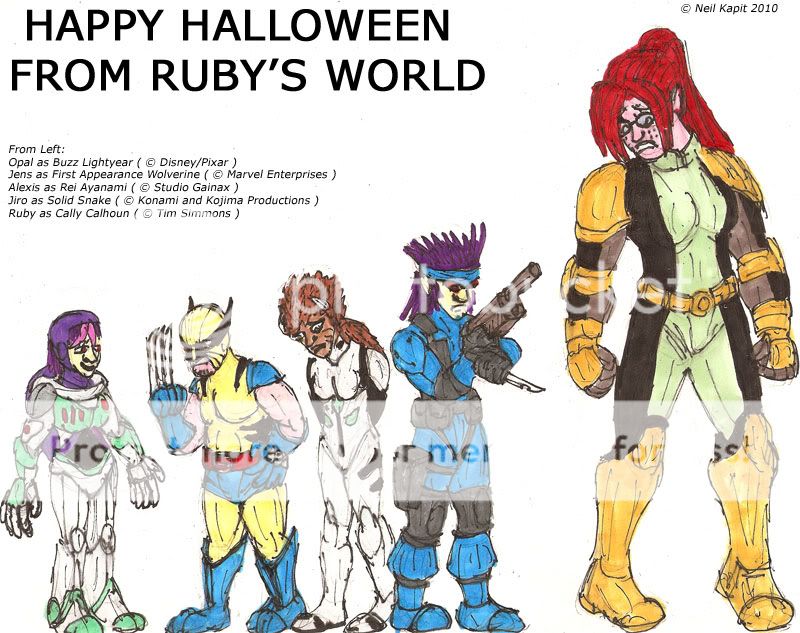
For two years I've been doing my webcomic Ruby's World, and for the second time in a row, I've done a Halloween cosplay image, with my characters dressed as other characters from comics and animations. In order, they are..
-- Buzz Lightyear from the Toy Story characters, a character who ( in the first film anyway ) is troubled by his artificial nature. This was a deliberately idiosyncratic choice, to reflect not just Opal's lack of social awareness, but her flexible gender as well ).
-- The original Wolverine from the 70's Hulk, wearing a costume which might be construed as badass, but is more likely completely ridiculous ( much like Jens' personal conflicts ).
-- Rei Ayanami from the landmark anime Neon Genesis Evangelion, an extremely quiet and isolated girl with a mysterious nature ( Rei's was revealed in extremely unsettling fashion; Alexis' has yet to be divulged. Yet. )
-- Solid Snake from the peerless Metal Gear Solid series of video games, a cloned super-soldier whose traumatic life has left him emotionally discombobulated and extremely cold, and whose stealth catsuit attire makes grown men question their heterosexuality. I'm not sure if the latter has been true regarding Jiro, but if any readers have had that experience, I won't judge.
-- Cally Calhoun from the recently launched webcomic Spy6teen, written by Tim Simmons, with art by DJ Keawekane, colors by Lisa Moore, letters by Brant Fowler, and story edits by D.J. Kirkbride. Starring another seemingly ordinary teen girl given super-powers and thrust into a larger conspiracy, with red hair to boot. The comic hasn't been around long, but it has such a high level of technical craft and collaborative skill that it deserves the shout-out. It updates weekly Here.
I'll also be bringing more major news regarding Ruby's World and its upcoming new direction. And more Sonichu reviews, of course. It works to my advantage that I put news about my comic following my Sonichu reviews, because no matter what I put out, it will seem like pure genius compared to Christian Weston Chandler's creative abortions.
Wednesday, October 6, 2010
Ruby's World Chapter 19 Up!

Go Here
It's finally here; a long hard slough getting this up while experimenting with the format for the eventual relaunch, but it's here. Feedback would be appreciated.
Friday, June 11, 2010
Asperchu: Putting the Comic back in Webcomic

( WARNING: Links are Not Safe For Work )
Asperchu, written and illustrated by Alec Benson Leary, is my current favorite webcomic. It is a parody of a very specific source; the webcomic Sonichu, by Christian Weston Chandler. Hence, you'll have to bone up on your knowledge of Chris-Chan before you can appreciate it. Fortunately, the man's life is documented here in all its pathetic glory.
A cursory look at Chris-Chan shows that he's an unlimited source of fuel for parody. He is quite possibly the most laughable excuse for a human being ever documented. He became internet-famous for his childishly-drawn comic about a mixture between Sonic the Hedgehog and Pikachu the Pokemon. His comic is set in the town of CWCville, where Chris inserts himself as the mayor. He regularly uses the comic to fight villains based on those in his real life, ranging from the trolls who make fun of him on the internet to the mall cops who take issue with his loitering. He's a fundamentalist Christian who regularly draws cartoon animals having sex, a vicious homophobe who takes every chance he can get to declare that he is in fact heterosexual, a creepy stalker who has drawn erotic fan art of ( former ) female friends, and a 28-year-old man still living with his parents off of welfare. He's apparently autistic, but he routinely bashes people with Asperger's for taking attention away from him, takes a strong pro-cure stance, and basically uses his disorder as an excuse not to do anything with his life. Thanks to the internet, however, he's an idiot for the global village.
Leary uses all this material in full force. Asperchu himself is a mixture between Sonichu and Chris himself, with the portly physique, childish shirts, and gaudy medallion. He lives in CWCville, but Leary's portrayal of the town makes it out to be a North Korea-type ego-opolis, with the real Chris-Chan replaced by a psychopathic man-child impostor. The trolls that Chris-Chan rails against in real life are a heroic underground resistance, fighting against a corrupt dictator who forces women into prostitution under the guise of " Dating Education ". Even Chris' own creations appear as rebels against him, with Sonichu in particular going on a hysterical revenge spree against his " father ". In the meantime, Asperchu is more of a foolish figurehead than a heroic protagonist, idly playing video games ( with an near-infinite supply of handheld consoles that he just pulls out of thin air ) while all this is going on. He has some importance to the larger plot, but while his destiny is calling him, he's too lazy to pick up the phone.
The art is extremely simplistic on purpose ( as a spoof of Chris' terrible Crayola comics ), but the subject matter is as dark as possible. This story, after all, is based on the imagination of a 28-year-old man with the maturity of an 8-year-old and the libidio of a 14-year-old. The strip seems to be based simply on trying to piss Chris off, and of all the people to troll the man-child, Leary has done it the best by far. Everything in this comic is a reference to just how pathetic Chris is, ranging from the protagonist drawing upon Chris' own sloth, to the overtly homo-erotic interactions between Sonichu and Asperchu, to the use of Chris' arch-enemies as heroic figures. It's extremely dark and creepy, but if you have the stomach, hilarious.
Sunday, May 23, 2010
Ruby's World Art Gallery Added!

My webcomic, Ruby's World, has inspired me to do various pieces of non-comic art for promotion and simple fun. I've finally gathered them all together here. There be spoilers at the end, though.
Tuesday, March 23, 2010
How To Write Autistic Characters ( With Examples From Ruby's World )
Much has been made of the " autism epidemic " in the media, either as a consequence of more precise diagnostic methods, or some overblown, unsubstantiated consequence of vaccination poisoning. As a result, autism has become a more frequent issue in fiction, be it the popularity of the novel " The Curious Incident of the Dog In The Night-Time ", the recurring Aspie kid Max on the new family drama Parenthood, an autistic man being the main character i the movie " Adam ", or Jodi Picoult using autism as set piece for her latest legal family melodrama " House Rules ". There are certainly more examples to recite, especially if we factor in isolated episodes of procedural shows ( like the episode of House where the doctor has a lower-functioning autistic boy as a patient, and it is speculated if House himself has Asperger's-- though it's later concluded that he just wishes he did so he would have an excuse for being an antisocial jerkass* ).
Unfortunately, most of these portrayals of autism as the hot topic for fiction forget to develop one little part of the situation-- the individual with autism. Many of these stories focus on the families of the autistic character as tragic figures, giving their all to function for a developmentally stunted morality pet. The autistic character, on the other hand, is displayed by the Rain Man stereotype, having talents that are portrayed as math genius parlor tricks, and being completely ineffectual in every other area. Rarely do you see autistic characters as major players, and if you do, it's often as a storytelling gimmick.
For example, Jacob Hunt in House Rules, the autistic boy suspected of murdering his social skills tutor. In this story, we see that Jacob is obsessed with criminology to the point of watching the same Crimebusters episodes over and over ( and always taking notes as if he didn't know how it would end ), obsessed with dinosaurs, a genius with computers to the point where he can do Hollywood hacking, incapable of eating foods that don't suit a corresponding day/color combination, repetitively listens to the Bob Marley song " I Shot the Sherrif ", incapable of understanding human emotions, incapable of lying ( except in the case of sins of omission ), incapable of understanding non-literal idioms, uses movie quotes to express emotions he can't communicate, and is prone to catastrophic meltdowns. Certainly real people on the spectrum would show one or more of these characteristics, but not all of them at once. This is like having a Jewish character who's a thrifty greedy neurotic hypochondriac devout Kosher sarcastic Hollywood executive. And it's certainly not helped by the fact that Picoult's other characters all spout extremely narrow-minded opinions about autism that are confirmed by Jacob's existence.
But Jodi Picoult and her ilk don't seem to notice that, instead perpetuating the notion of the autistic people themselves being helpless victims, with their families given martyr status ( despite the fact that Jacob's mother, as many critics have wisely pointed out, has infantilized him to the point where he never even had a chance to function independently ). Since the positive representations of autistic characters, especially those written by autistic authors, are so few and far between, I'm taking it on myself to write a primer on how to write autistic characters as actual characters. The examples are from my webcomic Ruby's World which has two prominent autistic characters in the ensemble cast, and an overall disability rights message. I use examples from my own work being specific only to this particular topic, because there's so little material that would offer a positive representation of autism in fiction**, especially by creators on the spectrum.
Here are the five simple rules that I hope are obvious...
1.) Don't Get Hung Up On Labels

There are plenty of words that are used to describe autism spectrum disorders. These are mostly fine as diagnostic criteria. They are, however, extremely poor at describing a person in their entirety. Unless you want a flat character like Jacob Hunt, writing a character with autism requires going past the stereotypes and thinking of what other characteristics they have-- or, at the very least, to portray the stereotyped behaviors associated with ASDs in a unique way.
The two autistic characters in Ruby's World are Jiro Sasaki and Alexis Deveraux. Both are science fiction characters who portray the " Organic Android " Trope ( Defined well here by NightStorm ), but do so in unique ways. Jiro is the mechanical side of autism, as a cybernetically enhanced being, but he's completely aware of his condition and often bemoans the limitations of his computer brain ( mostly due to internalized prejudice, the belief that he can't move past his label ). Alexis represents a more organic side, a hyper-empathic character with psychic abilities that defy explanation, even in a world of genetic engineering and nanotech-- her issue is with not fitting into any category, and feeling isolated as a result ( she's also bi-racial, with no idea who the non-white father is ). It should also be noted that while I intended both characters to be autistic, I didn't confirm either as being on the spectrum right off the bat-- it took me until Chapter 9 for Jiro, where it just slipped out in a conversation.
Language is inherently limited, but that shouldn't prevent you from stretching it as far as it can go to make a character seem three-dimensional. I should also note that if you do write a story with autistic characters, you shouldn't feel the need to mention every aspect of the condition, especially the vaccination debate ( as it suggests that the anti-vaccine side has a leg to stand on )
2.) Acknowledge the Character's Feelings About Their Condition

Just because autistic people tend to be very internalized doesn't mean they aren't aware of what they're " missing ". In some cases, the internalization may make them even more likely to dwell on their challenges. Characters like Jacob and Christopher Boone in the Curious Incident tend to be portrayed as so emotionally cut-off that they have almost no idea how their actions come across, or even enough self-awareness to associate feelings with their responses. Unless your character is extremely " low-functioning ", they're not going to take being autistic for granted, not when they're reminded of it via the challenges they face every single day. And even if they are " low-functioning ", just because someone can't communicate doesn't mean they don't have something valid to say, especially when it concerns the way they're being treated.
In Ruby's World, Jiro is a unique case because though he has always been autistic, he used to be on the " lower-functioning " end ( As seen in the backstory ). Thanks to some medical testing he volunteered for, he was upgraded to a bio-mechanical body, and his abilities far surpassed normal humans. But he still has all the experiences of being treated as disabled, and still maintains his old personality ( right down to the nervous tics as a stress response ). He's got a lot of bitterness about his condition, which is entirely justified; just because he's able to catch flies with his fingers doesn't mean he forgot about the time when his coordination was poor, or the way people treated him.
Autism is a neurological condition, but disability is a social construct. And even a person who can't read others well is going to pick up on being treated as persona non grata. If you're the writer, you have the opportunity for them to voice their dissatisfaction.
3.) Connect Their Problems To The Basic Human Condition

The worst stereotype seen in fictional autistic characters is the Oblivious Sociopath, the character who has so little understanding of human society that they can't tell right from wrong. House Rules presents this, and while it doesn't actually make Jacob the murderer ( he was covering for his brother, the one and probably only saving grace of that wretched book ), it still establishes him as someone who doesn't think about his motivations and their ethics, living simply for rudimentary human needs ( made worse by him being portrayed as unable to take care of himself ) and a steadfast adherence to routine. We don't get much about what Jacob wants to do with his life, we don't hear him talking about any plans to better himself, and only in extreme cases do we see him show sympathy for anyone else.
Just because it's hard for someone to understand and express the basic emotional needs that human beings have-- love, acceptance, success, honor, etc.-- doesn't mean that they aren't there. I use this scene from Ruby's World where Alexis is talking to her friend Jens about the notion of them having casual sex as an example-- she isn't really thinking about the consequences such an act would have, and expresses it just as a pragmatic release, but is responding to her need for connection. For a person on the spectrum, the problem is often that they want what other people want, but they're comparatively ill-equipped to acquire it from others.
The metaphor of autistic people being space aliens is a commonly used one, but that implies a completely different nature, so much so that they don't even belong to the same species paradigm. A better one might be to think of an autistic person's brain as a Mac, with the neurotypical brain being a PC-- same basic principles, but different architecture that often but not always leads to compatibility problems. ( This would also suit the " thinking in pictures " trope associated with autistic people, and why I've always felt more comfortable working with the interface-heavy Macs ).
4.) Do Not Treat Them As Saints

For anyone who gets the impression that I want to read about, and thus write, infallible characters on the spectrum, nothing can be further from the truth. My tastes in fictional characters tend towards the damaged, the characters who have problems and make mistakes on a regular basis. Just because a character is autistic doesn't mean they're not responsible for their actions. Everybody will act favoring their impulses over their conscience now and then ( though some more than others ). Autism may make certain impulses much harder to control, but to treat a character as helpless to their compulsions is just as wrong as treating them as being inherently selfish and irredeemable for having those compulsions.
This grisly scene involves Jiro and one of the main villains, Pierre Buzarde'. Buzarde' has just savagely attacked Jiro and Ruby ( the star of the strip and Jiro's girlfriend ), and they barely managed to fight him off. Now that he's had all his bones broken, the heroes need him for evidence against Beagle Labs and their vivisection, but that doesn't mean he's going to be treated humanely. Jiro stopped Ruby from killing Buzarde', but he's not going to stop himself from torturing the bastard. What Jiro did is best left to your imagination, other than the fact that it was extremely painful to Buzarde'. And while it was something Buzarde' certainly had coming, it was an unethical act. That Jiro is autistic doesn't excuse it; it's just spite, something that people on the spectrum and neurotypicals all feel.
Perfect characters are boring. Portraying a character in a minority group as being flawed has its risks, even if at the end of the day they're basically a good person. But if your story is safe from controversy, it's probably not worth the effort.
5.) There Are No Rules For Writing Autistic Characters
While this may seem like a cop-out, it's a basic summary of the previous four points, in that writing an autistic character shouldn't be any more exotic than writing any other kind of good, engaging, three-dimensional character. If you're writing an autistic character, you certainly will be informed by real-world diagnostic criteria, but if you're doing a good job you won't be using the DSM-V as your only reference. Racial, cultural, gender, and even neurological backgrounds only go so far. The rest is up to the writer to do something creative and sympathetic.
I close with the following panel from Ruby's World, with Jiro and Ruby in the heat of passion...

Ruby isn't autistic, but she is nine-foot-two-inches and two-hundred-seventy pounds of genetically engineered super-weapon, and no stranger to hardship herself, so they are able to understand each other well. Which I think as a good metaphor for the most important task of the writer; being able to humanize a character from a different background by relating your experience to theirs.
* ( In a note related to the comic-reading audience of this blog, I should mention that Reed " Mr. Fantastic " Richards of the Fantastic Four was speculated as being autistic in Grant Morrison's mini-series 1234. He fits the criteria excellently, and he would be a positive representation of an autistic character if he achieved the diagnosis-- a superhero, a genius surpassing even other Marvel geniuses, and a man capable of being a loving friend, husband, and father despite taking the absent-minded professor trope further than his cosmically-irradiated body can stretch.
A recommendation would be Elizabeth Moon's excellent sci-fi novel The Speed of Dark, about an autistic man who actually does subject himself to an autism cure. Possibly the best treatment of the subject in genre fiction yet.
Unfortunately, most of these portrayals of autism as the hot topic for fiction forget to develop one little part of the situation-- the individual with autism. Many of these stories focus on the families of the autistic character as tragic figures, giving their all to function for a developmentally stunted morality pet. The autistic character, on the other hand, is displayed by the Rain Man stereotype, having talents that are portrayed as math genius parlor tricks, and being completely ineffectual in every other area. Rarely do you see autistic characters as major players, and if you do, it's often as a storytelling gimmick.
For example, Jacob Hunt in House Rules, the autistic boy suspected of murdering his social skills tutor. In this story, we see that Jacob is obsessed with criminology to the point of watching the same Crimebusters episodes over and over ( and always taking notes as if he didn't know how it would end ), obsessed with dinosaurs, a genius with computers to the point where he can do Hollywood hacking, incapable of eating foods that don't suit a corresponding day/color combination, repetitively listens to the Bob Marley song " I Shot the Sherrif ", incapable of understanding human emotions, incapable of lying ( except in the case of sins of omission ), incapable of understanding non-literal idioms, uses movie quotes to express emotions he can't communicate, and is prone to catastrophic meltdowns. Certainly real people on the spectrum would show one or more of these characteristics, but not all of them at once. This is like having a Jewish character who's a thrifty greedy neurotic hypochondriac devout Kosher sarcastic Hollywood executive. And it's certainly not helped by the fact that Picoult's other characters all spout extremely narrow-minded opinions about autism that are confirmed by Jacob's existence.
But Jodi Picoult and her ilk don't seem to notice that, instead perpetuating the notion of the autistic people themselves being helpless victims, with their families given martyr status ( despite the fact that Jacob's mother, as many critics have wisely pointed out, has infantilized him to the point where he never even had a chance to function independently ). Since the positive representations of autistic characters, especially those written by autistic authors, are so few and far between, I'm taking it on myself to write a primer on how to write autistic characters as actual characters. The examples are from my webcomic Ruby's World which has two prominent autistic characters in the ensemble cast, and an overall disability rights message. I use examples from my own work being specific only to this particular topic, because there's so little material that would offer a positive representation of autism in fiction**, especially by creators on the spectrum.
Here are the five simple rules that I hope are obvious...
1.) Don't Get Hung Up On Labels
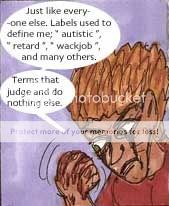
There are plenty of words that are used to describe autism spectrum disorders. These are mostly fine as diagnostic criteria. They are, however, extremely poor at describing a person in their entirety. Unless you want a flat character like Jacob Hunt, writing a character with autism requires going past the stereotypes and thinking of what other characteristics they have-- or, at the very least, to portray the stereotyped behaviors associated with ASDs in a unique way.
The two autistic characters in Ruby's World are Jiro Sasaki and Alexis Deveraux. Both are science fiction characters who portray the " Organic Android " Trope ( Defined well here by NightStorm ), but do so in unique ways. Jiro is the mechanical side of autism, as a cybernetically enhanced being, but he's completely aware of his condition and often bemoans the limitations of his computer brain ( mostly due to internalized prejudice, the belief that he can't move past his label ). Alexis represents a more organic side, a hyper-empathic character with psychic abilities that defy explanation, even in a world of genetic engineering and nanotech-- her issue is with not fitting into any category, and feeling isolated as a result ( she's also bi-racial, with no idea who the non-white father is ). It should also be noted that while I intended both characters to be autistic, I didn't confirm either as being on the spectrum right off the bat-- it took me until Chapter 9 for Jiro, where it just slipped out in a conversation.
Language is inherently limited, but that shouldn't prevent you from stretching it as far as it can go to make a character seem three-dimensional. I should also note that if you do write a story with autistic characters, you shouldn't feel the need to mention every aspect of the condition, especially the vaccination debate ( as it suggests that the anti-vaccine side has a leg to stand on )
2.) Acknowledge the Character's Feelings About Their Condition
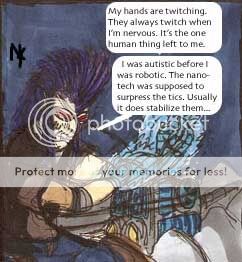
Just because autistic people tend to be very internalized doesn't mean they aren't aware of what they're " missing ". In some cases, the internalization may make them even more likely to dwell on their challenges. Characters like Jacob and Christopher Boone in the Curious Incident tend to be portrayed as so emotionally cut-off that they have almost no idea how their actions come across, or even enough self-awareness to associate feelings with their responses. Unless your character is extremely " low-functioning ", they're not going to take being autistic for granted, not when they're reminded of it via the challenges they face every single day. And even if they are " low-functioning ", just because someone can't communicate doesn't mean they don't have something valid to say, especially when it concerns the way they're being treated.
In Ruby's World, Jiro is a unique case because though he has always been autistic, he used to be on the " lower-functioning " end ( As seen in the backstory ). Thanks to some medical testing he volunteered for, he was upgraded to a bio-mechanical body, and his abilities far surpassed normal humans. But he still has all the experiences of being treated as disabled, and still maintains his old personality ( right down to the nervous tics as a stress response ). He's got a lot of bitterness about his condition, which is entirely justified; just because he's able to catch flies with his fingers doesn't mean he forgot about the time when his coordination was poor, or the way people treated him.
Autism is a neurological condition, but disability is a social construct. And even a person who can't read others well is going to pick up on being treated as persona non grata. If you're the writer, you have the opportunity for them to voice their dissatisfaction.
3.) Connect Their Problems To The Basic Human Condition

The worst stereotype seen in fictional autistic characters is the Oblivious Sociopath, the character who has so little understanding of human society that they can't tell right from wrong. House Rules presents this, and while it doesn't actually make Jacob the murderer ( he was covering for his brother, the one and probably only saving grace of that wretched book ), it still establishes him as someone who doesn't think about his motivations and their ethics, living simply for rudimentary human needs ( made worse by him being portrayed as unable to take care of himself ) and a steadfast adherence to routine. We don't get much about what Jacob wants to do with his life, we don't hear him talking about any plans to better himself, and only in extreme cases do we see him show sympathy for anyone else.
Just because it's hard for someone to understand and express the basic emotional needs that human beings have-- love, acceptance, success, honor, etc.-- doesn't mean that they aren't there. I use this scene from Ruby's World where Alexis is talking to her friend Jens about the notion of them having casual sex as an example-- she isn't really thinking about the consequences such an act would have, and expresses it just as a pragmatic release, but is responding to her need for connection. For a person on the spectrum, the problem is often that they want what other people want, but they're comparatively ill-equipped to acquire it from others.
The metaphor of autistic people being space aliens is a commonly used one, but that implies a completely different nature, so much so that they don't even belong to the same species paradigm. A better one might be to think of an autistic person's brain as a Mac, with the neurotypical brain being a PC-- same basic principles, but different architecture that often but not always leads to compatibility problems. ( This would also suit the " thinking in pictures " trope associated with autistic people, and why I've always felt more comfortable working with the interface-heavy Macs ).
4.) Do Not Treat Them As Saints

For anyone who gets the impression that I want to read about, and thus write, infallible characters on the spectrum, nothing can be further from the truth. My tastes in fictional characters tend towards the damaged, the characters who have problems and make mistakes on a regular basis. Just because a character is autistic doesn't mean they're not responsible for their actions. Everybody will act favoring their impulses over their conscience now and then ( though some more than others ). Autism may make certain impulses much harder to control, but to treat a character as helpless to their compulsions is just as wrong as treating them as being inherently selfish and irredeemable for having those compulsions.
This grisly scene involves Jiro and one of the main villains, Pierre Buzarde'. Buzarde' has just savagely attacked Jiro and Ruby ( the star of the strip and Jiro's girlfriend ), and they barely managed to fight him off. Now that he's had all his bones broken, the heroes need him for evidence against Beagle Labs and their vivisection, but that doesn't mean he's going to be treated humanely. Jiro stopped Ruby from killing Buzarde', but he's not going to stop himself from torturing the bastard. What Jiro did is best left to your imagination, other than the fact that it was extremely painful to Buzarde'. And while it was something Buzarde' certainly had coming, it was an unethical act. That Jiro is autistic doesn't excuse it; it's just spite, something that people on the spectrum and neurotypicals all feel.
Perfect characters are boring. Portraying a character in a minority group as being flawed has its risks, even if at the end of the day they're basically a good person. But if your story is safe from controversy, it's probably not worth the effort.
5.) There Are No Rules For Writing Autistic Characters
While this may seem like a cop-out, it's a basic summary of the previous four points, in that writing an autistic character shouldn't be any more exotic than writing any other kind of good, engaging, three-dimensional character. If you're writing an autistic character, you certainly will be informed by real-world diagnostic criteria, but if you're doing a good job you won't be using the DSM-V as your only reference. Racial, cultural, gender, and even neurological backgrounds only go so far. The rest is up to the writer to do something creative and sympathetic.
I close with the following panel from Ruby's World, with Jiro and Ruby in the heat of passion...

Ruby isn't autistic, but she is nine-foot-two-inches and two-hundred-seventy pounds of genetically engineered super-weapon, and no stranger to hardship herself, so they are able to understand each other well. Which I think as a good metaphor for the most important task of the writer; being able to humanize a character from a different background by relating your experience to theirs.
* ( In a note related to the comic-reading audience of this blog, I should mention that Reed " Mr. Fantastic " Richards of the Fantastic Four was speculated as being autistic in Grant Morrison's mini-series 1234. He fits the criteria excellently, and he would be a positive representation of an autistic character if he achieved the diagnosis-- a superhero, a genius surpassing even other Marvel geniuses, and a man capable of being a loving friend, husband, and father despite taking the absent-minded professor trope further than his cosmically-irradiated body can stretch.
A recommendation would be Elizabeth Moon's excellent sci-fi novel The Speed of Dark, about an autistic man who actually does subject himself to an autism cure. Possibly the best treatment of the subject in genre fiction yet.
Tuesday, January 5, 2010
Treasure Buried in Sturgeon's Law: Heroes, Inc.
Since my own webcomicc has been moved to a weekly schedule, I've taken to making a stronger effort to read other peoples' works. Sturgeon's Law may still apply, but I've also seen quite a lot of phenomenally good online strips. I've even seen some superhero webcomics, which are comparatively uncommon online ( as opposed to in Western print comics, but that's neither here nor there ). My favorite one would be Heroes, Inc.
Written and drawn by Scott Austin, Heroes Inc. deals with the Golden Age superheroes who've fallen into the public domain-- at least, the characters who used to be Golden Age heroes. The strip switches between the World War 2 setting and the modern age, and the years haven't been kind to characters like the American Crusader and the Black Terror-- the survivors may be better preserved than normal humans, but have reduced physical capacities and war-time PTSD that never faded. Against a new wave of super-terror, they're no longer effective-- so their blood is being used by scientists to develop new heroes.
It's a disturbingly realistic treatment of superheroes, and while that term is bandied around to every superhero comic with a fin-headed rapist or demonic canine sidekick, here it actually applies. The World War Two scenes are treated as horrific and traumatizing-- even if it's considered an ethical war, the soldiers ( super or not ) actually fighting it don't like what they have to do. There's an elaborate history between then and now regarding the super-soldiers' post-war lives-- one ended up a death row inmate, one as a feral creature living in the woods, and a lucky one as a minister with a clear need to atone. What's more, the development of superHEROES is treated as a novelty-- even with their powers, the Golden Age heroes still dressed in regular military uniforms and fought like anyone else-- and the young people taking on this responsibility might not be up to it.
The story is still relatively new, but shows incredible promise. The art by Austin is equally impressive-- he uses widescreen layouts and realistically renderings, with distinct character designs ( and for most of the cast, obvious signs of aging ). He would fit right in on a book like Ed Brubaker's Captain America, alongside Butch Guice, Luke Ross, Mike Perkins, and even Steve Epting. Sometimes the pages come in black-and-white for apparent time constraints, as opposed to storytelling reasons, but to simply keep up the momentum is very important for a comic series, especially a new one. This is an obvious labor of love, so I can accept the occasional breaks.
The comic can be found here, and comes strongly recommended.
Written and drawn by Scott Austin, Heroes Inc. deals with the Golden Age superheroes who've fallen into the public domain-- at least, the characters who used to be Golden Age heroes. The strip switches between the World War 2 setting and the modern age, and the years haven't been kind to characters like the American Crusader and the Black Terror-- the survivors may be better preserved than normal humans, but have reduced physical capacities and war-time PTSD that never faded. Against a new wave of super-terror, they're no longer effective-- so their blood is being used by scientists to develop new heroes.
It's a disturbingly realistic treatment of superheroes, and while that term is bandied around to every superhero comic with a fin-headed rapist or demonic canine sidekick, here it actually applies. The World War Two scenes are treated as horrific and traumatizing-- even if it's considered an ethical war, the soldiers ( super or not ) actually fighting it don't like what they have to do. There's an elaborate history between then and now regarding the super-soldiers' post-war lives-- one ended up a death row inmate, one as a feral creature living in the woods, and a lucky one as a minister with a clear need to atone. What's more, the development of superHEROES is treated as a novelty-- even with their powers, the Golden Age heroes still dressed in regular military uniforms and fought like anyone else-- and the young people taking on this responsibility might not be up to it.
The story is still relatively new, but shows incredible promise. The art by Austin is equally impressive-- he uses widescreen layouts and realistically renderings, with distinct character designs ( and for most of the cast, obvious signs of aging ). He would fit right in on a book like Ed Brubaker's Captain America, alongside Butch Guice, Luke Ross, Mike Perkins, and even Steve Epting. Sometimes the pages come in black-and-white for apparent time constraints, as opposed to storytelling reasons, but to simply keep up the momentum is very important for a comic series, especially a new one. This is an obvious labor of love, so I can accept the occasional breaks.
The comic can be found here, and comes strongly recommended.
Monday, December 28, 2009
Ruby's World: Now Weekly!
Just approaching the end of the Holidays, my comic takes a long-overdue shift in scheduling; now, it'll be updating in single pages, three times a week. This will mean a lot more work, but also increased momentum. To go directly to the latest page,
go Here
go Here
Saturday, November 21, 2009
Ruby's World Comic Update
Click Here
More comics up, this time with more emphasis on the " widescreen " school of storytelling. I've always liked that kind of letterbox layout in comics, as it appears under the hands of artists like Frank Quitely and John Cassaday and Bryan Hitch. Any feedback, especially pertaining to how this works, would be appreciated.
More comics up, this time with more emphasis on the " widescreen " school of storytelling. I've always liked that kind of letterbox layout in comics, as it appears under the hands of artists like Frank Quitely and John Cassaday and Bryan Hitch. Any feedback, especially pertaining to how this works, would be appreciated.
Subscribe to:
Posts (Atom)

