Ruby Nation

Ruby Nation
Ruby Nation: The Webcomic
Showing posts with label solid snake. Show all posts

Thursday, June 21, 2012

Metal Gear Solid: Guns of the Patriots Novel Review: A Labor of La Li Lu Le Love


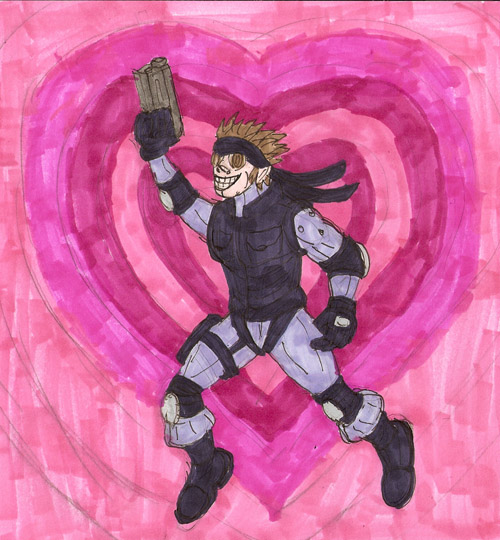
As anyone who's known me in the past two years can attest, I love Metal Gear. It's been the subject of my literal autistic obsession ever since I played the original PS1 game as a digital download. Since then, I've played through every game, beat all of the games in the Solid series multiple times, collected the various merchandise (including those beautiful but expensive Play Arts figures), and worked references into several aspects of my life (including my comics). Metal Gear has all the things I look for in a story; complex and sympathetic characters, a sophisticated (if often arcane and absurd) narrative, an ability to switch between wacky humor and tear-jerking drama, and a complex metatextual understanding of its own nature as a story. The best of the series, IMO, was Metal Gear Solid 4, the canonical ending of hero Solid Snake's story as he pulls his his dying, prematurely aged body together for one big final mission.

When I heard there was a novelization of MGS4, I was initially blasé about it; novelizations are usually mediocre to poor, as cheap cash-ins haphazardly trying to shoehorn a story into a different medium. The more appropriate piece of evidence for this case is Raymond Benson's novelization of the PS1 game, which treated the story as though it were a straightforward, cheesy James Bond epic, even giving Snake several lame one-liners (such as saying "Merry Christmas" to an enemy Genome Soldier, then choking him to death and saying "Christmas came early this year!"), which didn't fit at all with his usual warrior-poet personality. But this novelization has a much greater pedigree; it was written by the late Project Itoh (real name Satoshi Ito), a Japanese novelist and a personal friend of Metal Gear creator Hideo Kojima. Itoh was diagnosed with cancer in 2001, and fought a long, hard battle that tragically ended with his death in 2009. Kojima even writes the afterward of this novel, praising Itoh's work here and on his original stories (many of which were originally fan fiction of Kojima games like Snatcher), and saying that his "genes" are now infused into the Metal Gear mythology. Given how the series is all about genes and memes passing from generation to generation, this is lofty and touching praise.

But how is the novel itself? First of all, I should say that if you're a Metal Gear fan who's played MGS4, you absolutely have to read this book. The narrator is Hal "Otacon" Emmerich, who recounts the final days of his hetero life-mate's life (as he promised at the end of the game, bearing witness to everything the legendary hero was). This is a unique and more somber account of the events, leaving out the action scenes that wouldn't have contributed to the plot (such as the Beauty and the Beast Corps battles, grotesque parodies of Kojima's own wacky mini-bosses), and adding some background detail that fills in the gaps and revises the sillier elements of the story. For example, there's a section on the villainous Liquid Snake's history, which removes all the "recessive/dominant gene" nonsense of his backstory and instead tells about how he spent many of his formative years as a POW during the Gulf War, being degraded and tortured and left out to dry by his own government, while his twin-brother Solid Snake became the glorious hero of Outer Heaven and Zanzibar Land. There's also some interesting sci-fi explanations of elements that might have confused you, such as all the bar codes on Raiden's cyborg exoskeleton, or the full extent of Snake's illness. It may not have occurred to gamers that flying from Morroco to Peru to Czechlosovakia to Alaska to a floating ocean fortress was very hard on Snake's lungs, given all the wild differences in atmospheric pressure.

And if you haven't played any of the Metal Gear games? To be honest, that's a bit of a harder sell. MGS4 was a game with an extremely complex plot that invoked story threads from throughout Metal Gear history. The game worked because there were playable segments that didn't need such complex understanding, as well as an easily understandable and sympathetic main story of Old Snake's final mission. Here, a lot of it is left to exposition, including details that tell what characters feel instead of showing. It was written to be accessible to a wider audience, but in the end there's a bit too much hand-holding with the dialogue, especially when it comes to Solid Snake's motivations. Then again, that may be justified by the fact that this is written from Otacon's perspective, and it seems within his character to mix long technical pieces with blubbering histrionics. Especially when it comes to Snake, since Otacon lived and worked closely with the man for nine years, and saw more of Snake's tender core, rather than his tough super-soldier exterior.

But though the writing can be overwrought, I'd still recommend this as a piece of science fiction. For all its warts, including a convoluted narrative, a generous amount of Narm, and a villain who is possessed by the transplanted right hand of another villain, MGS4 is still a heartfelt story with a beautiful message. By this point, the series had evolved from being an anti-war narrative to an anti-digital-control-narrative to an ANTI-NARRATIVE NARRATIVE. The dystopian future of MGS4, where mercenary companies have dominated the world, war exists as the impetus for the global economy (how very far-fetched, he says with a roll of the eyes), and almost everyone has their senses monitored and influenced by nano machines, is the grim result of a power struggle between men trying to enforce their own ideal narratives upon the world. The utopian obsessions, spawned by different misinterpretations of a heroic idol, have led to a struggle of liberty vs. security with a result that satisfies neither. And Solid Snake, an artificially created man manipulated by both sides, has to put things right, motivated by no ideology but the desire to keep the world afloat so future generations can make their own decisions. The kanji character on Snake's uniform/powered armor in MGS4 stands for "To Let The World Be"*, and while this may at first sound like cowardice, it's actually a strong endorsement of volunteerism. If people do not make their decisions of their own free will, as opposed to subscribing to a systemic master narrative (be it religion, nationality, or the idolatry of a hero like the Boss from Metal Gear Solid 3), then there can be no progress.

Now if you'll excuse me, I'm going to check out some of Project Itoh's original works, right after removing the tears from my eyes after experiencing the Microwave Hallway scene AGAIN.

* You can even use this for a disability rights reading, since it endorses acceptance of differences and individual perspectives over master narratives, including ableist ones like enforcing that people try to be "fixed". 

Monday, November 14, 2011

Read My Review, Then Buy This Game


Published by the fine folks at GameDynamo.com

I'm sorry I've neglected this blog, though between my new real world job, my online game writing job, and my work on Ruby Nation, you can probably see why. Still, it's easy enough to link to my review of the collected glory that is the Metal Gear Solid HD Collection.

Sunday, June 19, 2011

Learning Social Skills with Solid Snake


Metal Gear Solid is infamous for its many repeated quirks, including rampant fourth wall breakage, high proportions of cutscenes, rampant homo-eroticism, and coaxing tears out of even the most masculine gamers' eyes. One of the most prominent quirks is protagonist Solid Snake's tendency to echo whatever is being said to him, repeating the most significant proper noun of the previous statement as a question. The most obvious example occurs whenever the titular Metal Gear robot is mentioned, in which Snake will say, "Metal Gear?!"

This can be annoying, but it's also a valuable conversation-maintenance tactic that can be applied to real life. By repeating the subject of the other person's conversation, Snake demonstrates that he was listening to what they were saying. He also fills in what otherwise would have been an awkward pause had he not spoken up. And by phrasing it as a question, he shows to the other person that he's interested in what they're saying and wants to hear more. Since almost everybody likes to be asked questions, they won't scrutinize the fact that Snake isn't contributing much to the conversation himself (unless he's making some poetic speech about the battlefield, in which case you listen because it's Snake).

Snake is not only a master of CQC, but he demonstrates with elegant simplicity an uncanny understanding of the dynamics of conversation.

Saturday, April 23, 2011

Hal "Otacon" Emmerich, Metal Gear Solid's Autistic Hero?


Fictional characters on the autism spectrum are hard to find, and good characters in that category are almost non-existent. As autism has become more prevalent, we've seen it portrayed more often in the media, but those portrayals too often fall into the stereotypes, such as the damaged, volatile child unwittingly tearing apart his supportive family, or the emotionless polymath sociopath who can do horrible things without seeing a problem. There are very few autistic protagonists, or even supporting characters of a positive nature*.

Thus, many autistic people have found themselves speculating on which of their favorite fictional characters fit the spectrum, following the completely understandable need to see inspiring figures to fit into their own narrative world. Sometimes these fictional diagnoses are simple wish fulfillment that don't describe the diagnosed character at all, such as claiming that Severus Snape of Harry Potter has Asperger's Syndrome**. Others are much more accurate, such as Grant Morrison's in-universe speculation that Reed Richards of the Fantastic Four is autistic, and could (and should) be incorporated into canon.

An example of the latter is Hal "Otacon" Emmerich, Solid Snake's tech-guy sidekick in the Metal Gear Solid series of video games. Otacon's spectrum traits go beyond simply being a nerd, and put him squarely in the neuroatypical category. If you don't believe me, here's the evidence...

WARNING: SPOILERS FOR THE GAMES AHEAD

1.) Otacon's interests are (or were) so obsessive and insular that he missed the harsh realities attached. When he was introduced in the PSOne game, he was designing a Metal Gear unit because he wanted to make robots like he'd seen in anime. He was attached to that utopian sci-fi narrative, the kind where fantastical machines keep people safe. He was also completely oblivious to the fact that his creation was being used as a platform for nuclear missiles, until Snake bluntly spelled it out for him. Otacon's code-name is short for "Otaku Convention", and his desk is covered with little toys and posters. In another series, he might have been able to play out his fantasies and help the world with his giant robot fixation. In Metal Gear, of course, he became instrumental in the creation of the world's most devastating WMD.

2.) Otacon is extremely literal-minded. This is used with hilarious effect in the Snake campaign of Metal Gear Solid 2, where the good doctor tries to read Snake ancient words of wisdom upon saving his data (the way Mei Ling did in the previous game). Unfortunately, he completely misses the point of those famous quotes, and comes up with extremely bizarre interpretations after taking them at face value. The phrase "It's better to be first among roosters instead of last among bulls", according to Otacon, means that it's better to be a chicken because cows are subjected to alien cattle mutilations.

3.) Otacon is TERRIBLE at understanding his relationships. The extent to which he does not comprehend others' intentions (or his own, for that matter) leads to some of the most tragic scenes in a series known for its depressing tone. In MGS1, Otacon falls for Sniper Wolf, a bloodthirsty sniper and one of the terrorists holding him hostage. It is unlikely that she reciprocates beyond a show of basic decency (as he helped feed her dogs), but Otacon takes this mercy and uses it to fuel his childish crush. It's touchingly pathetic how fast-- and how hard-- he falls for Wolf, especially after her demise at the hands of Solid Snake. And we see it happen again in MGS4, when the morally ambiguous Dr. Naomi Hunter seduces Otacon so she can get data needed for a larger plan. The ease with which she manipulates him, saying all the right words about atoning for the sins of her science to create a quick emotional bond, is disturbing to watch when you know what she's up to.

The is explored in MGS2, where we learn about Otacon's past-- he was always socially isolated, and his sole companions were the family his father married-- his step-sister and step-mother. He became strongly attached to the former and even played house with her, despite the fact that she was five years old and he was a teenager (though Otacon had no salacious intentions spending so much time with the little girl-- he just wanted to experience family). Unfortunately, he was also "seduced"*** by his step-mother, which led to his father's suicide and Otacon subsequently running away from home. We don't hear much about the details other than Otacon's words (which are words of contrition, blaming himself for all of this), but it's unlikely that he understood what was going on at that point-- his inherent lack of social awareness facilitated all these tragedies.

There's also the fact that by far Otacon's strongest relationship is with Snake, as the two men work and live together, and even end up adopting a child in MGS4. The homoerotic subtext is so thick that it basically ends up as text, but it's not exactly clear if Otacon's feelings for Snake are romantic. He likely doesn't understand what he feels for Snake, other than the intensity of the connection. The sensitive nerd and the dour super-soldier end up having quite a bit in common, as seen in the "bad" ending**** of MGS1. Both are profoundly isolated human beings, even if Otacon's loneliness is more internalized than his lab-grown, shell-shocked veteran partner.

4.) Most importantly, Otacon is a complex and sympathetic character. As I said before, when autistic characters are shown in most fiction, they're shown in terms of stereotypes and plot devices. But Otacon grows and changes over the course of Metal Gear Solid, and provides a vital pillar of strength. He's the most genuinely decent character in the entire series, surpassed only by The Boss from the prequel MGS3. And The Boss is the series' messiah figure, so it's not really a contest.

When we first see Otacon, it's as a messy-haired, badly-dressed, bespectacled little dork . His first appearance is hardly auspicious, as he's wetting himself in terror when confronted by a crazed cyborg ninja. But he shows tremendous courage later in the game, taking full accountability for his part in Metal Gear's creation and risking his life to shut it down. In the second game, he's Snake's tech-guy and half of the anti-Metal Gear organization Philanthropy, working to destroy those robotic WMDs despite the risk to his personal safety. He's also become more attractive and well-dressed, though still a bit dorky looking. And by MGS4, Otacon has developed a rugged handsomeness that puts him square in Hot Scientist territory. Poor hygiene is a common trait in autistic people, but it's not an insurmountable habit-- Otacon proves this.

But most importantly, Otacon is by Snake's side during all these ordeals. Snake is the action hero of Metal Gear Solid, the one putting his life on the line at every turn. But Snake couldn't be anywhere near as successful without Otacon's support. In MGS4, Snake has prematurely aged due to his cloned physiology breaking down, and has only a few months left to live. Otacon's tech is the only thing allowing Snake to survive on the battlefield; the strength-boosting Octocamo suit was Otacon's invention, as were the vision-enhancing Solid Eye and the helper robot "Metal Gear Mark 2" (redeeming the machine's tainted name). But Otacon's greatest act comes at the end of the game, when the still-dying Snake is wondering what he has left to live for in the new world, and Otacon promises to bear witness to Snake's final days. Otacon refuses to let Snake die alone and unloved.

I doubt Hideo Kojima created Otacon with autism in mind, but if the autism label is attached to the character, it not only fits him but helps eradicate many of the negative stereotypes.

* INSERT OBLIGATORY RUBY'S WORLD LINK
** There's no evidence for this in the books, other than Snape being a thoroughly repulsive human being-- and that's just proof that he's a repulsive human being, even if he didn't prove outright evil.
*** Otacon's words. But it's a clear case of rape, and one of the few instances where female-on-male rape is shown to be just as bad.
**** In which female love interest Meryl doesn't survive, and is replaced by Otacon as Snake's symbolic reason to keep on living.

Sunday, September 26, 2010

Metal Gear Solid 4: The Best Disability Game Ever


Finding good stories about disabled characters, like finding good stories about any minority group in narrative forms dominated by the majority, hard. Finding a good story about a disabled character in a video game would theoretically be even harder, because the interactive nature of games tends to attract people who want to enact fantasies of power, instead of dealing with more hardship than they have in real life. But if there's any one game series that can pull it off without falling into cliches and treating the disabled characters with respect and depth, it's Metal Gear Solid.

Hideo Kojima's popular stealth series has become famous ( infamous )? for savagely deconstructing the pop culture tropes that inspired it. One common theme of video games that is a regular target is the male power fantasy; the protagonist, super-spy/soldier Solid Snake, is NOT meant to be an enviable character. He was literally created via cloning to be the perfect soldier, has spent his entire life at war, and has developed a hardened demeanor that he seems almost inhuman. When this point went over the heads of most of the people who played the first game, the sequel MGS2 replaced Snake with Raiden, a whiny, effete, henpecked, and inexperienced Snake wannabe whose virtual reality training made him ill-suited to real combat. And while the third game was more charitable towards the notion of the power fantasy, its protagonist-- Big Boss, Snake's clone-father-- was established by that point as a villain, and the game played out as a supremely tragic prequel detailing the toll the horrors of war took on him.

Of course, MGS4 tops all three of these deconstructions by bringing back Solid Snake, only this time with a massive handicap.

WARNING: SPOILERS FOLLOW

MGS4 takes us on the final mission of Solid Snake, whose body is aging at an accelerated rate with a terminal prognosis. This soon established as degeneration thanks to the cloning method that created him, so we know there will be no miracle cure. But Snake still has to stop his arch-nemesis/clone-brother Liquid Snake from conquering the world, so he jumps into battle despite being physically in his seventies.

It's a common trope to see elderly veterans going out in a blaze of glory with their unbridled badassery. Unfortunately for Snake, this is not how his stubborn determination is perceived. His allies consider him a burden, treating him with polite patronizing at best and outright cruelty at worst. He's clearly in terrible health, and has to repeatedly inject himself with a nanotech syringe that causes tremendous pain, just to keep going. To get around in battle, he wears a high-tech muscle suit, but the suit doesn't give him superhuman endurance-- at best, it allows him to perform adequately. Despite all of this, Snake tries not to act like anything is different. A running joke throughout is Snake's attempt to continue smoking, despite being sent into a coughing fit every time he sticks a cigarette between his lips.

The events described above all occur in the cinematic cutscenes, but the player is not allowed to forget about Snake's handicap even in the playable sections-- some might say especially not in the playable sections. Snake's age is clear from just looking at his face on the game's packaging. He has the face of an old man, and an injury he sustains in the third act leaves half his face horribly scarred in a fashion usually reserved for villains. While Snake's previous design worn a skintight catsuit that showed off his muscles, he's now hiding his withered frame under bulky plastic muscles wrapped in a web of utility belts and pockets containing weaponry. He looks like an old man's head attached to the body Rob Liefeld superhero grotesque. Later you have the option of giving Snake a mask, or even cloaking his face to look like his younger self, but it won't change Snake's weary body language. He still moves slower, takes longer to get up when knocked down, and his stationary animations show fatigue and joint pain. Controlling Old Snake ( as even the screen interface derisively labels him ) requires the player to be very careful, to ensure that his stress levels don't become too high and further throw off his reflexes.

This all flies in the face of typical video game power fantasy logic, where sequels tend to give characters more abilities. The gameplay of MGS4 gives Snake new capabilities, but only in terms of his accessories. That his gadgets and weapons are more sophisticated than ever seems to draw attention to the fact that he needs assistance in his unexpectedly-early final days. It's been observed that even his radar must be separately selected and equipped; previous games had the enemy radar as an automatic function. And if this wasn't enough to establish Snake's infirmity, Raiden from MGS2 returns as a cybernetically-enhanced ninja, who pulls off non-playable feats of badassery and ends up rescuing Snake ( similar to the role Snake played for Raiden ). Note that while Raiden is handicapped, it's in the more conventional sci-fi fashion that ultimately enhances his capabilities; his new metal arms are capable of holding back a moving freighter.

In short, Snake is not aging gracefully, and his characteristic acts of masculine fantasy cause him too much pain for there to be vicarious appeal. But this is a world that will not let Snake be anything besides a soldier. Snake was literally designed to fight, his DNA an attempt to replicate Big Boss and his effectively superhuman combat abilities. His value on the battlefield existed in the fact that he had the physical strength and skill to kill better than anyone else. Once he starts losing those abilities, he becomes a liability instead of a hero. The battlefield demands perfect specimens, and civilians playing soldier via entertainment come in expecting that their avatar fit that ideal. Sequences like the infamous hallway trek in the final act, where a dying Snake has to literally drag himself to his destination across a microwave-laced corridor that is cooking him from the inside, aren't the stories that people expect of their avatars.

And this all would make MGS4 the most depressing video game ever made were it not for the epilogue, which rewards Snake for enduring such hardship. Earlier in the game, we're led to believe that Snake's accelerated aging will not only kill him, but interact with his altered body in the way that turns him into a biological weapon of mass destruction. After defeating Liquid, his final mission seems to be suicide, so he can save millions from himself. But a surprise revelation stops him from pulling the trigger, and while Snake is still dying, he has his final days to himself. No longer a soldier, Snake retires with his tech support partner Otacon and their adopted daughter Sunny. His prize for a life on the battlefield cut short by illness is to leave the world in peace, and with an actual family. An unconventional family that pushes homo-erotic subtext to its limit, but a family nonetheless.

In the end, Snake is not rewarded for his sacrifices by having his strength magically restored, or even by going out with a manly bang. Snake's reward is to see a world where his value is no longer contingent on his strength.

Saturday, August 21, 2010

Comic Animated Movie Fantasy Cast #1: Captain America in " Winter Soldier "


While there has yet to be a truly great direct-to-DVD Marvel or DC movie ( though the Last Frontier was pretty close ), the productions are steadily improving. Better yet, the production companies are bringing in some top-notch voice talent. In addition to the legendary voices for the characters ( Kevin Conroy for Batman, Clancy Brown for Luthor, Steve Blum for Wolverine, etc. ), we're seeing a great mix of B-List talent from TV and movies, and veteran voice actors. Who would've thought that David Boreanaz would make such a great Hal Jordan? Anyone who's seen a single episode of Bones, that's who. And the people who've watched Summer Glau on Firefly and Sarah Connor Chronicles know she'll be an excellent Supergirl. Of course, this isn't the leave out the veteran voice actors, but a solid mix of talent from diverse sources helps dispel the Animation Age Ghetto.

Since I spend a LOT of time thinking about who would voice which comic characters, both in my own readings and in my work, I've been doing fantasy voice casting for many years. The difference is, this time it's not too distant. So as I give my example voice casting list for the Winter Soldier story ( the first Ed Brubaker story with the character, and the one that immediately made me a fan of both Cap and Bru ), I feel good knowing the chance that this will appear as an OVA is closer to " slim " than " none ".

Anyway, the list...


STEVE ROGERS/CAPTAIN AMERICA: David Hayter. Hayter already played Steve Rogers in a flashback episode of X-Men Evolution, but he only had a few grunts. But he's qualified for the role because of his voice work as another legendary super-soldier-- Solid Snake of the ridiculously awesome Metal Gear Solid games. Brubaker writes Steve harder and rougher than most Captain America writers ( to his credit ), but keeps the heroic aspects of the character. If Hayter did a slightly less gravelly tone ( as he did with Naked Snake/Big Boss, Solid's clone-father, in MGS3 ), he'd be perfect for Cap.

BUCKY BARNES/WINTER SOLDIER: Yuri Lowenthal. Lowenthal has made a name for himself as the go-to guy for precocious boy heroes. He's done spunky, idealistic young men with Ben Tennyson, Iceman, and Superboy. He's also shown a darker side, as seen in his portrayal of troubled boy hero turned psychopathic man-child Sasuke in the English dub of Naruto. For Bucky Barnes, especially the twentysomething brainwashed cyborg Bucky, Lowenthal would do quite well.

FALCON/SAM WILSON: Phil LaMarr. LaMarr has a very strong hero voice, which can range from dead serious ( Samurai Jack, Green Lantern John Stewart, Vamp from Metal Gear, Hermes Conrad in a lovably uptight way ) to easy-going and jocular ( Virgil " Static " Hawkins, the Transformer Jazz, Wilt from Foster's Home for Imaginary Friends, the doofus Earth King from Avatar ). For Sam Wilson, unofficial heir to Bucky's sidekick mantle and the only man capable of being badass while dressing like a bird and talking to a hawk, he would do quite well.

SHARON CARTER: Tricia Helfer. A veteran actress of action heroines in both live action ( #6 from Battlestar Galactica ) and voice ( Black Cat from Spectacular Spider-Man, Boodika from the Green Lantern OVA, Sif from The Super Hero Squad Show ), Helfer could do exceptionally as Cap's on-again off-again girlfriend/ SHIELD liason. Both by being able to shoot bad guys and tell the Patriotic Super-Jesus things others wouldn't have the nerve to say to him.

NICK FURY: Paul Eiding. The Ultimates has ensured that all non-comic Furies will be played by Samuel L. Jackson or an effective imitator of Samuel L. Jackson, so picking the voice for an Ultimate-style Fury is about as difficult as breathing. For the MU Fury, I'd go with Eiding, Colonel Roy Campbell from ( again ) Metal Gear Solid as well as Grandpa Max from Ben 10. Though he has a wide vocal range, he's also master of the aged warhorse voice.

RED SKULL: Mark Hammil. Accents are tricky and can too often come across as stereotyped when voiced by English-speaking VAs, so I'm taking the Metal Gear approach of " Just Not Bothering ". Besides, Red Skull's evil has far outlasted Nazi Germany, making him his own insidious force. So who better than the master of animated villain voices-- former Luke Skywalker Mark Hammil, whose Joker voice out-evils even the late Heath Ledger, and who played the unparalleled paragon of wickedness that is Fire Lord Ozai in Avatar? It comes to my attention that he did voice the Skull in Super Hero Squad ( in an episode I didn't see ), but this isn't comedy Red Skull, but utterly depraved comic red skull.

ALEKSANDER LUKIN: Sir Ian McKellen. The master of the Cosmic Cube turned summer home for Red Skull's consciousness, Lukin is a suave but dangerous strategist, with experience as both a KGB soldier and the business oligarch head of the Kronas Corporation. Putting aside accents again, Ian McKellen could pull this off excellently-- he was a great Magneto in the X-Men movies, a menacing talking bear in the Golden Compass, and has a narrating voice that can easily shift from classy to dangerous.

CROSSBONES/BROCK RUMLOW: David Boreanaz. Boreanaz hasn't had too many VA roles, but those he's done evoked the strongest parts of his TV career. As Hal Jordan in the New Frontier, he brought the cocky competence and haunted past of Seeley Booth from Bones. As Squall Leonhart in Kingdom Hearts, he utilized the dour angst appropriate to both Squall and Angel. And for the right hand man of the Red Skull, he would bring the naked sadism of Angel's dark side, Angelus. Both are good at being bad, and both are unabashed cradle robbers, after all.

Whew! Any I forgot?

Thursday, July 15, 2010

70% of me is made of Housekeeping


I just realized that I haven't updated my blog since I've returned from the East Coast. I've been kept busy with several different projects, including my new job as LA Online Media Examiner, my animal-themed writing for Yeepet, my continuing work on Ruby's World, and a secret project that I can't divulge-- YET.

Of these projects, the most fun has admittedly been the least productive. As the paraphrased quote from Hideo Kojima ( replacing " movies " with " housekeeping " ) suggests, I've been playing through the Metal Gear Solid games one after another. So far, I've completed the first three Metal Gear Solid games, the two PSP prequels ( Portable Ops and the recent Peace Walker ), and am now working through the extended rereleases. Right now I'm on the GameCube's Twin Snakes, though that's easily the weakest thus far, remaking the original PS1 game in a very half-assed fashion. Seriously, developer Silicon Knights dropped the ball; they had the technology to give characters actual facial expressions, the innovations of Metal Gear Solid 2, completely remastered cutscenes, and a new soundtrack? And the result were faces only slightly less stiff than the PS1 game, an easier experience thanks to unmodified level designs, abuse of " bullet time " ( Though IIRC Kojima wanted that ), and the great original music replaced with annoying techno. Bah.

Still have yet to play MGS4, due to a lack of a PS3, but that will give me time to get caught up on this blog, and bring in some new topics.