Ruby Nation

Ruby Nation
Ruby Nation: The Webcomic

Wednesday, June 29, 2011

Dear Facebook DCU SDCC Protest: HAHAHAHAHAHAHAHA


Oh wait, you're not kidding.

Look, I'm no stranger to having fan preferences and making online complaints when those preferences aren't met (though I try to distinguish between what's personal preference and what's genuinely a loss of depth in the comics, and only act on the latter), but trying to organize a live protest? As in, people dragging their asses to SDCC to whine about DC changing "their comics" while thinking themselves as important as the Tiananmen Square Tank Man?

Tuesday, June 28, 2011

Holy Terror: Frank Miller vs. The Islamic World


More Of Frank Ruining His Legacy

I like this quote;

“My guy carries a couple of guns and is up against an existential threat. He’s not just up against a goofy villain. Ignoring an enemy that’s committed to our annihilation is kind of silly. It just seems that chasing the Riddler around seems silly compared to what’s going on out there. I’ve taken Batman as far as he can go.”

Does it really matter if he's using sub machine guns, Bat-Shark-Repellent, or poison-tipped Batarangs (a la All Star Batman and Robin)? It's still blunt physical force, and it's still largely irrelevant against what Miller himself calls an existential threat.

This isn't in any better taste than publishing a graphic novel right after 9/11 where the actual Batman fights Al Qaeda. Just because you filed off the Dark Knight's serial numbers and gave him handguns doesn't mean you're doing anything more than one-dimensional propaganda.

Saturday, June 25, 2011

RIP Gene Colan :(


Legendary Marvel artist Gene Colan passed a couple of days ago, at the age of 84. I met him briefly at San Diego ComiCon in 2001, when I was still a punk teenager. He was a very nice man and seemed pleased that I was aware of his artwork on Iron Man. Though I imagine most 16-year-old boys wouldn't have been aware of those classic old issues, it would be years before I became aware of the breadth of his career.

Gene Colan had one of the most illustrious careers in comics, starting back when Marvel was still called Timely. At Marvel, he helped bring their fledgling superhero universe to life. His contributions included the early Daredevil comics, the creation of the Falcon (one of the first African-American superheroes, and a mainstay in the universe to this date), a large part of Steve Gerber's Howard the Duck series, and the entirety of Tomb of Dracula. All of this was drawn in his sharp, fluid, value-intensive style.

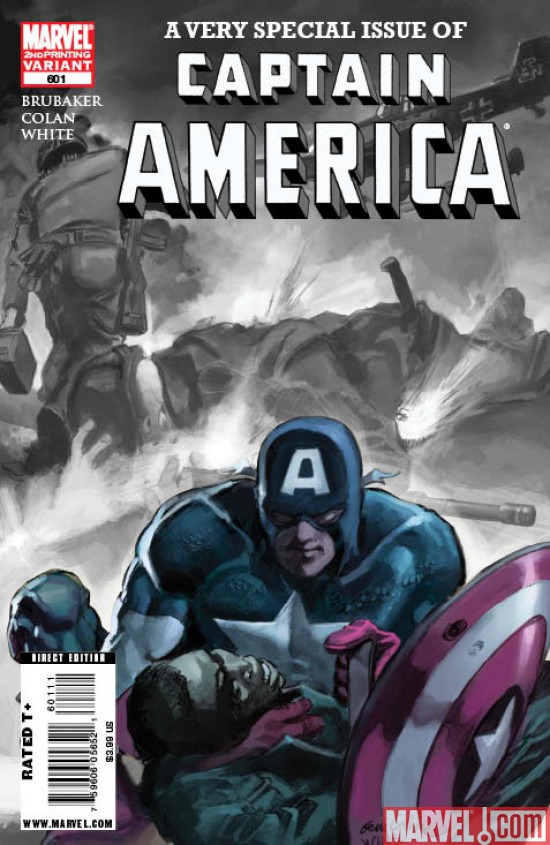
What I want to focus on, though, is his final Marvel work; a flashback WW2 Captain America story written by Ed Brubaker. When I saw this, it didn't look like the Gene Colan comics of which I was familiar, due to the unique mix of graphite and watercolor. But it was just as beautiful as any of his earlier works. It was a dark, atmospheric style suited to a dark, atmospheric story involving Captain America and Bucky being besieged by vampires. Not only was Colan an extremely talented artist but he was able to continue learning, growing, and reinventing himself, even as he approached his final days.

God bless you, Gene, and rest in peace. :(

Thursday, June 23, 2011

TVTropes Gives Me Bigoted Backhanded 'Praise'

Every day I go to TV Tropes, and every day I look to see if there've been edits to the Ruby's World page. Usually there aren't, so I was excited to see that somebody had catalogued some new tropes in relation to my comic. However, some of the the tropes added were offensive, and not for their dismissal of my talents. I quote directly from the YMMV section;

"Better Than It Sounds: Anybody who's trolled around the internet for long enough is no stranger to mentally handicapped people doing stories revolving around their aspie fixations with art that looks like it was done by somebody in grade school. That such a thing could be well-written, even thought-provoking and emotionally moving, is something else altogether."

Putting aside the insult towards my art (which I don't think is fair, because unlike Chandler I don't plagiarize and actively work to improve my draughtsmanship and my visual repertoire), I find the comparison between me and Christian Weston Chandler to be appalling PERIOD. This is the webcomics equivalent of Godwin's Law. And I've been compared to the being of unfathomable patheticness because A.) I am also on the autism spectrum and B.) also do a webcomic. The praise at the end is a backhanded compliment, because it suggests that I shouldn't be able to write anything good because of my apparent mental handicaps.

Given how much of Ruby's World is about the value of the individual experience due to the way the individual uses the hand life deals them (no matter how crappy), and given the explicit anti-ableist references I've made in the comic, it seems the person who added that trope didn't glean anything from my work. Apparently the value to my comic is in spite of my neurology, and is not informed by it.

Jesus, people, if you want to say "Your Webcomic Is Bad and You Should Feel Bad" to me, say it. Don't insult everyone on the spectrum in doing so, and FOR GOD'S SAKES DON'T USE CHRIS-CHAN AS YOUR STEREOTYPE OF AUTISM.

X-Men First Class Movie Review: Magneto Roolz, Charlie Droolz


X-Men: First Class was easily the finest Marvel movie I've ever seen, and probably the finest superhero movie (eclipsed only by Dark Knight, but at least First Class was unmolested by Christian Bale's goofy-ass growling) ever made. The difficulties with the film's production allowed director Matthew Vaughn and his crew to create a Marvel movie liberated from almost all of the cliche hollywood narratives, and gave us a superhero movie that actually had something important to say.

At its heart, the film is the story of the how X-Men's two key philosophers met,i.e. Charles Xavier (played by James McAvoy) and Erik "Magneto" Lensherr (played by Michael Fassbender). As expected from a movie about Xavier and Magneto, the story shows them drifting apart as their ideologies prove incompatible. But while the comics and the previous movies left the Xavier/Magneto equation as a matter of good vs. evil, X-Men: First Class shows us that Xavier is just as flawed as Magneto, and both men are equally victim to their hubris.

No punches are pulled in showing how different--and better-- Charles' youth was from Erik's. While Erik grew up in Auschwitz and saw his mother brutally murdered, Charles grew up in a mansion, and met a young mutant girl (Raven Darkholme/Mystique, played by Jessica Lawrence) to relieve him of his poor little rich boy angst. And while Erik spent his young adult hood hunting down Nazis in a quest to find the man who shot his mother, Charles went to Oxford, used his telepathic powers and knowledge of mutation to whore around, and kept the admiring adult Raven firmly in the friend zone (which he claimed was due to their childhood together, but was more likely motivated by his repulsion at her true, blue form; unlike Raven, Charles has no struggle trying to pass). Charles got the advantages of being a mutant without the drawbacks, and he didn't even appear to have the telepathic angst caused by stray thoughts.

The two men eventually meet when they end up facing a common enemy-- Sebastian Shaw (played by Kevin Bacon), who not only was the Nazi doctor who killed Erik's mom in an attempt to trigger his powers, but is using his Hellfire Club connections and mutant posse to try and heat up the Cold War. From there the two men instantly bond, and with the help of the CIA and agent Moira MacTaggert (Rose Byrne, playing a much different character than the comic version and her Scottish brogue), they start assembling young mutants. Of course, the more they get to know each other, the more they end up drifting apart, and the conclusion is tragic (though inevitable, given that this is a prequel).

Shaw makes an excellent villain because of the singularity of his vision and the lack of morals getting in his ways (as he did ally himself with the Nazis). But though neither Charles or Erik are as outright evil as Shaw, they both fall victim to their singular perspectives without trying to consider the other one's opinions. Note that the founding of the X-Men could not have been done without Erik-- Erik pushed to keep the CIA out of their affairs (while Charles would have cooperated), and Erik got Xavier to train the students for combat (Charles would've just taken them back to their homes, even for the ones whose homes were jails or strip clubs). Also note that Magneto doesn't become truly powerful until he embraces Xavier's motto that true focus lies between rage and serenity. When the two men cooperate, they can achieve virtually anything because they compensate for each other's weaknesses. It's when they become enemies that both end up being a detriment to mutantkind.

That's right, I said both. Vaughn's movie and McAvoy's performance give form to an idea that until recently many X-Men writers have simply danced around-- the idea that Xavier truly is holding mutantkind back. As we see in the movie, Xavier's idea of peace means teaching mutants to pass for human. He encourages Raven to maintain a regular blonde, Caucasian appearance, cooperates with government agencies that clearly want to enslave and/or terminate mutants (even if it's just starting as registration, as Erik points out), and advocates Erik against killing the former Nazi Shaw. He will use his powers to brainwash when necessary for survival, but that just makes him hypocritical. For Charles, the goal isn't "mutant and proud" so much as "you're a mutant? I hardly noticed".

Magneto's actions are similarly misguided, and definitely more destructive due to his extremist bent. Yet he's still more sympathetic than Xavier, because he actually knows what homo superior will have to face. Similar to Mystique, the audience finds him more appealing because he's fighting not just for mutantkind's survival, but also for mutantkind's individuality. Chris Rosa of Meltdown Comics got me excited about this film by telling me that Fassbender played Erik similar to Big Boss/Naked Snake of the Metal Gear Solid games, and the comparison is apt. As corrupted as both characters would later become, we see exactly what traumas put them on this path and sympathize with their perspectives, even if we can't condone their actions.

In many ways, this is a spiritual prequel to the modern X-Men comics. Grant Morrison's X-Men tried to resolve a dilemma similar to the one posed in First Class by having BOTH Xavier and Magneto prove obsolete. The way he portrayed Magneto's decline was a bit less subtle (if you can call getting high on drugs and genocide subtle, though I'd argue that it was a necessary point), but Morrison also demonstrated Xavier's impotence by having all the mutant cultural revolutions happen outside of his control. Keep in mind that the Xavier who outed the X-Men was actually his evil alien twin using his body; once the real Xavier returns, he finds himself a mere observer to a world far more complex than he could imagine. Yet that world was there all along, when the X-Men were playing superhero to appeal to the human masses while retreating to the gilded cage that is Xavier's Mansion during their off hours. This makes the X-Men's Utopia an inevitable response to a multicultural world*, allowing the new culture their own space to create their own society.

I could go on about the other details of the film, such as the specific actors' performances or the bizarre choices of characters, but the overall story was so great that complaining about small details** feels like a fanboyish waste of time. Highly Recommended.

* No matter how much of a douchepocalypse their president-for-life may be.
** I will note without reservation that the treatment of Darwin was angering, reducing one of the most charismatic of the new recruits to minority cannon fodder.

Sunday, June 19, 2011

Learning Social Skills with Solid Snake


Metal Gear Solid is infamous for its many repeated quirks, including rampant fourth wall breakage, high proportions of cutscenes, rampant homo-eroticism, and coaxing tears out of even the most masculine gamers' eyes. One of the most prominent quirks is protagonist Solid Snake's tendency to echo whatever is being said to him, repeating the most significant proper noun of the previous statement as a question. The most obvious example occurs whenever the titular Metal Gear robot is mentioned, in which Snake will say, "Metal Gear?!"

This can be annoying, but it's also a valuable conversation-maintenance tactic that can be applied to real life. By repeating the subject of the other person's conversation, Snake demonstrates that he was listening to what they were saying. He also fills in what otherwise would have been an awkward pause had he not spoken up. And by phrasing it as a question, he shows to the other person that he's interested in what they're saying and wants to hear more. Since almost everybody likes to be asked questions, they won't scrutinize the fact that Snake isn't contributing much to the conversation himself (unless he's making some poetic speech about the battlefield, in which case you listen because it's Snake).

Snake is not only a master of CQC, but he demonstrates with elegant simplicity an uncanny understanding of the dynamics of conversation.

Thursday, June 16, 2011

Dear Rebooted Superman


You've got your costume on inside-out. The trim goes on the inside. A Man of Tomorrow should be able to figure this out.