Ruby Nation

Ruby Nation
Ruby Nation: The Webcomic

Tuesday, July 10, 2012

The Goldfish's 10 Things Fiction Writers Need To Remember About Disability: The Spider-Man Movie People Should've Read This


One of the greatest essays I've read in the past few weeks online the Goldfish's 10 Things Fiction Writers Need to Remember About Disability. It's been broken up into Part One and Part Two, and both are well worth considering for any writer.

It's especially relevant to me because I read the first part the same week I saw the new Spider-Man movie, and while I liked that movie a lot, many of these things were ignored in regards to the film's antagonist. Of all the characters they could've picked, they chose Dr. Curt Connors, a.k.a. the Lizard. This character, who thought his amputated arm was such a disgrace that he would risk his own life to cure it (and, in doing so, turn himself into a giant reptile monster), represents several things on the Goldfish's list;

3. People with long-term impairments or chronic illness are not fascinated by their own condition or their own symptoms. While Connors doesn't natter on about statistics regarding amputated or malformed limbs, he is obsessed with curing his ailment, right down to his "World Without Weakness" rhetoric. Whatever sympathy he would've gotten for his handicap and his daily accessibility issues is lost when he starts using Eugenic language, and "weakness" is a term with further reaching connotations. Note that Connors is not dying, nor is his life completely ruined due to the lack of his arm. It's understandable that he would be frustrate with his limitation and admirable that he'd go into medical science, but using himself as a test subject shows a deeply internalized self-hating ableism. (And I get that he was feeling awful at the time, looking at being fired or even disappeared by Norman Osborn, but he'd been spouting the World Without Weakness rhetoric since his first scene.)


4. Disabled people are not all young, white, straight, affluent men. Connors is an older gentleman, so he at least beats the ageist part of that majority formula, but he's male, white, (presumably) straight, and lives comfortably. Then again, the Amazing Spider-Man movie only has a few female characters (albeit in important roles; Gwen Stacy is used superbly here as Peter's confidante as well as his girlfriend, and Emma Stone does a great job with the character. Aunt May is also used effectively, albeit with less screen time). It also has only one remotely significant character of color, that being Norman's henchman. And there are no gay, bi, or transgendered/intersexed characters. Not a surprise, and I can't hold it against this movie specifically, but it does illustrate the problem; young, white, straight, affluent, and abled men still control all the most visible narratives. 


Again, I liked Amazing Spider-Man a lot as a movie, and it's definitely in my top 5 of superhero films. But it's still a reminder that big budgets and blockbuster sales are rarely given to stories outside that very limited Hollywood narrative.


5. Disabled people go bad for a reason. There is a reason, but it's not a good one; surely Connors would've known that jamming himself full of reptile DNA wouldn't go well, either killing himself (a true act of weakness, regardless of physical or intellectual challenge) or turning himself into a monster. Since it's the latter, Connors is responsible for everyone the Lizard killed, in the same way that a drunk driver is accountable for the people they run over. Worse yet, even after Connors reverts back after his initial transformation, he's clearly gone evil by this point, addicted to the power of being the Lizard and chewing every inch of scenery.


6. There aren't many reasons for disabled people not to have sex. In the comics, Connors is (or was) married with a kid, so this was averted. Here, he seems to live alone and doesn't show any evidence of a romantic life. He's portrayed as completely sexless, though at least without a family, Connors doesn't betray those responsibilities. (And that might make the comic version worse, because in one of his most recent transformations, Connors ATE his son. Surely he'd rather have had a living son than a regrown arm, had he known what the Lizard serum would do?)


9. Disabled people know other disabled people. Connors is the only disabled character in the movie. Then again, if he'd talked to disabled people about his "World Without Weakness" nonsense, they might've been offended. I wish someone had asked him which is worse; not having an arm, or living in a world that makes you feel like a pariah without two arms? (this was done very well in X-Men First Class, when Mystique told off Xavier for trying to fit in with a bigoted world. By coincidence, that movie also had a major character try to cure his disability with science and fail miserably, with Hank McCoy's faulty mutant cure. That was even more foolish on Hank's part, because he wasn't physically limited beyond being forced to hide his simian feet, which was society's fault and not his own. Though he got off easier, because while the cure made him blue-furred, he did keep his mind, unlike Connors).


10. Disability is not a conflict that has to be resolved. Perhaps this is subverted because Connors is punished for trying to resolve that conflict, being sent to prison and not even keeping his regrown arm once he reverts to his human form. But the audience is supposed to sympathize with Connors for being an apparent "cripple", and for trying to cure his condition. And ideally, that sympathy would vanish once he acted on the feeling that he'd rather be dead or a monster than alive with one less arm than most. 


Again, thanks to The Goldfish for these great discussions!

Thursday, June 21, 2012

Metal Gear Solid: Guns of the Patriots Novel Review: A Labor of La Li Lu Le Love


As anyone who's known me in the past two years can attest, I love Metal Gear. It's been the subject of my literal autistic obsession ever since I played the original PS1 game as a digital download. Since then, I've played through every game, beat all of the games in the Solid series multiple times, collected the various merchandise (including those beautiful but expensive Play Arts figures), and worked references into several aspects of my life (including my comics). Metal Gear has all the things I look for in a story; complex and sympathetic characters, a sophisticated (if often arcane and absurd) narrative, an ability to switch between wacky humor and tear-jerking drama, and a complex metatextual understanding of its own nature as a story. The best of the series, IMO, was Metal Gear Solid 4, the canonical ending of hero Solid Snake's story as he pulls his his dying, prematurely aged body together for one big final mission.

When I heard there was a novelization of MGS4, I was initially blasé about it; novelizations are usually mediocre to poor, as cheap cash-ins haphazardly trying to shoehorn a story into a different medium. The more appropriate piece of evidence for this case is Raymond Benson's novelization of the PS1 game, which treated the story as though it were a straightforward, cheesy James Bond epic, even giving Snake several lame one-liners (such as saying "Merry Christmas" to an enemy Genome Soldier, then choking him to death and saying "Christmas came early this year!"), which didn't fit at all with his usual warrior-poet personality. But this novelization has a much greater pedigree; it was written by the late Project Itoh (real name Satoshi Ito), a Japanese novelist and a personal friend of Metal Gear creator Hideo Kojima. Itoh was diagnosed with cancer in 2001, and fought a long, hard battle that tragically ended with his death in 2009. Kojima even writes the afterward of this novel, praising Itoh's work here and on his original stories (many of which were originally fan fiction of Kojima games like Snatcher), and saying that his "genes" are now infused into the Metal Gear mythology. Given how the series is all about genes and memes passing from generation to generation, this is lofty and touching praise.

But how is the novel itself? First of all, I should say that if you're a Metal Gear fan who's played MGS4, you absolutely have to read this book. The narrator is Hal "Otacon" Emmerich, who recounts the final days of his hetero life-mate's life (as he promised at the end of the game, bearing witness to everything the legendary hero was). This is a unique and more somber account of the events, leaving out the action scenes that wouldn't have contributed to the plot (such as the Beauty and the Beast Corps battles, grotesque parodies of Kojima's own wacky mini-bosses), and adding some background detail that fills in the gaps and revises the sillier elements of the story. For example, there's a section on the villainous Liquid Snake's history, which removes all the "recessive/dominant gene" nonsense of his backstory and instead tells about how he spent many of his formative years as a POW during the Gulf War, being degraded and tortured and left out to dry by his own government, while his twin-brother Solid Snake became the glorious hero of Outer Heaven and Zanzibar Land. There's also some interesting sci-fi explanations of elements that might have confused you, such as all the bar codes on Raiden's cyborg exoskeleton, or the full extent of Snake's illness. It may not have occurred to gamers that flying from Morroco to Peru to Czechlosovakia to Alaska to a floating ocean fortress was very hard on Snake's lungs, given all the wild differences in atmospheric pressure.

And if you haven't played any of the Metal Gear games? To be honest, that's a bit of a harder sell. MGS4 was a game with an extremely complex plot that invoked story threads from throughout Metal Gear history. The game worked because there were playable segments that didn't need such complex understanding, as well as an easily understandable and sympathetic main story of Old Snake's final mission. Here, a lot of it is left to exposition, including details that tell what characters feel instead of showing. It was written to be accessible to a wider audience, but in the end there's a bit too much hand-holding with the dialogue, especially when it comes to Solid Snake's motivations. Then again, that may be justified by the fact that this is written from Otacon's perspective, and it seems within his character to mix long technical pieces with blubbering histrionics. Especially when it comes to Snake, since Otacon lived and worked closely with the man for nine years, and saw more of Snake's tender core, rather than his tough super-soldier exterior.

But though the writing can be overwrought, I'd still recommend this as a piece of science fiction. For all its warts, including a convoluted narrative, a generous amount of Narm, and a villain who is possessed by the transplanted right hand of another villain, MGS4 is still a heartfelt story with a beautiful message. By this point, the series had evolved from being an anti-war narrative to an anti-digital-control-narrative to an ANTI-NARRATIVE NARRATIVE. The dystopian future of MGS4, where mercenary companies have dominated the world, war exists as the impetus for the global economy (how very far-fetched, he says with a roll of the eyes), and almost everyone has their senses monitored and influenced by nano machines, is the grim result of a power struggle between men trying to enforce their own ideal narratives upon the world. The utopian obsessions, spawned by different misinterpretations of a heroic idol, have led to a struggle of liberty vs. security with a result that satisfies neither. And Solid Snake, an artificially created man manipulated by both sides, has to put things right, motivated by no ideology but the desire to keep the world afloat so future generations can make their own decisions. The kanji character on Snake's uniform/powered armor in MGS4 stands for "To Let The World Be"*, and while this may at first sound like cowardice, it's actually a strong endorsement of volunteerism. If people do not make their decisions of their own free will, as opposed to subscribing to a systemic master narrative (be it religion, nationality, or the idolatry of a hero like the Boss from Metal Gear Solid 3), then there can be no progress.

Now if you'll excuse me, I'm going to check out some of Project Itoh's original works, right after removing the tears from my eyes after experiencing the Microwave Hallway scene AGAIN.

* You can even use this for a disability rights reading, since it endorses acceptance of differences and individual perspectives over master narratives, including ableist ones like enforcing that people try to be "fixed". 

Wednesday, June 20, 2012

Northstar's Big Gay Wedding vs. Cyclops' Big Dumb Utopia


(First of all, I apologize for not doing more blogging here, and want to make clear that my readers here are indeed an important priority for me. So here's more content for those interested in what I think, which miraculously includes at least a few.)

Two important Marvel comics released this week. The first one was Astonishing X-Men #51, where Jean-Paul Baubier (a.k.a former Alpha Flighter and current X-Man Northstar) and his boyfriend Kyle Jinadu married in the state of New York. The other one was Avengers vs. X-Men #6, where Cyclops and four other X-Men claimed the power of the Phoenix for themselves, and used it to transform the world into a  Mutant-run Panopticon with free food, water, and energy for all- provided nobody steps out of line.

And Northstar did much more for mutant kind and the world than Cyclops did.

Scott Summers' "Pax Utopia" (as he calls it) is the kind of quick, shallow fix that characterizes almost all fictional paradises, and creates a standard that reality can't possibly reach. With the power of the Phoenix, his X-Men have created a world where nobody wants for anything, except for freedom from his reign. In the best case scenario, living in Scott's world means you're living in a sterile but pleasant bubble a la Adolus Huxley's Brave New World, where you don't need to worry about anything because you can just get a drug for any potential pains. In the worst case scenario, it's a pervasive prison where your telepathic mutant overlords can make your disappear for even a wrong thought. This is a perversion of what Charles Xavier dreamed, because instead of appealing to the human race's logic and compassion, Scott has just scared them into submission. Then again, that was his goal with the Extinction Team at the beginning of the new Uncanny X-Men series.

Northstar, on the other hand, acted on a much smaller and more personal level-- he married his boyfriend. He even did it in the state of New York, which already allows gay marriages (as a page in the back of the comic so helpfully illustrates). But Jean-Paul and Kyle did so in front of a crowd of seemingly hundreds, human and mutant, and with members of both teams of X-Men (at Wolverine's school and Cyclops' Bay Area banana republic). This isn't just a gay marriage, but an inter-species one, and even an inter-racial one (since Jean-Paul is white and Kyle is black, though the stigma of mixed-race marriage has lessened by comparison). Jean-Paul and Kyle fell in love with each other not despite their differences, but because of them; even the difficulties of marrying an X-Man constantly chased by super-villains wasn't enough to deter Kyle.

If progress doesn't happen by choice, it's not progress. Cyclops may try to save the world, but he's long since lost interest in engaging with it. He almost never takes off his X-Men costume, he does everything as the self-appointed Leader of The Mutant Race, and he speaks of defending lofty ideals over actual people. He can't make peace with the humans because he doesn't care about them, and the gifts he offers homo sapiens in Avengers vs. X-Men 6 come at the price of making the species into mutant kind's pampered pets. The Big Gay Mutant Wedding was a much greater victory for Xavier's cause because it was a literal union between human and mutant. And better have progress start with one couple choosing love past boundaries than making humanity into seven billion well-fed slaves of mutant masters.

Monday, May 28, 2012

Ruby Nation: Chapter 2 Talkback!


We're at the Chapter 2 point, Ruby Nation has hit the big revelation I've been leading towards since August of 2011. This is the point where I want to open a talkback friend for everyone who's been reading sso far. If you've been following my comic, please take a second to answer these questions. And be honest, because thoughtful feedback is necessary for improvement.

1.) How do you feel about Ruby Nation thus far?

2.) How do you feel about the ending of Chapter 2?

3.) How do you feel about the existence of the Ruby Nation Wiki/About Page?

4.) Do you have a favorite character so far? Why?

5.) Do you have a least favorite character? Why?

6.) What would you like to see in the coming strips?

Thank you in advance. You can email me any further comments and questions, as well.

Saturday, May 19, 2012

Grant Morrison, Supergods, and Super-Obama; WTF


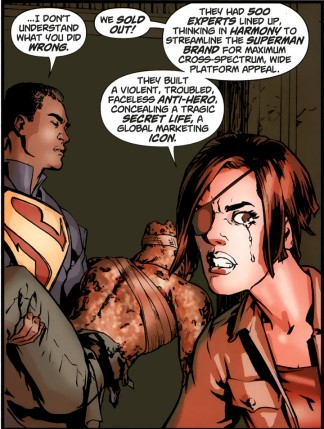
A friend of mine (Omar Karindu, as he goes by on Comics Should Be Good and Alvaro's Comicboards) suggested that Action Comics #9, the filler issue with President Calvin Ellis (a.k.a. President Superman, a.k.a the Super-Obama from that Alex Ross shirt brought into canon), was filled with subtext about how companies screw comic creators. Upon re-reading the comic, it's pretty obvious, and quite troubling.

In the comic, Super-Obama faces a corrupted Superman tupla (Tibetan for Solid Thought, a living idea). This was created by the Clark Kent, Jimmy Olsen, and Lois Lane of another world, who created the living idea to embody all that is great in humanity. But they needed a lot of money to bring the Super-Idea into existence, so they went to an amoral corporation who took their Super-Idea and warped it into their Super-Brand. Hence, that trio's world became an Orwellian police state ruled by a faceless, violent Super-Brand, which was colonizing other universes and killing their super-men. To quote their Clark's dying last words;

" He becomes anything you want him to be....our world wanted THAT..."

This is an interesting interpretation of the creator's rights debate that has particularly been on the forefront of the industry discussion in recent months. It also comes across as hypocritical coming from Grant Morrison. Not only has Morrison built his career largely on the characters of others (Superman in particular, but also Batman, the Justice League, and to a lesser extent the X-Men), but his interpretation of Superman transcends any writers or artists-- even Jerry Siegel and Joe Shuster, who he characterizes more as agents of the collective unconscious rather than actual creators of the character.

In Supergods, Morrison's history text/critical essay collection/autobiography/metaphysical ramble (which I've held off on reviewing due to its extremely frustrating and rambling nature), the Scottish writer basically dismisses the problems of Siegel and Shuster. He says that he started "believing" that DC swindled these two young men out of what was rightfully theirs, but later realized that it was business as usual, and both Siegel and Shuster legitimately sold Superman to DC while expecting to keep creating other heroes. Since Morrison is one of DC's highest-profile creators, it makes sense that he wouldn't speak badly about the company that made him a star. But Supergods talks about how Superman is an idea of greatness beyond the men and woman who created him, so Siegel and Shuster end up just a footnote to their own creation. Never mind the fact that both men fought hard battles for the character that DC made billions off of, or that they struggled to make end's meet while their creation made the rich even richer. They're just sacrifices to the cause.

Matt Seneca provides a good argument against Morrison's dismissal, albeit with harsher language against the man than I would use. I love Morrison's work, though I can't and won't speak to his quality as an actual human being. But his creed, the idea that fictional characters are ultimately more important than real people, isn't just New Age bollocks. It's also the kind of idea that creates the same problem Super-Obama must face, where a faceless brand is placed above the welfare of flesh-and-blood humans. And that comic doesn't even give it a good resolution, because it's Super-Obama who defeats the Super-Brand, not the Clark, Jimmy, and Lois who rightfully own it. Lois calls Super-Obama "Superman done right", but she's just crediting him as a good example of The Brand, not praising his virtues as an individual.

Is Morrison making a hypocritical argument with Action Comics #9, arguing against the ideas that he celebrates as one of DC's golden boys? Is he making a subversives attack against the company through his comics, the kind of statement he can't make directly? Does it even matter? Not really, because Super-Obama was the star of a filler issue. Next issue, we'll go back to the young, "hip", white, marketable "Ultimate Superman" we've seen in the New 52 reboot. And it won't matter that Super-Obama was an example of how to use the brand for good, to empower the downtrodden and reclaim power from the oppressors, because the brand is more important than the sum of its parts. In the end, Superman exists to sell Superman. The great stories told with the character are the result of the individual writers and artists putting in the creative effort to animate him, but in the end, there is no inherent value to Superman. Morrison tries to present Superman as a religion, but like any religion, it can be used as a tool of oppression.

And it's in really bad taste to call attention to the problem at the same time you're profiting from its perpetuation.

Thursday, May 10, 2012

I Can Has New Comix: Poet Kitties!


An attempt to subvert the pidgin English of LOLCats and give cats the kind of language they feel they deserve, Poet Kitties will update with new strips at least twice a week, on Mondays and Tuesdays. You
can see the site HERE.

 And for fans of Ruby Nation; well, all three of you should be happy to know that this side project won't impede that story's progress.

Sunday, May 6, 2012

Avengers Movie Review: A Thoughtful Fangasm (SPOILERS)


When I saw the Avengers movie yesterday, I thought there were two film's competing for the (hypothetical) audience's attention, and while I enjoyed one, I could've done without the other. The first film is a thoughtful character piece which takes a look at the costs of military expansion and the theory of deterrence's validity. It's immediately established that Fury would never have unleashed Loki and his Chitau'ri allies on Earth were he not fiddling with the Tesseract as a means to make weapons. He claims that he was looking at a source of clean energy, but as is so often the case with the military industrial complex, the beneficial uses of the new technology just end up as the agreeable wrapping paper trying to hide the jingoistic core. He assembles the Avengers to clean up the mess he effectively caused, and when they find out what he's really been up to, he justifies it by blaming them for bringing superhuman menaces to Earth and claiming a need for self-defense. Self-defense is perfectly valid, but it's hard to believe that Fury and SHIELD would just stop at deterrence. This is an organization wire-tapping every electronic device around the globe, confiscating/stockpiling the weapons of the worst criminals in history, and sending their highly skilled agents to capture or kill people at will. If anything, it confirms Loki's idea that people want to be ruled-- that they would rather feel safe with Big Brother watching over them, than know any true freedom. Which works up to the point when it doesn't, when you end up with neither due to an invasion. The best review I've found of the Avengers is Something Awful's, which eloquently (if critically) expresses this problem. However, I disagree with the author's belief that the Avengers is a justification of the US brand of imperialism. If anything, it's advocating the ability of individuals over byzantine political systems. The Avengers are all unique, skilled, yet damaged individuals. They may have been collected by Fury, but when they form a team, they do so on their own terms. And after they defeat the enemies, they go their separate ways, but will still come together if needed for another crisis. The Avengers don't represent America or any other nation; they represent people who can and will save lives. The only will they follow is the will of Coulson, after he proved too good for our sinful planet. The other film, on the other hand, is exactly what I feared the Avengers would be; a sensationalistic fangasm, a film that exists with no purpose beyond putting a bunch of big stars in the same room. For the most part, the Avengers avoids this due to mixing thoughtful and sympathetic character scenes with the big set pieces. However, we all know which one gets asses in seats. So unfortunately, the latter half of the movie is one long, repetitive fight. Which would be fine if it were shorter, but when you keep the action at that high level for so long, it stops being so intense. The Chitau'ri have no personality beyond being Mooks for the Avengers to slaughter (I assume they don't have families, right?), and their design doesn't even go beyond most CG aliens. When the Chitau'ri ship appeared, the big metal snake reminded me of Shockwave's craft in Transformers 3. Any time I'm comparing something to a Michael Bay movie, that's not a good sign, though at least this movie has substance beyond the prolonged final battle and at least keeps its goddamned camera steady. My fear was that this would be the end of the super hero movie's unique qualities; once they get to the crossovers, they become the same recycled garbage that so often characterizes the comics. The superhero is no longer special, but a face in a crowd of hundreds of others, with the act of putting on a costume being just another profession in that universe (albeit one that looks ridiculous to most in our universe). The Avengers doesn't go that far, as it thankfully keeps to a smaller cast and features a well-written story on top of all the requisite explosions. Still, can the next Avengers movies keep that self-contained? Or will we inevitably see "Avengers V: Secret Infinity Siege " and " Avengers VI: Coulson Reborn"? My general perspective with Marvel media (or any big franchise divorced from its original creators, for that matter) is to assume it's going to be bad and be surprised when it isn't. But with the Avengers, at least, I was surprised. Highly Recommended.