Ruby Nation

Ruby Nation
Ruby Nation: The Webcomic

Thursday, September 15, 2011

5 Ways to Magically Cure a Disabled Character, Part 1: Conspicuous Assistive Technology

In the comments section of my Batgirl review, it was asked why Barbara never used the DC Universe's supertech or magic to fix her spine. This is a question that comes up often around this issue, and is valid. Granted, it's a slippery slope towards removing any sense of dramatic urgency from the world, when you can just Phlebotnium any infirmity away, but it stretches disbelief a bit too far when characters bemoan their tragedies but don't go for the genre solutions right in front of them.

Of course, as another comment noted, supernatural injuries would be treated by supernatural medicines, and every medicine has its side-effects. So I'm doing this series of blogs to examine the ways in which these magic cures can be used to further the story and explore issues of disability, rather than simply swipe them under the rug and pretend they don't exist.

NUMBER FIVE: THE CURE IS DEFORMING (I.E. CYBORG PARTS)

This might stretch disbelief as well, because if the universe has technology sophisticated enough to replace a lost limb with a superhumanly strong prosthesis, it could go just a little further and replace it with one that looks human as well. However, it's a good symbolic way to show that even though the character has regained their mobility, they remain affected by the experience. It also makes the notion of "fixing" a disability less appealing, because disability is a social construct. This is a reason given for why Barbara Gordon never asked her pals in the Justice League to make her a walking exoskeleton; a wheelchair is hardly as conspicuous as a clunky robot suit that gives the wearer enough strength to crush a man like a paper cup.


BEST EXAMPLE: Cyborg of the Teen Titans. Victor Stone's life was saved from a life-threatening injury by replacing most of his body with metal parts. However, Vic wasn't very happy about this, and the fact that his father did the operation further intensified his daddy issues. He was kicked off of his high school football team, was abandoned by his girlfriend, and basically got cut off from society. It wasn't until he met the Teen Titans that he found a purpose to live again, fighting alongside other outsiders, saving lives, and taking out his anger on people who had it coming. But he was still mostly robotic, his human parts limited to half his face and bits of his torso.

What's also worth noting is that even though Victor's new body let him be a superhero, it also had a spectacular downside; it ruined his ability to be an athlete. When Vic was human, he loved football, and trained intensively so he could get stronger and stronger. But his cyborg body was not only superhumanly strong, but limits were built into his mechanical muscles. Several stories touched on the fact that he didn't like how he was robbed of the ability to improve himself with exercise. An episode of the cartoon even had this as the central conflict (though it ended with Cyborg beating the villain through the power of determination, presumably because his meaty bits gave him a boost of strength....somehow).

Other Sci-Fi/Fantasy Examples:

Raiden from Metal Gear Solid 4; The much-loathed replacement Snake from MGS2 got a major upgrade in MGS4, becoming a Cyborg Ninja. But he looked even less human than any of the other cyborgs, with claw-like hands, cloven feet, and the lower half of his head replaced by metal. At the ending he gets his combat limbs replaced with more realistic prostheses, but you can see all the seams. Raiden's most human appearance since his cyborganization still makes him look like a Ken doll.

Robotman from Doom Patrol: Poor Cliff Steele is an even greater extreme of the "disfiguring prostheses" trope; he's a brain in a jar, attached to a robotic body. Not only is he treated as a freak (even despite his heroic exploits; the Doom Patrol are some of the most Marvel-like characters in DC), but the amount of everyday human sensations that he's lost is profound. Cliff's described his predicament as phantom pain for his entire body.

Barret from Final Fantasy VII: The JRPG analogue to Mr. T lost his hand when being shot at by Shinra goons, the same goons who destroyed his hometown and killed his wife. The replacement for his hand was a huge cannon he used in vengeance. This is an odd version because Barret intentionally chose an intimidating weapon instead of a prosthetic hand, not caring about much beyond killing all of Shinra. In the Advent Children animated movie, he mellows out and gets a regular prosthetic, a metal hand that's conspicuous but actually functions like the original limb.

And again, you could just invent perfect replacements, but if it's a perfect transition, where's the story? An amputee might be pitied, but a cyborg is more likely to be feared and hated. It's a good metaphor for the way the experience of such trauma changes a person; once it's there, you can't be the same person you were, and others will pick on that.

Thursday, September 8, 2011

Newsarama on Batgirl: Excerpts from Yours Truly!

A few weeks ago I was interviewed by Vaneta Rogers of Newsarama regarding the Batgirl fiasco. I have hardly been quiet about this series of unfortunate events, but I was honored by the request. Vaneta's piece is up, which also includes quotes from Denny O'Neil, John Ostrander, and Professor James B. South.

It is a high honor to be quoted alongside these industry legends. :)

Wednesday, September 7, 2011

New 52 Batgirl #1 Review: Wasn't That Paralysis Just A Hassle?


The new Batgirl comic is finally out, and it's simultaneously not as repellent as I expected, yet still inherently repellent.

In all fairness, the story is still unfolding, and it's well-told. I'm not objecting to the abilities of Gail Simone as a writer or Adrian Syaf as an artist. It's the fact that the team involved is so talented that makes this book so galling. They should be able to do something better, and avoid the pitfalls.

Because at this point, it looks like the new Barbara Gordon was still shot in the spine, but got better. She says that she was in a wheelchair for three years after the Joker attacked her, but then " a miracle" happened. We don't hear what that miracle is, and I imagine we'll find out. But I don't see how it could be anything more than a quick Phlebotnium fix. The way Barbara's narration frames the miracle, it sounds like she spent the three years without her mobility just sitting on her ass moping in a dark room, but then she found this cure and she's back in the game.

Credit should be given to Simone for at least making Barbara's "recovery" believable, in that she's not recovered from the psychological aspect. She still knows what it's like to have been in a wheelchair, and finds herself bothered by ablist remarks people make without thinking ( such as the whole "being in a chair is worse than death" bullshit). She still has nightmares about the shooting, and she's very nervous on the battlefield after the incident. The cliffhanger even has Barbara freeze up and fail to save someone thanks to a PTSD flashback from a criminal pointing a gun at her just the way the Joker did.

However, the fact remains that Barbara can walk now, and she's used that opportunity to go back to being a more famous character's distaff counterpart. The theory that she wouldn't be able to walk without her new armored costume is debunked by the images of Barbara walking around in her civvies. Perhaps the costume helps her with mobility, since her legs would've atrophied in the three years of paralysis. It could be similar to Old Snake's Octocamo suit in Metal Gear Solid 4, adding a slight boost in strength to help with her impairments but not actually making her superhuman. Of course, wacky textures on costumes are everywhere in the rebooted DCU, so it might just be Barbara jumping on this "HR Giger meets Victoria's Secret"* bandwagon.

The disability aspect is present, but it's a past-tense motivator, a handicap used to make her able-bodied self look stronger. But the things Barbara accomplished as Oracle, without leaving her chair, were much more impressive and meaningful. The comic is interesting enough and well-written enough that I'm going to keep reading it for the time being, but I sincerely hope the representation of disability goes beyond "Origin Story Tragedy". It's a deeper handling than most writers would attempt, but it's not enough to compensate for the semiotic ableism inherent in "fixing" Barbara Gordon.

* A description I saw in a ComicsAlliance comments thread, which seems especially apt when looking at the new Batgirl.

Sunday, August 28, 2011

Ruby Nation: New Webcomic, Same Great Continuity!

After several moons' absence, the story that began in Ruby's World finally returns. Ruby Nation picks up three months after the end of World, with Ruby and her team actively working to build their super-soldier refugee state while having to maintain their morals in light of the circumstances (and what they'll be forced to do)

If you didn't read Ruby's World, you can do so any time you like, but you don't have to. The purpose of this "reboot" was as a jumping-on point for new readers. The prologue hits the ground running, but all the details should become apparent in the coming weeks for those just coming to the party. As a longtime reader of superhero comics, I'm aware both of the richness that an established history can bring, and the downsides that come with its misuse. When the history becomes too prominent, it keeps new readers from being able to understand what they're seeing. And even if the continuity is explained, it's like being told about a great story secondhand, rather than actually seeing the story. I'd rather not subject people to my personal nostalgia (except for the Halloween cosplay sketches).

There is a middle ground between having a past and being enslaved by it, however. Many of the greatest series I've read/seen/played have clearly defined backstories. The X-Men didn't become popular until the International team debuted in the 70's, keeping parts of the original iteration but forging a new path. Buffy, the greatest fantasy show ever, was based on the backstory of an utterly terrible movie attempt. And Metal Gear Solid's postmodern mastery has its roots in the plain old Metal Gear games for the MSX, before the series had extensive cutscenes, horribly tragic fates, and homoerotic subtext bordering on actual text. Wether intentional or not, it seems like all these series had a rough start that nevertheless allowed them to grow and change into something great. Stories, as well as their storytellers, have to learn by doing.

TLDR; Ruby Nation will be to Ruby's World what Metal Gear Solid is to MSX Metal Gear.

Anyway, I'll be delivering more of these musings as the series progresses, as the simple act of creating a piece of art and putting it out there is an act of ego, so I might as well take it further and show you my process as well.

Friday, August 26, 2011

Batman 80 Page Giant: Batman Fights Autism, Strikes Blow For Sentimentality


The recent Batman: 80 Page Giant makes the unlikely intersection between Batman and autism. In the story written by Joe Caramagna, a nonverbal autistic boy is reading a Batman comic when his mother takes the book away from him. She's bitching about how he can't differentiate between fantasy and reality (apparently unable to get her stereotypes straight, as most of these morons say that autistic people are too literal to be imaginative), while his father talks about how comics are just harmless fun. After getting upset by the bickering, the boy looks out the window, and either has a fantasy that he sees Batman and Solomon Grundy fighting, or actually witnesses Batman and Grundy duking it out. But in the end, this enables the nine-year-old to say his first word, to the delight of both his parents; "Batman".

The story is slightly better than most fictional representations of autism, in that the autistic by is the actual protagonist instead of a plot device to make his parents sympathetic, and the "warrior mother" stereotype is as much a pompous blowhard as a tireless champion for her child's development. The story isn't exactly deep, but given how it's a back-up strip in an anthology magazine, we can't expect too much. On the other hand, this is the only place where we'd see the autism "issue" in a Batman comic, and it's used in a revoltingly sentimental fashion, right down to the "everything's going to be okay" ending. And if the kid can't tell the difference between fantasy and reality, he's got problems that are far more debilitating than the autism spectrum-- it's Sucker Punch all over again..

But the problems with the book are severely exacerbated when you take This Article into account, in which Caramagna tells his local newspaper about his creative process. I'm sure that Caramagna is well-intentioned, but those intentions are expressed in a very condescending manner towards autistic people. Because autism is such a horrible fate, the language surrounding it tends to focus on treating (if not outright curing/erasing) the disorder. In fact, Caramanga talks about how he designed the story to potentially "unlock their imagination"

I wanted to tell a story where comics can make a difference in someone’s life and get their creative juices going. I don’t want to make it sound like if you give a kid a comic, he’ll be cured. But I think they can be used as part of a creative therapy or artistic therapy. With autism, no one knows what might be the thing that unlocks their imagination.

I totally agree that a Batman comic can unlock a child's imagination. Because it's BATMAN. He's already a character with near-universal appeal, evidenced by the fact that he maintains a transmedia presence stronger than pretty much any other comic hero, and has his backstory etched in the public imagination. Using him as an autistic kid's fantasy/delusion isn't going to stir those creative juices any better than a straightforward Batman story. In fact, it's probably going to be less effective, because A.) people who buy Batman would likely rather read about Batman than a "special needs" sob story stereotype, and B.) the autistic character might outright offend some of us on the spectrum.

Aside from that one comment, Caramagna doesn't say anything too infuriating. Most of the problem is the way the interview frames the comic, as "fighting autism". Of course, these articles never see autism as part of an autistic person, the neurological identity that shapes them into who they are (albeit with a lot of trials along the way, but the trials of the autistic individual are rarely dealt with as something that causes THEM suffering; it's usually shown as the burden on their families); they treat it as a bogeyman, a Jokeresque villain that steals a normal child's soul.

Coincidentally, there is quite a bit of the Batman mythos that relates to autism. Bruce Wayne isn't on the spectrum because he's too multi-talented in his masteries, but the drive in which he trained at martial arts/criminology/invention/breathing in space definitely resonates with Asperger's-style obsessions. The villains he faces are often tragic figures, prisoners of their own madnesses, and can be sympathetic to those who have difficulty controlling their emotions. Hell, there are two characters that may well be on the autism spectrum (albeit by fantastical circumstances) -- Cassandra Cain, the former Batgirl and current Black Bat, has tremendous martial arts skills but struggled with basic language and literacy. And Bruce's artificially-conceived son Damien Wayne may also fit; he was built to fight, he was never given social skills, he's extremely temperamental, and while he wants to do good he has little to no idea how to do so.

Of course, this all requires critical thought, and stereotypes are so much easier to digest.

Monday, August 22, 2011

How To Write A Fear Itself Tie-In comic


Step 1.) Check the comic you're writing to see if there's an overarching story in progress. If there is, put it on hold until the end of the summer.

Step 2.) Find an existing character (one who isn't necessarily connected to the comic) and give them a magic hammer with a merchandise-friendly redesign attached. Don't worry about wether or not the character will actually be merchandised.

Step 3.) Give that character a new name along the lines of "(Name), Breaker of (Thing)". The first name should be something punchy, even if it doesn't make sense in any known language. The second should be something that sounds ominous.

Step 4.) Now that you have your (Breaker), have them start randomly killing (Random Civilians). Don't worry about giving them a credible motivation, the (Random Runic Dialogue) should make them seem ominous enough to compensate.

Step 5.) Have the comic's existing (Hero/Heroes) drop everything they were doing to try and stop the Breaker of Something.

Step 6.) Show how no matter what powers the cast have, or what strategies they use, the (Hero/Heroes) do anything against (Breaker). At the same time, NEVER have (Breaker) inflict any lasting damage upon anyone who counts, beyond (Random Civilians)

Step 7.) Between the action scenes, intersperse talking heads of (Hero/Heroes) whining and crying about how they can't beat (Breaker). If you wish, you can connect it to some sort of larger sociological point about the economy or the war on terror or whatnot. Don't go too far with this point, lest you get away from the Formula.

Step 8.) Resume your comic's normal storyline after the Fear Itself event is over, hoping your existing readers haven't gotten totally sick of this shit.

Tuesday, August 16, 2011

Follow the Horrors of Spider-Island


E. Wilson is a regular follower and friend of this blog who always has good insights about comics. I'm going to repay the favor by directing you to The Horrors of Spider-Island, his admirable quest to read and review every issue of the current Spider-Man crossover. Excellent reading, and an impressive commitment.

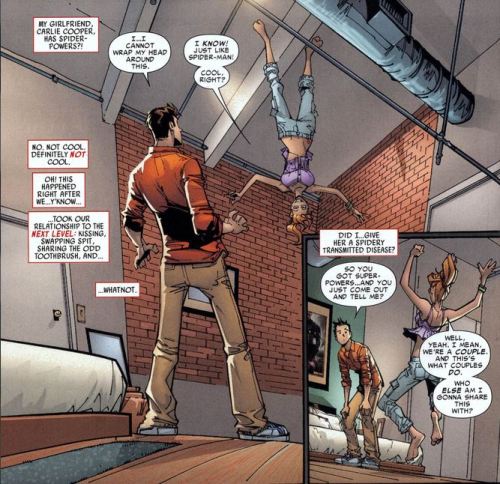
I'll be following the main comic as well, even though I'd stopped reading ASM once I realized that Dan Slott's interpretation of a twentysomething person doesn't go much further than rollerball and drunken tattoos and the hippin' and the hoppin' us darned kids do so much. Nevertheless, I have enjoyed Slott comics in the past, Humberto Ramos' art is perfect for such an over-the-top story, and if Carlie Cooper ends up getting herself killed after her apparent regression to the intellect of a 14-year-old fangirl with anime cat ears, I will be very relieved.

(And yes, this is probably the first time I've WISHED for a superhero's girlfriend to be stuffed in the fridge, but the major sin was in making the character so shallow and obnoxious that she actually interferes with her boyfriend's saving lives.)