
When I started chronicling the ten things I liked best about Bendis' Avengers, I knew that in fairness, I would have to write a list of things that I thought were mistakes. Earlier I compared Bendis' Avengers to Chris Claremont' old X-Men, and the biggest strength of both is also their biggest weakness; they produce a massive output of writing and take a lot of chances. Not all of these risks will pan out, otherwise there won't be risks. But even though Claremont did many ill-conceived things like a year of stories following the wanderings of the individual members of a disbanded X-Men, he also made the team the It superhero team comic for many years. I feel that Bendis is very similar in the way he approaches the Avengers.
That said, here are the ten things about the Bendis Avengers that bombed, again in no particular order...
10.) The return of the 70's and 80's looks. Since Marvel writers are basically doing professional fan fiction, they're definitely going to bring in the trappings of their favorite eras. In Bendis' case, this is sometimes good, and has resuscitated characters like Luke Cage, Jessica Drew ( at least, the one we THOUGHT was Jessica Drew ), Mockingbird, Namor, Brother Voodoo, and even characters handled by collaborating writers like Ms. Marvel. The downside is that most of them have returned in their nostalgic looks-- looks which were better left in the Bronze Age. Simple looks involving skintight fabric and bright colors in solid patterns worked back then, but the era of hyper-rendering superhero artists has called for more intricate designs, and the era of identity-politics-conscious writers makes the notion of wearing a costume a special statement and not a default wardrobe. . Ms. Marvel, an Air Force woman and outspoken feminist, wouldn't be prancing around in a swimsuit and hooker boots. Namor, the king of Atlantis, should have better fashion sense than a black wetsuit with a disco-style open chest. And there is little to nothing that says " Spider " about Spider-Woman's costume, a rather bland red number. Thank the Flying Spaghetti Monster that Luke Cage isn't wearing the tiara and puffy yellow jacket again...
9.) Jessica Drew's return. I praised the revelation that the Spider-Woman who joined the team earlier was really the Skrull Queen in disguise. I'm not going to praise the return of the original, who has been Lost in Space all this time and is now moping about being usurped by an alien empress. I wasn't terribly fond of the issues of her solo comic which I read, but she's just a waste of whiny space in New Avengers.
8.) Ronin. Bendis and Joe Quesada designed a great superhero ninja look that to this date hasn't found an appropriate character. If Ronin were Daredevil as was originally planned, it would be a great fit. But the changes ended up making the character Maya Lopez with padded masculine muscles, and then proceeded to drop that plot for almost a year. When Ronin returned, it was worn by an even less appropriate character-- Clint Barton, formerly Hawkeye. It's bad enough that a Japanese-style ninja costume be taken by a non-Japanese character ( and seriously, we need more Asian and Asian American heroes and heroines besides stereotypes like Sunfire.. Secret Identities shows us how much potential there is in that identity space ), but at least Matt Murdoch and Maya Lopez have prior background in Japanese culture and ninjutsu. This is a completely different skill set from a backwoods American carny who trained in archery and hand-to-hand-combat, who now is apparently a master of the katana. I buy that about as well as I buy Chris Farley as a ninja, but at least that was meant to be funny.
7.) Secret Invasion-era New and Mighty Avengers issues. I loved the main Secret Invasion series, but it rendered the Avengers books themselves as repositories for tie-in material. Some of this was good work that illuminated the seeds planted for the Skrulls' Invasion. Most of it was, as befits most tie-ins to crossovers, filler material that didn't advance anything dramatically and just served to keep the titles going. I'm glad that for Captain America's book, they're focusing exclusively on the Reborn even until it finishes ( even if it's still looking to replace the improved Cap with the old model...but more on that in another post ).
6.) House of M. I've already mentioned how this crossover kneecapped the X-Books, but it just wasn't good as a story in and of itself. it starts promising enough, with the Avengers and X-Men teaming up to take care of the Scarlet Witch situation ( one way or another, creating an interesting ethical dillema )....but then we go into Wanda's Bizarro world, and the next six issues have the heroes puttering around the alternative universe like fools, gradually regaining their original memories only to completely fail to put the world back. In the end, Wanda causes the problem and Wanda fixes it; everyone else is just peripheral. For the first mega-crossover in years, it was a tremendous letdown.
5.) Dr. Strange. Similar scenario, where the heroes do nothing but hand-wring until the climactic moment where they fail. To this date, Dr. Strange failed to detect Wanda's madness, failed to cure it once it became epidemic, chickened out of the Civil War, and used dark magic to fight the Hulk only to get smacked down himself. As far as Sorcerer Supremes go, he went from being the New York Yankees of magic to the New York Mets. Thankfully, Brother Voodoo has taken his place so he may retire with dignity.
4.) The reasoning presented behind Wolverine's Avengers membership. I actually like having Logan on the Avengers-- he's a cosmopolitan character who can work in a lot of settings, and on a team book the writers are less likely to wallow in his nonsensical spider web of a backstory. But Tony Stark brought him onto the team because he's " able to get to a place where we can't "-- i.e., killing the bad guys. This is really wrong for two reasons; one, because heroes should consider lethal force the last resort, not the pre-emptive one. And two, because neither Tony or Captain America needs to get their new Canadian friend to do their dirty work. Cap had to kill plenty of Nazis in The Deuce, and Tony's origin involved him burning his way out of the POW camp in Vietnam/now Afghanistan/eventually Iran. Neither man likes doing it, but they aren't chicken about it either.
3.) The Hood's return. Because this character isn't the Hood. The Hood we know and love, the one created for the MAX imprint by Brian K. Vaughan and Kyle Hotz, was a realistically dysfunctional young man with a deeply messy personal life, who lucked into magic powers as a means to make something of his life. He was a unique and deep character....the one who appeared in New Avengers is just a Kingpin substitute, with dialogue far more melodramatic than a nineteen-year-old petty crook who never finished school would have. It would have been much better to get a new character, as opposed to taking one who doesn't fit the role at all and diluting him.
2.) The Sentry. Yes, we know he's Superman as a schizophrenic agoraphobe, and I admit that's a really compelling hook...or, at least, WAS a really compelling hook. But in practice he's just been a hindrance, a deus ex machina who occasionally doesn't come into play because he's huddled in a fetal position due to a psychotic episode. His own wife said " find a way to power him down, or kill him before he kills us all ". Now if only someone would GET AROUND TO DOING THAT, that would be a good sentiment.
And the number one worst thing to happen in New Avengers ( which actually IS the worst thing... )
1.) Clint Barton's return. Had Hawkeye stayed dead in Avengers Disassembled, it would have been a satisfying heroic sacrifice. Since he's come back from the dead--twice consecutively-- he's just been a morally defective wanker. He slept with an amnesiac Scarlet Witch, didn't tell her who he really was, then ditched her the next morning-- given her mental situation, an act that could/should get him convicted for rape. He returned in the Ronin costume simply because it was there, and hasn't stopped wearing it despite having no background in ninjutsu. And he's gone after Norman Osborn in the most ineffectual way possible, first by ranting at him on the television with all the airtight debating strategy of a man with a " End of the World " sandwich board, then by trying to pull a hit on the guy, as if murdering an appointed official ( even an evil one ) would solve anything in the long term. I literally laughed out loud when Clint got the crap kicked out of him in his attempt to assassinate Norman; since I used to like the character, I wish I could enjoy him for more than schadenfreude.
One more essay to go, then I'll have five essays for five years...
Sunday, November 8, 2009


Saturday, November 7, 2009
Cartooning for a Cause: Autism Speaks and Burrito Bob

On a more serious note than my usual blog discussions of superheroic disabilities and PR-enhanced goblins, I was able to use my cartooning abilities towards a cause I believe in.
The neurodiversity blogger abfh wrote a scintillating essay on the response shown by Autism Speaks supporters to civil protestors. For those who don't know, Autism Speaks is an organization devoted to speaking for autism and Asperger's-- if you consider autism a disease that will prevent your child from ever being normal, functional, and happy. They have a lot of support and very deep pockets, and they use it to create awareness- but towards the end of treating autism as a childhood epidemic, and working towards a cure. Their slogan involves " solving the puzzle ", as though a child with cognitive differences is inherently incomplete and needs to be fit together into a preordained form more in line with the social contract.
In a fair world, these people would be treated with the same amount of dignity and respect ( by logical people, at least ) as those camps that try to " pray the gay away ". This is not a fair world, so Autism Speaks has gained a lot of notoriety. They even got director Alfonso Cuaron to do a PSArepresenting Autism as a big scary voice over. They take the understandable desire for parents who want their child to succeed and warp it into bigotry against diversity. Worse, they claim they can speak for autistic people, including autistic adults ( who they pretend do not exist ).
As a person with high-functioning autism, who has had plenty of experience living with difference and the stigmas attached and doesn't want to see that imposed on anyone else by a big company with celebrity support and dubious science, I can speak. And here are the things I say in response...
1.) I'm not going to ever be cured. Even if you developed a pharmaceutical solution much like the mutant cure in X-Men 3, I'd still have all the knowledge and experience that I've gained as a neuro-atypical person-- and I wouldn't just assimilate. Having that identity is just as significant as the neurological quirks that caused it, so if you want to cure me, you'd be better off using your funds to make autistic-hunting Sentinel Robots.
2.) I don't think that people who think differently should be stigmatized by disability. Nobody, even if they function at a very low level, is useless to society. Everyone has something to contribute, and the contributions of a " classic autistic ", the kind who apparently can't live an adult life without Autism Speaks' intervention, give far more than bigots trying to impose order.
3.) The things that have helped me be able to function as well as I do ( which is far from perfect ) came from the love and devotion of my family, my teachers, my friends online and off, and my partner. To know that I am appreciated creates a much better framework for improvement than subjecting children to various medical/behavioral treatments.
4.) Your voice-over PSAs don't speak for me, but Alfonso Cuaron speaks for you. When your opinions are represented by the director that took the third Harry Potter book and made it a pointless, pretentious display of special effects artistry that make The Robin Sparkles Films look like Orson Welles' works, you are by default made of Fail.
Okay, ending rant due to the personal stakes. But the bottom line is this...abfh mentioned an Autism Speaks supporter throwing a burrito at a protestor, in a display of characteristic reasoning ability. She asked for someone to design a mascot around that theme, with a dollar sign attached to characterize the size of their pockets and the stakes involved, so thus I put together my take on Burrito Bob. It's not the best design, and it does look very stupid. But that's the role of satire, isn't it? For all their faux-caring about the disabled children, an organization putting out a bigoted agenda deserves to be treated with all the dignity of an anthropomorphized piece of lard and grease.
Thank you to abfh for putting up the sketch, and for everyone speaking out for autism and disability rights.
Tuesday, November 3, 2009
Treasure Buried in Sturgeon's Law: Air Raid Robertson
While looking through DeviantArt today, I found an interesting, relatively new webcomic by Ryan Valentine called Air Raid Robertson. The comic is done as a spoof of the old adventure strips at the dawn of comics, back when newspapers gave comics enough space to do such things. Air Raid Robertson is the buffoonish bi-plane riding hero; his bi-plane is shared with his handlebar mustauched comrade Ridley, who has kept him from dying since childhood. They get into various wacky adventures that typically involve them being in danger of being eaten alive, and often end up bickering with the omniscient narrator ( and normally I find regular 4th-wall breaking obnoxious, but since that kind of old-time caption narration was obnoxious in and of itself by describing EXACTLY WHAT WE'RE SEEING ON THE PAGE IN FRONT OF US, it's a welcome part of the satire ).
The current storyline has Air Raid and Ridley trapped on the Island of Misfit Supervillains, the most demented parody of the old adventure strips yet-- these are all the ethnic stereotypes from the old comics, diabolical Asians and thieving Mexicans and greedy Jews. They have been exiled to this island for their offensive traits, ( their leader The Claw bemoaning the fact that being evil isn't equal opportunity ), but I can say that from what 30's and 40's comics I've seen, they are not exaggerations of those stereotypes at all, and are actually somewhat tame by contrast. Hell, Iron Man's former arch-nemesis the Mandarin is much more offensive than the Claw, and he was created in the 60's and pops up to this date!
Hilarious stuff, and well worth a look.
New Avengers: Five Years New Retrospective-- 10 Things that Worked
( Note; this will be the third in a series of five essays, celebrating five years of New Avengers. I presume I could do more, or less for that matter, but I like symmetry. So there.
A friend of mine, in response to the first Five Years New essay, wrote a thoughtful response onhow New Avengers relates to Avengers history, and how it now IS Avengrs history. Realizing that Brian Michael Bendis has been writing the comic for five years leads me to two conclusions;
1.) I'm getting old, since I remember an era when the Avengers was just called the Avengers, Clint Barton called himself Hawkeye, and we were almost going to call John Kerry president, and
2.) New Avengers has been around so long now that even if Bendis leaves the title, it's still become entrenched in the comic's history, and the book is not going to go back to the way it used to be.
In other words, the people still whining about Bendis being the worst Avengers writer ever had the final nail put in the coffin of their hopes for a retro revival. For many readers, New Avengers IS the Avengers. If they started reading with Bendis, their first frame of reference for the comic is a team with Wolverine and Spider-Man. If they were long-time Avengers fans who have been following the book, they've gotten further and further away from a point where bringing back a team of familiar second-stringers would be a viable choice. This isn't a statement about the New Avengers' quality, so much as an assertion of fact; New Avengers isn't going anywhere.
As for assertions about the book's quality; well, I'm going to do this in two parts. The first part here is a discussion, Letterman-style, of the ten things that Bendis has done right with the title. The second part will be the ten things he's done that I didn't think succeeded. Positives first though, since that's an inherently rebellious act on the internet.
The Top 10 Best Contributions Brian Michael Bendis has made to the Avengers
10.) Veranke. From the start of the reboot, new recruit Spider-Woman's loyalties were in question, and readers were asked to wonder wether or not she was really on the Avengers' side. Based on the information given, the answers available were; no, yes, kind of, and No To The Millionth Power. The latter occured when it was revealed that she was not actually Spider-Woman, but Queen Veranke of the Skrull Empire in disguise. Even if you didn't believe that Jessica Drew was doing things for the right reasons, we were given plenty of evidence to believe that at least she wasn't a Skrull impostor. That she was, and that still it made sense in hindsight, was an impressive feat-- and gives re-readings of older New Avengers issues a really creepy undercurrent.
9.) Bendis-speak. Bendis' unique style of dialogue, admitted by the author as influenced by David Mamet, tends to be polarizing-- you either love his back-and-forths or hate it. I'm in the love category, because he pays more attention to conversational rhythm than most comic book scripters. Individual quotes may not be as spectacular, but dialogues flow marvelously-- and while others have criticized the way he writes characters from a non-American-lower-middle class background, I think it's a strength of his-- characters like Namor, Ares, and even Dr. Doom sound like they're actually engaging with the person they're talking to, instead of just going into monologue and tying it into whoever's nearby.
8.) The Cabal.While a secret society of heroic metahuman kings and visionaries proved to be a huge mistake on the part of the characters ( and IMO, a mistake on the part of the writers ), Norman's own group worked much better. Like Jesus if the Son of God were about sinning in every way possible instead of the other way around, Norman has united many different groups for a common cause-- ruling the world. Of course, the various megalomaniacs in Norman's Inner Circle don't like being subordinate to the once and future Green Goblin, so their secret meetings are always an entertaining display of tension and disdain. Thus far two of Norman's Cabal have betrayed him, and there's three more to go-- and from what the solicitations, Victor's the next, leading to a war of the tin tyrants.
7.) The Luke Cage/Jessica Jones marriage. Amidst the overwhelming darkness of the past few years of Marvel, this has been one of the great bright spots. The fact that it's Marvel's first mixed-race marriage isn't important ( well, it's a great thing for representations, but it's just background that doesn't overshadow the characters' individual depths ), here we have two heroic characters who've had hard lives finding solace in each other. Their marriage has been troubled by the shit they've had to deal with as outlaws, especially with their baby involved-- but they've ultimately managed to become closer due to the adversity, not drift apart. If Spider-Man remembered that he was married at one point, he'd regret selling that to the devil after seeing Luke and Jess as a dynamic and likable 'ship.
6.) Avenging Ares. The moral complications of the Marvel Universe have made it so that a public Avengers team can not only have a villainous God of War on the team, but have him in a capacity where he doesn't even need to feign recriminations. Michael Avon Oeming made Ares a complex character, and Bendis gave him the spotlight-- and in a capacity where his love of battle and gratuitous violence always steal the show. Tony Stark called him a mix between Wolverine and Thor, but he's more like the video game character Kratos-- angry and dangerous but more often than not pointed at people who deserve it ( as opposed to that game's Ares, who's more like the old Marvel Ares )At the same time, he does have redeeming qualities beyond pointing his axe at the right targets-- he's trying to be a good single father and do honest work, even if it's for a reprehensible human being like Norman Osborn. Hopefully when Norman falls, Ares won't go with him.
5.) The Iron Patriot. Say, for a moment, that evil is analogous to sugar content, and villains are deserts. Norman Osborn as the costumed maniac Green Goblin is like a good solid milk chocolate bar. Norman as a more realistic corporate shark is like a Nutrageous, loaded with extra peanut butter and caramel. Norman dressed up in a patriot-colored Iron Man suit and swindling the public into thinking that he's America's greatest hero is a Godiva Chocolate Cheesecake. And that Norman combined with the fact that he now believes he's America's greatest hero without acting any less depraved? That's like getting high fructose corn syrup injected directly into your jugular vein.
4.) Iron Man's rise to power. In recent years, Iron Man has gone from a dependable B-Lister to Marvel's A-List. Obviously the excellent movie and RDJ are the main causes, but he's also gotten a lot of great writing in recent years ( even amidst Civil War, when more than half of Marvel's staff felt that he needed a swastika on his armor ). Bendis may not write Tony's solo book, but he always wrote a dynamic Iron Man in the Avengers-- a character whose mistakes come from the fact that he's trying to do good on a much greater scale than any other hero. One of the best scenes in Bendis' run is the moment in New Avengers where he solemnly addresses Luke Cage's team, asking them if they have a better idea how to help the world than him. Unfortunately for him, they don't/can't answer.
It's also worth noting that Bendis' Iron Man scenes are written with a unique display of Tony in the armor-- they show him as a floating VR self in a womb of monitors. Sometimes artists make it look like he's a little fairy floating in a hollow suit, but overall it's a clever way to display the character's abilities.
3.) Luke Cage. It is a great thing that a hero who started out as a Hero For Hire with a tiara, poofy yellow jacket, and endless supply of stereotypical one-liners ( " Where's my money, honey? " ) could eventually take up the reins of Captain America. Luke 's easily the most heroic of the New Avengers, and he often does so simply through stoicism-- refusing to give in, be it to misguided heroes or outright bastards. In the latest issues, he's stood up to Norman while dying of a heart attack.
2.) The Dark Avengers. A perversely entertaining outgrowth of not only Warren Ellis' excellent Thunderbolts, but the direction of the Marvel Universe in general. In Civil War, the super-villains took an unfortunate backseat to the heroes' petty squabbling. Now they've come back at full force, even stealing their enemies' intellectual properties. Not only is Dark Avengers a great series, but it's helped several characters get a new lease-- it's good to see Bullseye moving his agenda beyond killing Daredevil's girlfriends.
And the Number One Good Thing;
1.) Luke Cage in the Elevator, Circa the Ronin Arc. Thrown out a skyscraper window by ninjas, Luke must get back to the upstairs fight-- but first he must take the elevator and listen to a rendition of Matthe wWilder's biggest and debatably only musical hit, Break my Stride. Normally music flops in comics, but this scene used the lyrics to add insult to Cage's injury.
Okay, it's not in a particular order, but these are still the things I liked.
Saturday, October 31, 2009
Ruby's World Halloween Fan Art; A Thought Experiment in Cosplay
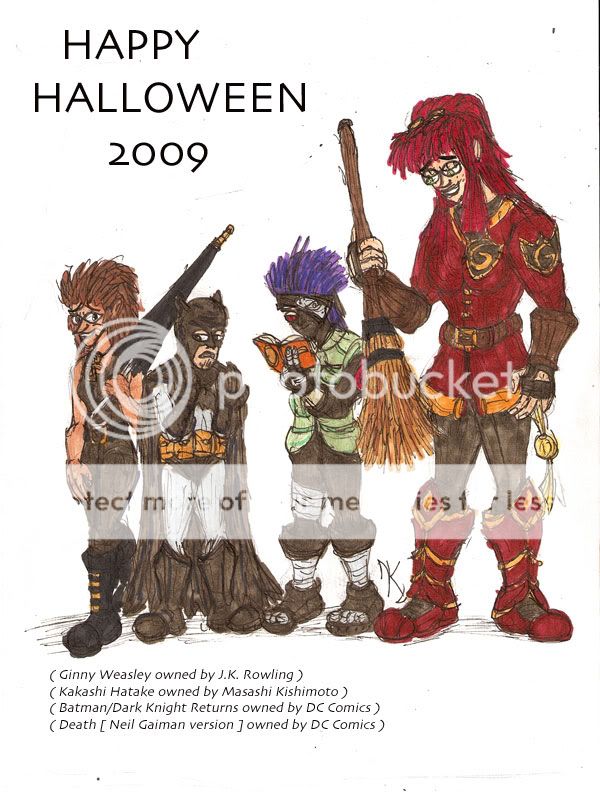
In the tradition of the trope Halloween Cosplay, I put together a sketch showing my own webcomic characters in Halloween garb. The purpose was as a thought experiment for better characterization, to determine what characters my cast would go as if they were dressing up for Halloween. This is impossible based on my story's internal continuity, since not only is it July 2008 in the timeline, but they're too busy being on the run on the other side of the US/Mexico border to thinking of cosplay.
I wanted to get a wide cross section of my favorite genres/mediums, so I assigned a different story universe to each character's pick. For example, Ruby is dressed as Ginny Weasleyof the Harry Potter books, another red-headed heroine in a fantastical universe. When I showed the art to her, my partner, who is a far more learned Harry Potter fan than I, thought that it's odd that Ruby, a freakishly large but gentle and shy young woman, would go as a character consistently described as small and energetic. My logic was that Ruby would want to go as a character with traits she envies; it's been established that Ruby is a Harry Potter fan, but also that she faces constant internal conflict over her actions and exercises caution over how best to use her power. To take on the guise the main love interest in a young fantasy series where the Big Bad is well-documented by all as " The Dark Lord " would be a fantasy she'd find appealing.
Jiro's interests come from shonen manga, as he is dressed as Naruto's mentorKakashi Hatake. The logic of a character dressing as who they'd want to be is also here, as Kakashi is the very definition of unflappable, his permanently masked face only showing emotion through his eye, which tends to look bored. Only in very extreme situations is Kakashi angry, and even then it's controlled; most of the time he's mellow to the point of apathy, and can even read his book the midst of a fight. Jiro would like people to think of him the same way, but in reality he's got a very short temper and has several sensitive points ( most of which involving Ruby ). Still, the two characters have quite a bit of similarity in terms of their competence levels; I actually write Jiro's dialogue sounding like Kakashi's American voice actor Dave Wittenberg, albeit with more emotional variation than Kakashi shows.
Jens' costume is the only one from a superhero universe; he's dressed as the Batman from Frank Miller's Dark Knight Returns series, the masterpiece of grim and grit starring a middle-aged, psychopathic Batman ( note the colors, the pronounced bat-symbol, and the baggy belt pockets ). Not only does it fit with Jens' personality that he'd pick something from that incredibly violent and angsty period of hero comics ( and probably missing the artistic message and focusing on the bloodshed in the process ), but that Batman represents the kind of hero Jens could actually aspire to be. The story involves Bruce having to become more vicious by necessity; he's an older man who can't do all the Batman stuff as easily as he used to, so he's got to compensate by being more of a bastard. Jens is young but a normal human in a world of powers; thinking in terms of brutal pragmatism is the only way he can adapt.
Finally, Alexis comes as Neil Gaiman's version of Death, the disturbingly cheery goth girl. It occured to me that Alexis has not smiled yet in the comic, which makes sense given her backstory-- a broken home, a mixed racial background, and a post-human level of awareness that not even she understands-- so her idol would be on someone who has peace with that kind of knowledge. Gaiman's Death is almost perpetually perky, in contrast with her Grim Reaper job. I hadn't though of Alexis' fictional tastes in as much detail as the others, but I thought I'd use her to bring in my love of the Vertigo line, the comics that got me into comics as an adult.
Hopefully I'll be able to do this again next year, based on whoever my characters develop into then.
Friday, October 30, 2009
New Avengers: Five Years New Retrospective-- Avenging killed the X-Book Star
In my previous essay, I touched upon the fact that Bendis’ take on the Avengers has been very similar Chris Claremont’s enduring X-Men formula. Both storytelling engines use long stories with extensive subplots and no designated end. Both have an ensemble cast that mix characters across various age, experience, and personality archetypes ( in addition to an even larger supporting cast ). And both the New Avengers and the Classic Claremont X-Men have the heroes as underdogs and outlaws struggling against a nebulous enemy that can’t ever be defeated. One might consider it redundant for Marvel to take their #2 team franchise and twist it into an imitation of their #1. I’d be surprised this complaint hasn’t been leveled more often at Marvel, but for the fact that the company has handicapped the X-Men franchise on a level that seems almost calculated to make the Avengers more significant.
I say “ seems “ because I don’t know for sure. And it would be stupid for a company to take something profitable and push it to the side in favor of a new version of something classically LESS lucrative. If Marvel really wanted the X-Men to fail so the Avengers could become their central franchise, they could just cancel the books; that’s a strategy they’ve actually used with the Ultimate Marvel revamp. They wouldn’t intentionally make the books crappy, and I don’t think the X-Books are outright bad even the franchise has taken several missteps in the past few years. But they have made the X-Men increasingly cut-off from the rest of the Marvel Universe, and that’s where the company’s creative and commercial emphasis has been of late.
So let’s say, in a strictly hypothetical context, that Marvel wanted the Avengers to be their publishing bread and butter, and wanted to diminish the X-Men to make it happen. First, they would need a motive. The exponential increase in comic book movies is good enough; Marvel’s bread and butter is in intellectual property, and while both the X-Men and Avengers have that appeal, they have the drawback that their individual characters/parts do not make up the whole. You can do a successful X-Men movie; it’s been done four times now ( even if only three of those were team movies, and only two of that fraction weren’t a waste of time, money, and Stewart ). But a Colossus movie would never happen, just as a Wasp movie wouldn’t get past the pitch; they’re decent enough as members of an ensemble cast, but don’t have the appeal or versatility for isolated endeavors. Hence New Avengers, a Justice League-style team comic made primarily of successful solo characters; Spider-Man, Captain America, Iron Man, and even lesser heroes with untapped licensing potential like Luke Cage. Thus they give me the perfect perfect segue; one of the successful solo heroes put on the new team is Wolverine, the X-Man most successful as an independent protagonist. At the time, Wolverine was just “ lending “ his services to the Avengers, and still stuck with the X-Men. But from our hypothetical conspiracy perspective, this is the first blow to the X-Men. The most popular character of the X-Men has been partially exported to the Avengers, his marriage to the X-Men becoming a Salt Lake City affair. Phase one of eliminating Marvel’s own competition.
Of course, that leads to ( hypothetically ) sinister phase two-- House of M. This story brings the X-Men into an Avengers story for a mega crossover, and ends up DeciMating the mutant population. Homo superior, at that point numbering in the millions and able to fill their own nations, has been magically cut down to a small fraction ( which was supposed to vary to upwards of thousands, but once the name “ the 198 “ was attached, that became literal ). Most of the important characters keep their powers, but many villains and second-string heroes just become regular people, usually shuffled off to the background. Those who survive become cloistered within the mansion, all but ignoring super-heroing to focus exclusively on the problems faced by the few mutants left. Even those mutants are no longer special, because super-humans without the X-Gene stigma far out number them. There’s no reason being a mutant is different from being a radioactive spider victim or Super Soldier specimen or other, making the minority metaphor an arbitrary, self-imposed exile.
Which is even more convenient-- or deviously schemed. After House of M, mega-crossovers become even more prominent. Every year has a big event series, and every year, the X-Men decline to participate. Sure they get a tie-in book or two, but otherwise they remain peripheral ( except for Wolverine, who’s now readily identified with the Avengers and shows up for these events ). In Civil War, they remain neutral and simply don’t engage with either side; in World War Hulk, they’re just a brief pit stop on the Hulk’s rampage, as he attacks Professor X based on the possibility that he would have joined the heroes in shooting the green bastard into space ( even though Xavier was absent during the actual event ). And in Secret Invasion, all we see is the X-Men as the San Fransisco resistance for the Skrulls’ global attack. Now, the X-Men franchise has continued through these events, but their storylines remain stifled and insular. They try to undo the DeciMation and restore the depowered mutants, but each time receive a microscopic nudge towards success at best. Now their plan involves making their own closed island nation while waiting for the Messiah Baby to save them. But since the X-Men’s only real mission now is trying to save the dying species, any other stories are irrelevant. If they go into space, find a lost civilization, or make a hit squad to fight zombies, it’s just trying to draw attention away from the big picture, and failing. Thus, what was once Marvel’s most important franchise is now treading water with its island of just under 200 super-malcontents, with no concern other than protecting said just under 200 super-malcontents.
Meanwhile, the Avengers has gained many of the tropes that made the X-Men popular. Large, diverse, and dynamic cast? Check-- in addition to the traditional rotations of the Avengers line-up, the book’s importance in the shared continuity gives it a huge supporting cast that pops in and out. Long stories that branch outwards instead of reaching a resolution? Check-- even after Secret Invasion wraps up one conspiracy storyline, we go directly into Dark Reign, where Norman Osborn becomes the new Big Bad. Stories where the heroes are the outsiders? Check-- the Avengers were on shaky territory with the authorities from the start of Bendis’ series, and they became the literal underground resistance after Civil War.
The difference is that in the Avengers, they are at least trying to do good, to fight against a massive multi-layered foe even if they fail. The X-Men are holed up on their island, ready to take down anyone who looks at them funny. But as Norman puts it, the X-Men can just be ignored as long as they stay off the mainland. Better for the Avengers, and their new merchandising powers.
Tuesday, October 27, 2009
New Avengers: 5 Years New Retrospective--Storytelling Engine
In November, Marvel's popular comic series New Avengers will have been running for five years. If you count its run as starting when writer Brian Michael Bendis did the old Avengers book's final arc, it's been going since August 2004. In this time, the Avengers have become the most popular/profitable franchise Marvel has, supplanting even the X-Men. They've gone from one book to four; New was followed by Mighty, The Initiative, and now Dark.They've also become the flagship of the shared universe, dictating the way all the other books go.
Needless to say, the New Avengers have been subject to intense criticism. To be fair, much of this is internet criticism, which is about as intellectually sound as three-year-olds whining about how they want macaroni and cheese instead of Chef Boyardee. But valid points have also been made about the errors of Bendis and Marvel's direction. I happen to agree with many of the individual criticisms, but not enough that I would lose interest in the franchise overall. In fact, Bendis' Avengers may have made me the most intellectually engaged in a Marvel franchise's progress that I've ever been; the contradictions are part of what make it so fascinating and enjoyable.
The most common criticism of New Avengers as a series that I've seen is that it isn't new, other than as repackaging the Avengers in a darker and edgier setting. John Seavey, a very insightful comic blogger who coined the term " Storytelling Engine " in reference to an ongoing series' underyling " blueprint ", derided New Avengers in his essay on the Old Avengers. He commented that by excising the old Avengers' storytelling engine, the New Avengers have ended up a random group of superheroes that use some Avengers trappings.
I submit to Mr. Seavey that the void left by the old Avengers' long history is the point.
One thing that has always bothered me about superhero comics is how they so easily slip into taking their fantastical, convoluted genre history for granted. They're stories where you have grown men and women who dress in bright, revealing spandex, have amazing powers and gadgets, and fight evil across realms of magic, aliens, gods, and more. To a person who's familiar with superheroes, this is par for the course. To a person who's not familiar with superheroes, it's either incredibly awesome or incredibly stupid, depending on how the creators make it across.
The Old Avengers was a book whose storytelling engine so often put it in the " incredibly stupid category ". This is not to diminish the fine work the title's many writers and artists have done over the years, but to acknowledge that it was the kind of book that existed in a space where superheroes were business as usual. The original line-up was an attempt to ape DC's Justice League and have all the A-List heroes in one monthly book; however, at the time the Marvel Universe was still very new and didn't have a well-defined A-List. What's more, Marvel's heroes were much rougher around the edges in personality than DC's; where DC's Justice League was like the country club of superheroes with its affluent, pretty, well-adjusted white guys, Marvel's heroes tended to be significantly more anti-social. Spider-Man was not put on the original team, the Fantastic Four were already a cohesive family unit, and the Hulk left in the second issue after realizing that the prettier members hated him. So the line-up became a home for second-string heroes, and cycled through a growing base of possible members repeatedly. Like a sports team, the membership varied regularly, but the status quo was always there; they would always be the A-List superhero team, the bright-and-shiny public heroes that lived in Tony Stark's New York Mansion, had an official charter and regular meetings, and fought evil within the confines of the law.
Bendis' Avengers has that history, but it's used in a much more self-conscious way that allows for increased story potential; in his series, being a super-hero is not a fixed identity, but one that has been challenged by world events, and one that the characters work to redefine. When the series starts, the Old Avengers have disbanded after one of their most trusted members went crazy and used omnipotent power to kill, injure, discredit, and otherwise traumatize many of her comrades. A breakout at a supervillain prison creates a setting where a new group of heroes band together, and decide to take on the Avengers name again. But they don't slip so easily into the role, because they're much more aware of the complexity of the larger world. The stakes are higher than for the Old Avengers; the super-villain underworld has done their own organizing, the government is watching the superhero community with their own agenda in mind, and even the Avengers themselves have their own closets full of skeletons.
Critics have accused Bendis of crassly trying to make the Avengers into an A-List team, most notably by admitting members like Spider-Man and Wolverine. I would be a complete idiot if I denied the marketing value of putting Wolverine on an Avengers team, but it isn't without story purpose. The New Avengers want to establish new value as a symbol, and their membership establishes that. The initial line-up of the team is led by Captain America and Iron Man, original Avengers who represent Greatest Generation idealism and futurist realism, respectively. Spider-Man finally joins the team, the isolated nerd given a chance to prove himself after years of treading water as a working-class vigilante. The membership extends to the other spheres of the superhero community, as we have prominent urban hero Luke Cage ( once a blaxploitation stereotype " Hero-for-Hire ", now given a chance to truly prove his worth ), duplicitious SHIELD Agent Spider-Woman ( an explicit link to the conspiracy theory storylines ), omnipotent yet agoraphobic Superman analogue Sentry ( a hero who could have been great were it not for his mental illnesses, now given a chance to actually be great ), and pragmatically lethal X-Man Wolverine as a link between the two brands. It's a mix of A-List and B-List heroes across multiple parts of the Marvel Universe, that's a calculated appeal in-universe to make super-heroes cool again.
Of course, things don't actually turn out that way for the characters; hurbis is another big theme. In trying to control their meaning to the world, the heroes tend to create more problems. One the series ties into Mark Millar's Civil War storyline, this reaches a head as the heroes split into in-group and out-group. Iron Man is the in-group, who believes that by joining the system he can control it for the benefit of the people, by making superheroes a legitimate function of the law. Captain America is the other side, thinking that the heroes work best when they have autonomy and serve ideals instead of rules. From here the series splits off into two, with New Avengers being the underground resistance, and Mighty Avengers being Iron Man's attempt to make a fully legit team with complete control over their representation. This fails catastrophically for Iron Man, and he ends up being disgraced and replaced by Norman Osborn, which leads to Dark Avengers; villains using this kind of PR manipulation to pass as heroes.
Storywise, this owes much of its influence to the Ultimates, the cynically satirical alternative take on the Avengers. However, while the Ultimates redesigned the heroes from scratch, New Avengers engages with the history of the Marvel Universe; this is not a story about the dawn of the Age of Heroes, but the attempt to start a new one. And while the Ultimates was almost completely self-contained, Avengers has the task of setting the standard for the other Marvel Comics. The other major component to New Avengers is the storytelling style pioneered by Chris Claremont in his foundational X-Men stories; long, soap-operatic sagas with continual progression and no inherent end. By merging the two styles, it creates something unique; an ongoing superhero saga about the attempt to define superhero identity, and the many pitfalls along the way.
I'll be analyzing key Avengers stories from recent years to further try to understand where this is all headed.
Subscribe to:
Posts (Atom)
