Ruby Nation

Ruby Nation
Ruby Nation: The Webcomic
Showing posts with label postmodernism. Show all posts

Sunday, May 1, 2011

Sonichu Episode 15 Critical Review Part Two: Compulsory Monogamy


Let's Do The Time Warp Again

As if the Family Guy "Skitch" wasn't terrible enough, here we have Christian Weston Chandler's adventure through the "glory days" of high school, joined by his "sweet friend" Megan and his plagiarism prototype Bionic the Hedgehog. And if there's one thing that comes of this voyage through time and space, it's Chris-Chan's ability to play matchmaker for his forgotten electric hedgehog, while lamenting his own isolation.

At the opening of the chapter, Bionic has been on a date with Megan's furry companion, Megagi La Skunk. Megagi, a creation of the real Megan Schroeder, is distinct from any of Chandler's hedgehogs; not only is she a different species, but she has a punk-influenced look that sets her apart from Chandler's hyper-feminized Rosechus. Of course, the pink stripes and spiked bracelets don't keep her from being dragged into Chandler's interpretation of adult relationships, where things progress in a linear fashion that invariably results in sex on the third date. Megagi ends up just as obsequious as the other Rosechus, with any potential for individually stripped away so none of Chandler's hedgehogs "feel"* alone.

But this mechanically depraved form of cartoon animal sex is what Chris-Chan desires, and he whines over the fact that he can't get with Megan. She sees him about to cry and offers some moral support, which immediately perks up his mood. Megan is impressed by Chris-Chan's 180 degree mood shift, even thinking to herself that he has a "Goku-get-'em" attitude. Yes, she actually says that under Chandler's pen.

You know how many great writers recommend that aspiring authors listen to real people's conversations? Christian Weston Chandler's dialogue proves the merits to this statement. Because of Chandler's infamous contempt for anything outside his own experience, he gives everyone the same awkwardly melodramatic and childish lines. They make references that come out of nowhere and often don't fit the character-- even if Megan is an anime fan, it's highly unlikely she'd make a DBZ reference in her inner monologue about her feelings (however made up) for a man. Humor is infused so randomly that it doesn't even reflect what people might actually find funny. And nothing is ever dishonest or understated, because every character wears their heart (at whatever level of shattering) on their sleeve.

If we were to consider Sonichu as an intentionally terrible work, though, this would fit into the world's magical realism. This is a voyage into the mind of a depraved man-child, raised almost exclusively by television and video games. Everyone, even the designated antagonists, speaks in his over-the-top, reference-saturated vernacular. And if Sonichu is intentionally terrible, then it's a masterpiece on the level of anything to come from Alan Moore's wooly head.

Oh, and there's some plot about time travel and making sure that history stays on track, but clearly Chandler didn't care enough about it to have the plot make sense. So why should we?

* And it's documented that Chandler actually believes that these characters are real people, albeit in an alternate dimension a la Roger Rabbit. His concern for their welfare overrides any interest in making them interesting to the audience.

Saturday, April 2, 2011

Sonichu Episode Critical Review, Two: Attack of the Clones


The density of awfulness within these comics is getting harder to address in single entries, so I'm probably going to be splitting up these reviews in the future.

Naitsirhc's eviller/gayer form may be the most disturbing new character in Episode 14, but there's another addition to the cast who says more about Christian Weston Chandler. Bionic the Hedgehog debuts in this chapter, and gives us a glimpse at what Chandler's creative process was like ten years ago.

While it would be statistically impossible for Chandler to come up with worse ideas than Sonichu, it's not like Bionic was much better.

Bionic the Hedgehog is basically Sonic with orange fur and an affinity for basketball. There are no other characteristics to the little creature, other than the fact that he can throw the orange ball hard enough to knock Chris-Chan's evil twin into a temporary coma. Bionic is only notable because he was the first character Chris-Chan came up with, only ripping off one property instead of two.

Chris-Chan visits Bionic because, through deus ex machina (the internal driving force behind Sonichu's story), he goes back in time to his high school days. This is part of the search for the Sonichu Balls or something*, but the real reason Chandler takes his fictional self back in time is for personal gratification. High school was a better time for Chandler than anything since, and the further he gets from those days.

However, all this does for anyone else is illuminate how little Christian Weston Chandler has possessed. Back in the 1990s, he was drawing rip-offs of Sonic characters. A decade later, he's still doing it. But back then this could be forgiven as the result of inexperience and perhaps a coping mechanism. As a grown man, this is downright pathetic.

Even more pathetic is the fact that instead of moving on from Bionic, Chandler feels compelled to work the waste of orange Crayola ink into his current projects. The only way this could have worked would be if it was meta-commentary on Chandler's creative process, comparing and contrasting the progress (such as it is) between Bionic and Sonichu, but it reads as a compulsive need for Chandler to validate everything he's done, with no room for admitting mistakes or reconsidering his direction.

Even worse is the fact that Bionic was Chandler's main weapon in his 1999 "War on Autism". Chandler has made it clear that he wants a cure for autism, and would not hesitate to shed his neurological "curse". Ironic, as Chandler has built so much of his identity around being a victim of autism, and if he were cured, he would no longer have any excuses for his behavior. Granted, he doesn't have any excuses now, at least in the eyes of anyone but his decrepit parents and the state of Virginia.

* (Which gave us the immortal line, "My Two Balls!". Chandler has since retconned them into the Sonichu Crystals.

Sunday, March 20, 2011

Ruby's World Post-Script: Take That, Neil Kapit


The Pages In Question, Here and Here

One of the most frustrating things about doing long-form series fiction is that when you create a character or idea who seems less and less interesting in practice, you're usually forced to continue with that. One of the most rewarding things about long-form series fiction is that as you keep going and your universe develops, you can find ways to remake that character or idea into something to fit the increased complexity of your framework.

I started doing Ruby's World over 2 and a half years ago, so at the time I thought that the most compelling villains were those who were just pure evil to the Nth degree. Hence, the physical face of Beagle was Buzarde', who I wrote as more and more deranged with each appearance. It was fun to write a character that was every inch a depraved serial killer, but it didn't make him a very interesting character to others.

I would hardly be the first person to make this mistake, as many writers enjoy creating Complete Monster villains. Even now, I can still appreciate the appeal. However, ideally even those bad guys have some kind of viewpoint with some appeal beyond the complete release of impulses. If you're writing an antagonist who doesn't have any kind of hook other than pure nihilism, you're not really challenging the protagonists' morals, just their skills and physical abilities. Certainly there are very few people in reality who actually see themselves as the bad guy, despite their actions.

So, dissatisfied with what I'd done, I came up with a solution that would break the Fourth Wall to make Buzarde' more compelling; a villain who was literally designed for evil, and failed at it. Then he's kind of a pathetic figure because he can't help the way he is. Not only was he constructed only to do evil, but he wasn't even good at it. And his impulse to torture when he should just execute turned out to be a flaw in his effectiveness, something an instrumentalist villain like Dr. Carcharria would not tolerate.

In the new world of the Ruby Nation, villains so simple have no place as a credible threat. This is me symbolically outgrowing those past mistakes.

Wednesday, February 9, 2011

Sonichu Sub-Episode 8: I Got Through This, But It Just Gets Worse From Here


Thank God This Shit's Over, It Was Just Getting Tedious And Not Even Entertainingly Stupid


Bit by bit, Christian Weston Chandler is returning to the internet. He'd kept himself in exile for the past two months, going back to being a pathetic, isolated shut-in instead of a pathetic, publicized internet-famous shut-in. But LittleBigPlanet2 has debuted, and with it, another excuse for Chandler to spend taxpayer money on spamming user-generation games with his wretched creations. I'd been derelict in my responsibilities, but now I realize that I have to get through this series. Because even if Chandler actually succeeds in forgetting the Internet, the Internet must never forget Chandler.

Anyway, this Sub-Episode is the final Sub-Episode, because Chandler's mother insisted that he stop doing them. This was a move that was a good call in the short term, but completely useless in the bigger picture. Barbara Chandler, after all, has enabled Chris to become what he is, treating him like he's special (albeit in that patronizing way too often used on the developmentally disabled), not encouraging him to do something with his life, and bailing him out when he acts inappropriately. Even if she was worried that doing comics about his frustrations against real people would get back to him, it wouldn't ruin his life any worse than Barbara's already done.

Especially because Barbara herself appears in this comic-- albeit symbolically. Crystal Weston Chandler, the magical twin sister of Chris-Chan, serves as Barbara's surrogate. She is a familial figure to Chris-Chan, a woman he cannot fuck, but who insists that he is indeed attractive and is only single because others are conspiring against him. She helps him defeat his enemies, and even tells them why Chris' Love Quest is a noble pursuit (even his Attraction Sign methodology). Furthermore, she assures Chris that he is an attractive man, because she is related to him, and is presented attractively*.

Chandler probably didn't intend for his sister-character to resemble his mother-character, but then, he probably didn't intend for the fact that his 'children' Sonichu and Rosechu would be seen as having an incestuous relationship. But Chris had his entire childhood and adolescence to be shielded from consequences by his parents, and sadly, it's unlikely that he's ever going to admit he's done anything wrong now. And that goes for Chandler as an artist as well as Chandler as a human being.

Oh, and Spoiler Alert; Chandler may have stopped the sub-episodes, but he made the core Sonichu comic more about his personal problems than ever.

* Something that cannot be said for real-life Barbara, who is often compared to the Pokemon Snorlax.

Friday, January 14, 2011

Sonichu Sub-Episode 7 Critical Review: Remember When This Comic Was About Sonichu?


We're Still Fighting Mall Security?


There's not much more that can be said about the plot here, as it's still Chris-Chan fighting super-powered mall security. He finally meets their leader, Jerkhief Daitenzen Bagget*. The character is based on real-life Albemarle County police officer Marcus Baggett, who actually sounds like an upstanding gentleman. His noble deeds include risking his life to get two people out of a burning building, shooting down a man who stole a police car and shot at the cops, and, of course, telling a creepy man-child not to solicit for sex in the Target food court. The latter, obviously, contradicts Chandler's perspective.

From most people's perspectives, Bagget is a brave and decent member of local law enforcement. If there is any evidence to the contrary, it is not the fact that he had the gall to get remove Chandler and his Attraction Sign from a public location. Of course, in the world of CWCVille, it's not enough that Bagget and Chandler disagree. Bagget has to be a super-villain who rides a Cybertronian war machine.** Which actually works in canon-Bagget's favor, because he's standing up to the clown-striped Caligula. The "Private Villa of Corrupted Citizens" is the underground resistance in Sonichu fanworks for a reason, after all.

This comic also has one of the most significant panels in the history; the Drinking Straw of Fail. Christian Weston Chandler's trademark failure at proportion strikes hardest here, as the straw in his avatar's mouth looks especially long, wide, and thick. Chandler is also well-documented as a homophobe. Connect the dots as you see fit...

On the plus side, Jared's comments in the previous Sonichu review were inspiring and well-written. The man he spoke of is the Peter Parker to Chandler's Doctor Octopus.

* Apparently a reference to/plagiarism of Excel Saga, an anime the Chandler loves. I should probably start watching it, because I hear it's actually good, just that the parody elements go right over Chandler's head.
** "Crackder", inspired by the Transformers: Cybertron/Galaxy Force version of Thundercracker. That was a really shitty design, with one of the robot's hands being a huge slab of the jet's back. Certainly Chandler's spent enough of his parents/the state of Virginia's money on Transformers that he could at least plagiarize a toy that didn't look like ass?

Saturday, January 8, 2011

Sonichu Sub-Episode 6 Critical Review: A Documentary On Human Despair


If you tried to forget the horror, I won't let you

Christian Weston Chandler has disappeared from the internet in recent weeks-- at least, he's disappeared from the parts of the internet that he doesn't like. He's still spending the majority of his life on the PlayStation Network, playing games bought with taxpayer money and racking up trophies for his "achievements". I'd lost my enthusiasm for writing these reviews at first, because the momentum of his saga was lost. However, though Chandler may have left being an amusing failure on the internet behind so he can return to being a tragic failure in real life, his body of work remains.

We must never forget.

Sonichu Sub-Episode 6 is a bizarre attempt at world-building, as Chris-Chan gives us a documentary on the 'evil' Jerkops. In this so-called Backyard Safari, Chris-Chan is the authoritative voice narrating the truth about his mall security nemeses. Presumably, this is a propaganda film distributed through CWCVille to mold public opinion. Since CWCville already has a Mayor-For-Life who maintains order through his private military of electric hedgehogs, the idea that it's a totalitarian state is hardly a stretch.

There is disturbing similarity between this documentary and the racist propaganda used by various governments, as Chris-Chan takes great pains to convince us that the Jerkops are sub-human. According to Chris-Chan, the Jerkops only think evil and naughty thoughts, are covered with disgusting veins and hair under their clothes, and instinctually loathe virgins. The Jerkhief is most distrubing of all, weighing 1'500 pounds of bone and blubber. What makes this especially disturbing is Chris-Chan's assertion that Jerkops are recruited via brain-washing the mentally handicapped, so he's effectively slaughtering helpless human beings without a care in the world. Of course, Chandler has already dehumanized his enemies, as bigots tend to do. It's easier if you assume your target doesn't feel pain.

This chapter demonstrates both why Christian Weston Chandler the phenomenon is so fascinating, and why Christian Weston Chandler the individual isn't deserving of sympathy. Chandler pursues his targets with disgusting vitriol, but his hang-ups are so bizarre and petty that he's as hilarious as he is disturbing. I mean, his fictional city uses propaganda to fan the flames of hatred against mall security officers who try to stop him from hitting on any boyfriend-free girl that moves. Who else would think up such a thing without a note of irony? For that matter, who could come up with such a concept even with irony?

Wednesday, December 1, 2010

Sonichu Sub-Episode 5 Critical Review: How I Learned To Stop Worrying And Drool Over My Sister


Didn't I Tell You It Gets Worse

Previously in Sonichu, Chris-Chan had defeated the B-Manajerk and Merried Seinor Comic who threatened to stop him from soliciting for sex at the " Mal-Wart " food court. However, he was confronted by the WM-Manajerk, a human head attached to a giant robot body*. Now, Chris-Chan is getting the crap beaten out of him by this new Manajerk. Fortunately, his gold-armored " Cherokian " ancestor appears in a vision, and tells Chris-Chan what he needs to do in order to summon his dream sibling....Crystal Weston Chandler.

Crystal is basically the female twin of Chris-Chan ( not Christian Weston Chandler, mind you, but his idealized avatar ). She wears a hedgehog medallion and a gaudy striped shirt, transforms into a Rosechu, and wields the same " Curse-Ye-Ha-Me-Ha " black magic as her brother. Her personality is entirely supplimentary to Chris'; she assists him in defeating the WM-Manajerk, and lectures the defeated severed head on why her brother's Love Quest is noble, but doesn't show any outside independent thought. Chandler created Crystal as the exact kind of woman he wants, a servile distaff counterpart to himself. Yet he chose to make this woman a blood relative, the kind that he couldn't ethically touch ( even by his own flimsy moral code ).

So why would a man capable of creating the woman he wants to be his dream mate instead create a sister he can't touch? Well, Chandler wants someone who understands and approves of him and his plans. By creating a clone of himself, he's made sure that his ideal friend understands what it means to be him. And by making the clone female, her approval of his Love Quest is meant to carry more weight. Back in high school, Chandler had several " gal-pals "**, females who were friendly to him but not romantically linked. Perhaps making Crystal a sister is Chandler's way of ensuring that she stay as his friend, because even his libido wouldn't make him commit the incest taboo.

It may also be the case that Chandler doesn't want to get a girlfriend without having " earned " her through a Love Quest, which is why he can't get a girl even in his own fictional universe. This is possibly the only concession that can be offered to Chandler, that he isn't so absorbed in his fantasy world that he can invent himself a sweetheart. Then again, Chandler isn't above having his avatar get laid; in later chapters, he travels to the future and fucks his future self's wife, taking advantage of the mistaken identity.***

And the sad part is that at this point, Chandler at least approaches his Love Quest with honest ( if deluded ) conviction. But we're still seeing things like his ad for Axe Deodorant, where Rosechu tells Sonichu that she wants to " orbit your belt " because he uses the Orion scent. The pretense that there's anything noble about Sonichu gets flimsier and flimsier.

* Which appears copied from the Transformer Jazz. It's likely that Chandler owns that specific toy of the character, given everything else upon which he's blown Virginian taxpayer money. And yet he doesn't draw the body with any attempt at proportion or perspective, thus negating even the POINT of plagiarizing.
** Having mainly platonic female friends is commonly associated with gay men-- ironic considering Chandler's vicious homophobia.
*** I'm worried about how well my sanity will hold out until that review. :P

Tuesday, November 23, 2010

Sonichu Sub-Episode 4 Critical Review: Childish Idolatry Just The Way You Like It


Happy Thanksgiving, Hope You Like Crap

Christian Weston Chandler's famed inability-- nay, unwillingness*-- to grow up is best symbolized by his avatar's power sources. In the augmented reality of CWCVille, Chandler's toys, games, and dress-up accessories aren't just creature comforts**-- they actually give him the strength to defeat his enemies. This gives a whole new meaning to the phrase " Security Blanket ", because the security provided to Chandler by his in-universe playthings is the equivalent of the most dangerous private military contractor.

Sub-Episode 4 has Chris-Chan demonstrate the power of his Peter Pan mentality upon more villains ( i.e. people who don't want to see a creepy little man soliciting his body in a public place ). We open to see Chris-Chan sitting in the Mal-Wart region's food court ( a.k.a. the real world Wal Mart, because that's where all the eligible young singles congregate ), musing upon how the world is against his Love Quest. He is confronted by the B-Manajerk and his partner " Merried Senior Comic "***, who tell him that love is forbidden in the Mal-Wart region. They call him a solicitor, an accurate assessment that sends Chris-Chan into a self-righteous fury. Fortunately, Chris-Chan is joined by his latest electric hedgehog creation, Darkbind Sonichu ( a mixture of Sonic, Pikachu, Darkwing Duck, and Link from Legend of Zelda**** ).

In the fight, Chandler uses all of his childish playthings with deadly results. Not only does his Sonichu medallion allow him to once again become Chris-Chan Sonichu, but it turns the anime wing hairclips on his head from a girl's cosplay accessory to actual flight-capable wings sprouting from his skull. In the battle, Chris-Chan also accesses his Pixelblocks to create a duplicate of himself that throws off the B-Manajerk-- because the 8-bit video game construction toy is now apparently capable of creating a lifelike copy of an organic lifeform.

It's a common theme in hero stories to demonstrate that super-powers can't solve personal problems-- that being Spider-Man won't help Peter Parker keep a job or a girlfriend, that Iron Man tech won't solve Tony Stark's fear of intimacy, that Green Lantern's ring can't stop bigoted thugs from beating up his gay assistant, and so on. This is not much different in Sonichu, except for the fact that this is how Christian Weston Chandler honestly sees his life. He believes that Sonichu is advantageous for him as a potential mate. The security he feels with the trappings of his TV-Y7 fandoms is where he feels empowered, and he doesn't listen to anyone who would tell him otherwise.

But if CWCVille makes Chandler's comfort zone into a super-power, then it also makes the people who tell him what he doesn't want to hear into one-dimensional villains. It's not enough that Wal-Mart not be a place where soliciting for a mate is acceptable, it has to be a fascist regime with anti-love laws written into its constitution. And it's not enough that Chris-Chan simply wants a mate but can't find one due to him being Chris-Chan, he has to be a tragic hero fighting on against the " infinitely-high boyfriend factor ".

* The disturbingly extensive documentation we have about Chandler's life is plenty of reason not to show him sympathy; the people who try to defend him need only read the CWCiki to learn that nobody trolls Chris worse than Chris.
** I'm not really one to criticize adult men for having toys, given my three-figure collection of Transformers. But like with his other quirks, Chandler's problem isn't that he has interests below his appropriate age range-- it's that he doesn't want to bother with anything else, and doesn't feel like he should have to.
*** Nobody has figured out what that string of misspelled words means. Probably not even Chandler himself.
**** The latter because he wields a sword and is on a quest to rescue his princess, Zelina Rosechu. Ironically, the Legend of Zelda games never suggest that Link's desire to save Zelda is anything more than his platonic heroism.

Tuesday, November 2, 2010

Sonichu Sub-Episode 3 Critical Review: Stop Me If You've Heard This One Before


Explaining The Joke, Here

....a Dean of Student Affairs at the Piedmont Virginia Community College*, by the name of Mary Lee Walsh, is confronted with a student creating a problem. The student, one Christian Weston Chandler, is soliciting newsletters based on his plagiarized children's comic strip that explicitly ask for a boyfriend-free girl, and publicly carrying a sign doing the same. The dean sees him as a public nuisance at the lowest, but since the dean is also a member of the Virginia Sexual and Domestic Violence Action Alliance, perhaps she suspects something worse about this creepy little student.

So the dean reprimands the student and tells him to stop spamming the campus with his desperation. But the student ignores her warning and continues to carry his " Attraction Sign " and distribute his " Sonichu's News Dash " papers. The dean, obviously annoyed by her authority being ignored, calls the student into her office, and orders him to stop. She uses very blunt but accurate language, saying that the student would never get a girlfriend this or any other way. He angrily screams at her, but all it does is get him expelled for a year.

But the dean doesn't hear the last of the student. The student works the dean into his plagiarized children's comic strip as an evil witch, who spends her spare time plotting against love itself. The student, on the other hand, is reinvented as the hero who fights for the sake of love. After a tense** fight, she is defeated when the hero teams up with his plagiarized cartoon " son ", pooling their powers together for a massive energy blast that defeats her. For now.

But it doesn't end there. While the dean doesn't dignify the student with a response, the group of internet users devoted to following the student's terrible life and work take note. And seeing the badly drawn image of the evil witch Mary Lee Walsh, they interpret her golden helmet as a shock of blonde hair with horns, and draw her as a sexy succubus. Some fan stories even cast her as a heroine, fighting against the corrupt regime of the student's ego-based imaginary town.

So the elderly dean of a southern US community college, simply by doing her job, becomes turned into an online sex symbol that doubles as a troll symbol. And here's the punchline...

This isn't a joke. All this shit actually happened.

And nothing I say can top that.

* You can find the full story here; yes, an entire Wiki has become devoted to Chandler's failures.
** If by " Tense ", you mean " badly drawn Pokemon moves followed by Mary Lee Walsh tapping Chris-Chan Sonichu on his neck, causing him to revert back to Chris-Chan in the dumbest weakness since Thor turning back to mortal Dr. Don Blake if he lets go of his hammer for 60 seconds ", then yes, it was quite " tense ".
*** Courtesy of Sonichu Finale, one of many entertaining fan works that redeem Chandler's " creations " with good writing and art. And one of many fan works replete with Metal Gear Solid references.

Saturday, October 30, 2010

Sonichu Episode 9 Critical Review: Dark Graduation


Psychological Hang-Ups The Way You Like Them Here

The Chris-Chan/Sarah Hammer/Wes Iseli love triangle continues this issue, as Christian Weston Chandler continues to bend time and space towards a favorable reality. And in doing so, he introduces the arch-villain of Sonichu, Count Graduon, whose name is a reference to Christian Weston Chandler's high school graduation.

The fact that a story about one man's refusal to grow up and take responsibility for his life would have a villain named after a rite of passage into an adulthood is stupefyingly appropriate.

Count Graduon is represented as a purple staff containing an evil spirit-- the Cherokee and Wasabi clans apparently teamed up to banish him to an inanimate prison. While the symbolism inserted by Chandler doesn't go further than the name, the meaning attached to Graduon runs much deeper, like everything else about Sonichu. Graduon is a perfect representation of the personal and cosmic forces that Chandler believes oppose him; while he has a name, he does not have a body. He is a force that is attached to an inanimate object. But he directs the efforts against Chandler, coordinating efforts of the Jerkops, Mary Lee Walsh, and the other " trolls " who deny Chandler immediate pleasure and ask him to do things that might cause pain.

The symbolism is even more telling ( and horrifying ) due to what Chandler attributes to his high school graduation. He sees it as the turning point in his life, the point where things started to go downhill. Chandler has said that he expected to receive an award for his art at the ceremony, and when he didn't, he started crying. It is certainly understandable that a young person, especially a socially awkward one who'd been coddled by his parents due to his " special needs " labeling**, would become visibly upset if they did not receive the recognition they felt due. However, the disappointments in our life are the moments where we are given opportunity to show our true strength. At that moment, Chandler could have,

A.) Done what every person ( autistic or not ) has to do, intellectually accept that life isn't fair, and try to make the best of his situation, or

B.) Create a comic strip universe inhabited by childhood heroes where he is treated like the very special flower he wants to believe he is, and refuse to leave there.

Guess which one he did? Instead of pushing back against the circumstances of graduation, Chandler DID bottle them up in a cartoon super-villain, and constrict their overt activities to sending giant golem monsters after CWCVille. Except that adulthood is too big a concept to be adequately summarized as a single bad guy, shaped like a glowing purple dildo***.

But that's the unwitting central conflict of Sonichu-- Chandler tries to create a paradise where adult problems become manageable villains, but only creates more problems for himself as he tries to simplify/ignore his challenges. The triangle between Chris-Chan, Sarah Hammer, and Wes Iseli is another example; Sarah dumps Wes for attacking her " best friend ", and teams up with Chris-Chan to fight Graduon's monster. But Wes is still around, acting mopey and hopeless until Chris tells him to snap out of it ( because Chris-Chan's ephemeral infatuations are apparently a worse loss than Wes actually being dumped by a woman with whom he was in an adult relationship ). And after the battle, when the two take a taxi home****, Chris-Chan makes a point of " being there " for Sarah, listening to her talk and playing the best friend ( while obviously waiting for her to jump his bones ) only to find that she still regards him as nothing more than a friend. Because being honest about his feelings would be a risk for Chris-Chan, and CWCVille is a place which is supposed to be free of risks-- even if that keeps Chris-Chan from the female contact he so badly wants.

The sad part is that is that Chandler ends the chapter with a tribute to the real world Sarah Hammer, his childhood friend. Uncharacteristically, he's actually acknowledging the good times they had together as kids, and mentioning specific instances that he fondly remembered. This is emotion that evokes a genuine feeling of loss, untainted the sexual frustration that warps everything else in Sonichu. It's also a reminder that underneath his outer shell of childhood trappings and adolescent libido, there are redeeming qualities that remain in Christian Weston Chandler. Of course, every time they surface, he immediately buries them under more outlandish behavior, and never learns any lessons.

* Who I'll get to in the review of the next sub-episode.

** There isn't a hell painful enough for Bob and Barbara Chandler, whose enabling of Chris catastrophically ruined a child who had as much chance of success as any. It's known that Chandler's mother buys his clothes for him, and speculated that she picks those ridiculous clown colors so that he'll appear more " special " and thus won't face adult repercussions for his actions. It's also known that Chandler's father encourages him to remain on welfare for disability, despite a lack of any known impairments that couldn't be corrected by a tall glass of Grow The Fuck Up. Chandler at least garners pity; these people are simply reprehensible.

*** This is one of many things that makes Chandler's homophobia doubly hilarious.

**** In a badly drawn taxi so lopsided that it could never roll in a straight line. Like Greg Land, Chandler's drawings liberally borrow/plagiarize from other sources; unlike Greg Land, he can't even copy his references accurately.

Saturday, October 23, 2010

Sonichu Episode 7 Critical Review


Click here for the strip

One of the most important points I want to make in this series is that Christian Weston Chandler isn't just an isolated freak. All of his bizarre theories and hang-ups can be found in other people, both neurotypical and autistic, and especially in internet fandoms. Chandler is just a special case because he's cut himself so completely off from everything BUT his hobbies and his neuroses, so they inbreed and mutate into the compelling train wreck that is Sonichu.

Case in point: The Anchuent* Prophecy introduced in Episode 7. This is where Sonichu is literally replaced by Chris-Chan as the star of the comic, and where Chris-Chan's grand purpose within CWCVille is revealed. Chris-Chan is, beyond any shadow of a doubt, a Mary Sue character, an author avatar created in an idealized image. And he has all the typical traits of a Mary Sue. The story is devoted to proving that Christian Weston Chandler is a very special flower.

The plot involves Sonichu finding an ancient tomb in the CWCVille woods guarded by a mysterious old man. He brings it to Chris-Chan's attention, and while reading the heiroglyphics, Chris-Chan meets the ghost of his Cherokee ancestor. Chris is granted the power of Chris-Chan Sonichu-- this is the origin of his transformation in Sub-Episode 1, where he renders his flagship character completely and utterly irrelevant.

You can practically use Chris-Chan Sonichu as a textbook case for the Mary Sue, a character found in awful writing everywhere. Let's use the ;TVTropes checklist of Common Mary Sue Traits

-- Chris-Chan is portrayed as pure and incorruptible. All of the denizens of CWCVille, human or hedgehog, love their mayor. His only weakness is his inability to get a girlfriend, but Chandler presents his avatar's romantic woes as the result of the cruel world in which he lives. Hanna toyed with him because she was a bitch, and his attempts to find a mate at the mall were only hindered by the Jerkop conspiracy.

-- Chris-Chan is all-powerful. The Anchuent Power that his ancestor bestows upon him isn't defined, so he's basically in God Mode. The Curse-Ye-Ha-Me-Ha is powerful enough to warp reality against someone's welfare. Like the Scarlet Witch in recent years of Avengers comics, Chris-Chan's power can do anything except get him the kind of relationship he wants, which causes his descent into madness. Except that the Scarlet Witch wants her dead children back instead of just getting laid, and is actually treated as criminally insane. Perhaps the next Sonichu issue will have Chris-Chan declare " No More Boyfriends " and make himself the only male on Earth. Even then it wouldn't do him any good.

-- Chris-Chan is striking and uniquely handsome in his appearance. Granted, this is entirely in the context of the comic, where everyone's proportions warp and weft based on how much or how little time Chandler spent on the panel. But he's got a unique wadrobe, gaudy jewelry, and special eyes. In real life, Chandler has mild heterochromia, with one eye colored slightly differently than the other. But in the comic they're sapphire blue and emerald green, further proof that Chris-Chan is a Very Special Flower.

-- Chris-Chan is the hero of the story thanks to the powers of destiny. In fact, the Cherokee heritage that empowers Chris-Chan makes him so important that he can retroactively change the entire culture to suit his own whims. In Sonichu, the " Cherokian Clan " consists of Caucasians in gold armor and purple silk, who have recorded their Empire in ancient tombs with Heiroglyphics. Plenty of Americans claim that the slight sliver of Cherokee heritage in their genetics makes them special, allowing them to identify as Native American as much or as little as they want-- and it invariably becomes " as little " when it's dealing with the circumstances forced upon actual Cherokees. Chris-Chan takes it even further, identifying fully with his Cherokee heritage by completely disregarding any and all traits of actual Cherokee culture. He doesn't even use common Native American stereotypes, like feathered head-dresses or communion with nature ( unless you count deformed hedgehogs as nature ).

The upside to this is that Chris-Chan's identification with Native American culture isn't stereotypical, so much as just outright stupid. The only people who should be offended by the Ancient Chief of the Cherokian Clan are fans of Yu-Gi-Oh, since Chris-Chan basically stole the Ancient Egypitan backstory, and thus people who watch Yu-Gi-Oh or play the card game will forever have the image of Christian Weston Chandler tainting their fandom.

-- Chris-Chan is literally modelled after his creator. The literal aspect makes what is strongly implied by other fanfic insert characters a direct statement. And since people from Chandler's real life will be introduced next chapter, it gets even more of a ridiculous attempt to skew the world to the author's whims...

* Pronounced " An- CHU- Ent Prophecy ", though most people assumed it was just a misspelling, like 90% of other words Chandler types.

Thursday, October 21, 2010

Sonichu Episodes 4-6 Review: The Black Sonichu Saga And The Vestigial Remnants of Sonic


Read Here

I'm reviewing " the Black Sonichu Saga " as one lump installment because, frankly, there's not much to say here. This is still the point where Chris-Chan's Caligula-like reign over CWCVille doesn't totally dominate Sonichu, and as such, the stories can be read as just another awful fanfic crossover, instead of a surreal documentation of Christian Weston Chandler's ongoing nervous breakdown. Everything here is plagiarized; Black Sonichu is an inferior copy of Shadow the Hedgehog, himself a transparently grim-and-gritty copy of Sonic the Hedgehog. His construction was a joint effort by the Pokemon villain Giovanni ( leader of Team Rocket ), and Sonic's arch-nemesis Dr. Robotnik. His black shade is explained as accidental, as his creator Bill the Scientist spilled Cherry Cola over the Sonichu DNA.*

So yeah, there's no gripping narrative here, intentional or not. The swindled Sonic and Pokemon villains make an evil Sonichu clone, said evil Sonichu clone kidnaps Rosechu, Sonichu and Sonic the Hedgehog ( also swindled from his copyrighted environment ) team up to fight Black Sonichu and Metal Sonichu ( a derivative of Metal Sonic, another evil Sonic doppelganger ). The day is saved, with Black Sonichu defeated, Metal Sonichu retreating to the moon, and Rosechu getting to have girl talk with Amy Rose.

Christian Weston Chandler has repeatedly tried to counter accusations of plagiarism by saying that Sonichu is a parody. But this isn't making fun of Sonic or Pokemon, or even using them to try and make some sort of point. This is just a poorly written, poorly drawn regurgitation of those series' formulas. The worst fact is that even though both Sonic and Pokemon have comic adaptations, Chandler chose to plagiarize from the animated medias, the games and the cartoons. He has no grasp of sequential storytelling; he uses massive text walls to dump information upon his readers, and those salvos of Comic Sans MS usually don't even have full figures attached-- he cheats and has the speaker be a severed head floating in white space. He takes on the Pokemon style of having characters scream the names of their moves while they attack, but instead of utilizing the page space for dramatic angles, Chandler crams the action into little panels the size and ( poorly approximated ) shape of a Game Boy screen. Presumably he doesn't use a ruler, or even use the line tool in Photoshop to create borders.

The only thematic value the " Black Sonichu Saga " has is that Black Sonichu becomes a major character later on, and there's some interest in having the original Sonic the Hedgehog meet his his hideous half-Pokemon counterpart. To Chandler's credit, Sonichu holds up okay as a character when compared to his inspiration. Of course, given how Sonic's games have been infected by superfluous and uninspired supporting characters over the past decade or so, that's not a compliment to Chandler so much as an insult to Sega. Were he divorced from Chandler's problems, Sonichu would fit right in with Amy Rose, Shadow, Big the Cat, Silver the Hedgehog, Rouge the Bat, Cream the Rabbit, and any number of other annoying spin-offs.

Sunday, October 17, 2010

Sonichu Episode 3 Critical Review: Eternal President of the Republic of CWCVille


Witness the Work for your Self

Sonichu Episode 3 is an interesting transitional episode, marking the point where Sonichu stops being a children's adventure story and starts becoming the final stand for Christian Weston Chandler's besieged youth. On the one hand, it has a very clear good vs. evil plot, with the villainous Naitsirch ( Christian spelled backwards ) trying to kidnap Pokemon-- a standard plot for the show that contains half of Sonichu's conceptual DNA. On the other hand, it is the full introduction of the stage upon which Sonichu is set-- CWCVille, the city where Chris-Chan is mayor, and holds his office in the shopping mall.

Fan works regarding Sonichu often treat CWCVille as a totalitarian state, dominated by the promotion of its dictator's ego. Later issues of Sonichu will justify this, but for now CWCVille is a haven where Chris-Chan is treated with respect-- he's a benevolent authority figure who has the townsfolk's respect, even if the townsfolk are mostly mutant hedgehogs. But this is also the debut for Chris-Chan's major character arc-- his " love quest ". Chris-Chan is absolutely obsessed with finding a girlfriend, and treats the search for a relationship as a Herculean ordeal. Ironically, at this point he can't find a mate, even within a fictional world of his own creation. But his " son " Sonichu is there to give Chris-Chan words of encouragement. Even though Sonichu's thought balloons show that he doesn't really believe Chris-Chan will be successful, he still admires his creator's courage for continually trying.

At this point, Chris-Chan knows he is not the hero who gets the girl, but the sad sack nice guy who can't get past the " friend zone ". He uses the comic as a means of coping with this problem, by having the hero to whom he aspires validating him. Even though Sonichu calls Chris-Chan " father ", he's more of a good big brother figure here; Chris-Chan watches how Sonichu and Rosechu interact, and he sees the kind of relationship he thinks he should have. It's similar to a sick child seeing an actor dressed as their favorite cartoon character as part of a Make-a-Wish event, and having the actor tell the kid how important they are. Except that Chris-Chan is A.) a grown man and B.) has no serious illnesses.

Sonichu's relationship with Rosechu is another important development here, showcasing what Chandler believes a man-woman relationship should be. Rosechu exhibits every female gender stereotype in existence-- she wears pink, she shops to the point of running up a massive credit card debt, she has Sonichu lug her purchases around like a pack mule, and she's completely useless in an actual fight. This is a common phenomenon in boys' adventure stories, where we are told that the female is just as tough as the guys, but she never actually proves it ( at risk of upstaging the men ). Believe me when I say that the hypocrisy here is NOT an isolated incident for Sonichu; most of the perverse appeal of Sonichu comes from Chandler's extremely twisted conception of " women's rights ". The hypocrisy of trying to telling us that the main heroine is effective while showing her as helpless without her man is just the beginning.

But the story here is still a story that, hypothetically, could be taken as a straight adventure comic. Granted, it would be an adventure comic well below professional standards, due to the unique storytelling methods chandler employs. Chandler makes countless amateur mistakes; he uses Comic Sans MS as a font, his pages are infected with white space, and his panel borders are crudely drawn by hand. This isn't even beginning to describe the many errors present with his anatomy, perspective, reference material, and basic consistency. But since I'm analyzing Sonichu as a postmodern artistic statement for the sake of this academic exercise, I think it serves the story. The childish, Crayola-colored visuals accentuate the fact that CWCVille is an adult-free Neverland, and they make the instances where more mature issues slip in even more jarring.

Sonichu Episode 2 Critical Review: The OTP Syndrome, Electric Hedgehog Style


Sonichu Episode 2 continues to set up the world of CWCVille, and while it's still relatively benign in its content, it predicts the relationship dynamics that would help make Sonichu an ironic favorite. What's unfortunate is that the " chemistry " between Sonichu and Rosechu is NOT a problem exclusive to Christian Weston Chandler's personal problems.

Like most Sonichu stories, the plot of episode 2 is about as deep as a wet piece of paper. While looking for food for his new, larger body, Sonichu realizes that he's lonely and needs a mate. At that exact moment, Rosechu walks by and Sonichu is immediately smitten. Later, Rosechu is talking with her Pokemon trainer Kel about how she needs a mate; they are conveniently interrupted by Sonichu arriving at the door. Not in the least bit perturbed by Sonichu having followed her home, Rosechu invites Sonichu in for dinner. A few days later, Sonichu and Rosechu look at the night sky together, exchange some truly awkward confessions of love, and kiss.

There is no conflict in Sonichu and Rosechu's relationship, even when they first meet. Their personalities complement each other and their goals are identical. The entire basis for the coupling is because Chandler considers them the One True Pairing. After all, Chandler is as much fan as creator, so if he wants to live vicariously through Sonichu, he'll make sure that the character has what Chandler considers an ideal relationship-- one based on " true love " and not any shared interests or experience.

Almost everything in Sonichu is lifted from other sources, and Rosechu is no different-- she is based on Amy Rose, the pink female hedgehog from the Sonic series. However, while Amy is smitten with Sonic, Sonic has never returned Amy's affections-- in canon, at least. Their dynamic is very much like a gender-flipped Pepe Le Pew cartoon, and Sonic's only kindness towards Amy is being willing to save her life when her stalkerish activities put her in danger. In other words, the canon Sonic/Amy dynamic is a relationship meant for comedy. But Chandler is just one of several fans who see an actual relationship between the two, with Sonic eventually returning the affections. In Chandler's " adaptation ", the variants of Sonic and Amy do not have any dramatic tension interfering with their romance. That they have romance is enough.

Any fandom will have readers who view the stories in context of the relationships, and wether or not they fit the reader's individual tastes a la a bingo game. They need not even have any basis in canon, and often don't; Sonic has the aforementioned Sonic/Amy, Avatar: The Last Airbender has Kitara/Zuko*, and Metal Gear Solid has Snake/Otacon**. The most egregious example may be Harry Potter, where Harry/Hermione 'shippers even threatened to boycott the books if Harry ended up with Ginny. It's worth noting that regardless of the pairings, NONE OF THESE SERIES ARE BASED EXCLUSIVELY ON ROMANCE. The interest in shipping comes from the personal baggage the fans collectively bring to the forums.

This is an odd phenomenon, and unfortunately, it's one that threatens to derail drama and creativity-- instead of reading stories because they're curious where the characters will end up, fans have strong preconceived notions of what they want to see, and won't accept anything else. It doesn't matter for Chandler that nobody cares about Sonichu and Rosechu's true love but him, because this world is his escapist paradise. Unfortunately, the phenomenon isn't restricted to the mass of neuroses and perversions that is Christian Weston Chandler-- just take a glance at the majority of fan fiction.***

One of the most interesting relationships that I've read in a mainstream comic is the X-Men pairing of Scott Summers and Emma Frost. This is because it's an active deconstruction of the nature of the OTP. While Scott and Jean Grey were the official pairing of the X-Men****, Grant Morrison had Scott come to realize that after all the hardship he'd been through in his life, he didn't want a perfect relationship. He found himself more comfortable with tempestuous ex-villainess Emma Frost, whose sins made her more relatable. The relationship began with an affair and was cemented with a kiss over Jean Grey's corpse, but so what? These are mutant pariahs whose profession has a high mortality rate. They aren't part of the culture that sets the terms for what acceptable love is, they aren't necessarily going to be drawn to conventional notions of relationships, and they're going to seize any chance at happiness they can get. Of course, this is antithetical to fandom logic, but it allows for more story options.

* Of course, because Aang/Kitara was an Official Coupling done with all the subtlety of a sledgehammer and logic of a fanfic parody, I can understand this.
** And Hideo Kojima has all but made this canon, since MGS4 ends with Snake living out his final days with Otacon and their adopted daughter Sunny. I can't even call Metal Gear a homoerotic series anymore, because between this, Ocelot being a secret hero motivated by his gay love for Big Boss, and the Big Boss/Miller slashfic missions in Peace Walker, Kojima is basically pre-empting the fandom with homosexual pairings.
*** There are many great fan fics, mind you. I want to make clear that just because the medium is used by terrible writers doesn't mean it has exclusively terrible writers. Some are even more inventive than the canon creators.
**** I often think of the main 'ship in my own comic as a reconstruction of the Scott/Jean dynamic, with genuine devotion and love being constantly challenged by the fact that Ruby and Jiro are two outcasts with troubled histories and no other real options.

Saturday, October 16, 2010

Sonichu Episode 1 Critical Review: A Postmodern Masterpiece Begins


I've discussed the fascinatingly pathetic phenomenon of Sonichu before, in context of the hilarious parody Asperchu. For something so utterly terrible, Christian Weston Chandler's much-derided webcomic has drawn more interest than many genuinely good stories. Most likely this is because Chandler* is so ready and unwittingly willing to embarrass himself, and the internet is quick to seize upon the bizarre and novel. But I think there's something to Sonichu that's more compelling than simply being a bad comic by a truly disturbing individual.**

Academia enjoys its alternate readings of works, and Sonichu need not be any different. Reading it as Chandler intended, as a children's adventure comic, means getting a badly written, badly drawn expression of an author's neuroses for an audience that could care less. But reading Sonichu as a parody ( and not " parody " in the way Chandler intends, as an excuse to swindle copyrighted characters ) shows a genuinely interesting psychodrama. Sonichu is an unintentionally brilliant commentary on genre fiction and its fans, and how people use stories and characters to cope with a complex world. Everybody does this, but Chandler's excesses illuminate fandom in a less-than-flattering light.

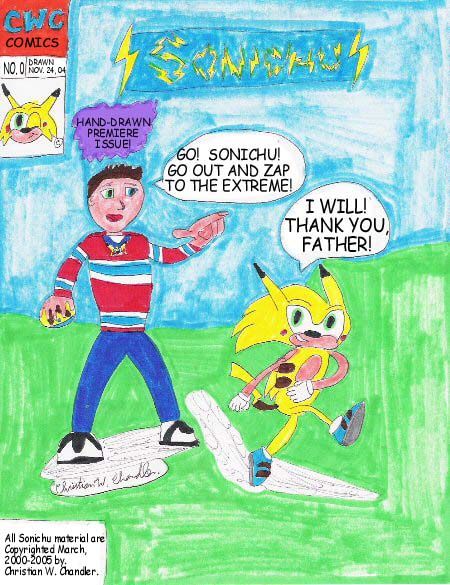
Even from the first Sonichu story, we see that the " electrical hedgehog Pokemon " is not the star of his strip. The very cover of " Issue Zero " has comic Chris-Chan telling Sonichu to " Zap out to the Extreme ", and Sonichu thanking his " father " for the instruction. The dynamic between Chris-Chan and Sonichu is meant to be father and son, but it goes without saying that biology would not allow a virgin birth of a cartoon animal to a human male. Instead, Sonichu serves as Chandler's idealized avatar-- if the Chris-Chan who appears in the comic is meant to represent Chandler's " dogged nice guy " conception of himself, then Sonichu is who Chandler wants to be, the children's hero who thrives within a never-maturing status quo.

Not only does Chris-Chan hog the cover, but he serves as the narrator for the debut story. He frames the story as its " intrusive creator ", telling us how the unwitting influence of Super Sonic transformed a Pikachu into Sonichu, and a Raichu into his female counterpart and girlfriend Rosechu. The Pikachu is literally just sitting there, about to be eaten by a monster, when he is transformed into Sonichu. After the transformation, he immediately fights and defeats the monster. He's cheered by the public, is impressed by his newfound power and ability to speak, and does not hesitate to rename himself " Sonichu ". Chris-Chan starts and ends this sequence, reminding us that Sonichu is his creation-- Chandler not only lives vicariously through Sonichu, but feeds off of the hypothetical adulation Sonichu receives, hoping that there will be a trickle-down fandom from his creation to him. He's creator and fan in one.

The episode concludes with a " Who's Who " list, involving Sonichu, Rosechu, the " Chaotic Combo " of other recolored hedgehog characters, the villains ( based on Chandler's real-life antagonists ), and three mysterious new Sonichus. There's not much to say about this as writing, since it's clearly telling and not showing. But it does reinforce the idea that Sonichu is about a status quo-- and in later chapters, that status quo finds itself under threat and has to resist.

More to Come..

* I'm referring to the real world Christian Weston Chandler by his last name, while the in-comic CWC will be called " Chris-Chan ".
** And this is NOT because of his autism. While Chandler may use his autism diagnosis as an attempt to excuse his problems, too many people bash him in context of his condition. Autism does not make people do any of the things Chandler has done, and calling him things like " that autistic fuck " or " autistic man-child " in the comments will not be tolerated.