Ruby Nation

Ruby Nation
Ruby Nation: The Webcomic
Showing posts with label superman. Show all posts

Wednesday, December 25, 2013

Forever Evil, The Most DC Comicsy DC Comic of The Year


Really, this says it all. An evil alternate universe Superman powering up by snorting Kryptonite as though it were crack cocaine. This was the most DC Comicsy moment of 2013. Make of that what you will.

Happy Holidays, and sorry if this is a far, far less adequate present than you all deserve.

Sunday, June 30, 2013

Comics, Cats, and 'Casts: Stuff I've been Up To

It's been a while since I've posted here, and I apologize for that. In addition to my regular job, I've had plenty of activities, such as the following comics from Ruby Nation;

http://www.therubynation.com/comics/1749042/bizarre-post-human-biology/
http://www.therubynation.com/comics/1753690/male-bonding/
http://www.therubynation.com/comics/1757607/college-planning/
http://www.therubynation.com/comics/1766514/human-hearts-post-human-biology/

As well as all of my cat comics at Poet Kitties, including this favorite of mine;

http://www.poetkitties.com/comics/1752373/criminal-balzac-cat/

And best of all, my podcast with Up Up and Away's Siike Donnelly on the topic of Superman, where I discuss bullies, memes, Ruby, and Grant Morrison among other things;

http://www.blogtalkradio.com/nerdnation/2013/06/12/up-up-and-away--episode-3

Enjoy!

Monday, December 31, 2012

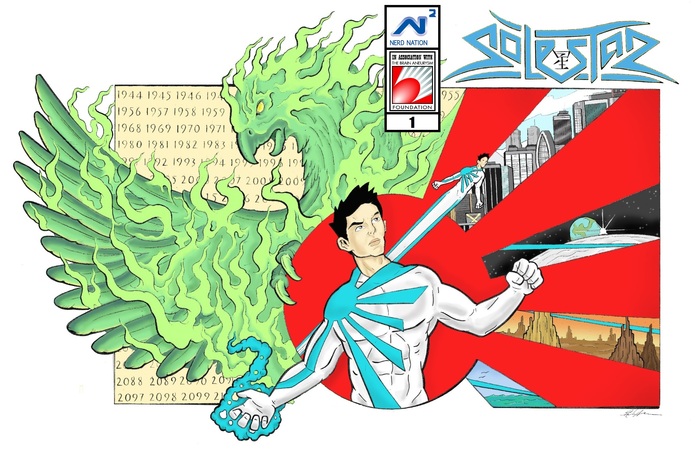
Solestar: Support The Greatest Comic Of 2013!


If there's one comic I'm most excited for in the coming year, it's Solestar. It's currently in the Kickstarter phase, but it deserves your attention and your support.

Writer/creator Siike Donnelly is a friend of mine, who I met first on Facebook and later in person at Golden Apple Comics in Los Angeles. Siike is a survivor of a brain aneurysm, a cerebral eruption that left him severely debilitated. Despite this, he's managed to relearn basic functions that most of us take for granted, such as walking and talking. He's also kept very active in the comics community, having written a few novels, doing a regular Nerd Nation podcast with Gene Hoyle , adopting an adorable stray dog named Echo, and even doing some real-life superheroing.

Usually discussions of people "overcoming" disability are incredibly patronizing, treating the disabled subject as an object of pity, and using the narrative to shame able-bodied/minded people in a way that has the opposite effect (i.e. "this person can't walk but has done so much with their life, therefore you should be able to do even better than this cripple"). They also tend to gloss over the actual challenges of disability by treating them like a super-villain that can be conquered. I'm trying to avoid that here, because I know that Siike struggles on a daily basis, and lives with a lot of pain. His many achievements do not lessen what I know he has to endure, but they do show a man who's become much stronger than most for his hardships. I believe the two defining characteristics of any person are their compassion and their willpower, both of which transcend any physical or cognitive difficulties. Siike has plenty of both.

And Solestar is the culmination of Siike's achievements, a story about a superhero's final days. It's a charity project for the Brain Aneurysm foundation, with all proceeds helping that organization and by extension the people who have suffered that insidious condition. It started as a pitch for a Superman story, but was later reworked into an original character's saga, and came out even stronger for it. And it's got artwork by over 60 people, including yours truly. (Siike gave me a script for a page that was written to my talents, so expect to see a lot of kitties doing kitty things). The artist roster has a wide array of men and women, all of them with unique abilities but each bringing their own voice to the project. There are even some big names in the mix, such as Bill Morrison of Bongo Comics, Sean "Cheeks" Galloway, and Ninja Turtles co-creator Kevin Eastman.

I've read part of the script for this and really want Solestar to be published. Solestar is co-titled "the Naive Project", due to the inherent naiveté of trying to change the world with art and comics. But it's only naive if we let it be naive. Please consider adding some funds to the Kickstarter to bring Siike's story to the entire world.

Here's the link once again.

Saturday, May 19, 2012

Grant Morrison, Supergods, and Super-Obama; WTF


A friend of mine (Omar Karindu, as he goes by on Comics Should Be Good and Alvaro's Comicboards) suggested that Action Comics #9, the filler issue with President Calvin Ellis (a.k.a. President Superman, a.k.a the Super-Obama from that Alex Ross shirt brought into canon), was filled with subtext about how companies screw comic creators. Upon re-reading the comic, it's pretty obvious, and quite troubling.

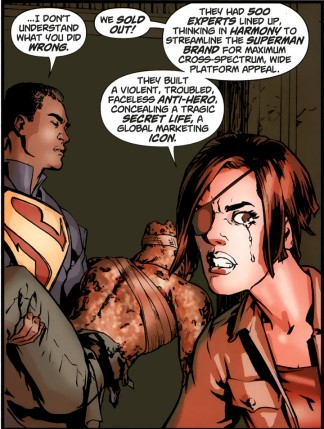
In the comic, Super-Obama faces a corrupted Superman tupla (Tibetan for Solid Thought, a living idea). This was created by the Clark Kent, Jimmy Olsen, and Lois Lane of another world, who created the living idea to embody all that is great in humanity. But they needed a lot of money to bring the Super-Idea into existence, so they went to an amoral corporation who took their Super-Idea and warped it into their Super-Brand. Hence, that trio's world became an Orwellian police state ruled by a faceless, violent Super-Brand, which was colonizing other universes and killing their super-men. To quote their Clark's dying last words;

" He becomes anything you want him to be....our world wanted THAT..."

This is an interesting interpretation of the creator's rights debate that has particularly been on the forefront of the industry discussion in recent months. It also comes across as hypocritical coming from Grant Morrison. Not only has Morrison built his career largely on the characters of others (Superman in particular, but also Batman, the Justice League, and to a lesser extent the X-Men), but his interpretation of Superman transcends any writers or artists-- even Jerry Siegel and Joe Shuster, who he characterizes more as agents of the collective unconscious rather than actual creators of the character.

In Supergods, Morrison's history text/critical essay collection/autobiography/metaphysical ramble (which I've held off on reviewing due to its extremely frustrating and rambling nature), the Scottish writer basically dismisses the problems of Siegel and Shuster. He says that he started "believing" that DC swindled these two young men out of what was rightfully theirs, but later realized that it was business as usual, and both Siegel and Shuster legitimately sold Superman to DC while expecting to keep creating other heroes. Since Morrison is one of DC's highest-profile creators, it makes sense that he wouldn't speak badly about the company that made him a star. But Supergods talks about how Superman is an idea of greatness beyond the men and woman who created him, so Siegel and Shuster end up just a footnote to their own creation. Never mind the fact that both men fought hard battles for the character that DC made billions off of, or that they struggled to make end's meet while their creation made the rich even richer. They're just sacrifices to the cause.

Matt Seneca provides a good argument against Morrison's dismissal, albeit with harsher language against the man than I would use. I love Morrison's work, though I can't and won't speak to his quality as an actual human being. But his creed, the idea that fictional characters are ultimately more important than real people, isn't just New Age bollocks. It's also the kind of idea that creates the same problem Super-Obama must face, where a faceless brand is placed above the welfare of flesh-and-blood humans. And that comic doesn't even give it a good resolution, because it's Super-Obama who defeats the Super-Brand, not the Clark, Jimmy, and Lois who rightfully own it. Lois calls Super-Obama "Superman done right", but she's just crediting him as a good example of The Brand, not praising his virtues as an individual.

Is Morrison making a hypocritical argument with Action Comics #9, arguing against the ideas that he celebrates as one of DC's golden boys? Is he making a subversives attack against the company through his comics, the kind of statement he can't make directly? Does it even matter? Not really, because Super-Obama was the star of a filler issue. Next issue, we'll go back to the young, "hip", white, marketable "Ultimate Superman" we've seen in the New 52 reboot. And it won't matter that Super-Obama was an example of how to use the brand for good, to empower the downtrodden and reclaim power from the oppressors, because the brand is more important than the sum of its parts. In the end, Superman exists to sell Superman. The great stories told with the character are the result of the individual writers and artists putting in the creative effort to animate him, but in the end, there is no inherent value to Superman. Morrison tries to present Superman as a religion, but like any religion, it can be used as a tool of oppression.

And it's in really bad taste to call attention to the problem at the same time you're profiting from its perpetuation.

Wednesday, June 29, 2011

Dear Facebook DCU SDCC Protest: HAHAHAHAHAHAHAHA


Oh wait, you're not kidding.

Look, I'm no stranger to having fan preferences and making online complaints when those preferences aren't met (though I try to distinguish between what's personal preference and what's genuinely a loss of depth in the comics, and only act on the latter), but trying to organize a live protest? As in, people dragging their asses to SDCC to whine about DC changing "their comics" while thinking themselves as important as the Tiananmen Square Tank Man?

Thursday, June 16, 2011

Dear Rebooted Superman


You've got your costume on inside-out. The trim goes on the inside. A Man of Tomorrow should be able to figure this out.

Sunday, February 27, 2011

Superman/Batman: Apocalypse: Lolita of Steel


Stanley Kubrick was one of the most accomplished and innovative directors in the history of film. One of his most interesting feats was the fact that he made a film of Vladimir Nabokov's Lolita, and under the MPAA's totalitarian Hayes Code no less. While Kubrick wasn't satisfied with the way the thoroughly censored adaptation turned out, he did manage to create a film riddled with sexual suggestion. If he couldn't do a film that explicitly told the pedophile's story, then he'd find plenty of ways to hint at Humbert Humbert's lust for a 14-year-old girl*, using careful direction to show the character's gravitation towards Lolita (and her reciprocation) without actually stating it.

Superman/Batman: Apocalypse, the animated adaptation of Jeph Loeb and the late Michael Turner's Supergirl reboot, works the same way, except the disturbing implications AREN'T intentional. And that's why it went from just being a lame movie to an outright disturbing one.

The story centers around Kara Zor-El, Superman's teenaged cousin from Krypton. Its plot, typical of a Jeph Loeb story, is a frenetic jump between various action sequences without much plot connecting them. All of the instances follow Kara trying to find a place to fit in, given the destruction of her homeworld. She arrives on Earth completely naked, witnessed by some construction workers who try to rape her (big mistake, given her super-powers). From there we see her trying different identities influenced by the adults guiding her. It's worth noting that she meets few if any other teenagers, and is the sole icon of youth and inexperience amidst a cast of grown-ups. It's also worth noting that each time she tries out an identity, Kara gets a new set of clothes that invariably fails to adequately clothe her. For example...

-- When Clark Kent takes Kara in, he takes her shopping. As Kara becomes assimilated in an improbably quick fashion (because apparently teenaged girls across all cultures take to conspicuous consumption like a duck to water), she tries on a bunch of trashy outfits, while Clark looks on with a raised eyebrow and a stern expression at his younger cousin's choices.

-- When Wonder Woman decides that Kara would best grow up on Paradise Island with other super-powered women, she takes to the Amazon wardrobe of leather body armor (and not much of it). Though Kara bonds with the Amazonians, she's still clearly the youngest there, taken in with a firm, trusting, and blatantly homoerotic hand from Lilah (a.k.a. Harbringer).

-- After being kidnapped and brainwashed by Darkseid, Kara wears a really trashy black leather ensemble, using the time-honored tradition of using leather fetish gear to evoke eeevil.

-- Finally, once she and Clark defeat Darkseid and return, Kara's "independent choice" is to become Supergirl, with a bared madriff and improbably short skirt.

The last one is the nail in the coffin; even Kara's final decision has her dressed in her paternal figure's colors, but skewed to emphasize her youth and sexuality. Worst of all, the character design clearly imitates Michael Turner's version. While I hate to speak ill of the dead and don't think Turner was a bad human being at all, his version of Supergirl was especially troubling. She had no body fat, a very thin bone structure, and an elongated torso to show off her belly button. Turner's Kara was an anorexic with big breasts attached.

To be fair, the scenes on Paradise Island keep Apocalypse from failing the Blechdel Test, because Kara and Lilah talk about things other then men. However, Kara is still the lone teenager in a cast of adults, and every wardrobe change has her re-interpreted through the lens of an adult's sublimated fantasies. Be they the outfits Clark outwardly disapproves of, the dominatrix getup Darkseid assigns, or the miniskirt outfit with branding borrowed from Superman, Kara is only given an identity in the context of others. And this wouldn't be so troubling if Kara actually looked and acted like a real girl, instead of a middle aged man's sexualized interpretation.

Needless to say, I didn't like this movie and thought it a waste of the talent of Summer Glau. I hope she gets a voice-over role soon that is closer to the complex characters she's known for playing, as opposed to an emaciated underage superloli.

Friday, December 24, 2010

The Limp Arrow Awards For Worst Comics Of 2010


Originally I had entitled these end-of-year rant posts the "Humperdoozie ", after the inbred descendant of Christ from Preacher. However, I realized that might come across as though I equate crappy comics with developmental disabilities, and I don't want that. So I've changed the award name to something more specific and less offensive-- except to people who can't get it up because of nanite arm stump infection. Fortunately, none of them are coming forward any time soon.

Here's the best way I can express my opinion about the year's comics-- 2010 was the year when I stopped identifying myself as a superhero comic fan. I'd enjoyed a lot of the stuff from 2009, and I still enjoyed some things in 2010. But this was the year where I finally emancipated myself from specific allegiances, because I'd found other interests that filled the void. I've found franchise superhero comics largely an Ouroburos that somehow kept finding more of its tail upon which to nosh, and I don't know if it was just getting fed up with the directions of comics, or focusing my attention on other mediums that told the kinds of stories I actually wanted to see.

But let's put it this way...you know how Mark Millar wrote his own afterword for Superior #1, saying about how comics fans needed new superhero characters to replace the tired constructs of the Golden and Silver Ages? Well, I found my new hero. His name is Solid Snake. :P

Anyway, onwards with the awards...

Worst Story Resolution: X-Men: Second Coming. After dragging the DeciMation out for five years, Marvel resolves it via living deus ex machina Hope Summers, whose Phoenix powers revive the mutant race with....five new mutants. That's equal to the amount of mutants killed in the crossover, significantly less than the amount of mutants killed since the DeciMation, and not even remotely worth the moral compromises Cyclops made in the name of chasing a messiah child without any evidence to support his faith. Yet now Cyclops is the hero, and everyone loves him, even though he's treated every mutant he wasn't sleeping with (re: every mutant except Emma and maybe Wolverine ) as expendable. Seeing Scott awarded the Medal of Honor by Captain America was especially jarring, since Cap wouldn't have stood for the shit Scott did, even in a wartime situation.

Worst New Direction: JMS' Superman. Walking through small towns trying to find the real America was corny when Green Lantern and Green Arrow did it in the 70's. But at least they were open to learning from their experience. Superman's just ditching his responsibilities to the entire world so he can slum it with mere mortals and feel better about himself. At best he's a politician going on a campaign trail to win his constituents' favor, and at worst he's an anthropologist fascinated by the behavior of us chimpanzees. Neither seems like a good use of his talents, and it's an especially jarring waste of a year's worth of comics.

Worst Move For Diversity Of Representation: DC Comics killing off the Ryan Choi Atom. Was Ray Palmer such an original and compelling personality that he had to return to the role at the cost of the new guy's life? What made him so much more " iconic " in that minor role, that he would have his competition eliminated by divine intervention...oh, wait, he's a white Silver Age character. And Ryan's a Chinese-American from the current generation. That explains it, and it's hardly the only example of the classic white guys taking back roles from their more diverse counterparts. At least in this case, people who enjoyed the All-New Atom comic/don't enjoy DC's current direction got a karmic bone by seeing the villain who killed Ryan sentenced to death by Snoo-Snoo.

Worst Comic About A Junkie Ex-Sideckick Who Cradles A Dead Cat During A Heroin Hallucination After Being Unable To Get It Up With The Supervillain Babymama Of His Dead Daughter Due To A Nanobot Infection In His Arm Stump: Rise of Arsenal. Okay, it didn't have too much competiton, but still, you can't make that shit up. At least, you couldn't until a professional writer DID.

Worst Trend: Identity Sub-Franchising. The Incredible Hulk has become The Incredible Hulks, with every character of his supporting cast now being a similar gamma-powered monster. Batman has become Batman Inc., franchising his identity built through a lifetime of suffering out to anyone who passes the job interview. Wolverine's gone from a solo X-Men spin-off to his own franchise, with a team book of is own and books for his clone daughter and evil son. There are two Captain Americas, a family of Flashes, and a Lantern Corps of every color. Has everyonejust given up on the idea that being a superhero can be inherently special? Or is it just

Limp Arrow 2010 Lifetime Unachievement Award: Mark Millar. See the above comment, except that his " new " concepts are a book about comic book fanboys playing at being heroes, a book about a Batman rip-off acting like a Joker rip-off, and a book about a Shazam rip-off. If you don't want to do the same old thing as everyone else, don't do the same old thing as everyone else! Filing off the serial numbers and adding a lot of swearing and "timely" pop culture references isn't good enough.