Showing posts with label new 52. Show all posts
Wednesday, December 25, 2013
Saturday, May 19, 2012
Grant Morrison, Supergods, and Super-Obama; WTF
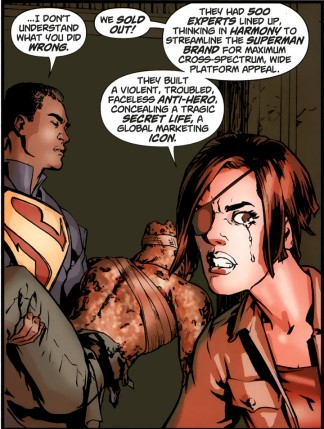
A friend of mine (Omar Karindu, as he goes by on Comics Should Be Good and Alvaro's Comicboards) suggested that Action Comics #9, the filler issue with President Calvin Ellis (a.k.a. President Superman, a.k.a the Super-Obama from that Alex Ross shirt brought into canon), was filled with subtext about how companies screw comic creators. Upon re-reading the comic, it's pretty obvious, and quite troubling.
In the comic, Super-Obama faces a corrupted Superman tupla (Tibetan for Solid Thought, a living idea). This was created by the Clark Kent, Jimmy Olsen, and Lois Lane of another world, who created the living idea to embody all that is great in humanity. But they needed a lot of money to bring the Super-Idea into existence, so they went to an amoral corporation who took their Super-Idea and warped it into their Super-Brand. Hence, that trio's world became an Orwellian police state ruled by a faceless, violent Super-Brand, which was colonizing other universes and killing their super-men. To quote their Clark's dying last words;
" He becomes anything you want him to be....our world wanted THAT..."
This is an interesting interpretation of the creator's rights debate that has particularly been on the forefront of the industry discussion in recent months. It also comes across as hypocritical coming from Grant Morrison. Not only has Morrison built his career largely on the characters of others (Superman in particular, but also Batman, the Justice League, and to a lesser extent the X-Men), but his interpretation of Superman transcends any writers or artists-- even Jerry Siegel and Joe Shuster, who he characterizes more as agents of the collective unconscious rather than actual creators of the character.
In Supergods, Morrison's history text/critical essay collection/autobiography/metaphysical ramble (which I've held off on reviewing due to its extremely frustrating and rambling nature), the Scottish writer basically dismisses the problems of Siegel and Shuster. He says that he started "believing" that DC swindled these two young men out of what was rightfully theirs, but later realized that it was business as usual, and both Siegel and Shuster legitimately sold Superman to DC while expecting to keep creating other heroes. Since Morrison is one of DC's highest-profile creators, it makes sense that he wouldn't speak badly about the company that made him a star. But Supergods talks about how Superman is an idea of greatness beyond the men and woman who created him, so Siegel and Shuster end up just a footnote to their own creation. Never mind the fact that both men fought hard battles for the character that DC made billions off of, or that they struggled to make end's meet while their creation made the rich even richer. They're just sacrifices to the cause.
Matt Seneca provides a good argument against Morrison's dismissal, albeit with harsher language against the man than I would use. I love Morrison's work, though I can't and won't speak to his quality as an actual human being. But his creed, the idea that fictional characters are ultimately more important than real people, isn't just New Age bollocks. It's also the kind of idea that creates the same problem Super-Obama must face, where a faceless brand is placed above the welfare of flesh-and-blood humans. And that comic doesn't even give it a good resolution, because it's Super-Obama who defeats the Super-Brand, not the Clark, Jimmy, and Lois who rightfully own it. Lois calls Super-Obama "Superman done right", but she's just crediting him as a good example of The Brand, not praising his virtues as an individual.
Is Morrison making a hypocritical argument with Action Comics #9, arguing against the ideas that he celebrates as one of DC's golden boys? Is he making a subversives attack against the company through his comics, the kind of statement he can't make directly? Does it even matter? Not really, because Super-Obama was the star of a filler issue. Next issue, we'll go back to the young, "hip", white, marketable "Ultimate Superman" we've seen in the New 52 reboot. And it won't matter that Super-Obama was an example of how to use the brand for good, to empower the downtrodden and reclaim power from the oppressors, because the brand is more important than the sum of its parts. In the end, Superman exists to sell Superman. The great stories told with the character are the result of the individual writers and artists putting in the creative effort to animate him, but in the end, there is no inherent value to Superman. Morrison tries to present Superman as a religion, but like any religion, it can be used as a tool of oppression.
And it's in really bad taste to call attention to the problem at the same time you're profiting from its perpetuation.
Monday, February 27, 2012
Batgirl 5-6 Thoughts: Ableist Garbage Day!
(Now just imagine if the Joker said that when he opened the door and capped Barbara in the spine.)
Joking and memetic-mutating aside, Batgirl has gone from being a technically competent comic with a disgusting ableist message, to an amateurishly written and sappy mess (albeit with good art by Adrian Syaf) with a disgusting ableist message. Issues 5 and 6 involve Barbara teaming up with Batman to fight a new villainess, Gretel, who gained mind control powers after a traumatic brain injury by a mobster she was investigating. It also has a script that bends over backwards trying to convince the audience that Batgirl is great and we should all love her as much as Gail Simone does. To wit;
1.) Bruce Wayne spends the first half of this arc hypnotized, and bumbles around like a puppet until Barbara breaks the spell by bringing up how his parents are dead. Batman, the most insanely prepared man in the DC Universe or any other (right down to literally creating his own backup personality in case of mind control of mental breakdown), is overridden like an amateur. I could accept this were it not so obvious that it was done to make Barbara look better by comparison, as the one who keeps her wits and saves Bruce's ass.
2.) Bruce Wayne hugs her afterwards, and whispers, " You were always meant to be Batgirl". This is an endorsement on par with the line in The Rise of Arsenal and its tie-ins, "was he not up for the task of being Red Arrow"? A sidekick's name, a weaker spin-off of an established hero, means nothing. Furthermore, it shows that Bruce, a man who's extremely guarded about his personal life and who he lets into his crime fighting circle, is perfectly fine with Barbara going into the battlefield physically and mentally unprepared after her apparent recovery. And that he doesn't particularly mind if Barbara's spinal chip gives out in the middle of a fight. Because she's more useful to him as Batgirl than Oracle, for reasons that don't exist!
3.) Barbara's narrative captions blanket the pages, with her beating us over the head with how great it is that she be Batgirl and help people. This is standard for modern superhero comics, the kind of "emo noir" that conceals perfectly good artwork behind boxes full of navel-gazing. But it's especially galling when Barbara talks about how she was never a partner to Batman, and was her own crime fighter. Who apparently took all of Batman's moves and gadgets for her great individual identity, but that doesn't really matter.
4.) Gretel is the second case in a row where the main villain of a new Batgirl story is a heavy-handed parallel to Barbara's own trauma. In the previous case, it was Mirror, who survived an accident that killed his family, and became devoted to killing everyone else who'd experienced miracles. In this case, it's a woman who was nearly killed by criminals, and is now a lethal vigilante. Batgirl makes sure we don't miss the parallels for a second, making this analogy about as subtle as a House episode where the patient's problem somehow connects to House's leg/addiction/misanthropy (re: EVERY FUCKING EPISODE). And, of course, Barbara has to be all weepy about it, telling the cops to treat Gretel well when they ship her off to Arkham.
It's also worth noting that Gretel still has clear evidence of her trauma-- her multicolored wigs disguise her bald head, which has a bullet scar where hair would've been. Further confirming that heroic characters don't have deformities, only bad guys! I can't wait to see Barbara fight a villain who's in a wheelchair, then give a speech about how she feels their pain!
In the end, what bothers me most about Batgirl is that it represents the character as "the good cripple". She was physically and mentally scarred, but she put the former behind her with a magic cure, and she's working on 'overcoming' the latter. Disability, to Barbara, was just a transitory state so she could look stronger once she emerged from it. And when she emerges, she emerges as a character who doesn't rock the boat or say anything controversial. She's just become another face in the Bat-crowd, only distinguishable by the Pollyanna-type bullshit about second chances and miracles that flows from her mouth.
Labels:
ableism,
barbara gordon,
batgirl,
batman,
dc comics,
gail simone,
garbage day,
joker,
new 52,
oracle,
representation of disability
Sunday, January 1, 2012
Batgirl, The Most Repulsive Comic of 2011
At the end of 2011, the new Batgirl has completed its first arc, and while it's not too bad from a craft standpoint, the implications are so disgusting that it was easily the worst comic I read all year. That includes plenty of comics that WERE bad from a craft standpoint, and even more comics that had a decent level of craft but were based on profoundly stupid concepts. But none of these comics had as revolting a message behind them, and even if they did, their negative implications were immediately seized upon by the audience. The new Batgirl is vile, but a positive commercial and critical reception enable its vileness.
Again, the issue here isn't with the art or writing, at least no more so than any other comic. Adrian Syaf's art is exceptional, and he at least makes the book nice to look at. And Gail Simone's script is decently constructed, if not nearly as good as her work on Birds of Prey or Secret Six. But she's based the book around one of the worst representations of disability I've seen in recent years. This is a comic that deals explicitly with the fact that the character of Barbara Gordon was the rare character who was both a semiotic victory and a memorable, complex entity on her own-- then pisses all over it.
I've already mentioned the bullshit conceit behind this book, that Barbara Gordon can walk again and is using that opportunity to be Batgirl. Now that we're a full four-issue story arc into this comic, we learn how Barbara was cured; she went to a special clinic in South Africa, to receive an experimental surgery. There's the chance that her condition could deteriorate, especially with intense physical strain (the kind that comes part and parcel with crime-fighting), but she's doing it anyway. In Barbara's mind, she's received a miracle, and she has to use her second chance to help people.
It's a strong religious metaphor without the courage to attach itself to a specific religion. But worse, it's a miracle cure that reinforces the notion that Barbara was broken because she couldn't walk. It doesn't matter that it's from the fringes of real-world science instead of DC Universe Phlebotnium, it's still an awful plot device. Barbara can walk again, so she's using this chance to become the exact same person she was before being put in the wheelchair. Her time as Oracle is completely glossed over, with the only bit of past continuity explicitly referenced being when she was shot by the Joker.
Worse yet, the book has the gall to try to treat disability with respect. Barbara scoffs at how Alysia* talks about the loss of mobility as a pitiful fate, and talks about what the chair "lets you do". It's referenced that the word "cure" was a dirty word in the Gordon household, with her father having brought up the clinic with veiled language (so as not to offend Barbara's proud identity). But this means absolutely nothing because Barbara still took the cure, and still enjoys not only her life as an able-bodied person, but as a pinnacle of athletic skill.
Some might argue that it's Barbara's choice to take this cure, and to live the kind of life she wants without accepting limitations. Except Barbara doesn't have much respect for her own life, for the following reasons;
1.) Subjecting herself to an experimental and possible life-threatening surgery in order to walk again, as though the risk of being dead was worth the reward of being able to walk.
2.) Becoming a crimefighter despite being badly out of practice and physically/psychologically unfit for the task. Throwing herself onto the battlefield in situations that could (and, in fact, did) cost civilians their lives due to her incompetence.
3.) Refusing help from her ex-boyfriend and fellow Bat-sidekick Dick Grayson, brushing him off as an over-protective man and going off to fight the villain herself. (This isn't a feminist issue, it's an issue of someone close Barbara not wanting her to get herself killed out of stupid pride).
4.) Being yet another member of the Bat-Family, now in a role that hundreds of crimefighters do better (thanks to Batman, Incorporated). Grant Morrison's notion of Oracle as a cyber-crimefighting digital Batgirl was silly and rooted in very dated conceptions of the internet, but it at least gave Barbara a unique role suited to her skill-set. Here she's just one of the Bat-Grunts, albeit without the ability to handle her emotional baggage.
In short, the message of the new Batgirl is that being disabled limits what you can do, being "normal" is an ideal for which you should readily throw away your life, and disability is just a pit-stop on the able-bodied hero's journey. To this, I use the words of a still-active disabled character, played by an extremely talented actor with a disability (Peter Dinklage);
" [as a cripple] I beg to differ. Death is so terribly final, while life is full of possibilities. "-- Tyrion Lannister, George R. R. Martin's A Game of Thrones
*the Ethnic Best Friend, because DC's books still have to belong to the white characters; so long, Cassandra Cain!
Again, the issue here isn't with the art or writing, at least no more so than any other comic. Adrian Syaf's art is exceptional, and he at least makes the book nice to look at. And Gail Simone's script is decently constructed, if not nearly as good as her work on Birds of Prey or Secret Six. But she's based the book around one of the worst representations of disability I've seen in recent years. This is a comic that deals explicitly with the fact that the character of Barbara Gordon was the rare character who was both a semiotic victory and a memorable, complex entity on her own-- then pisses all over it.
I've already mentioned the bullshit conceit behind this book, that Barbara Gordon can walk again and is using that opportunity to be Batgirl. Now that we're a full four-issue story arc into this comic, we learn how Barbara was cured; she went to a special clinic in South Africa, to receive an experimental surgery. There's the chance that her condition could deteriorate, especially with intense physical strain (the kind that comes part and parcel with crime-fighting), but she's doing it anyway. In Barbara's mind, she's received a miracle, and she has to use her second chance to help people.
It's a strong religious metaphor without the courage to attach itself to a specific religion. But worse, it's a miracle cure that reinforces the notion that Barbara was broken because she couldn't walk. It doesn't matter that it's from the fringes of real-world science instead of DC Universe Phlebotnium, it's still an awful plot device. Barbara can walk again, so she's using this chance to become the exact same person she was before being put in the wheelchair. Her time as Oracle is completely glossed over, with the only bit of past continuity explicitly referenced being when she was shot by the Joker.
Worse yet, the book has the gall to try to treat disability with respect. Barbara scoffs at how Alysia* talks about the loss of mobility as a pitiful fate, and talks about what the chair "lets you do". It's referenced that the word "cure" was a dirty word in the Gordon household, with her father having brought up the clinic with veiled language (so as not to offend Barbara's proud identity). But this means absolutely nothing because Barbara still took the cure, and still enjoys not only her life as an able-bodied person, but as a pinnacle of athletic skill.
Some might argue that it's Barbara's choice to take this cure, and to live the kind of life she wants without accepting limitations. Except Barbara doesn't have much respect for her own life, for the following reasons;
1.) Subjecting herself to an experimental and possible life-threatening surgery in order to walk again, as though the risk of being dead was worth the reward of being able to walk.
2.) Becoming a crimefighter despite being badly out of practice and physically/psychologically unfit for the task. Throwing herself onto the battlefield in situations that could (and, in fact, did) cost civilians their lives due to her incompetence.
3.) Refusing help from her ex-boyfriend and fellow Bat-sidekick Dick Grayson, brushing him off as an over-protective man and going off to fight the villain herself. (This isn't a feminist issue, it's an issue of someone close Barbara not wanting her to get herself killed out of stupid pride).
4.) Being yet another member of the Bat-Family, now in a role that hundreds of crimefighters do better (thanks to Batman, Incorporated). Grant Morrison's notion of Oracle as a cyber-crimefighting digital Batgirl was silly and rooted in very dated conceptions of the internet, but it at least gave Barbara a unique role suited to her skill-set. Here she's just one of the Bat-Grunts, albeit without the ability to handle her emotional baggage.
In short, the message of the new Batgirl is that being disabled limits what you can do, being "normal" is an ideal for which you should readily throw away your life, and disability is just a pit-stop on the able-bodied hero's journey. To this, I use the words of a still-active disabled character, played by an extremely talented actor with a disability (Peter Dinklage);
" [as a cripple] I beg to differ. Death is so terribly final, while life is full of possibilities. "-- Tyrion Lannister, George R. R. Martin's A Game of Thrones
*the Ethnic Best Friend, because DC's books still have to belong to the white characters; so long, Cassandra Cain!
Labels:
barbara gordon,
batgirl,
batman,
birds of prey,
dan didio,
dc comics,
dc relaunch,
gail simone,
new 52,
oracle
Subscribe to:
Posts (Atom)