Ruby Nation

Ruby Nation
Ruby Nation: The Webcomic

Thursday, February 20, 2014

My Response To The Michael B. Jordan Fantastic Four Casting


In response to the news HERE, though the Michael B. Jordan casting was known well before it was finalized today.

I do have misgivings with the castings (namely that Sue Storm was cast as Kate Mara, a white woman, when there are plenty of talented black actresses that have a harder time getting work and would've looked more like Jordan's sister), but the inevitable, often-racist shitstorm that comes with changing the race of 1960's characters for film is usually entertaining (if depressing) to watch. Especially when it's related to the Fantastic Four, a book that has struggled to be interesting and relevant ever since Jack Kirby left the book, barring a few standout periods (such as Byrne's run and the Waid/Weiringo stuff). 

Friday, January 17, 2014

I Got Issues Comic Reviews for 1/15/2014: Velvet, Miracleman, Amazing X-Men, and Ultimate Ultimates


Another week, another stack of comics (though unfortunately I couldn't find a copy of Voice in the Dark #3).

AMAZING X-MEN #3: The art by Ed McGuinness is an absolute dream, full of excitement and energy in every panel. The story is at this point mostly an excuse to give Ed McGuiness exciting things to draw. It's a Jason Aaron X-Men comic, which means it's full of wacky high-concept stuff first and characterization second. The interactions between the characters are perfunctory, especially with the obvious character shipping (and the revelation that Nightcrawler and Storm have always been in love with each other, and didn't Aaron just pair her up with Wolverine? Either she's polyamorous, which I wouldn't mind, or pairing her up is the most interesting thing Aaron has planned for Ororo, which I would seriously mind)At least this doesn't have any overbearingly wacky stuff like the 12-year-old Hellfire Club (literally the most annoying team of villains in Marvel history, from my perspective at least), but it's still a comic about the X-Men joining Nightcrawler in the afterlife to fight Satan and his pirate crew. In other words, it's the Axe Cop of the X-Men. But again, great art. RECOMMENDED.

ULTIMATE COMICS CATACLYSM: THE ULTIMATES #3: The Ultimate comics have stuck around far longer than they should have, the promise of a simpler, more relatable Marvel Universe long since expired in favor of a bunch of earth-shaking cataclysms. Galactus eating the world is the third time we've seen this happen, but this tie-in by Josh Fialkov and Carmine di Giandomenico has been surprisingly entertaining. It takes the rather predictable doomsday set-up and uses it to do a fast-paced, snappily-written story with a snarkier take on the formula. Since the story has Nick Fury's Ultimate Howling Commandos (re: a bunch of second and third stringers, such as Ultimate Stature and Ultimate Hercules) on an essential doomsday mission against a techno-organic Gah Lak Tus cult. The characters are suitably dysfunctional, but there's a bit of pathos too with Danny Ketch's dying words, and his eventual fate. It doesn't really end, but it's interesting enough that I'll actually try the Ultimate FF book that follows. The art by Carmine di Giandomenico is exceptional too, which nearly matches the widescreen detail of Bryan Hitch but has a fluid, expressive line more appealing than the usual "photo-realism" we see in this sort of book. RECOMMENDED.

MIRACLEMAN #1: It's 12 pages of the Alan Moore/Garry Leach run padded out with old Mick Anglo strips for childred and extra material for a price of $5.99. The great lost work of Western comics is why people are here, but it's not even the majority of the product; Marvel's gouging the audience who'd buy this for all they're worth. I'd never read the original Miracleman stories, so I can't really judge the overall story. This prologue is beautifully drawn by Leach, but the script is extremely familiar in its portrayal of the superhero as an outlet for a mid-life crisis-- though that's be due to its influence, both on Moore's later works and the genre in general. Still, this issue itself is an expensive curio, so I'd have to give it a MILDLY RECOMMENDED.

VELVET #3: It's great that Ed Brubaker and Steve Epting, two creators perhaps best known for the Winter Soldier story of Captain America, can now do their thing unfettered by Marvel franchises and apparently make a living at it as well. In this case it's Velvet, a.k.a. "what if Moneypenny went on a rampage to avenge a dead James Bond". It kind of defies belief that Velvet can be such a strong action heroine at her age (at least in her fifties) with her long retirement from field work, but given how my favorite spy story involves a man physically in his seventies fighting against mooing robots and nanotech vampires, I'm in no position to complain. This is the sort of story that seems like a perfectly natural take on the high concept, but still comes across as novel and exciting. Velvet's perspective as a woman offers her a distinct insight in to the Martini-flavored spy game, as she's a PROTAGONIST who uses the Honey Trap techniques instead of a love interest/femme fatale. Everything about this book, from the script to the art to the coloring to the basic magazine design with the white gutters, just works. STRONGLY RECOMMENDED.

Wednesday, January 15, 2014

Top 10 Better Alan Moore Miracleman Reprint Credits than "The Original Writer"


Marvel has enough brass to reprint Miracleman against Moore's wishes without actually putting his name on the book, but why stop there...

--Prospero
--Jordan Elliott
--Alan Smithee
--Storybook Smith
--Mallan Oore
--Captain Adam
--The Occupier
--Kid Moore
--Sodam Yat
--Alan Morrison

Friday, January 10, 2014

I Got Issues Comic Reviews Week of 1/8/2014: Sex Criminals, Kamala Khan, Sad Wolverine, and the Colonial Iron Man


Trying a new format for reviewing comics, so these aren't going to go over two paragraphs each; I'm going for expedience as well as quality critique. So here's what I read this week...

Sex Criminals #4: Matt Fraction and Chip Zdarsky's painfully realistic story about people who stop time when they fuck continues. In this issue, Jon and Suzie meet even more people with their "condition", albeit a peacekeeping force who apprehend the Quiet's so-called "Sex Criminals"(TITLE DROP!). While I'm not entirely sold on the world-building of the Sex Police, that's not really the point; this is still Suzie's story, and about how her condition adds even greater complexity to the already nigh-incomprehensible territory of human intimacy. The best parts are still Suzie's narration, as she talks about her past and what sorts of things she did during the Quiet (including her first illegal activity, using the time freeze to frame her friend's rapist college boyfriend for marijuana possession-- a morally ambiguous approach with a similarly ambiguous outcome).

With Fraction's script and Chip Zdarsky's expressive art and detailed backgrounds (including some of the greatest ambient detail ever depicted for a store called "Cumworld", Sex Criminals continues to be the frank, mature sex talk the medium so badly needs. STRONGLY RECOMMENDED.

Wolverine #13; The finale of Killable, setting up the new direction for the supervillainous relaunch. As expected, Wolverine has no chance against Sabretooth without his healing factor. Sabretooth doesn't kill Logan, but instead takes the opportunity to rub Logan's mortality in his face, lecturing him on how they're not so different and how Logan's moral hypocrisies are unavoidable without his regenerative crutch. It's a brutal scene, and one of the few effective uses of the Origin continuity that I've seen, since Sabretooth calls attention to the fact that underneath his stereotypical man's man demeanor, Logan was still born as sissy nobleman's son James Howlett, and his attempt to be the blue collar hero falls apart given his privilege (both the initial wealth and the later, now absent mutant indestructibility). I hope that Sabretooth gets his not-so-inevitable comeuppance from Logan, though; similar to the Joker or the Green Goblin, Sabretooth is the kind of Complete Monster arch-villain who enjoys the kind of invincibility only a shared universe allows, and the fact that such rotten characters haven't been killed (in a permanent manner, at least) demonstrates an inherent futility to the nature of the shared universe superhero. At least Logan's killed Sabretooth before (though it obviously didn't stick), but the guy is one of the most successful characters in the Marvel Universe, and he owes it largely to his complete lack of moral restraint. "The best lack all conviction, and the worst are filled with passionate certainty", as Yeats would put it.

Perhaps once Logan becomes a super-villain himself, he'll learn that being a bad guy is the way to go in a world where nobody important to Marvel's bottom line really dies, healing factor or not. Until then, it's a powerful story, made all the more powerful by the choice the badly injured Logan is given towards the end. It's another moment that's simultaneously easy to predict in terms of logic but difficult to prepare for as an emotional response. Another great issue from Paul Cornell, and sadly the final issue with Alan Davis drawing-- there's a reason he's a legend in comics, and that reason is seen in effortless nature of this issue's storytelling. STRONGLY RECOMMENDED.

IRON MAN #20: Easily the weakest book I read this week, though that's partly because everything else was so great. Still, the Kieron Gillen run on Iron Man continues to underperform, competent but not at the level I'd expect from the one writer to make modern Cyclops into a sympathetic character.  There have been many extenuating factors, most notably the immediate shadow of Matt Fraction's brilliant run, the wretched Greg Land art plaguing the first year or so, but also the fact that most of it was stuck out in space due to the Guardians of the Galaxy status quo, and the fact that the Secret Origin story was resultantly told light years away from Tony's home planet. Not to mention thirtysomething years away from a point where the events within the origin story might have actually been relevant, as Tony had plenty of nurture to overcome whatever hypothetical genetic tampering would've been done to him in vitro, but I digress.

This current storyline is a mixed bag. On the one hand, there's the strong central idea of Tony building his own city over the ruins of the Mandarin's old regime, trying to create a test-bed for modern living. But it's told in such a way that it's hard to sympathize with Tony's goals. It's clear that Tony's overcompensating with this project to avoid dealing with the news that he was adopted, but we haven't really seen anything to indicate why the city is so great, other than Tony telling us that it is The City of the Future and not just a way for him to hide from his real problems within his toybox. There's the obviously problematic symbolism of Tony building a city over foreign soil without foreign consent, and the story itself acknowledges this-- but through the mouthpiece of Abigail "Red Peril" Burns, a one-dimensional anarchist strawman villain, devoid of anything but buzzwords and firepower. There's an impressive fight scene with Tony facing her using a battery of remote units (with the help of his new "brother" Arno Stark), as well as Tony cleverly wearing an invisible Iron Man suit over his street clothes. The art by Joe Bennett helps as well, and not just because it's not Greg Land. Bennett offers a strong cinematic flair reminiscent of Bryan Hitch.

I think my central problem with the current Iron Man volume is that it's obviously using a movie-style take on the character, where we're supposed to interpret the protagonist's complete disinterest in the consequences of his actions as roguishly charming. I'm much more interested in Arno's story, and the implication that he chooses not to rebuild his Iron Lung into something capable of mobility. Perhaps he's reticent to go out into the world after spending his entire life hiding, due to his comment earlier on how people tend to see people like him (i.e. handicapped geniuses) as villainous. Then again, that may be in part an excuse for the fact that such a transition would be frightening. It's a believable and sympathetic approach to a character potentially "overcoming" a disability, even if it's in going from an Iron Lung to an Iron Exoskeleton. Too bad it's not the main story. Overall, MILDLY RECOMMENDED.

ALL-NEW MARVEL NOW POINT ONE: Now this was a pleasant surprise. Six strips, and not a stinker in the bunch. I'm not going to buy all of these books, but all of the prologue stories were strong examples of craft. I'm probably not going to get the Invaders series by James Robinson and Steve Pugh, given my lack of interest in the Invaders, but it did look like a good hook for a traditional super-team comic. The Black Widow story by Nathan Edmonson and Phil Noto was also pretty good, especially the art, even if the script was a bit predictable in its portrayal of Natasha as a conflicted assassin. I'm more interested in the Loki series by Al Ewing and Lee Garbett, which has a strong grasp of the character (at least the Tom Hiddleston version that will likely be the default take from here on out). And the Avengers World strip by Jonathan Hickman, Nick Spencer, and Rags Morales could lead to something really great, provided that the writing is influenced more by Spencer than Hickman. Spencer has a strong flair for character work, which can be true for Jonathan Hickman but usually isn't, due to his greater interest in writing stories as meticulous chess games with complex plotting and strategizing taking precedence over a dramatic hook. (His Avengers is especially guilty of this, but it was foreshadowed in his Ultimates series, which started strong but quickly regressed into a demonstration of how awesome the villainous Reed Richards could be).

The two books I will definitely be buying after reading this comic are Silver Surfer by Dan Slott and Michael Allred, and especially Ms. Marvel by G. Willow Wilson and Adrian Alphona. I enjoy Dan Slott's writing quite a bit, and I like the idea of Silver Surfer getting a Doctor Who-style companion so he has someone to talk to besides his crippling sense of self-pity (and Slott uses it to his advantage by playing the Surfer's seriousness as comical in contrast to everything around him). The art by Michael Allred is beautiful as always, and the pop art charms are most important when we see the Surfer fighting a bunch of anthropomorphic sea-predator pirates. The Ms. Marvel story deserves special praise, and not just because it pisses off the right kinds of people. New 16-year-old Muslim superheroine Kamala Khan immediately shows the kind of conceptual strength right off the bat that most teenage heroes only dream of acquiring. She's a shape-shifter as a metaphor for a child of multiple cultures and demands, growing up in New Jersey under Pakistani-American parents, with both mother and father having their own sets of well-intentioned demand (the mother for the right marriage, the father for the right career). She's definitely an eccentric young woman who's immediately figured out creative uses for her powers, but there's not much room for her to express her abilities; her first superfight is limited to a monster in a junkyard, and even that's interrupted by a call from her mother. The art by Adrian Alphona is perfect, as I would expect from the artist of Runaways; he's especially good at showing Kamala's powers in action, and how awesome being able to stretch one's body and limbs can be. Too bad it doesn't help her larger identity issues, or in Kamala's words; "I can change my face, but I wear a mask instead. There are LAYERS of unpackable crazy up in here."

Based on the overall quality but also the strength of the Ms. Marvel story, STRONGLY RECOMMENDED.

Tuesday, December 31, 2013

Voice in the Dark, Comic of the Year!


Whatever my vote for comic of the year might have been worth in past years, it's probably lessened by the lack of blogging I've done this year. This year was the one in which I largely lost interest in American comics, to the point where I couldn't even get angry at the myriad stupid things that inevitably happen within the Marvel and DC Universes. But this was also the year in which creator-owned comics truly became a force in the industry, with countless great titles coming from smaller publishers without a franchised character in sight. Most of the comics I enjoyed were from Image, who got behind such great series as Saga, Sex Criminals, Elephantmen, Black Science, Velvet, Fatale, and most importantly, Voice in the Dark.

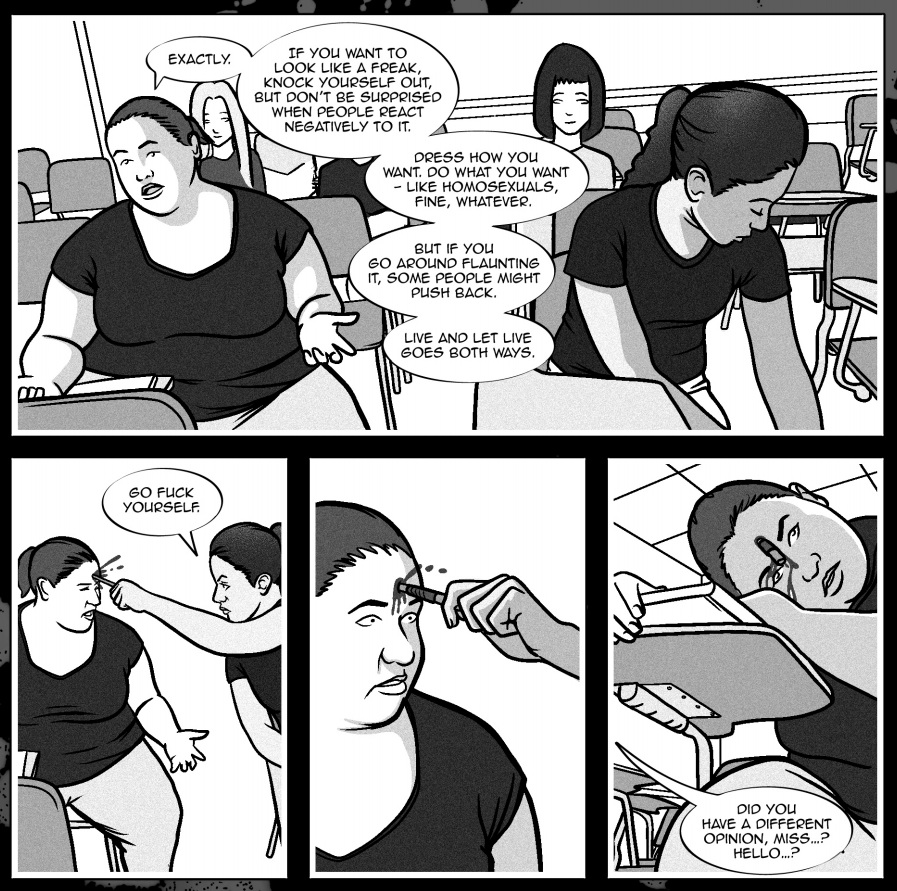
My vote for Voice in the Dark is partially based on the fact that its writer/artist, Larime Taylor, is disabled. I've spent a lot of time talking about disability within comic characters, but not nearly enough talking about disability within the comics' creators, who are obviously* far more important to the process. Since Larime Taylor has arthogryposis, he does not have the passing privilege that other disabled characters might use, and has been admirably frank in his criticisms of his difficulties getting around comic conventions. Even from a creative perspective this impacts his work, as he does his drawing with his mouth.

I'm trying to be very careful talking about Taylor's disability, because A.) I can only imagine as to what his life is actually like, and B.) I want to avoid the patronizing "inspiration porn" often used in describing disabled peoples' achievements. Voice in the Dark isn't good because it's by an artist who doesn't have the luxury of drawing it with his hands, though I also don't want to diminish the personal strength of character Larime shows to draw a monthly comic with his impairments. It's an admirable achievement, but that in and of itself doesn't make a good comic, and to focus solely on the author's personal handicaps ultimately diminishes their individual achievements (e.g. the condescending statement "It's good comic for an artist with...insert disability here...") No, Larime Taylor's Voice in the Dark is good because it's an objectively well-crafted comic that shows a natural grasp of characterization and visual storytelling that most cartoonists would need an entire lifetime of work to achieve.

For those who haven't read Voice in the Dark (which you should), this series chronicles the life of Zoey Aarons, a college freshman with serial killer impulses. Though it's not entirely clear how many people she's killed and under one circumstances (so far we know she killed a popular girl who romantically manipulated her sister, but Zoey's also an inherently unreliable narrator), she fights against violent, homicidal impulses that don't have a clear pathological origin. Zoey keeps this to herself for obvious reasons (including the fact that her beloved Uncle Zeke is a homicide detective), and she tries to help other people by running an anonymous radio show, where she encourages them to confess their own forbidden thoughts and feelings (while offering herself a place for "Dark Zoey" to safely speak).

Zoey is an inherently compelling character because, unlike Dexter Morgan (the most obvious comparison people have made regarding the sympathetic serial killer protagonist concept), she doesn't indulge her compulsion with an elaborate vigilante persona. She's mostly just trying to live her life, get through school, and not kill any more people. Repressing urges that society considers forbidden is something that everybody deals with, be it the urge to murder someone in cold blood or the urge to shout "This movie sucks and you suck for liking it" when watching Iron Man 3 in a theatre**. Zoey isn't devoid of empathy; far from it, as seen in the events of issue 2, when her advice to a suicidal caller is taken in a far less constructive way than she intended. Her experiences with her mental illness have made Zoey extremely contemplative and introspective for her age, and this definitely makes it harder for her to suffer the unwitting shallowness of her peers (though as far as we know, all she's done is fantasize about stabbing her roommates and classmates).

Even from two issues in, the characters are strongly defined and visually distinct. Despite being a grayscale comic without any fantastical elements, virtually everyone is recognizable as a unique character. Characters come from a variety of different cultural backgrounds within the Seattle, WA setting, and while you can understand why Zoey wants to kill some of them just for the sake of shutting up, nobody comes across as a one-dimensional stereotype. I definitely recognized some of the personality types from my own undergraduate experience (where I was similarly withdrawn and resentful thanks to my own illnesses, albeit not in a way that involved wanting others to bleed out), and the dialogue was realistic enough to make it a smooth read. This is a book that's mostly talking heads, but the character designs, expressions, and movements feel accurate and emotionally resonant.

This is a comic that virtually came out of nowhere*** and offered me a better reading experience than anything else I'd picked up in comic stores this year, and I strongly look forward to successive issues. In the end, if there's one thing I can say about Larime Taylor's Voice in the Dark, it's that you should buy it. Now.

* (Christian Weston Chandler of Sonichu fame doesn't count, as all he's created is a reason for aliens to destroy our planet, Alderaan-style).
** Thankfully I have a blog for that. 
*** It didn't come out of nowhere in a literal sense, but it did come from a successful Kickstarter.

Wednesday, December 25, 2013

Forever Evil, The Most DC Comicsy DC Comic of The Year


Really, this says it all. An evil alternate universe Superman powering up by snorting Kryptonite as though it were crack cocaine. This was the most DC Comicsy moment of 2013. Make of that what you will.

Happy Holidays, and sorry if this is a far, far less adequate present than you all deserve.

Tuesday, December 24, 2013

Wolverine By Paul Cornell and Alan Davis, Superhero Comic of the Year

This is the year where I finally put my money where my mouth is and drifted away from mainstream superhero comics. It wasn't because the books were offensively bad, just that most of them weren't really going anywhere that wasn't permitted by the dual demands of movie licensing and comics continuity. One of the comics that got around those and remained consistently memorable, however, was the new Wolverine book by Paul Cornell and artist Alan Davis.

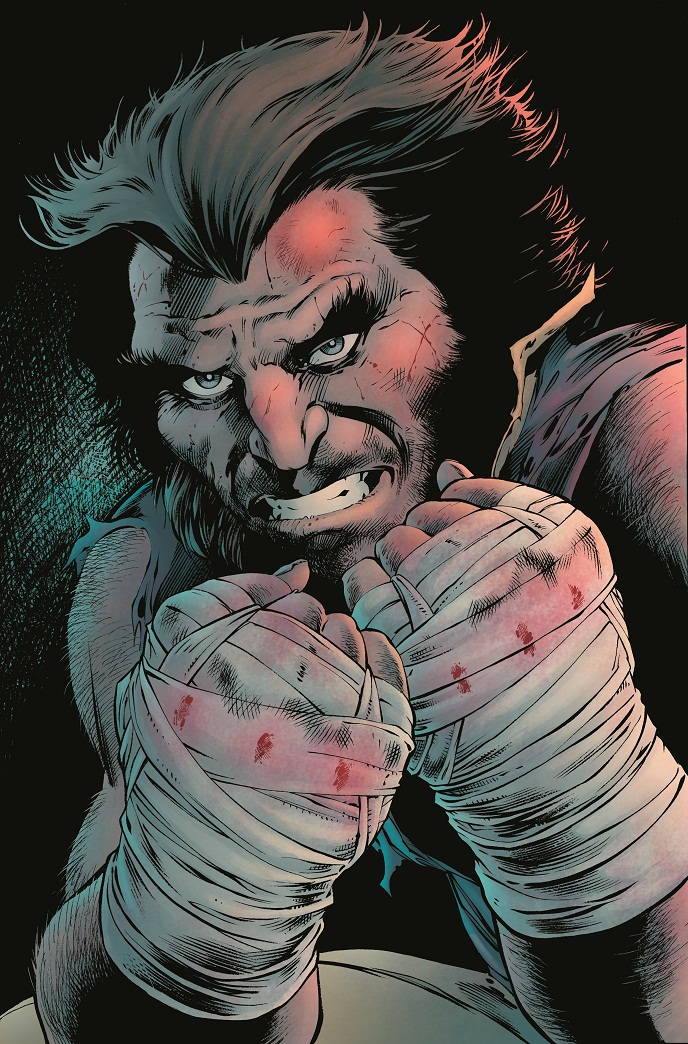
On the surface, one could say that this was another case of a comic being an adaptation of its own adaptation, since the big hook for Cornell's story is Logan losing his healing factor and becoming Killable-- the thing that happened in the Wolverine movie, which I still have yet to see. However, Cornell has done exemplary work showing us how Wolverine is adapting-- or not adapting, rather-- with his newfound mortality. Without a mutant regeneration ability that can cure him of every ailment conceivable, from being drunk to being hit with Little Boy *, the list of new problems that Logan must face are endless. In the very first issue after a sentient virus burns out his healing factor, Logan realizes that he has to be careful with EVERYTHING-- he even considers buying a practice shaving razor, as his previous shaving techniques were much rougher. Logan is unparalleled at ignoring pain, but that's because pain is the body's signal that something is wrong, and there used to be nothing that Logan's magic healing flesh couldn't fix. Now he has to worry about not only normal human injuries, ailments, intoxications, and all-around mortality, but he also has to deal with the added disabilities of his other powers.

 Immediately after Logan is diagnosed as "mortal" by Hank McCoy, he's prescribed a drug to counteract the heavy metal poisoning of his adamantium skeleton, which would otherwise kill him rather quickly. The metal skeleton may be unbreakable, but it also makes him vulnerable to electro-magnetic attacks, and early issues imply that Logan's torn up his own ligaments against his metal bones in past berserker rages (just that he didn't notice because he immediately healed up). He can't use his claws without bleeding a lot, making his primary weapon a double-edged sword. And his heightened senses also make him more vulnerable to sensory attacks-- as seen when he's drugged by some ninja enemies, and starts tripping even harder than an ordinary man.

This is why the book has become so intense, even if Logan gets his healing factor back-- we finally see the character as VULNERABLE. There have been other stories where Wolverine has lost his powers**, but they haven't been nearly as brutal in showing Logan's emotional responses. Even his legendary stoicism is challenged, as everything Logan used to rely on to do his job is compromised, and he has to live his life with caution. If that weren't enough, his enemies are aware of his newfound mortality, and are using it to toy with Logan's emotional weaknesses as well as his physical ones. Mystique slips into his bedroom unnoticed to steal an heirloom sword, making it clear that she could kill him any time she wanted, but is just toying with him. Sure, Wolverine can put on a brave face and fight back, but it's becoming increasingly clear that his ability to overcome weakness with a manly man attitude has its limits. A lot of his actions now seem motivated by a desire to compensate for this and prove to others that he's still got it, such as picking a fight with the Black Panther (ex-husband of Wolverine's friend-with-benefits Storm), or going off on a quest in search of his stolen sword despite knowing it's an obvious trap.

Marvel seems to have realized how good this book is, and has heavily promoted the series' relaunch, which implies that Wolverine will become a super-villain, retraining himself by working alongside the super-powered crooks he used to turn into sashimi. The new costume is inspired by samurai armor, not just to protect Logan's weakened body, but to reflect his new mood. In this series, Logan has made several references to samurai culture, but with a more cynical edge than before; though he admires the ideal of bushido, he's sickened by the reality of the samurai culture, as mercenary dogs of the aristocracy. But that's what Logan might have to do now, if he wants to get his edge back. He could only fight his arch-enemies like Sabretooth to a standstill even when he had his healing factor, and now that he's lost such an advantage, he's got to find another way to stand up to the most despicable mass-murderers on Marvel's Earth.

The Nietzche line of "he who fights monsters" has always been a theme in Wolverine comics, as his innate brutality proves necessary to protect the innocent, but keeps him on the edge of becoming as bad as his foes. Now that Logan's lost his X-Gene crutch, he's much less stable, and may well fall off that edge. And even if he gets his healing factor back at some point, he may never atone for what he'll have to do to reclaim the level of viciousness needed to defeat Sabretooth.

This has been an excellent comic, and everything I look for in a Marvel book. Paul Cornell is superb at making Wolverine a sympathetic character, and the story is gripping from issue to issue. The art by Alan Davis needs to introduction, as Davis is unquestionably one of comics' legends. But the fill-in issues by Mirco Pierfederici were surprisingly good, even under Davis' shadow; he did a great job selling Wolverine's newfound vulnerability, as he finally is able to get drunk and ends up in a disarmingly weepy state. And new artist Ryan Stegman looks like he'll do another great job, fresh off his "Superior"*** work on Superior Spider-Man. I actually look forward to where this book goes next. You should too.

* From the Marvel Knights Logan series, by Brian K. Vaughan and Eduardo Risso. Wolverine was apparently at ground zero when Hiroshima was bombed, fighting against Imperial Japan and getting laid for the first time. Logan explicitly mentions the parallels between losing his virginity and entering the atomic age. I AM NOT MAKING THIS UP.
** Most notably in Larry Hama's epic run on Wolverine, in which his healing factor is burnt out by the strain of Magneto tearing out all the adamantium. This is unfortunately undercut by the fact that, after a year of being vulnerable and having to rely on bone claws, Logan's healing factor overclocks and turns him into a feral brute whose noseless face is covered by a pirate mask and has huge wads of forearm hair. Again, I AM NOT MAKING THIS UP.
*** Too easy, I know