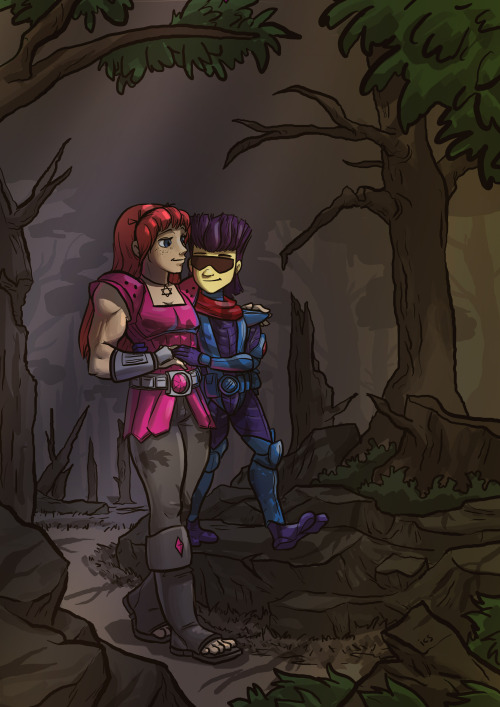
I've finished the latest round of text pieces for
Ruby's World, but the ending came sooner than I'd originally planned. Normally I don't like to talk about my work, for fear of A.) hindering the audience's ability to make their own conclusions, and B.) coming across as a pretentious douche. However, this is a case where the audience is unfortunately not likely to come to these conclusions.
If it seems deliberate that the two boys in Ruby's life-- Jens Larson and Jiro Sasaki-- both have first names that are four letters and start with J, that's because it is deliberate. The early drafts of this story were called " Ruby and Jens ", and only had those two characters plus Ruby's father. The rest was more standard high school superhero stuff, with Ruby's giant form triggered by stress ( sort of like a pre-college " Savage She-Hulk " ). These stories, which I did in undergraduate largely as prose pieces, were extremely crude by comparison to what I'm doing now. Like any self-respecting artist, I look back upon my previous work and see only mistakes, and the only satisfaction I get is to realize that I'm not doing that shit anymore. The thing that bothered me most in hindsight was the fact that I wrote Jens as too idealized a normal guy-- he was still without powers and had a sarcastic voice, but he was unremittingly loyal and selfless, and more effective in combat situations. Which in hindsight, is pretty ridiculous even by science fiction standards; if you want to compete in a world of super-powers, you have to work harder than ever, and the sacrifices that must be made to become that competent leave scars that take you outside the world of normality. Just ask Batman.
When I revised the story in 2008 and expanded upon it dramatically as " Ruby's World ", I kept Jens around, but instead of using him as more of a male power fantasy ( albeit one who exists in a world where the protagonist is a female hero, and is measured by his ability to be badass by normal human standards ), I used him as an obnoxious counterpoint to Ruby and the new characters. Jiro was created as an explicit contrast to Jens, someone who had the hyper-competences, but came from a place of feeling like an outsider. While Jens' issues were mostly ones of teen angst, Jiro had hard challenges in his life-- autism, poverty from the hardships his Japanese-American family still faced, incredible PTSD from the experiments that made him a cybernetic super-soldier, and clear markings of difference even with his powers ( red eyes and metal joints ). And Ruby became closer to Jiro because he actually understood what it was like to be different, instead of slumming with the outcasts despite having the ability to pass for normal.
When I started writing the text pieces from Jens' perspective, I started with a clear direction in mind; I was going to make him a villain. I would have his feelings of inadequacy due to his lack of powers get to the point where he'd abandon Ruby and her group, and make a deal with Beagle Labs to get powers of his own. Of course, he wasn't going to become evil, because he was doing it to secretly help Ruby. Similar to Revolver Ocelot from the Metal Gear Solid games, he'd ultimately be on the same side as the heroes, but he'd make himself the bad guy and make morally unconscionable decisions in the process. And he'd do so knowing that it would eventually get him killed, but that sacrifice would be redemptive.
However, as I started to get feedback on these stories, particularly from a friend who eloquently expressed how he could relate to Jens, I changed course. Even though Jens could pass for normal, it was observed that he didn't feel normal-- even before the world became overtly transformed by nanotech, he felt weak and inadequate. People think it's easy for young men in American culture, at least compared to young women-- however, many of the privileges that come with being in the majority are only available if you meet the majority's criteria. If you want to be treated as a strong man ( especially in high school ), you have to act manly, to not show feelings and through your weight around, and to not have interests that could put you in the out-group. Jens was shy and awkward, and didn't fit those criteria. Even though he was male, white, straight, and neurotypical, he still didn't fit socially. Which is why he's drawn to Ruby and her group-- he knows what it feels like to be an outcast. Realizing that, I thought it would be better to keep him alive. A heroic sacrifice after feigning treachery would suggest that the character's worth was contingent on an impressive suicide, and would be a betrayal of the audience members who found something worthwhile in Jens.
So I shifted direction with the story, and changed the text pieces to reach a quicker but more subdued and humane ending. I wanted instead for Jens to reach some kind of peace with himself-- not for him to stop feeling inadequate, but to give him just enough of a morale boost to keep going. The scene with him and Alexis talking was a metatextual expression of this; both characters feel peripheral, as Alexis has the same feelings of inadequacy, and while she does have powers, they're non-combative and ill-defined ( in contrast with the rest of the series, where advanced technology explains everything ). Their ability to go on becomes contingent on their ability to find worth in themselves, instead of their roles in cultural ( and in this case, literal ) narratives.
Given my own experiences, I feel proud that I am able to use my work to examine the troubles that everyone feels-- even if they don't wear it on the outside.