

Showing posts with label captain america. Show all posts
Showing posts with label captain america. Show all posts
Sunday, May 6, 2012
Avengers Movie Review: A Thoughtful Fangasm (SPOILERS)


Wednesday, April 4, 2012
Avengers vs. X-Men #1 Thoughts: The I Hate Cyclops Fanclub
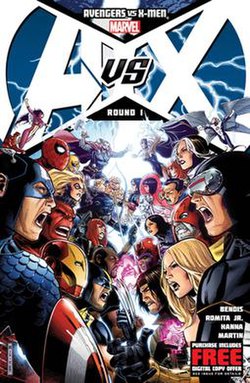
I honestly wasn't expecting this comic to be as good as it was, especially with Marvel clearly marketing it towards the battle boards types who don't care about plot, character, theme, style, draughtsmanship, design, or anything else but living vicariously through their favorite character being successfully violent. Thankfully, there was all of the above stuff in this first issue by Brian Michael Bendis and John Romita Jr. And the conflict started with a bang, strong enough to make me want to read more.
The most interesting part of the book is the fact that it's actually pushed Scott Summers to the point where all the previous books have only alluded; that he is actually a villain, the kind of crackpot megalomaniac to fill the void that the semi-reformed Magneto has left. His "training" of Hope represents the exact kind of cruel behavior that caused Wolverine to take half the team to the East Coast. In that scene both Magneto and Emma are dismayed by Cyclops' ruthlessness, as he's deliberately inflicting as much pain upon Hope as possible without causing any impairing injury. He claims that this was how Professor Xavier trained him, but nothing could be further from the truth. Xavier may have trained the young X-Men to fight, but he didn't make them suffer to get his point across.
In the argument between Cyclops and Captain America, Scott tells Steve Rogers that they've never done anything for the mutant species. He may have a point, but Scott's also made clear that he doesn't want anything to do with the human race, either. He's segregated all those willing to follow him on a banana republic floating away from humanity, and he's kept the X-Men out of most of the recent events in the superhero community; the X-Men didn't lift a finger to help during the Civil War or the World War Hulk stories, and they only defended their own borders during Secret Invasion, Dark Reign, and Fear Itself. Now he plans to doom all of human and mutant kind by trying to use the Phoenix, reborn in Hope, to revive the mutant species. Maybe he actually believes he can control the Phoenix, but more likely he's so obsessed with his goals that he doesn't even care about who dies.
All of which would still make him a sympathetic antagonist if he at least cared about the individuals who make up the species he'll do anything to protect. But Cyclops is now no better than Joseph Kony, treating anyone in his army-- no matter how young-- as an expendable weapon. His final line, that Hope no longer has any say over what happens to her, is very telling. Hopefully now that he's crossed the moral event horizon, he'll finally get what he deserves.
Saturday, June 25, 2011
RIP Gene Colan :(
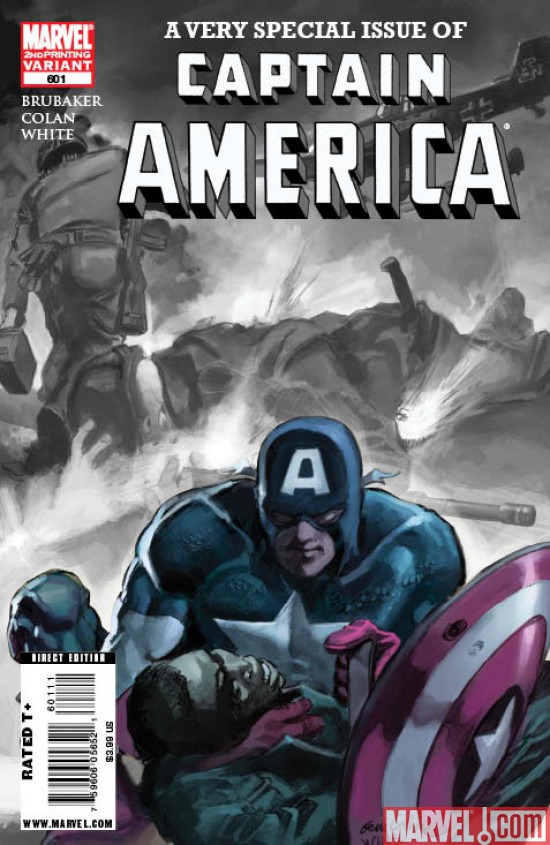
Legendary Marvel artist Gene Colan passed a couple of days ago, at the age of 84. I met him briefly at San Diego ComiCon in 2001, when I was still a punk teenager. He was a very nice man and seemed pleased that I was aware of his artwork on Iron Man. Though I imagine most 16-year-old boys wouldn't have been aware of those classic old issues, it would be years before I became aware of the breadth of his career.
Gene Colan had one of the most illustrious careers in comics, starting back when Marvel was still called Timely. At Marvel, he helped bring their fledgling superhero universe to life. His contributions included the early Daredevil comics, the creation of the Falcon (one of the first African-American superheroes, and a mainstay in the universe to this date), a large part of Steve Gerber's Howard the Duck series, and the entirety of Tomb of Dracula. All of this was drawn in his sharp, fluid, value-intensive style.
What I want to focus on, though, is his final Marvel work; a flashback WW2 Captain America story written by Ed Brubaker. When I saw this, it didn't look like the Gene Colan comics of which I was familiar, due to the unique mix of graphite and watercolor. But it was just as beautiful as any of his earlier works. It was a dark, atmospheric style suited to a dark, atmospheric story involving Captain America and Bucky being besieged by vampires. Not only was Colan an extremely talented artist but he was able to continue learning, growing, and reinventing himself, even as he approached his final days.
God bless you, Gene, and rest in peace. :(
Tuesday, May 3, 2011
The Heroic Age And Its Discontents

One year ago, Marvel's big thing was the Heroic Age, returning to a place of heroes being heroes and villains being villains after years of Civil Wars and Dark Reigns. Today, this is giving way for Fear Itself, which so far has the Marvel Universe public returning to their usual state of apocalyptic panic and incompetent xenophobia. The age of the bright, cheery shared universe status quo is ending, in favor of Mighty Marvel chaos and trepidation.
And I, for one, am relieved by this development.
The Heroic Age reminded me of Civil War in the sense that the only good titles published under that banner were rebelling AGAINST the basic premise, wether intentional or not. When Civil War was going on, the framework set up by Mark Millar was so shoddy that every other writer ended up contradicting the original intention, as seen in stories where Iron Man is portrayed as an outright villain (which, to be fair, is the only thing you can do with the creator of Clor) instead of one of two morally relative sides, or stories where the heroes' attempts to capture actual wrong-doers are hobbled by bureaucracy and petty in-fighting. The Heroic Age doesn't suffer from the same problem in the sense that it's not a poorly built world-- the premise is pretty straightforward. The problem with the Heroic Age is that the setup is anti-dramatic.
Marvel's marketing of the Heroic Age was the kind of "everything's going to be alright" optimism seen during Obama's inauguration, and lost after reality set in. Because the Marvel Universe is fictional, the authors could convincingly sweep the recent past under the rug and move forward, as seen by Cyclops dodging any and all penalties for his sins in X-Force. But by the same token, peace and prosperity is NOT ideal for a fictional universe. Conflict is what motivates good drama, but the Heroic Age moved the Marvel Universe into a peacetime state, with the conflicts largely regressed back to isolated supervillain fisticuffs.
If this meant a return to books that were relatively self-contained with shared universe compatibility becoming optional, I would be all for the Heroic Age. But Marvel launched it as the new status quo for all the books. The new Director of SHIELD, a job whose occupant is required to appear in every Marvel book, is Steve Rogers. Since his reputation makes Abraham Lincoln look like a child pornographer, he'll never be caught doing the kinds of morally dubious things Nick Fury and Tony Stark had to do (and which gave Norman Osborn a hard-on). His Avengers are basically every hero under the sun, pro-registration and anti-registration alike (though that issue's been removed). And his enmity with Tony Stark was resolved in Avengers Prime, which amounted to an Asgardian adventure making Tony beg for forgiveness (despite having a good case for pro-registration, random acts of evil like Clor aside), and Steve forgiving him.
The X-Men's DeciMation dilemma was resolved, but in a half-assed way that swept the issue of the limited mutant population under the rug and exonerated Cyclops for unforgivable sins-- note how Steve Rogers doesn't seem to know about X-Force, the Legacy Virus strain in Secret Invasion, or other war crimes. Their first Heroic Age story basically ignored the hard questions and had them fight vampires, offering little more than inconsequential fight scenes and Twilight-bandwagoning*. Daredevil's descent into fanaticism would have been justified by what he'd been through and what the heroes had conveniently forgotten, but it turned out that it was just a demon using him as a meat-puppet. And the Secret Avengers' first mission (not sure about their later ones) hardly fit the tone that black ops requires, instead having them fight villains on Mars. As Ellis put it (IIRC), it's secret because nobody cares.
The books that have been genuinely compelling in the Heroic Age have been the ones questioning this optimism. Avengers Academy is the best example, because it deals with the kids traumatized by Norman Osborn's experiments, and has them counseled by the Avengers with the most baggage of their own. Captain America has made a big deal about how Bucky can't escape his past, especially when standing next to a living Steve Rogers. And the new X-Force, with Wolverine leading a team of hardened anti-heroes instead of child soldiers, openly acknowledges that some situations will require resolutions that can't be seen in the Heroic Age. Of course, these are all stories going against the nature of the Heroic Age's naive optimism. They're saying, don't let the bright marketing fool you-- the life of a hero still casts shadows.
What's been the most interesting example of the Heroic Age's tension is Stark Resilient, the first post-lobotomy story by Matt Fraction and Salvador Larocca. Thanks to erasing his brain (and the Registration Database with it), Tony doesn't remember any of his Civil War-era sins. But he's pieced together what he's done, and has almost completely stepped out of the military-industrial complex that informs modern superhero stories. Not only has he retired from his role as all-seeing police chief a la Major Zero**, but he's given up trying to engage in conflict unless provoked. His goal is to win wars preemptively by eliminating reasons for conflict, be it with the repulsor batteries threatening to replace oil, or by creating new jobs in the rebuilding of Asgard. Unfortunately, his engagement with the bad guys has gone beyond self-defense and towards an obstructive pacifism, as he simply tries to avoid conflict rather than resolving it (as seen by his show of faux-groveling in the Doc Ock story). He'll have to once more learn that sometimes force is a necessary solution, and that some enemies can't be coaxed with the promise of an improved quality of life.
Still, it's preferable to slugging vampires.
*Thank God Jubilee lost her original mutant powers, otherwise she'd be a Sparkling Vampire.
** If you've played Metal Gear Solid 4, you know just how well this comparison fits.
Saturday, August 21, 2010
Comic Animated Movie Fantasy Cast #1: Captain America in " Winter Soldier "

While there has yet to be a truly great direct-to-DVD Marvel or DC movie ( though the Last Frontier was pretty close ), the productions are steadily improving. Better yet, the production companies are bringing in some top-notch voice talent. In addition to the legendary voices for the characters ( Kevin Conroy for Batman, Clancy Brown for Luthor, Steve Blum for Wolverine, etc. ), we're seeing a great mix of B-List talent from TV and movies, and veteran voice actors. Who would've thought that David Boreanaz would make such a great Hal Jordan? Anyone who's seen a single episode of Bones, that's who. And the people who've watched Summer Glau on Firefly and Sarah Connor Chronicles know she'll be an excellent Supergirl. Of course, this isn't the leave out the veteran voice actors, but a solid mix of talent from diverse sources helps dispel the Animation Age Ghetto.
Since I spend a LOT of time thinking about who would voice which comic characters, both in my own readings and in my work, I've been doing fantasy voice casting for many years. The difference is, this time it's not too distant. So as I give my example voice casting list for the Winter Soldier story ( the first Ed Brubaker story with the character, and the one that immediately made me a fan of both Cap and Bru ), I feel good knowing the chance that this will appear as an OVA is closer to " slim " than " none ".
Anyway, the list...
STEVE ROGERS/CAPTAIN AMERICA: David Hayter. Hayter already played Steve Rogers in a flashback episode of X-Men Evolution, but he only had a few grunts. But he's qualified for the role because of his voice work as another legendary super-soldier-- Solid Snake of the ridiculously awesome Metal Gear Solid games. Brubaker writes Steve harder and rougher than most Captain America writers ( to his credit ), but keeps the heroic aspects of the character. If Hayter did a slightly less gravelly tone ( as he did with Naked Snake/Big Boss, Solid's clone-father, in MGS3 ), he'd be perfect for Cap.
BUCKY BARNES/WINTER SOLDIER: Yuri Lowenthal. Lowenthal has made a name for himself as the go-to guy for precocious boy heroes. He's done spunky, idealistic young men with Ben Tennyson, Iceman, and Superboy. He's also shown a darker side, as seen in his portrayal of troubled boy hero turned psychopathic man-child Sasuke in the English dub of Naruto. For Bucky Barnes, especially the twentysomething brainwashed cyborg Bucky, Lowenthal would do quite well.
FALCON/SAM WILSON: Phil LaMarr. LaMarr has a very strong hero voice, which can range from dead serious ( Samurai Jack, Green Lantern John Stewart, Vamp from Metal Gear, Hermes Conrad in a lovably uptight way ) to easy-going and jocular ( Virgil " Static " Hawkins, the Transformer Jazz, Wilt from Foster's Home for Imaginary Friends, the doofus Earth King from Avatar ). For Sam Wilson, unofficial heir to Bucky's sidekick mantle and the only man capable of being badass while dressing like a bird and talking to a hawk, he would do quite well.
SHARON CARTER: Tricia Helfer. A veteran actress of action heroines in both live action ( #6 from Battlestar Galactica ) and voice ( Black Cat from Spectacular Spider-Man, Boodika from the Green Lantern OVA, Sif from The Super Hero Squad Show ), Helfer could do exceptionally as Cap's on-again off-again girlfriend/ SHIELD liason. Both by being able to shoot bad guys and tell the Patriotic Super-Jesus things others wouldn't have the nerve to say to him.
NICK FURY: Paul Eiding. The Ultimates has ensured that all non-comic Furies will be played by Samuel L. Jackson or an effective imitator of Samuel L. Jackson, so picking the voice for an Ultimate-style Fury is about as difficult as breathing. For the MU Fury, I'd go with Eiding, Colonel Roy Campbell from ( again ) Metal Gear Solid as well as Grandpa Max from Ben 10. Though he has a wide vocal range, he's also master of the aged warhorse voice.
RED SKULL: Mark Hammil. Accents are tricky and can too often come across as stereotyped when voiced by English-speaking VAs, so I'm taking the Metal Gear approach of " Just Not Bothering ". Besides, Red Skull's evil has far outlasted Nazi Germany, making him his own insidious force. So who better than the master of animated villain voices-- former Luke Skywalker Mark Hammil, whose Joker voice out-evils even the late Heath Ledger, and who played the unparalleled paragon of wickedness that is Fire Lord Ozai in Avatar? It comes to my attention that he did voice the Skull in Super Hero Squad ( in an episode I didn't see ), but this isn't comedy Red Skull, but utterly depraved comic red skull.
ALEKSANDER LUKIN: Sir Ian McKellen. The master of the Cosmic Cube turned summer home for Red Skull's consciousness, Lukin is a suave but dangerous strategist, with experience as both a KGB soldier and the business oligarch head of the Kronas Corporation. Putting aside accents again, Ian McKellen could pull this off excellently-- he was a great Magneto in the X-Men movies, a menacing talking bear in the Golden Compass, and has a narrating voice that can easily shift from classy to dangerous.
CROSSBONES/BROCK RUMLOW: David Boreanaz. Boreanaz hasn't had too many VA roles, but those he's done evoked the strongest parts of his TV career. As Hal Jordan in the New Frontier, he brought the cocky competence and haunted past of Seeley Booth from Bones. As Squall Leonhart in Kingdom Hearts, he utilized the dour angst appropriate to both Squall and Angel. And for the right hand man of the Red Skull, he would bring the naked sadism of Angel's dark side, Angelus. Both are good at being bad, and both are unabashed cradle robbers, after all.
Whew! Any I forgot?
Saturday, April 10, 2010
Temporary Deaths: The First Deadly Sin of Modern Comics

( The first part of a seven-part series examining cliches of the last decade of American comics. Illustrations are all by yours truly. )
The Trend: A major superhero is killed off in front of the audience. The truth, however, is that they didn't actually die, and will later come back in some really contrived supernatural manner-- writers have stopped pretending that dead means dead, and will kill off a character to do stories about their absence. But the cast all believes the hero is dead, so we're subjected to long, often angsty mourning scenes before they return.
The Culprits: Batman ( Batman RIP and Final Crisis ), Captain America ( Captain America: Reborn ), an arseload of DC heroes in Blackest Night ( such as Martian Manhunter, Aquaman, Hawkman and Hawkgirl, and others who will be starring in Brightest Day ), Hawkeye ( twice in Bendis' run on Avengers ), Phoenix ( Planet X and Phoenix: Endsong ), Thor ( Thor Disassembled, though that was a case of taking the Odinson off the board until they got a creative team with a good hook for him ). The ur-example is, of course, Superman's Death in the 1990's.
The Problem: Reading superhero comics, we already have to suspend a lot of disbelief. And this isn't even counting the ability to accept a world full of gods, aliens, robots, demons, and other polygenre supernaturals. Unless you're reading a creator-owned superhero comic like Dynamo 5 or Invincible ( both of which I strongly recommend, BTW ), you're dealing with characters who are frozen in place in the interests of the franchise. Peter Parker is never going to see his thirtieth birthday, Tony Stark's origin story is going to be retconned to take place in wherever America last fought an unpopular war*, and no super-battle is going to end with the hero getting capped in the head and stuffed in a box. This isn't to say that franchise superheroes are inherently stifling to innovation, just that there are restraints that writers have to work around creatively.
Having a character get killed off with no intention of having them stay dead isn't working around the restraints, it's calling attention to them. It's reminding us that nothing that happens has consequence because everything gets reset, and in doing so, it makes the stories told during the hero's dirt cat-nap seem like a waste of time.
Take the death of Captain America. If I were to actually believe that Steve Rogers could stay dead, I would absolutely love Brubaker's stories since, because Bucky Barnes is a more interesting Captain than his Patriotic Super-Jesus predecessor. But when you stop treating these as a coming of age story about Bucky overcoming his trauma to take up his brother-in-arms' duties, and realize that said brother-in-arms was just sent off on a really contrived Groundhog D-Day scenario, it becomes less engaging because it's just Bucky as the substitute. Even though I love Ed Brubaker's writing and appreciate him keeping Bucky around as Cap, I just know that when Steve Rogers said he wanted Bucky to stay as Cap or else he'd die, that Steve was breaking the fourth wall. The whole exercise was enjoyable, but it required a lot of disbelief to be actively suspended.
Worse than that is the current situation with Batman, which follows a very similar structure, but is even more ridiculous and difficult to accept. The fact that we learn from the start that Bruce isn't dead makes it seem like all the heroes mourning him are fools, since they live in the DC Universe and are even more familiar than us with means to bring a character killed by unusual means back. And unlike with Steve and Bucky, Dick Grayson is not a more interesting character than Bruce Wayne-- he's had his sidekick inferiority complex for many moons now, and the fact that he's actually been forced to replace his mentor makes the whining super-obnoxious ( though to at least Grant Morrison's credit, the whining's been abbreviated in the main book ). We know that Dick isn't going to get the chance to step up and become the Batman, so as entertaining as the stories are, it's hard to ignore the fact that they're killing time until the main event of Bruce's return. Again, if I believed that Dick would stay as Batman ( and since Batman is a character who exists across so many different media and adaptations, it'd be easy for DC to do alt-continuity stories with the original Caped Crusader while allowing DickBat to continue and develop ), I might not have this problem.
I'm not even going to approach the blanket resurrection of Blackest Night, since I haven't actually read the final issue, but I stopped reading that series early because calling textual attention to the endless cycles of death and resurrection on superhero comics didn't make them any easier to tolerate.
The Solution: Find more unique means to take a major player off the board, ones that don't involve rigor mortis. Tony Stark has been removed from the Marvel Universe three times without killing him; once in a drinking binge, again when dying of nerve damage and faking his death to undergo surgery, and most recently when he became a fugitive bent on destroying the data in his brain. When Chris Claremont wanted to shake up the X-Men way back inthe Mutant Massacre, he didn't kill Colossus, Nightcrawler, and Shadowcat-- he just sidelined them with serious injuries, severe enough to take them off the team and shake the X-Men's confidence, but certainly not a death sentence. And Professor Xavier is the undisputed master of finding ways to disappear when a writer feels like the X-Men don't need adult supervision ( he was stranded in space during the Mutant Massacre, for example ).
With these solutions, you can do stories about a major character's absence without needing a super-silly resurrection story.
Tuesday, January 5, 2010
Treasure Buried in Sturgeon's Law: Heroes, Inc.
Since my own webcomicc has been moved to a weekly schedule, I've taken to making a stronger effort to read other peoples' works. Sturgeon's Law may still apply, but I've also seen quite a lot of phenomenally good online strips. I've even seen some superhero webcomics, which are comparatively uncommon online ( as opposed to in Western print comics, but that's neither here nor there ). My favorite one would be Heroes, Inc.
Written and drawn by Scott Austin, Heroes Inc. deals with the Golden Age superheroes who've fallen into the public domain-- at least, the characters who used to be Golden Age heroes. The strip switches between the World War 2 setting and the modern age, and the years haven't been kind to characters like the American Crusader and the Black Terror-- the survivors may be better preserved than normal humans, but have reduced physical capacities and war-time PTSD that never faded. Against a new wave of super-terror, they're no longer effective-- so their blood is being used by scientists to develop new heroes.
It's a disturbingly realistic treatment of superheroes, and while that term is bandied around to every superhero comic with a fin-headed rapist or demonic canine sidekick, here it actually applies. The World War Two scenes are treated as horrific and traumatizing-- even if it's considered an ethical war, the soldiers ( super or not ) actually fighting it don't like what they have to do. There's an elaborate history between then and now regarding the super-soldiers' post-war lives-- one ended up a death row inmate, one as a feral creature living in the woods, and a lucky one as a minister with a clear need to atone. What's more, the development of superHEROES is treated as a novelty-- even with their powers, the Golden Age heroes still dressed in regular military uniforms and fought like anyone else-- and the young people taking on this responsibility might not be up to it.
The story is still relatively new, but shows incredible promise. The art by Austin is equally impressive-- he uses widescreen layouts and realistically renderings, with distinct character designs ( and for most of the cast, obvious signs of aging ). He would fit right in on a book like Ed Brubaker's Captain America, alongside Butch Guice, Luke Ross, Mike Perkins, and even Steve Epting. Sometimes the pages come in black-and-white for apparent time constraints, as opposed to storytelling reasons, but to simply keep up the momentum is very important for a comic series, especially a new one. This is an obvious labor of love, so I can accept the occasional breaks.
The comic can be found here, and comes strongly recommended.
Written and drawn by Scott Austin, Heroes Inc. deals with the Golden Age superheroes who've fallen into the public domain-- at least, the characters who used to be Golden Age heroes. The strip switches between the World War 2 setting and the modern age, and the years haven't been kind to characters like the American Crusader and the Black Terror-- the survivors may be better preserved than normal humans, but have reduced physical capacities and war-time PTSD that never faded. Against a new wave of super-terror, they're no longer effective-- so their blood is being used by scientists to develop new heroes.
It's a disturbingly realistic treatment of superheroes, and while that term is bandied around to every superhero comic with a fin-headed rapist or demonic canine sidekick, here it actually applies. The World War Two scenes are treated as horrific and traumatizing-- even if it's considered an ethical war, the soldiers ( super or not ) actually fighting it don't like what they have to do. There's an elaborate history between then and now regarding the super-soldiers' post-war lives-- one ended up a death row inmate, one as a feral creature living in the woods, and a lucky one as a minister with a clear need to atone. What's more, the development of superHEROES is treated as a novelty-- even with their powers, the Golden Age heroes still dressed in regular military uniforms and fought like anyone else-- and the young people taking on this responsibility might not be up to it.
The story is still relatively new, but shows incredible promise. The art by Austin is equally impressive-- he uses widescreen layouts and realistically renderings, with distinct character designs ( and for most of the cast, obvious signs of aging ). He would fit right in on a book like Ed Brubaker's Captain America, alongside Butch Guice, Luke Ross, Mike Perkins, and even Steve Epting. Sometimes the pages come in black-and-white for apparent time constraints, as opposed to storytelling reasons, but to simply keep up the momentum is very important for a comic series, especially a new one. This is an obvious labor of love, so I can accept the occasional breaks.
The comic can be found here, and comes strongly recommended.
Wednesday, December 30, 2009
The Best Comics of 2009
After a long post of grousing, I felt it was needed to mention the stand-outs of 2009's comic books-- and there were plenty of them. There were a lot of books that genuinely excited me last year. The rise of the Norman Empire made Marvel's line all in all more interesting, and even DC had a few standouts amidst its usual mix of Silver Age nostalgia and relentless sadism. Meanwhile, the smaller publishers gave us a salvo of great new material-- from continually entertaining series like Dynamo 5 and Umbrella Academy, to new phenomenons like Chew and Beasts of Burden. Granted, there was still the influence of Sturgeon's Law upon the industry, but this year it seemed that the quality AND quantity of 2009's portion of good comics was an increase over last year.
So, the awards:
BEST SUPERHERO STORY ARC: World's Most Wanted, Invincible Iron Man, Matt Fraction and Salvador Larroca, Marvel. Not since Daredevil: Born Again has a mainstream superhero been torn apart so effectively. I could discuss how the story destroyed the entire empire of Tony Stark, down to the last soldering iron and broom closet. I could discuss how his supporting cast was forced to pick up his slack, and prove their worth against impossible odds. And I could even discuss the meticulousness of Tony's plans, which were so elaborate he could even pull them off with a barely working brain at hand.
But therein lies the greatest part of the story; Tony having to sacrifice his very intellect to fulfill his plans and atone for his sins. Many stories have been told with heroes on the run, and heroes like Tony Stark typically maintain a MacGyver-like aptitude for making solutions out of thin air. In this case, the deconstruction even went for his mind. An uncharacteristic level of sophistication was used for the treatment of Tony's degenerating brain, having the loss of knowledge occur in multiple areas in a randomized arrangement, and showing that he could still accomplish things without certain sections of ability ( as opposed to the linear model of IQ that is tragically common in pop culture ). Eventually, Tony would lose all of his function-- but the last thing to go was his heroism. Even at the end of the story, so addled he couldn't form a complete sentence, Tony tried to fight back against a superior and completely depraved enemy. His victory was phyrric in the practical sense, but in the moral sense, flawless-- would a lesser superhero subject themselves to a fate worse than death to fight off such an enemy? Or would such a story even occur to a lesser writer than Fraction?
The revelation that Tony had a back-up of his mind intended to be used by the other superheroes may somewhat mitigate the redemption of this story, but it was still a huge risk for the hero. And for the creative team, to take a whole year with a story that had the protagonist mentally deteriorating. But Fraction's brilliant scripting and Larroca's always excellent visual storytelling ( especially in regards to his renditions of technology ) pulled it off.
MOST IMPROVED SERIES: The Boys, Garth Ennis and Darick Robertson, Dynamite. At its launch, one might have dismissed the Boys as being a puerile spoof of superhero comics, much in the same vein of Mark Millars' Wanted. Superhero comic fans still do, but if they actually read the comic, they'd have less and less justification for their critiques beyond prudishness. What began as a continuation of Ennis' " The Pro " has actually been living up to the author's claim that it would exceed his magnum opus Preacher.
For all the gaudy spandex trappings, the Boys isn't really a superhero comic-- it's a scathing critique of the military-industrial complex, with the capes as the garnish. From the start we knew that the stereotypical superhero universe was just smoke and mirrors for a world of Caligula-like excess, but Ennis and Robertson drove the point home further and further. That the origin of all superhuman power is a compound developed decades ago through the Nazis' vivisection? That the United States' leadership is divided in a coup between the President, the Vice-President, and the military contractors responsible for the power of both? Or that the X-Men analogue " G-Men " is composed of children abducted at a young age and sexually abused to give them the right disposition? Even Norman Osborn in his flag-colored robot suit is nowhere near so cutting an instrument of satire.
Not that it's just unpleasant to read; it has all the great dialogue and dark humor characteristic of a Garth Ennis comic, and Darick Robertson's excellent character design is in full force here. There's even a love story at the heart that serves as an anchor amidst the relentless cruelty of the universe. What Preacher did as a satire of religion, the Boys appears to be doing as a satire of military culture; don't let the abuse of capes detract from that.
BEST SINGLE ISSUE: Captain America: Who Will Wield the Shield. Ed Brubaker, Butch Guice, Luke Ross. Marvel. This wasn't a good year for Cap, after an exceptional 2008; the big event of the year, the resurrection of Steve Rogers, was just an extended action scene with a pointlessly convoluted plot, harmed by the art of Bryan Hitch ( who has moved too far from energetic storytelling into hyper-rendered set pieces, with the story suffering for it. Fortunately, the one-shot epilogue to the series delivered in a very substantial way.
The question raised by the title is answered, but not conclusively-- the prediction was that with Steve Rogers back, his replacement Bucky would either meet a quick end or simply fade into the background. Steve metatextually agrees, hence how he responds to ominous visions by asking Bucky to stay as Cap. But Steve's not simply retiring; he's keeping active in the hero community, especially given how far it's gone to hell in his absence. The characterization is as sharp as ever under Ed Brubaker, but what really sold me on the issue was Steve's dialogue with Barack Obama.
Marvel writers tend to lean towards the left, hence why Marvel-Dubya has been stripped naked tortured by Magneto AND cuckolded by Iron Man. Given Obama's reputation, one would think he'd escape this scrutiny-- at least, last year, that's what one would think. But Barack's inability to make real change has not been unnoticed, and his talk with Captain America makes him almost a pathetic figure-- he's talking about how he doesn't agree with things like Superhuman Registration or HAMMER Director Norman Osborn, but how he can't do anything about it. One might even think that he actually voted for the Registration Act while he was a Senator, and is retrospectively downplaying this given the company he's with. Obama isn't the savior others made him out to be, and his office forces him to support the status quo that he knows should be changed-- so thus, he turns to Captain America.
It's really interesting since the Dark Reign was conceived during Dubya's reign of error, and the Marvel Universe finally appears to be catching up to current politics. If Tony and later Norman represented the Bush administration, Steve is now Obama-- the figurehead for change and hope. I'll enjoy seeing how well he holds up under this level of pressure.
BEST NEW SERIES: Chew, John Layman and Trevor Guillory, Image. The moment this appeared in the solicitations, it looked like a huge conceptual gamble-- something that would be wonderful or terrible. Certainly the ideas represented were way out of the audience's experience. A detective with a psychometric sense of taste, who can read the past of what he eats? A job that forces him to eat all manner of awful things? A food-themed alternate America where the FDA rules with an iron fist and poultry is banned?
And then you get to the series itself, beyond the first issue. The character designs are extremely bizarre and exaggerated; the character of Mason is described by the artist as " the love child of Orson Welles and a grizzly bear ". The stories involve all sorts of food-themed bizarreness, such as a woman who can empathically influence people with her writing about food. And there's a meticulous constructed plot here about the Bird Flu scare, and the truth about it. Yes, this is an ongoing series with very dark undercurrents about a detective who psychically reads what he eats ( except beets, which somehow block his power ). It would either succeed spectacularly or perish pathetically.
And guess what? It succeeded. So suck it.
BEST MINI-SERIES: Beasts of Burden, Evan Dorkin and Jill Thompson, Dark Horse. It's no secret that I love animals, especially dogs and cats. I love seeing comics about animals being animals; anthropomorphized enough to talk, but not enough to stand, wear clothes, or have human-type anatomy ( I'm NOT going any further with that ). Unfortunately, it's hard to find that balance in a way that's convincing. We3 was a triumph in this arena, but beyond that, good treatments of animal characters are few and far between.
Beasts of Burden delivered this. It's a great comic about household pets solving neighborhood supernatural crimes. The series is still relatively new-- it has some backstory as an online strip and only four issues on the stands-- and admittedly many of the characters seem identical. But the dogs and cats are wonderful creatures, who show depth beyond the story structure requirements when given a chance. Here, they aren't animals acting like their human masters; they're animals who have far more going on than their masters assume, but in a uniquely non-human way; the dialogue is in English, but the perspectives feel like they're from a different species with their own religious traditions. There are many stories about evil in suburban backyards, but few where the animals hold the line.
What's more, it's not a simple funny story. It has a strong element of horror, and sadly, that horror isn't always from the monsters-- the worse scenes involve human treatment of the pets. Issue 2, which had a ghostly dog trying to find justice for the deaths of her puppies ( coldly thrown in a lake ), was just brutal. And issue 4 was just as gripping.
They've only begun to scratch the surface of the Beasts of Burden's world, but Dorkin and Thompson gave us so much, that I demand more in 2010.
And the Person Of The Year: Brian Michael Bendis, for New Avengers and Dark Avengers. The series of essays I did for New Avengers' five-year-anniversary illustrate better how I feel about Bendis' work on the Avengers as a whole, but the Avengers books were the comics I followed closest this year. Intellectually pretentious fans may bitch about crossovers, and lord knows I've done it too; however, I can't deny how much I've enjoyed Dark Reign, especially in the aforementioned Iron Man comic and the Avengers books.
Bendis' Avengers have steadily been improving since the rough start of Avengers Disassembled, and really hit their stride when he started writing the second book Mighty Avengers as well. The idea of two duelling Avengers teams was a welcome one, but then the two teams were holding back against each other due to their former friendships. Now, we have the dynamic consolidated, with one book for the heroes, and one book for the newly-marketable villains. The way both of Bendis' books tie into each other is a unique dynamic, and I have to admit, one that could only work in a super-consolidated shared universe.
In New Avengers, we've seen many improvements. The Secret Invasion conspiracy stories are over, so the dangling plot threads have been reduced. The character dynamics have been developed further, with Luke Cage and Jessica Jones really starting to see how impossible it is to raise a child as vigilante metahumans, Clint Barton's nervous breakdown getting more and more extreme, and Captain Bucky joining with the disposition of a kid trying to fit in with his older brother's friends. Also, Stuart Immonen's art has turbo-charged the enjoyment of the book, and the stories have become more focused without the rotations and flash.
Meanwhile, Dark Avengers is just great. Norman Osborn, a complete monster in other comics, actually receives some sympathy in the comic series that is basically his. He's joined by the rest of his EllisBolts buddies, also dressed as heroes and trying/failing to restrain their psychopathic tendencies. The team isn't all evil, as Ares ( more of a Chaotic Neutral figure in the D&D alignment schema ) and the impressionable Sentry are on the staff, but it's still very much a villain book. The entertainment is in watching how long they can keep it up, and from all indications, it's falling apart. Also, Mike Deodato Jr. is on the art duties, and he's the artist who's given us the definitive version of Norman since he drew the guy's sex-face.
I hope that once Dark Reign ends early next year, the two-book dynamic will be kept up, because I've enjoyed it so much this year that reverting to a single Avengers faction with a unified heroic mission would be a let down. Kudos, BMB.
Here's to 2010 being even better.
So, the awards:
BEST SUPERHERO STORY ARC: World's Most Wanted, Invincible Iron Man, Matt Fraction and Salvador Larroca, Marvel. Not since Daredevil: Born Again has a mainstream superhero been torn apart so effectively. I could discuss how the story destroyed the entire empire of Tony Stark, down to the last soldering iron and broom closet. I could discuss how his supporting cast was forced to pick up his slack, and prove their worth against impossible odds. And I could even discuss the meticulousness of Tony's plans, which were so elaborate he could even pull them off with a barely working brain at hand.
But therein lies the greatest part of the story; Tony having to sacrifice his very intellect to fulfill his plans and atone for his sins. Many stories have been told with heroes on the run, and heroes like Tony Stark typically maintain a MacGyver-like aptitude for making solutions out of thin air. In this case, the deconstruction even went for his mind. An uncharacteristic level of sophistication was used for the treatment of Tony's degenerating brain, having the loss of knowledge occur in multiple areas in a randomized arrangement, and showing that he could still accomplish things without certain sections of ability ( as opposed to the linear model of IQ that is tragically common in pop culture ). Eventually, Tony would lose all of his function-- but the last thing to go was his heroism. Even at the end of the story, so addled he couldn't form a complete sentence, Tony tried to fight back against a superior and completely depraved enemy. His victory was phyrric in the practical sense, but in the moral sense, flawless-- would a lesser superhero subject themselves to a fate worse than death to fight off such an enemy? Or would such a story even occur to a lesser writer than Fraction?
The revelation that Tony had a back-up of his mind intended to be used by the other superheroes may somewhat mitigate the redemption of this story, but it was still a huge risk for the hero. And for the creative team, to take a whole year with a story that had the protagonist mentally deteriorating. But Fraction's brilliant scripting and Larroca's always excellent visual storytelling ( especially in regards to his renditions of technology ) pulled it off.
MOST IMPROVED SERIES: The Boys, Garth Ennis and Darick Robertson, Dynamite. At its launch, one might have dismissed the Boys as being a puerile spoof of superhero comics, much in the same vein of Mark Millars' Wanted. Superhero comic fans still do, but if they actually read the comic, they'd have less and less justification for their critiques beyond prudishness. What began as a continuation of Ennis' " The Pro " has actually been living up to the author's claim that it would exceed his magnum opus Preacher.
For all the gaudy spandex trappings, the Boys isn't really a superhero comic-- it's a scathing critique of the military-industrial complex, with the capes as the garnish. From the start we knew that the stereotypical superhero universe was just smoke and mirrors for a world of Caligula-like excess, but Ennis and Robertson drove the point home further and further. That the origin of all superhuman power is a compound developed decades ago through the Nazis' vivisection? That the United States' leadership is divided in a coup between the President, the Vice-President, and the military contractors responsible for the power of both? Or that the X-Men analogue " G-Men " is composed of children abducted at a young age and sexually abused to give them the right disposition? Even Norman Osborn in his flag-colored robot suit is nowhere near so cutting an instrument of satire.
Not that it's just unpleasant to read; it has all the great dialogue and dark humor characteristic of a Garth Ennis comic, and Darick Robertson's excellent character design is in full force here. There's even a love story at the heart that serves as an anchor amidst the relentless cruelty of the universe. What Preacher did as a satire of religion, the Boys appears to be doing as a satire of military culture; don't let the abuse of capes detract from that.
BEST SINGLE ISSUE: Captain America: Who Will Wield the Shield. Ed Brubaker, Butch Guice, Luke Ross. Marvel. This wasn't a good year for Cap, after an exceptional 2008; the big event of the year, the resurrection of Steve Rogers, was just an extended action scene with a pointlessly convoluted plot, harmed by the art of Bryan Hitch ( who has moved too far from energetic storytelling into hyper-rendered set pieces, with the story suffering for it. Fortunately, the one-shot epilogue to the series delivered in a very substantial way.
The question raised by the title is answered, but not conclusively-- the prediction was that with Steve Rogers back, his replacement Bucky would either meet a quick end or simply fade into the background. Steve metatextually agrees, hence how he responds to ominous visions by asking Bucky to stay as Cap. But Steve's not simply retiring; he's keeping active in the hero community, especially given how far it's gone to hell in his absence. The characterization is as sharp as ever under Ed Brubaker, but what really sold me on the issue was Steve's dialogue with Barack Obama.
Marvel writers tend to lean towards the left, hence why Marvel-Dubya has been stripped naked tortured by Magneto AND cuckolded by Iron Man. Given Obama's reputation, one would think he'd escape this scrutiny-- at least, last year, that's what one would think. But Barack's inability to make real change has not been unnoticed, and his talk with Captain America makes him almost a pathetic figure-- he's talking about how he doesn't agree with things like Superhuman Registration or HAMMER Director Norman Osborn, but how he can't do anything about it. One might even think that he actually voted for the Registration Act while he was a Senator, and is retrospectively downplaying this given the company he's with. Obama isn't the savior others made him out to be, and his office forces him to support the status quo that he knows should be changed-- so thus, he turns to Captain America.
It's really interesting since the Dark Reign was conceived during Dubya's reign of error, and the Marvel Universe finally appears to be catching up to current politics. If Tony and later Norman represented the Bush administration, Steve is now Obama-- the figurehead for change and hope. I'll enjoy seeing how well he holds up under this level of pressure.
BEST NEW SERIES: Chew, John Layman and Trevor Guillory, Image. The moment this appeared in the solicitations, it looked like a huge conceptual gamble-- something that would be wonderful or terrible. Certainly the ideas represented were way out of the audience's experience. A detective with a psychometric sense of taste, who can read the past of what he eats? A job that forces him to eat all manner of awful things? A food-themed alternate America where the FDA rules with an iron fist and poultry is banned?
And then you get to the series itself, beyond the first issue. The character designs are extremely bizarre and exaggerated; the character of Mason is described by the artist as " the love child of Orson Welles and a grizzly bear ". The stories involve all sorts of food-themed bizarreness, such as a woman who can empathically influence people with her writing about food. And there's a meticulous constructed plot here about the Bird Flu scare, and the truth about it. Yes, this is an ongoing series with very dark undercurrents about a detective who psychically reads what he eats ( except beets, which somehow block his power ). It would either succeed spectacularly or perish pathetically.
And guess what? It succeeded. So suck it.
BEST MINI-SERIES: Beasts of Burden, Evan Dorkin and Jill Thompson, Dark Horse. It's no secret that I love animals, especially dogs and cats. I love seeing comics about animals being animals; anthropomorphized enough to talk, but not enough to stand, wear clothes, or have human-type anatomy ( I'm NOT going any further with that ). Unfortunately, it's hard to find that balance in a way that's convincing. We3 was a triumph in this arena, but beyond that, good treatments of animal characters are few and far between.
Beasts of Burden delivered this. It's a great comic about household pets solving neighborhood supernatural crimes. The series is still relatively new-- it has some backstory as an online strip and only four issues on the stands-- and admittedly many of the characters seem identical. But the dogs and cats are wonderful creatures, who show depth beyond the story structure requirements when given a chance. Here, they aren't animals acting like their human masters; they're animals who have far more going on than their masters assume, but in a uniquely non-human way; the dialogue is in English, but the perspectives feel like they're from a different species with their own religious traditions. There are many stories about evil in suburban backyards, but few where the animals hold the line.
What's more, it's not a simple funny story. It has a strong element of horror, and sadly, that horror isn't always from the monsters-- the worse scenes involve human treatment of the pets. Issue 2, which had a ghostly dog trying to find justice for the deaths of her puppies ( coldly thrown in a lake ), was just brutal. And issue 4 was just as gripping.
They've only begun to scratch the surface of the Beasts of Burden's world, but Dorkin and Thompson gave us so much, that I demand more in 2010.
And the Person Of The Year: Brian Michael Bendis, for New Avengers and Dark Avengers. The series of essays I did for New Avengers' five-year-anniversary illustrate better how I feel about Bendis' work on the Avengers as a whole, but the Avengers books were the comics I followed closest this year. Intellectually pretentious fans may bitch about crossovers, and lord knows I've done it too; however, I can't deny how much I've enjoyed Dark Reign, especially in the aforementioned Iron Man comic and the Avengers books.
Bendis' Avengers have steadily been improving since the rough start of Avengers Disassembled, and really hit their stride when he started writing the second book Mighty Avengers as well. The idea of two duelling Avengers teams was a welcome one, but then the two teams were holding back against each other due to their former friendships. Now, we have the dynamic consolidated, with one book for the heroes, and one book for the newly-marketable villains. The way both of Bendis' books tie into each other is a unique dynamic, and I have to admit, one that could only work in a super-consolidated shared universe.
In New Avengers, we've seen many improvements. The Secret Invasion conspiracy stories are over, so the dangling plot threads have been reduced. The character dynamics have been developed further, with Luke Cage and Jessica Jones really starting to see how impossible it is to raise a child as vigilante metahumans, Clint Barton's nervous breakdown getting more and more extreme, and Captain Bucky joining with the disposition of a kid trying to fit in with his older brother's friends. Also, Stuart Immonen's art has turbo-charged the enjoyment of the book, and the stories have become more focused without the rotations and flash.
Meanwhile, Dark Avengers is just great. Norman Osborn, a complete monster in other comics, actually receives some sympathy in the comic series that is basically his. He's joined by the rest of his EllisBolts buddies, also dressed as heroes and trying/failing to restrain their psychopathic tendencies. The team isn't all evil, as Ares ( more of a Chaotic Neutral figure in the D&D alignment schema ) and the impressionable Sentry are on the staff, but it's still very much a villain book. The entertainment is in watching how long they can keep it up, and from all indications, it's falling apart. Also, Mike Deodato Jr. is on the art duties, and he's the artist who's given us the definitive version of Norman since he drew the guy's sex-face.
I hope that once Dark Reign ends early next year, the two-book dynamic will be kept up, because I've enjoyed it so much this year that reverting to a single Avengers faction with a unified heroic mission would be a let down. Kudos, BMB.
Here's to 2010 being even better.
Saturday, November 14, 2009
New Avengers Five Years New Retrospective: Marvel's Wardrobe Malfunction
If there's one moment that I think defines Bendis' New Avengers for better or worse, it's the very first scene of the first issue, where a shadowy figure offers Max Dillion ( a.k.a. the villain Electro ) a job, and tells him that it's up to him how he wants to dress for it; costume or no costume. Dillon puts on his lightning mask, gives us an evil grin, and says " costume ".
This, in microcosm, set the stage for the way Marvel would be doing the next few years of stories, and the way they continue to write. Keep in mind that New Avengers came at a period when Marvel, under the direction of controversial ( and at that point, recently absent ) president Bill Jemas, had rebelled against their roots. Their biggest hit was the Ultimate Universe, which reinvented the characters from scratch in a more realistic and subdued context, dramatically simplifying or removing the costumes ( except Spidey ), largely avoiding stories about magic and gods and grounding everything in either the Super-Soldier Formula or the mutant gene. Many of their franchises had been made over to reject superhero genre tropes; the Grant Morrison X-Men most notoriously, having ditched costumes altogether and explicitly denying their superhero identities. But we also had the Bruce Jones Hulk, who simply wandered the countryside in a conspiracy theory variant of the old TV show; Captain America in the Marvel Knights imprint, spending more of his time fighting Islamic fundamentalists than costumed criminals; even Bendis' Daredevil, which used quite a bit of the old continuity, made the distinction between Matt Murdoch as superhero and Matt Murdoch as pulp vigilante. Marvel was not really publishing non-superhero material, but they weren't comfortable with their old characters.
Whatever your opinion is on this rebellion against Marvel history, it was not obvious in the Avengers of the time, and one has to admit that they suffered for it. The Avengers remained the traditional superhero team living in a posh mansion and fighting costumed criminals. The team had writers who kept them in that status quo, most notably Kurt Busiek, but also Geoff Johns and Chuck Austen. In the meantime, Marvel was also publishing the Ultimates, which gave us a strikingly warped version of the characters. And the market seemed to prefer the latter; Tony Stark as a repentant do-gooder in form-fitting metal tights wasn't as dynamic as Tony Stark as a decadent neo-liberal in a humanoid mech. Regardless of individual tastes, Ultimate-style comics were where the discussion was; to try and ignore it was folly.
So thus we get to what Bendis did, which wasn't to deny the superhero genre's trappings-- but not to embrace them, either. The way Bendis writes the Marvel characters, being a superhero or a supervillain is a statement; you wear a costume as a conscious choice about what identity you're projecting. Electro is a villain who does not need a costume; when he's powered up, he's spewing electric sparks everywhere, so wearing a green leotard with a yellow lightning mask is redundant as well as ridiculous. By putting on the costume, he's putting himself out there-- in that issue, he arrives at the metahuman prison called the Raft, breaks all the convicts out, and stands before them in his costume, dramatically telling them that they owe him. The costume isn't just a fact of the business for Max Dillon, it's an emblem of why he's in this business-- to look, feel, and act powerful. Even though they use their power to help instead of hurt, superheroes have the same motivation.
And this goes not just for costumes, but superhero genre trappings in general. Since New Avengers, Marvel's publishing landscape has swung back towards comics' historical excesses. Shared universe crossover has increased, with New Avengers and Mighty/Dark Avengers being the center and every other comic following their lead. Stories aren't written as much like done-in-one movies in trade paperback form, with long, subplot-filled sagas like the Death of Captain America back in vogue. And history is once more a motivator for contemporary stories, from Bucky coming back from the dead and eventually taking on his mentor's patriotic identity, to Spidey's dead ex Gwen Stacy having been impregnated with Norman Osborn's gobliny children ( the former being a good example, the latter being one of significantly lesser quality ). But they're doing this largely with the awareness that they're working with a very specific genre, and trying to expand or subvert it. I've talked about Bendis' Avengers being very conscious of their image, but even solo books, like Matt Fraction's sci-fi-driven Iron Man or Ed Brubaker's political thriller-inspired Captain America, have made the superhero heritage of their books more deliberate in the new era.
One could say that this mixture of old and new leads to greater work; one could also say that it's a faulty compromise that gets away from what makes superheroes work. But it's the way Marvel's been for years, and Bendis' New Avengers has led the charge.
This, in microcosm, set the stage for the way Marvel would be doing the next few years of stories, and the way they continue to write. Keep in mind that New Avengers came at a period when Marvel, under the direction of controversial ( and at that point, recently absent ) president Bill Jemas, had rebelled against their roots. Their biggest hit was the Ultimate Universe, which reinvented the characters from scratch in a more realistic and subdued context, dramatically simplifying or removing the costumes ( except Spidey ), largely avoiding stories about magic and gods and grounding everything in either the Super-Soldier Formula or the mutant gene. Many of their franchises had been made over to reject superhero genre tropes; the Grant Morrison X-Men most notoriously, having ditched costumes altogether and explicitly denying their superhero identities. But we also had the Bruce Jones Hulk, who simply wandered the countryside in a conspiracy theory variant of the old TV show; Captain America in the Marvel Knights imprint, spending more of his time fighting Islamic fundamentalists than costumed criminals; even Bendis' Daredevil, which used quite a bit of the old continuity, made the distinction between Matt Murdoch as superhero and Matt Murdoch as pulp vigilante. Marvel was not really publishing non-superhero material, but they weren't comfortable with their old characters.
Whatever your opinion is on this rebellion against Marvel history, it was not obvious in the Avengers of the time, and one has to admit that they suffered for it. The Avengers remained the traditional superhero team living in a posh mansion and fighting costumed criminals. The team had writers who kept them in that status quo, most notably Kurt Busiek, but also Geoff Johns and Chuck Austen. In the meantime, Marvel was also publishing the Ultimates, which gave us a strikingly warped version of the characters. And the market seemed to prefer the latter; Tony Stark as a repentant do-gooder in form-fitting metal tights wasn't as dynamic as Tony Stark as a decadent neo-liberal in a humanoid mech. Regardless of individual tastes, Ultimate-style comics were where the discussion was; to try and ignore it was folly.
So thus we get to what Bendis did, which wasn't to deny the superhero genre's trappings-- but not to embrace them, either. The way Bendis writes the Marvel characters, being a superhero or a supervillain is a statement; you wear a costume as a conscious choice about what identity you're projecting. Electro is a villain who does not need a costume; when he's powered up, he's spewing electric sparks everywhere, so wearing a green leotard with a yellow lightning mask is redundant as well as ridiculous. By putting on the costume, he's putting himself out there-- in that issue, he arrives at the metahuman prison called the Raft, breaks all the convicts out, and stands before them in his costume, dramatically telling them that they owe him. The costume isn't just a fact of the business for Max Dillon, it's an emblem of why he's in this business-- to look, feel, and act powerful. Even though they use their power to help instead of hurt, superheroes have the same motivation.
And this goes not just for costumes, but superhero genre trappings in general. Since New Avengers, Marvel's publishing landscape has swung back towards comics' historical excesses. Shared universe crossover has increased, with New Avengers and Mighty/Dark Avengers being the center and every other comic following their lead. Stories aren't written as much like done-in-one movies in trade paperback form, with long, subplot-filled sagas like the Death of Captain America back in vogue. And history is once more a motivator for contemporary stories, from Bucky coming back from the dead and eventually taking on his mentor's patriotic identity, to Spidey's dead ex Gwen Stacy having been impregnated with Norman Osborn's gobliny children ( the former being a good example, the latter being one of significantly lesser quality ). But they're doing this largely with the awareness that they're working with a very specific genre, and trying to expand or subvert it. I've talked about Bendis' Avengers being very conscious of their image, but even solo books, like Matt Fraction's sci-fi-driven Iron Man or Ed Brubaker's political thriller-inspired Captain America, have made the superhero heritage of their books more deliberate in the new era.
One could say that this mixture of old and new leads to greater work; one could also say that it's a faulty compromise that gets away from what makes superheroes work. But it's the way Marvel's been for years, and Bendis' New Avengers has led the charge.
Subscribe to:
Posts (Atom)
