Ruby Nation

Ruby Nation
Ruby Nation: The Webcomic
Showing posts with label asperger's syndrome. Show all posts

Friday, September 28, 2012

Dear Something Awful: Autistics can be People, Not Bronies


Recently the humor site Something Awful did an expose on the "brony" phenomenon (i.e. adult men obsessed with My Little Pony, sometimes to the point of fetishization). The article consisted entirely of insulting the Bronies for being pervy and pathetic, and most of those insults were various permutations of Autism and Asperger's. To quote author Seth Bailey;

"As you may have noticed, I've made a lot of autism/aspergers jokes in this update. The reason for this is twofold: 1) The Autism Spectrum is a bottomless lulzmine of comedy gold that never goes dry no matter how many mother loads are discovered by the internet hate machine and 2) a disproportionate number of bronies identify (either self-diagnosed or for realsies) as autistic/aspergarian. The sperg is practically rampant in this subculture."

Take this "documentary" for example. While it was uploaded to troll bronies, these are real, honest to God members of the culture in the video. I had the misfortune of watching the entire goddamn thing and there is not a single normal person to be had; not one. I'm not sure which came first: the children's show that hit so many spergbuttons that it would inevitably become obsessed over by neckbearded futurepedos or the broken-ass brain that was looking for a children's show to latch on to. Science would suggest a co-evolution.

The basic notion expressed here is that autism has a direct correlation with not just liking My Little Pony, but devoting your life to a sexual arousal of prepubescent cartoon horses. The fact that it's expressed as humor is besides the point. This is hardly the first time Something Awful has used autistic people as a target, based on the actions of a few. And it's developed an influence to the point where simply admitting having autism on the internet carries a risk of being trolled. And reacting to that trolling makes you look over-sensitive, as though wanting to not be judged by your neurological make-up (or "broken-ass brain") makes you a member of the "PC Police".

I stopped writing my reviews of Sonichu because I felt they were doing more harm than good; I intended to make sure I was just making fun of Christian Weston Chandler for being an awful writer/artist and a personally disturbed and unpleasant individual, but I doubt it came across that way to everyone who read it. Chandler (who's also a brony) is a laughable failure of a human being, but he's that way from his own experiences, his own poor upbringing and his own bad choices. The same is true for the bronies being ridiculed there; autism is only one part of an autistic's entire persona, and while it may guide the direction in which they go, it's not an immutable lock upon who they'll be and what they'll do. There are certainly "neuro-typical" bronies engaged in these perversions, and there are certainly plenty of autistic people who have meaningful jobs, relationships, and lives outside of their fandoms. (I personally could care less about My Little Pony either way).

I doubt that a Something Awful writer would explicitly  make a joke about howall Christians were homophobic bigots, that all African-Americans were materialistic gangsters, that all homosexuals were gaudy perverts, or any other sweeping generalization about a large group of people. I don't mind the making fun of the more extreme bronies, though the unpleasant traits they express have more to do with their own personal sexual dysfunctions than simply liking My Little Pony . What I mind is the notion that because of the way I was born, I'm somehow less than human, and cannot escape association with the internet's sub-cultural laughing stocks.

Monday, April 9, 2012

Autism ACCEPTANCE Month: Fuck Your Awareness


Since it's Autism Acceptance Month (a rewording of Autism Awareness Month, from neurodiversity proponents who want to take the month back), I wanted to explain what Autism Acceptance means to me, and what I hope for the future of me and other autistics I know and love.

Autism Awareness is a term used in the same vein as Breast Cancer Awareness, Kony 2012, and other "slactivist" campaigns. It means being involved only so far as sharing a link on Facebook or buying a shirt. It means endorsing a superficial understanding of the issue, but not actually trying to understand what it means (especially for the people directly involved). It may be better than being completely oblivious, but it's not enough. Where "Autism Awareness" is concerned, it's especially troubling because it speaks of the disability in the same vein as a terminal illness. The autistic person then is reduced to an object to be pitied, with the condition treated as a bogeyman that captures the "real" person underneath, rather than a factor that influences their larger individual personality.

Autism Acceptance means actually understanding that autistic people, and for that matter other people who aren't physically or mentally normal (re: everyone), are simultaneously influenced by their conditions but not defined by them. It means looking at such differences as a part of life that can't be erased, no matter how much money we pour into medical research for a "cure". It means trying to understand and negotiate with people who have different behaviors, and see what they can contribute to society on their terms.

In a world of Autism Acceptance, people on the spectrum will be able to find work based on their talents, not their disabilities. Autistic celebrities will not just be people that promote themselves for "overcoming" autism, but people with actual occupations as well. The world of Autism Acceptance will be a world where we have openly autistic doctors, teachers, scientists, politicians, athletes, journalists, artists, CARTOONISTS, and others. As Ari Ne'eman (IIRC) puts it, we'll have fewer professional autistics, and more autistic professionals.

In a world of Autism Acceptance, neurological disabilities will not be treated as an inherent stigma. The R word will be treated as hate speech, just like the N word or the other F word. "Don't be so autistic" won't be treated as a colloquial insult, and autistic people who behave like total assholes won't reflect on everyone on the spectrum. The likes of Christian Weston Chandler will be treated as a reflection of nothing but internet weirdos.

In a world of Autism Acceptance, neuro-atypical characters will abound on television and literature and be acknowledged as neuro-atypical. They will come in all shapes and sizes, not just the stereotypes of the inspirationally disadvantaged, the special needs morality pet for the martyr parents, or the autistic sociopath. We'll no longer need to make do with diagnosing fictional characters like Reed Richards or Hal "Otacon" Emmerich who probably fit the criteria.

In a world of Autism Acceptance, discussion of autistic peoples' handicaps will be focused on practical accommodation, not fanciful cures. Discussions about the "autism epidemic" and its causes will be dismissed, inconsequential compared to the people here right now. Instead of talking about sweeping, badly-researched gestures like gluten-free diets or chelation therapy, treatments will try to stick to the individual and how to treat their specific symptoms, not the "bogeyman" of autism.

In a world of Autism Acceptance, no moral ambiguity will be put into debates over news stories like the murder of George Hodgins by his mother. The focus will be on the victim, whose life was tragically cut short by the person he should've been able to trust the most. There will be no sympathy given to the mother who murdered him, because no matter what difficulties she had raising a special needs child, nothing can excuse taking an innocent life. The caregivers who murder their charges (and this is way too common) will be treated as that-- murderers, the likes of whom can and will burn in hell.

Finally, in a world of Autism Acceptance, the kids I work with at my residental facility day job will see all of these things happen, and be able to navigate a world even slightly less harsh and narrow-minded.

Sunday, March 4, 2012

The "Autism Cure" In Avengers Academy, and The Fascism of Utopia


(This is largely reposted from the Comic Book Resources forums, in response to an issue of Avengers Academy where the corporate sociopath genius kid Jeremy Briggs starts recruiting super-teens away from the school. Veil, formerly a student at Avengers Academy, touts Briggs' merits by mentioning how the work they're doing reforming society and attacking social problems is far more important than fighting villains and getting bloody hands. However, the example she gives of her work is a cure for autism. Since I normally like Avengers Academy, and since Marvel is one of my main hyper-focused Aspergian interests, this read like a punch to the gut).

Wether it was Gage's intent or not, Veil's line about working on a cure for autism immediately made me want the proper Avengers to take down Briggs and anyone working with him.

The kind of " utopia " Briggs is working towards, like most science fiction utopias, is the ideal of a few imposed upon everyone else. It's getting rid of things that people consider problems with easy solutions, by making a magic pill to cure any perceived imperfections, or using force to quietly subdue any dissidents. It's creating a pretty-looking, clean community by retroactively removing any evidence that it might have been dirty, working towards an ideal while forgetting the minority experiences that give humanity diversity, meaning, and narrative.

The autism line hits home for me, true, but it's a good example in microcosm of why Briggs is as insidious as any super-villain. Maybe Veil believes that autism is just a disease that abducts children from their parents and creates wall-eyed freaks who will never grow up to prosper, but that's hardly the case for all autistics, most of whom are capable of communication, thought, and contribution (even if on different terms, such as requiring facilitated communication). Worse yet, it excludes people with the condition from the discussion. If Briggs and Veil created a cure for the X-Gene, would it be treated as an altruistic afterthought? How about the gay gene? Does society really get to decide how the individual's neurology should be, and change it by force?

The job of the superhero is to save peoples' lives, not decide how their lives should or shouldn't be. That's the other side of the coin that we've seen since the genre's inception, which is fascism.

And another good quote about the dangers of imposing one's views on others, from Big Boss in the game Metal Gear Solid 4;

" It's not about changing the world. It's about doing our best to leave the world the way it is. It's about respecting the will of others, and believing in your own. "

Friday, August 26, 2011

Batman 80 Page Giant: Batman Fights Autism, Strikes Blow For Sentimentality


The recent Batman: 80 Page Giant makes the unlikely intersection between Batman and autism. In the story written by Joe Caramagna, a nonverbal autistic boy is reading a Batman comic when his mother takes the book away from him. She's bitching about how he can't differentiate between fantasy and reality (apparently unable to get her stereotypes straight, as most of these morons say that autistic people are too literal to be imaginative), while his father talks about how comics are just harmless fun. After getting upset by the bickering, the boy looks out the window, and either has a fantasy that he sees Batman and Solomon Grundy fighting, or actually witnesses Batman and Grundy duking it out. But in the end, this enables the nine-year-old to say his first word, to the delight of both his parents; "Batman".

The story is slightly better than most fictional representations of autism, in that the autistic by is the actual protagonist instead of a plot device to make his parents sympathetic, and the "warrior mother" stereotype is as much a pompous blowhard as a tireless champion for her child's development. The story isn't exactly deep, but given how it's a back-up strip in an anthology magazine, we can't expect too much. On the other hand, this is the only place where we'd see the autism "issue" in a Batman comic, and it's used in a revoltingly sentimental fashion, right down to the "everything's going to be okay" ending. And if the kid can't tell the difference between fantasy and reality, he's got problems that are far more debilitating than the autism spectrum-- it's Sucker Punch all over again..

But the problems with the book are severely exacerbated when you take This Article into account, in which Caramagna tells his local newspaper about his creative process. I'm sure that Caramagna is well-intentioned, but those intentions are expressed in a very condescending manner towards autistic people. Because autism is such a horrible fate, the language surrounding it tends to focus on treating (if not outright curing/erasing) the disorder. In fact, Caramanga talks about how he designed the story to potentially "unlock their imagination"

I wanted to tell a story where comics can make a difference in someone’s life and get their creative juices going. I don’t want to make it sound like if you give a kid a comic, he’ll be cured. But I think they can be used as part of a creative therapy or artistic therapy. With autism, no one knows what might be the thing that unlocks their imagination.

I totally agree that a Batman comic can unlock a child's imagination. Because it's BATMAN. He's already a character with near-universal appeal, evidenced by the fact that he maintains a transmedia presence stronger than pretty much any other comic hero, and has his backstory etched in the public imagination. Using him as an autistic kid's fantasy/delusion isn't going to stir those creative juices any better than a straightforward Batman story. In fact, it's probably going to be less effective, because A.) people who buy Batman would likely rather read about Batman than a "special needs" sob story stereotype, and B.) the autistic character might outright offend some of us on the spectrum.

Aside from that one comment, Caramagna doesn't say anything too infuriating. Most of the problem is the way the interview frames the comic, as "fighting autism". Of course, these articles never see autism as part of an autistic person, the neurological identity that shapes them into who they are (albeit with a lot of trials along the way, but the trials of the autistic individual are rarely dealt with as something that causes THEM suffering; it's usually shown as the burden on their families); they treat it as a bogeyman, a Jokeresque villain that steals a normal child's soul.

Coincidentally, there is quite a bit of the Batman mythos that relates to autism. Bruce Wayne isn't on the spectrum because he's too multi-talented in his masteries, but the drive in which he trained at martial arts/criminology/invention/breathing in space definitely resonates with Asperger's-style obsessions. The villains he faces are often tragic figures, prisoners of their own madnesses, and can be sympathetic to those who have difficulty controlling their emotions. Hell, there are two characters that may well be on the autism spectrum (albeit by fantastical circumstances) -- Cassandra Cain, the former Batgirl and current Black Bat, has tremendous martial arts skills but struggled with basic language and literacy. And Bruce's artificially-conceived son Damien Wayne may also fit; he was built to fight, he was never given social skills, he's extremely temperamental, and while he wants to do good he has little to no idea how to do so.

Of course, this all requires critical thought, and stereotypes are so much easier to digest.

Thursday, June 23, 2011

TVTropes Gives Me Bigoted Backhanded 'Praise'

Every day I go to TV Tropes, and every day I look to see if there've been edits to the Ruby's World page. Usually there aren't, so I was excited to see that somebody had catalogued some new tropes in relation to my comic. However, some of the the tropes added were offensive, and not for their dismissal of my talents. I quote directly from the YMMV section;

"Better Than It Sounds: Anybody who's trolled around the internet for long enough is no stranger to mentally handicapped people doing stories revolving around their aspie fixations with art that looks like it was done by somebody in grade school. That such a thing could be well-written, even thought-provoking and emotionally moving, is something else altogether."

Putting aside the insult towards my art (which I don't think is fair, because unlike Chandler I don't plagiarize and actively work to improve my draughtsmanship and my visual repertoire), I find the comparison between me and Christian Weston Chandler to be appalling PERIOD. This is the webcomics equivalent of Godwin's Law. And I've been compared to the being of unfathomable patheticness because A.) I am also on the autism spectrum and B.) also do a webcomic. The praise at the end is a backhanded compliment, because it suggests that I shouldn't be able to write anything good because of my apparent mental handicaps.

Given how much of Ruby's World is about the value of the individual experience due to the way the individual uses the hand life deals them (no matter how crappy), and given the explicit anti-ableist references I've made in the comic, it seems the person who added that trope didn't glean anything from my work. Apparently the value to my comic is in spite of my neurology, and is not informed by it.

Jesus, people, if you want to say "Your Webcomic Is Bad and You Should Feel Bad" to me, say it. Don't insult everyone on the spectrum in doing so, and FOR GOD'S SAKES DON'T USE CHRIS-CHAN AS YOUR STEREOTYPE OF AUTISM.

Monday, May 23, 2011

Toys R Us Devalues The Meaning Of Heroism


If you've been to Toys R Us in the past couple of years, as a parent getting something for your kids or as an adult collector getting toys for yourself, you've probably seen the Autism Speaks promotions they're doing. This pro-cure organization, the organization that takes money largely for abstract research and pharmaceutical studies** over helping actual people, asks TRU customers to donate to help "solve the puzzle". Thus, the experience of the autistic people themselves is marginalized, as we are just a puzzle to be solved, a weird disorder to be put before AS' metaphorical Dr. House so it may be cured and the normal person within us can be freed.

It always bugs the crap out of me when I'm asked to donate at the register, and since they've started doing their "be a hero for autism" advertising, it's especially aggravating. Because, as a fan of the superhero comics that have led me into the store even beyond the point when it was "age-appropriate", I tend to think that the hero label should be applied to those who undertake difficult tasks for a noble cause. Raising an autistic child, especially a severely handicapped one, is a difficult task, but it's how the parent copes with the task and treats their child that determines their heroism, not the simple fact that they have the burden. (Lord knows I've seen plenty of parents of autistic people who are assholes, as well as great parents like my own). And putting down a dollar when going to a toy store means absolutely nothing. You're not sacrificing anything by giving your pocket change to a faceless "nonprofit" so they can do the work for you while you hold onto a glimmer of self-aggrandization.

And the worst part is the fact that the cashiers who ask me these questions aren't to blame, because they're just doing their job. Otherwise I'd prepare for the inevitable "do you want to be a hero for autism" question by putting on my best Solid Snake voice, and growling, "I'm no hero. I'm just an old aspie brought out of retirement for some new transformers."

* Me being in the latter category, obviously.
** Yeah, I'm getting vibes from the third X-Men movie here. I SAY WE ARE THE CURE!!!!

Saturday, April 23, 2011

Hal "Otacon" Emmerich, Metal Gear Solid's Autistic Hero?


Fictional characters on the autism spectrum are hard to find, and good characters in that category are almost non-existent. As autism has become more prevalent, we've seen it portrayed more often in the media, but those portrayals too often fall into the stereotypes, such as the damaged, volatile child unwittingly tearing apart his supportive family, or the emotionless polymath sociopath who can do horrible things without seeing a problem. There are very few autistic protagonists, or even supporting characters of a positive nature*.

Thus, many autistic people have found themselves speculating on which of their favorite fictional characters fit the spectrum, following the completely understandable need to see inspiring figures to fit into their own narrative world. Sometimes these fictional diagnoses are simple wish fulfillment that don't describe the diagnosed character at all, such as claiming that Severus Snape of Harry Potter has Asperger's Syndrome**. Others are much more accurate, such as Grant Morrison's in-universe speculation that Reed Richards of the Fantastic Four is autistic, and could (and should) be incorporated into canon.

An example of the latter is Hal "Otacon" Emmerich, Solid Snake's tech-guy sidekick in the Metal Gear Solid series of video games. Otacon's spectrum traits go beyond simply being a nerd, and put him squarely in the neuroatypical category. If you don't believe me, here's the evidence...

WARNING: SPOILERS FOR THE GAMES AHEAD

1.) Otacon's interests are (or were) so obsessive and insular that he missed the harsh realities attached. When he was introduced in the PSOne game, he was designing a Metal Gear unit because he wanted to make robots like he'd seen in anime. He was attached to that utopian sci-fi narrative, the kind where fantastical machines keep people safe. He was also completely oblivious to the fact that his creation was being used as a platform for nuclear missiles, until Snake bluntly spelled it out for him. Otacon's code-name is short for "Otaku Convention", and his desk is covered with little toys and posters. In another series, he might have been able to play out his fantasies and help the world with his giant robot fixation. In Metal Gear, of course, he became instrumental in the creation of the world's most devastating WMD.

2.) Otacon is extremely literal-minded. This is used with hilarious effect in the Snake campaign of Metal Gear Solid 2, where the good doctor tries to read Snake ancient words of wisdom upon saving his data (the way Mei Ling did in the previous game). Unfortunately, he completely misses the point of those famous quotes, and comes up with extremely bizarre interpretations after taking them at face value. The phrase "It's better to be first among roosters instead of last among bulls", according to Otacon, means that it's better to be a chicken because cows are subjected to alien cattle mutilations.

3.) Otacon is TERRIBLE at understanding his relationships. The extent to which he does not comprehend others' intentions (or his own, for that matter) leads to some of the most tragic scenes in a series known for its depressing tone. In MGS1, Otacon falls for Sniper Wolf, a bloodthirsty sniper and one of the terrorists holding him hostage. It is unlikely that she reciprocates beyond a show of basic decency (as he helped feed her dogs), but Otacon takes this mercy and uses it to fuel his childish crush. It's touchingly pathetic how fast-- and how hard-- he falls for Wolf, especially after her demise at the hands of Solid Snake. And we see it happen again in MGS4, when the morally ambiguous Dr. Naomi Hunter seduces Otacon so she can get data needed for a larger plan. The ease with which she manipulates him, saying all the right words about atoning for the sins of her science to create a quick emotional bond, is disturbing to watch when you know what she's up to.

The is explored in MGS2, where we learn about Otacon's past-- he was always socially isolated, and his sole companions were the family his father married-- his step-sister and step-mother. He became strongly attached to the former and even played house with her, despite the fact that she was five years old and he was a teenager (though Otacon had no salacious intentions spending so much time with the little girl-- he just wanted to experience family). Unfortunately, he was also "seduced"*** by his step-mother, which led to his father's suicide and Otacon subsequently running away from home. We don't hear much about the details other than Otacon's words (which are words of contrition, blaming himself for all of this), but it's unlikely that he understood what was going on at that point-- his inherent lack of social awareness facilitated all these tragedies.

There's also the fact that by far Otacon's strongest relationship is with Snake, as the two men work and live together, and even end up adopting a child in MGS4. The homoerotic subtext is so thick that it basically ends up as text, but it's not exactly clear if Otacon's feelings for Snake are romantic. He likely doesn't understand what he feels for Snake, other than the intensity of the connection. The sensitive nerd and the dour super-soldier end up having quite a bit in common, as seen in the "bad" ending**** of MGS1. Both are profoundly isolated human beings, even if Otacon's loneliness is more internalized than his lab-grown, shell-shocked veteran partner.

4.) Most importantly, Otacon is a complex and sympathetic character. As I said before, when autistic characters are shown in most fiction, they're shown in terms of stereotypes and plot devices. But Otacon grows and changes over the course of Metal Gear Solid, and provides a vital pillar of strength. He's the most genuinely decent character in the entire series, surpassed only by The Boss from the prequel MGS3. And The Boss is the series' messiah figure, so it's not really a contest.

When we first see Otacon, it's as a messy-haired, badly-dressed, bespectacled little dork . His first appearance is hardly auspicious, as he's wetting himself in terror when confronted by a crazed cyborg ninja. But he shows tremendous courage later in the game, taking full accountability for his part in Metal Gear's creation and risking his life to shut it down. In the second game, he's Snake's tech-guy and half of the anti-Metal Gear organization Philanthropy, working to destroy those robotic WMDs despite the risk to his personal safety. He's also become more attractive and well-dressed, though still a bit dorky looking. And by MGS4, Otacon has developed a rugged handsomeness that puts him square in Hot Scientist territory. Poor hygiene is a common trait in autistic people, but it's not an insurmountable habit-- Otacon proves this.

But most importantly, Otacon is by Snake's side during all these ordeals. Snake is the action hero of Metal Gear Solid, the one putting his life on the line at every turn. But Snake couldn't be anywhere near as successful without Otacon's support. In MGS4, Snake has prematurely aged due to his cloned physiology breaking down, and has only a few months left to live. Otacon's tech is the only thing allowing Snake to survive on the battlefield; the strength-boosting Octocamo suit was Otacon's invention, as were the vision-enhancing Solid Eye and the helper robot "Metal Gear Mark 2" (redeeming the machine's tainted name). But Otacon's greatest act comes at the end of the game, when the still-dying Snake is wondering what he has left to live for in the new world, and Otacon promises to bear witness to Snake's final days. Otacon refuses to let Snake die alone and unloved.

I doubt Hideo Kojima created Otacon with autism in mind, but if the autism label is attached to the character, it not only fits him but helps eradicate many of the negative stereotypes.

* INSERT OBLIGATORY RUBY'S WORLD LINK
** There's no evidence for this in the books, other than Snape being a thoroughly repulsive human being-- and that's just proof that he's a repulsive human being, even if he didn't prove outright evil.
*** Otacon's words. But it's a clear case of rape, and one of the few instances where female-on-male rape is shown to be just as bad.
**** In which female love interest Meryl doesn't survive, and is replaced by Otacon as Snake's symbolic reason to keep on living.

Tuesday, March 23, 2010

How To Write Autistic Characters ( With Examples From Ruby's World )

Much has been made of the " autism epidemic " in the media, either as a consequence of more precise diagnostic methods, or some overblown, unsubstantiated consequence of vaccination poisoning. As a result, autism has become a more frequent issue in fiction, be it the popularity of the novel " The Curious Incident of the Dog In The Night-Time ", the recurring Aspie kid Max on the new family drama Parenthood, an autistic man being the main character i the movie " Adam ", or Jodi Picoult using autism as set piece for her latest legal family melodrama " House Rules ". There are certainly more examples to recite, especially if we factor in isolated episodes of procedural shows ( like the episode of House where the doctor has a lower-functioning autistic boy as a patient, and it is speculated if House himself has Asperger's-- though it's later concluded that he just wishes he did so he would have an excuse for being an antisocial jerkass* ).

Unfortunately, most of these portrayals of autism as the hot topic for fiction forget to develop one little part of the situation-- the individual with autism. Many of these stories focus on the families of the autistic character as tragic figures, giving their all to function for a developmentally stunted morality pet. The autistic character, on the other hand, is displayed by the Rain Man stereotype, having talents that are portrayed as math genius parlor tricks, and being completely ineffectual in every other area. Rarely do you see autistic characters as major players, and if you do, it's often as a storytelling gimmick.

For example, Jacob Hunt in House Rules, the autistic boy suspected of murdering his social skills tutor. In this story, we see that Jacob is obsessed with criminology to the point of watching the same Crimebusters episodes over and over ( and always taking notes as if he didn't know how it would end ), obsessed with dinosaurs, a genius with computers to the point where he can do Hollywood hacking, incapable of eating foods that don't suit a corresponding day/color combination, repetitively listens to the Bob Marley song " I Shot the Sherrif ", incapable of understanding human emotions, incapable of lying ( except in the case of sins of omission ), incapable of understanding non-literal idioms, uses movie quotes to express emotions he can't communicate, and is prone to catastrophic meltdowns. Certainly real people on the spectrum would show one or more of these characteristics, but not all of them at once. This is like having a Jewish character who's a thrifty greedy neurotic hypochondriac devout Kosher sarcastic Hollywood executive. And it's certainly not helped by the fact that Picoult's other characters all spout extremely narrow-minded opinions about autism that are confirmed by Jacob's existence.

But Jodi Picoult and her ilk don't seem to notice that, instead perpetuating the notion of the autistic people themselves being helpless victims, with their families given martyr status ( despite the fact that Jacob's mother, as many critics have wisely pointed out, has infantilized him to the point where he never even had a chance to function independently ). Since the positive representations of autistic characters, especially those written by autistic authors, are so few and far between, I'm taking it on myself to write a primer on how to write autistic characters as actual characters. The examples are from my webcomic Ruby's World which has two prominent autistic characters in the ensemble cast, and an overall disability rights message. I use examples from my own work being specific only to this particular topic, because there's so little material that would offer a positive representation of autism in fiction**, especially by creators on the spectrum.

Here are the five simple rules that I hope are obvious...

1.) Don't Get Hung Up On Labels
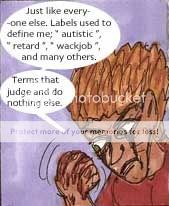


There are plenty of words that are used to describe autism spectrum disorders. These are mostly fine as diagnostic criteria. They are, however, extremely poor at describing a person in their entirety. Unless you want a flat character like Jacob Hunt, writing a character with autism requires going past the stereotypes and thinking of what other characteristics they have-- or, at the very least, to portray the stereotyped behaviors associated with ASDs in a unique way.

The two autistic characters in Ruby's World are Jiro Sasaki and Alexis Deveraux. Both are science fiction characters who portray the " Organic Android " Trope ( Defined well here by NightStorm ), but do so in unique ways. Jiro is the mechanical side of autism, as a cybernetically enhanced being, but he's completely aware of his condition and often bemoans the limitations of his computer brain ( mostly due to internalized prejudice, the belief that he can't move past his label ). Alexis represents a more organic side, a hyper-empathic character with psychic abilities that defy explanation, even in a world of genetic engineering and nanotech-- her issue is with not fitting into any category, and feeling isolated as a result ( she's also bi-racial, with no idea who the non-white father is ). It should also be noted that while I intended both characters to be autistic, I didn't confirm either as being on the spectrum right off the bat-- it took me until Chapter 9 for Jiro, where it just slipped out in a conversation.

Language is inherently limited, but that shouldn't prevent you from stretching it as far as it can go to make a character seem three-dimensional. I should also note that if you do write a story with autistic characters, you shouldn't feel the need to mention every aspect of the condition, especially the vaccination debate ( as it suggests that the anti-vaccine side has a leg to stand on )

2.) Acknowledge the Character's Feelings About Their Condition
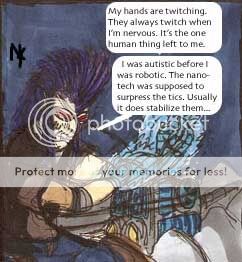


Just because autistic people tend to be very internalized doesn't mean they aren't aware of what they're " missing ". In some cases, the internalization may make them even more likely to dwell on their challenges. Characters like Jacob and Christopher Boone in the Curious Incident tend to be portrayed as so emotionally cut-off that they have almost no idea how their actions come across, or even enough self-awareness to associate feelings with their responses. Unless your character is extremely " low-functioning ", they're not going to take being autistic for granted, not when they're reminded of it via the challenges they face every single day. And even if they are " low-functioning ", just because someone can't communicate doesn't mean they don't have something valid to say, especially when it concerns the way they're being treated.

In Ruby's World, Jiro is a unique case because though he has always been autistic, he used to be on the " lower-functioning " end ( As seen in the backstory ). Thanks to some medical testing he volunteered for, he was upgraded to a bio-mechanical body, and his abilities far surpassed normal humans. But he still has all the experiences of being treated as disabled, and still maintains his old personality ( right down to the nervous tics as a stress response ). He's got a lot of bitterness about his condition, which is entirely justified; just because he's able to catch flies with his fingers doesn't mean he forgot about the time when his coordination was poor, or the way people treated him.

Autism is a neurological condition, but disability is a social construct. And even a person who can't read others well is going to pick up on being treated as persona non grata. If you're the writer, you have the opportunity for them to voice their dissatisfaction.

3.) Connect Their Problems To The Basic Human Condition


The worst stereotype seen in fictional autistic characters is the Oblivious Sociopath, the character who has so little understanding of human society that they can't tell right from wrong. House Rules presents this, and while it doesn't actually make Jacob the murderer ( he was covering for his brother, the one and probably only saving grace of that wretched book ), it still establishes him as someone who doesn't think about his motivations and their ethics, living simply for rudimentary human needs ( made worse by him being portrayed as unable to take care of himself ) and a steadfast adherence to routine. We don't get much about what Jacob wants to do with his life, we don't hear him talking about any plans to better himself, and only in extreme cases do we see him show sympathy for anyone else.

Just because it's hard for someone to understand and express the basic emotional needs that human beings have-- love, acceptance, success, honor, etc.-- doesn't mean that they aren't there. I use this scene from Ruby's World where Alexis is talking to her friend Jens about the notion of them having casual sex as an example-- she isn't really thinking about the consequences such an act would have, and expresses it just as a pragmatic release, but is responding to her need for connection. For a person on the spectrum, the problem is often that they want what other people want, but they're comparatively ill-equipped to acquire it from others.

The metaphor of autistic people being space aliens is a commonly used one, but that implies a completely different nature, so much so that they don't even belong to the same species paradigm. A better one might be to think of an autistic person's brain as a Mac, with the neurotypical brain being a PC-- same basic principles, but different architecture that often but not always leads to compatibility problems. ( This would also suit the " thinking in pictures " trope associated with autistic people, and why I've always felt more comfortable working with the interface-heavy Macs ).

4.) Do Not Treat Them As Saints


For anyone who gets the impression that I want to read about, and thus write, infallible characters on the spectrum, nothing can be further from the truth. My tastes in fictional characters tend towards the damaged, the characters who have problems and make mistakes on a regular basis. Just because a character is autistic doesn't mean they're not responsible for their actions. Everybody will act favoring their impulses over their conscience now and then ( though some more than others ). Autism may make certain impulses much harder to control, but to treat a character as helpless to their compulsions is just as wrong as treating them as being inherently selfish and irredeemable for having those compulsions.

This grisly scene involves Jiro and one of the main villains, Pierre Buzarde'. Buzarde' has just savagely attacked Jiro and Ruby ( the star of the strip and Jiro's girlfriend ), and they barely managed to fight him off. Now that he's had all his bones broken, the heroes need him for evidence against Beagle Labs and their vivisection, but that doesn't mean he's going to be treated humanely. Jiro stopped Ruby from killing Buzarde', but he's not going to stop himself from torturing the bastard. What Jiro did is best left to your imagination, other than the fact that it was extremely painful to Buzarde'. And while it was something Buzarde' certainly had coming, it was an unethical act. That Jiro is autistic doesn't excuse it; it's just spite, something that people on the spectrum and neurotypicals all feel.

Perfect characters are boring. Portraying a character in a minority group as being flawed has its risks, even if at the end of the day they're basically a good person. But if your story is safe from controversy, it's probably not worth the effort.

5.) There Are No Rules For Writing Autistic Characters

While this may seem like a cop-out, it's a basic summary of the previous four points, in that writing an autistic character shouldn't be any more exotic than writing any other kind of good, engaging, three-dimensional character. If you're writing an autistic character, you certainly will be informed by real-world diagnostic criteria, but if you're doing a good job you won't be using the DSM-V as your only reference. Racial, cultural, gender, and even neurological backgrounds only go so far. The rest is up to the writer to do something creative and sympathetic.

I close with the following panel from Ruby's World, with Jiro and Ruby in the heat of passion...


Ruby isn't autistic, but she is nine-foot-two-inches and two-hundred-seventy pounds of genetically engineered super-weapon, and no stranger to hardship herself, so they are able to understand each other well. Which I think as a good metaphor for the most important task of the writer; being able to humanize a character from a different background by relating your experience to theirs.

* ( In a note related to the comic-reading audience of this blog, I should mention that Reed " Mr. Fantastic " Richards of the Fantastic Four was speculated as being autistic in Grant Morrison's mini-series 1234. He fits the criteria excellently, and he would be a positive representation of an autistic character if he achieved the diagnosis-- a superhero, a genius surpassing even other Marvel geniuses, and a man capable of being a loving friend, husband, and father despite taking the absent-minded professor trope further than his cosmically-irradiated body can stretch.

A recommendation would be Elizabeth Moon's excellent sci-fi novel The Speed of Dark, about an autistic man who actually does subject himself to an autism cure. Possibly the best treatment of the subject in genre fiction yet.